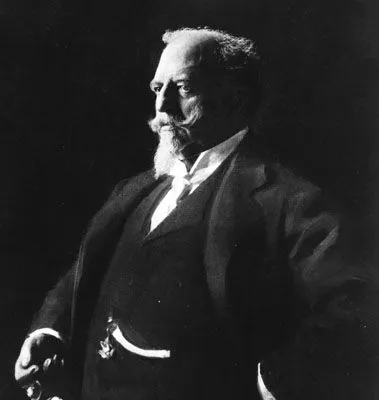
Adolphus Busch
Human Design Chart
Biography
He died at age 74 while on vacation on 10 October 1913 in Lindschied, Hesse, Germany.
Adolphus Busch as a Generator 3/5 in Human Design
Generator 3/5 — Design at a Glance
Adolphus Busch was known for his immense and enduring work ethic, comparable to a strong workhorse that only efficiently used its strength when it had the necessary inner energy. As a Generator, he had a lot of sacral energy, which was released not through spontaneous initiatives but by reacting to external impulses. His life strategy involved waiting for signals from his environment and then acting only when his inner self gave a clear "yes." This approach allowed him to effectively shape things in his life without exhausting himself. When he lived in harmony with this principle, he acted from his gut and experienced deep satisfaction and a sense of fulfillment. However, when he tried to initiate against his natural rhythm or was held back from his heart project while still full of power, it inevitably led to frustration and a lack of energy. The danger always lay in expending energy on tasks he had no interest in, which could lead to long-term exhaustion. His success was based on learning not to initiate but to respond to what truly spoke to him, thereby making his enormous endurance effective.
Emotional Authority
Adolphus Busch showed himself to be someone who never made decisions based on the first emotional wave. His design carried emotional authority, meaning that his defined Emotional Center formed the internal decision-making authority – regardless of which other centers were also defined. This configuration subjected him to a constant emotional ups and downs, coloring his perception of the world through his current mood. What appeared inspiring in one moment could be perceived as negative in the next. Since this first impression was only a snapshot and not necessarily the truth, spontaneous actions based on emotion would have been risky. Instead, his mechanics required patience and conscious hesitation. By taking the time to let decisions mature and sleep on them multiple times, he gained emotional distance. Over time, the intense feelings subsided, and the necessary clarity and calmness set in. This process of waiting was crucial for long-term, life-defining decisions, ensuring that the choice was based on a deeper, more comprehensive understanding and not on a passing mood.
The 3/5 Profile — Martyr / Heretic
Adolphus Busch revealed himself as someone who learned through personal experimentation, later supporting others with this practical knowledge. His Human Design Profile 3/5, that of the experimenter and hero, established this tendency. The third line, that of the adventurer, meant that he initially did not accept anything at face value but tested everything himself. In doing so, he accumulated a rich treasure trove of life experiences, even from failures, which served as learning processes.
This self-earned wisdom became visible to his surroundings through the fifth line, the hero line, which gave him a natural attractiveness and the ability to handle high expectations. Other people sought his proximity to benefit from his experiences, which brought him the role of the rescuer or storyteller. This recognition flattered his ego, as it confirmed his competence. At the same time, the profile carried the risk that public failures in experiments would be painful, as he was always under the pressure to act as a hero. The combination of the need for trial and error and the later universalization of his insights shaped his characteristic way of solving problems through personal practice and making these solutions accessible to others.
Split Definition — Defined & Open Centers
Adolphus Busch was someone who operated under a constant, internal mental pressure to question and understand connections. This tendency stemmed from his definition between the Head Center and Ajna Center. He had a firm way of thinking but was not equipped to directly implement these ideas into action. Attempting to forcefully realize mental inspiration would have frustrated him; instead, he acted as an inspirational source for others who possessed the energy to put his concepts into practice.
As a Generator with a defined Sacral Center, he had an enormous, vital energy source. His design required him not to initiate but to wait for stimuli to react. Only through a confirming sacral response could he mobilize his full power for work and obligations. This aligned with his emotional authority in the Solar Plexus Center. He was dependent on waiting for the waves of his feelings before making decisions. Immediate action in emotional highs or lows would have led to chaos; patience created the necessary clarity.
At the same time, his Spleen Center was defined, giving him a spontaneous, intuitive intelligence. He could perceive in the 'now' what was correct for his well-being and survival and had to trust this instinctive knowledge without rationalizing it.
In contrast, his undefined centers revealed specific vulnerabilities. His open Throat Center tended to feel pressured to seek attention or speak too much, rather than waiting for the natural timing. The open G Center left him without a fixed identity; he adapted to people and places rather than asserting his own direction. His open Heart Center drove him to prove his worth through promises and performance, which could lead to a cycle of self-doubt if he failed. Finally, his open Root Center absorbed external stress, making him vulnerable to overwork and burnout if he did not recognize the pressure of the environment as foreign and withdraw.
Channels for intimacy, intuitive power and abstract comprehension.
Adolphus Busch was characterized by a deeply rooted intuition for survival and the ability to deepen relationships through patient nurturing. His design tended to focus on the essential and trust inner signals.
The Power Channel 34-57 connected the intuitive insight of the Spleen with the sacral life force. This configuration created a strong survival instinct, making him vigilant for dangers in his environment. He responded spontaneously to vibrations from people and places, helping him navigate complex situations safely. This energy kept him physically fit and acoustically attentive, selectively listening to grasp the true intention behind words.
Parallel to this, the Pairing Channel 59-6 linked sacral sexuality with emotional wave. This tribal channel promoted intimacy but required patience. Adolphus Busch built relationships healthiest by first fostering friendships before delving into deeper realms. His emotional wave determined the timing for releasing feelings; by waiting, he gained clarity on whether a connection was truly fruitful or if the wave would reunite him later.
Mentally, the Abstraction Channel 64-47, connecting the Head with the Ajna Center, marked him. His mind searched every experience for patterns and stories, often accompanied by mental confusion. He sought a perspective that made sense and shared these insights only after a clear picture emerged over time. This mental power was ill-suited to directly steer his own life but helped him understand complex connections and develop inspiring narratives.
Additionally, Gates like 53 (Freedom, Pioneer Spirit) and 54 (Connection of worldly success and spirituality) contributed to his development. Gate 53 allowed him to forge new paths, while Gate 54 linked the drive for success with mystical insight. Gate 51 gave him willpower and adaptability, while Gate 22 promoted openness and calm listening. This combination of intuitive survival strength, patient relationship building, and abstract thinking shaped his unique path.
Individual Circuitry — Circuit Signature
Adolphus Busch's design inclined him towards emotional reflection, paired with a deep, instinctive concern for the protection and preservation of his immediate surroundings. His chart featured a Split Definition, meaning his energetic powers worked in two separate, non-directly connected groups.
The first group connected the Solar Plexus and Sacral Centers. Through the Protector Circuit, specifically the Pairing Channel, here flowed a primal energy. It served the instinct to protect, nurture, and preserve family and genetics. This connection created a timeless force of care and defense that acted independently of rational planning.
Parallel to this, a second, isolated group encompassed the Head and Ajna Centers. Here, the Explorer Circuit operated through the Abstraction Channel. This energy revolved around reflecting on the past and finding meaning in past events. Insights emerged in waves, emotionally and often illogically, with the aim of sharing and learning collectively from the experience.
Additionally, the Integration Circuit connected the Sacral and Spleen Centers through the Power Channel. This enabled drawing strength from reacting to life and intuitively guiding in the present moment. As this connection belonged to the first group, it reinforced the ability for self-reinforcement and survival, remaining energetically separate from the abstract, reflective processes of the Head-Ajna part. Adolphus Busch thus lived with two parallel but non-fusing focal points: instinctive protection of his own and emotional understanding of the past.
Right Angle Cross of Penetration 2
Adolphus Busch's Human Design profile indicated a tendency towards deep, often painful, internal analysis. This configuration, the right cross of the second penetration, described a life task characterized by intense self-reflection and a need for mental clarity. It was not superficial contemplation but a process that often began with inner pain or confusion, ultimately leading to a clear, penetrating understanding.
This mechanism acted as a driving force, pushing Adolphus Busch to look beyond the surface of things. The energy of this cross promoted an attitude that did not ignore difficulties but used them as a necessary path to truth. It revealed someone willing to accept uncomfortable truths to find a more authentic existence. The second penetration combined the power of endurance with the intuition of the mind, leading to insights that were not just thought but felt and internalized.
This process required patience, as insights often developed slowly and step by step. Adolphus Busch lived this dynamic by facing the complexity of his own nature without running from the darkness. The challenge was to understand the pain of insight not as failure but as a necessary step towards transformation. Thus, this configuration shaped a personality characterized by the ability for deep analysis and the willingness to confront the shadow aspects of life.
Saturn Return · Uranus Opposition · Chiron Return · 2nd Saturn Return — Life Cycles
Adolphus Busch was someone who combined structural stability with strategic expansion. His design indicated a tendency to take on long-term commitments and translate these into tangible, concrete results. This attitude became visible in 1865, at the age of 26, when he purchased the wholesale house of Ernst Wattenberg. This step marked his first Saturn return, a cycle in which years of groundwork often condenses into a solid, institutional foundation. Busch used this phase not for spontaneous experiments but to anchor his position in the existing economic structure.
Later, in 1879 at the age of 40, the company was renamed Anheuser-Busch Brewing Association. This coincided with the Uranus opposition, a phase often requiring deep structural changes and the redefinition of one's role in the larger context. Busch adapted to this energy by sharpening and modernizing his company's identity. Instead of chaotic breaks, his design showed the ability to steer necessary transformations in an orderly manner. The mechanics of his chart suggested that he used changes not as threats but as opportunities for consolidation and expansion of his reach. His life followed a clear trajectory: building, anchoring, and then controlled further development.
Generator · Emotional Authority — Synthesis
Adolphus Busch was a Generator whose life was marked by a deeply rooted, sacral energy. This energy, combined with emotional authority, led him through a life characterized by intense waves of enthusiasm and doubt. His ability to learn from experiences – as an experimenter and hero – and to pass this knowledge on created a strong attraction to others. The defined Head Center amplified the internal pressure to understand and inspire, while the Pairing Channel suggested a deep, personal connection to intimacy and potential fertility. The recurring cycles, particularly the Saturn return at the age of 26 (purchase of the wholesale house) and the Uranus opposition at 40 (renaming the company), showed a tendency to grow through phases of consolidation and restructuring.
A central paradox in Adolphus Busch's design lay in the tension between the need to surrender to the emotional wave and find clarity through time and maturity, and the drive to continuously experiment as an experimenter. He lived in a cycle of immersing in experiences, reflecting on the past (Perception Circuit), and sharing his insights. This dynamic carried the risk of getting lost in unproductive activity if the sacral response was ignored, but it also offered the possibility of growing through authentic experiences and emotional depth and inspiring others.
3 Defined Channels
Incarnation Cross - Right Angle Cross of Penetration 2
Solar Return
The Solar Return shows the moment when the sun returns to its exact birth position - your personal solar year.
Life Cycles
Discover the life cycles with a detailed triple view (birth chart, cycle chart, composite).
Human Design Profile
- Type
- Generator
- Strategy
- To respond - wait for something to respond to
- Authority
- Emotional Authority
- Profile
- 3/5 - Martyr / Heretic
- Definition
- Split Definition
- Incarnation Cross
- Right Angle Cross of Penetration 2
- Date of Birth
- 10.07.1839 16:00
- Place of Birth
- Mainz, Germany
Frequently Asked Questions
What was Adolphus Busch's Human Design type?
What profile did Adolphus Busch have?
What authority guided Adolphus Busch?
What incarnation cross did Adolphus Busch have?
When was Adolphus Busch born?
Discover your own Human Design
Are you also a Generator? Find out in a personal reading how to use your sacral energy correctly and discover deep satisfaction.
More Personalities
Back to overviewAaliyah

Alexia

Angèle

Anne-Marie

Arcángel

Arno