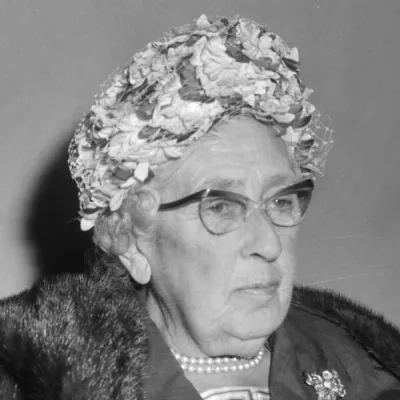
Agatha Christie
Human Design Chart
Biography
A writer during the "Golden Age of Detective Fiction", Christie has been called the "Queen of Crime"—a nickname now trademarked by her estate—or the "Queen of Mystery". She wrote the world's longest-running play, the murder mystery The Mousetrap, which has been performed in the West End of London since 1952. She also wrote six novels under the pseudonym Mary Westmacott. In 1971, she was made a Dame (DBE) by Queen Elizabeth II for her contributions to literature. She is the best-selling fiction writer of all time, her novels having sold more than two billion copies.
Christie was born into a wealthy upper-middle-class family in Torquay, Devon, and was largely home-schooled. She was initially an unsuccessful writer with six consecutive rejections, but this changed in 1920, when The Mysterious Affair at Styles, featuring detective Hercule Poirot, was published. Her first husband was Archibald Christie; they married in 1914 and had one child before divorcing in 1928.
Agatha Christie as a Manifesting Generator 1/3 in Human Design
Manifesting Generator 1/3 — Design at a Glance
Agatha Christie's design inclined her towards lightning-fast action paired with the ability to provide constant energy. As a Manifesting Generator, she was a hybrid type: She had the powerful, steady endurance of a generator through her defined Sacral Center but also possessed the speed of a manifestor to skip steps and quickly draw things into her life.
This configuration carried two specific risks. First, her swiftness could lead her to overlook important processes, necessitating going back later to make up for it – a potential source of frustration. Second, her system tended to react simultaneously to numerous impulses and start multiple projects at once. Without the constant approval of her inner authority and Sacral Center, this creative force could quickly grind to a halt.
The key to her satisfaction lay in the strategy of not initiating herself but reacting to life. Success came when she waited for her system to clearly approve before acting. In this state of „play mode“, characterized by variety and fun, she could use her parallel work style without getting distracted. Her deep fulfillment did not come from linearly completing individual tasks but from fluidly switching between various impulses as long as they were confirmed by her inner „yes“. Thus, the risk of rushing became dynamic efficiency.
Sacral Authority
Agatha Christie based her decisions on an internal, physical resonance rather than rational considerations in her head. She was a Generator whose strategy and inner authority were identical: Sacral Authority. This mechanism fundamentally simplified her decision-making process as it acted directly from the body, provided that the emotional center remained open to these signals.
Her responses to external stimuli manifested as gut feelings or bursts of energy – audible as grunts, hums, or a simple „Mhm“. When her sacral motor was engaged, she felt vital and alive. She had inexhaustible energy and tackled her tasks with great enthusiasm. Her design saw her moving through life with joy and satisfaction, fully immersed in her tasks without rigid purposefulness.
This ability was supported by her activated Spleen Center. This center functioned as a supportive authority to the Sacral, giving her immediate access to instinctive perception and physical well-being. As such, Agatha Christie could react particularly quickly and spontaneously. She reliably followed these deep, bodily impulses that shaped her actions and determined her orientation.
The 1/3 Profile — Investigator / Martyr
Agatha Christie was someone whose judgment rested on double testing: theoretical preparation and practical experimentation. Her Human Design Profile 1/3, that of the Researcher and Experimentor, set this tendency. Line 1 of her design emphasized the need for withdrawal to regenerate and clarify. This retreat served not for failure but renewal and introspection before engaging in new relationships or projects. She sought intimacy through this phase of distancing to understand her own feelings and the nature of potential connections.
At the same time, line 3 of her profile demanded a process of trial and error. Here she learned through social interaction and self-analysis. Mistakes were not defeats but necessary steps towards gaining knowledge. There was an internal tension between the desire for adequate preparation (line 1) and the impulse to simply try things out (line 3). When she deemed something good, she had thought it through in her withdrawal as well as tested it thoroughly in practice. This interplay made her judgment trustworthy since it did not stem solely from intuition or pure theory but from self-earned, verified insights. She was both a scientist and an adventurer who gained knowledge through learning and doing.
Single Definition — Defined & Open Centers
Agatha Christie revealed herself through a design based on strong inner drive. Her defined centers – Sacral, Heart, Throat and Spleen – formed a closed circuit of energy, will, expression, and intuition. The defined Sacral Center provided vital life force energy, while the defined Heart Center supplied willpower and the need for control over resources. This power flowed directly into her defined Throat Center, making her actions and words direct manifestations of her will ("I want it"), not as intellectual constructs. Her also defined Spleen Center ensured that these actions were always in harmony with her momentary intuition and well-being; she acted spontaneously from the present moment, protected by a strong instinct for health and safety.
This autonomous core contrasted with her open centers: Head, Ajna, G-Center, Solar Plexus, and Root. This openness made her vulnerable to external influences that she could not recognize as her own. The open Head and Ajna Centers meant that mental inspiration or confusion often came from outside; she tended to get entangled in questions that were not her own problem instead of trusting her inner authority. The open G-Center lacked a fixed, rigid identity; instead, it reflected the environment and sought the right place and people to feel belonging rather than taking on a role.
Especially relevant was her open Solar Plexus Center, which absorbed and amplified foreign emotions. Agatha Christie risked experiencing other people's moods as her own whims or avoiding conflicts out of fear of rejection. Her open Root Center allowed her to take in external stress, leading to feelings of pressure that she did not generate herself. The challenge of her design lay in not personalizing these open areas: observing mental confusion as a foreign phenomenon, not taking others' emotional waves personally, and not being driven by external stress. Instead, she relied on the clear response of her Sacral Center and the protection of her Spleen intuition to express her own powerful truth in a world full of external stimuli without losing herself in the identity or emotions of others.
Channels for devotion, charisma, intuition and individual power.
Agatha Christie's Design inclined towards impulsive, charismatic action guided by intuitive insight in the moment. Channel 34-20 connected the Sacral Center with the Throat Center. This configuration required a reaction to external stimuli to transform raw physiological energy into focused manifestation. Without this sacral guidance, there was a risk of chaotic eruption; with it, an impressive ability emerged to act in the moment and inspire others through spontaneous vitality.
This charismatic power was refined by Channel 57-20. Here intuitive insight flowed directly from the Spleen Center to the Throat Center. Agatha Christie possessed the ability to immediately recognize the truth or core of a situation and express it in the present moment. This "Brainwave" enabled her to encourage others to awaken their own inner survival intelligence by clearly articulating existential knowledge.
Channel 34-57 connected Spleen and Sacral Centers, creating an archetype of individualized survival. The generative life force from the Sacral supported the intuitive awareness of the Spleen. Agatha Christie was designed to be acutely aware through sacral reactions to danger and act spontaneously. This combination kept her physically fit and acoustically alert, trusting in her ability to make decisions in fractions of a second to protect herself.
Additionally, Channel 44-26 between Spleen and Heart Center influenced her with an instinctive sense of what the "tribe" needed. She could assess others and sell appropriate ideas or security. Her willpower served to manipulate the tribe for her benefit by recognizing what people needed before they knew it themselves. This entrepreneurial intuition complemented her intuitive and charismatic nature, adding a strategic component to promote her insights.
Individual Circuitry — Circuit Signature
Agatha Christie's Design revealed a clear, coherent energetic structure. As someone with a simple definition, her defined centers – Throat, Sacral, Spleen, and Heart – formed a continuous flow without separate islands. This created an integrated experiential world where intuition, expression, and emotional processing seamlessly intertwined.
The Knowledge Circuit connected her Throat Center to the Spleen through the Flash of Insight Channel (20-57). She immediately translated intuitive impressions and sudden insights into words, allowing for a direct, auditory expression of her inner perception.
The Ego Circuit linked Heart and Spleen via the Devotion Channel (26-44). This was not about individual ego but cooperation and the joint creation of resources. It showed her ability to mediate and support within her environment based on balanced giving and taking.
The Integration Circuit brought these areas together through two channels: Charisma (20-34) connected Throat and Sacral, while Power (34-57) linked Sacral and Spleen. Thus, energy from the reaction to life (Sacral) flowed through intuitive patterns (Spleen) into current expression (Throat). This configuration strengthened her self-validation and allowed her to realize inner impulses directly in the present moment without needing external validation.
Right Angle Cross of Eden 3
Agatha Christie's design carried the imprint of the right cross of Eden 3. This configuration established a fundamental disposition characterized by a deep connection with life itself. It was an archetypal expression of vital energy and an instinctive orientation towards natural occurrences in the world.
The right cross of Eden 3 describes a specific energetic structure in Human Design. It connects aspects associated with joy, creativity, and trust in one's own rhythm. People with this configuration tended to shape life actively and passionately rather than merely observing it. The focus was on the present moment and the ability to draw new impulses from every situation.
For Agatha Christie, this meant an inner attitude marked by resilience and an unwavering belief in good within life. The mechanics of this cross promoted a kind of wisdom that did not stem from abstract theory but from direct experience of the flow of life. It was about accepting the gifts of existence and transforming them into one's own creations or actions. This energy supported a deep understanding of human needs and drives without judgment, instead aiming to use these forces constructively. The expression often took an intuitive and direct form, driven by an inner compass aligned with well-being and authenticity. This created a foundation for a life that, despite possible challenges, always held the potential for renewal and growth within it.
Saturn Return · Uranus Opposition · Chiron Return · 2nd Saturn Return — Life Cycles
Agatha Christie's design indicated a tendency towards sudden, profound life changes. She was someone who in certain phases of her existence was marked by unexpected breaks or new beginnings that broke out of previous frameworks. This dynamic stems from the Uranus opposition in Human Design: A cycle often accompanied by the feeling that the old no longer serves and requires a radical realignment. It is not a gentle shift but a moment of liberation from old structures, coupled with the chance for something entirely new.
In 1930, at age 40, this mechanism came into concrete effect: Agatha Christie married Max Mallowan. This relationship marked a clear break in her design from earlier life plans and the beginning of a new phase. The Uranus opposition describes precisely such turning points where external circumstances can change rapidly to give space to an inner drive for change. For Agatha Christie, this was not mere coincidence but an expression of her energetic configuration based on such breaks. The marriage symbolized the conclusion of an old chapter and the opening of new perspectives, driven by Uranus's power to break through status quo. At this moment, the abstract mechanics of her chart condensed into a very personal, tangible life decision.
Manifesting Generator · Sacral Authority — Synthesis
Agatha Christie lived a life marked by a constant interplay between initiative and reaction. As a Manifesting Generator, she possessed the ability to quickly spark things (Channel of Charisma), yet her sacral center always demanded a response to external stimuli before she could truly act. This combination led to a dynamic lifestyle where she pursued impulsive ideas while also ensuring they stemmed from an inner 'yes'. The Profile of the Researcher and Experimenter (1/3) reinforced this cycle by combining the urge for thorough testing with the need to gather experiences and learn from them—a process that manifested in repeated trials and refinements.
A central paradox in her design lay in the tension between the defined Throat Center (Communication & Manifestation) and sacral authority. The Throat Center points towards a natural talent for expression and influence, yet the sacral reaction required patience and waiting for the right moment. This led to an inner dynamic where creative impulses were present but could only fully unfold through bodily confirmation—constantly balancing the desire for immediate implementation with the necessity of trusting one's own internal timing. A notable event, a relationship entered into at age 40 (Uranus opposition), might be interpreted as an expression of this tension field.
4 Defined Channels
Incarnation Cross - Right Angle Cross of Eden 3
Solar Return
The Solar Return shows the moment when the sun returns to its exact birth position - your personal solar year.
Life Cycles
Discover the life cycles with a detailed triple view (birth chart, cycle chart, composite).
Human Design Profile
- Strategy
- To respond - wait for something to respond to
- Authority
- Sacral Authority
- Profile
- 1/3 - Investigator / Martyr
- Definition
- Single Definition
- Incarnation Cross
- Right Angle Cross of Eden 3
- Date of Birth
- 15.09.1890 14:14
- Place of Birth
- Torquay, England, United Kingdom
Frequently Asked Questions
What is Agatha Christie's Human Design type?
What Profile did Agatha Christie have in Human Design?
What Authority did Agatha Christie possess?
What incarnation cross did Agatha Christie have?
When was Agatha Christie born?
Discover your own Human Design
Are you also a Manifesting Generator? Find out in a personal reading how to unfold your multi-talents and direct your energy wisely.
More Personalities
Back to overviewAldair

Alizée

Angeli

Arletty
Artus

Balthus