
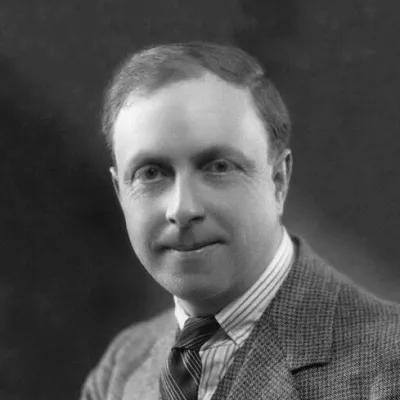
A.J. Cronin
Human Design Chart
Biography
He died on 6 January 1981, aged 84, in Montreux, Switzerland.
The Human Design of A.J. Cronin: Generator 1/3
Generator 1/3 — Design at a Glance
A.J. Cronin's Design indicates a tendency towards great endurance and inner drive, comparable to the strength of a workhorse. As a Generator, he had plenty of sacral energy, but it was not released through self-initiative; instead, it became active only when he responded to external signals. His strategy involved reacting to impulses from life and waiting for his gut feeling to give a clear "yes" before taking action. Only in this moment of reaction could he unleash his full power and push projects forward sustainably.
This functional principle brought two specific risks with it. If A.J. Cronin was prevented from doing his actual work, even though he still had plenty of energy, or if he had to perform tasks that did not stir any inner desire within him for a prolonged period, his energy would stagnate. Such phases of non-resonance led to frustration and a noticeable lack of strength in him, up to exhaustion. However, in alignment with his design, by consistently reacting rather than initiating, he found access to deep satisfaction. His life force materialized most effectively when he did not take the first step himself but waited for what called to him from outside and then acted with full commitment. This protected him from burnout and ensured the necessary endurance for his long-term plans.
Emotional Authority
A.J. Cronin exhibited an internal decision-making structure that did not immediately clarify but rather unfolded in waves. His design featured an Emotional Authority carried by the defined Emotional Center. In Human-Design mechanics, this authority is considered primary: once the Emotional Center is defined, it takes the lead in decisions regardless of which other centers are also active. This meant for A.J. Cronin that his feelings were subject to constant fluctuation – from enthusiasm to deep skepticism within short periods. This emotional wave colored his perception of the world at all times; a current impression was merely a snapshot and not yet the final truth. Quick, spontaneous judgments based on this fleeting mood would often prove misleading. The mechanics of his inner authority required patience: decisions needed time to mature, ideally overnight or over several days. Only when the initial emotional intensity subsided and some distance had been gained did clarity and calmness emerge. This process of "sleeping on it" was not a sign of indecisiveness but rather the necessary path to deep insight. Especially for long-term life steps that would significantly shape his course, this waiting period was essential to ensure that the choice made was based on a stable inner truth and not just a passing emotional surge.
The 1/3 Profile — Investigator / Martyr
A.J. Cronin showed himself to be someone whose judgment was based on a double test: theoretical depth and practical experience. His design as a Researcher and Experimenter (Profile 1/3) established that he did not just accumulate knowledge but validated it through action. Line 1 drove him to study fundamentals and seek quality in stimulation – a process often accompanied by the feeling of not knowing enough yet to act. But Line 3 demanded the opposite: it called for trial and error, testing extremes to survive and continue developing.
This tension between planning and action shaped his approach. When A.J. Cronin deemed something valuable or correct, he had previously analyzed it intellectually as well as tested it thoroughly in reality. His Gate 56 emphasized the necessity of feedback to understand whether an idea was truly effective or merely served trivial purposes. At the same time, the mutating potential of Gate 3 (Line 3) promoted biological survival and evolutionary adaptation through direct experience. Thus, his insights were never mere theory but self-discovered truths that had withstood rigorous testing. This combination of a learning researcher and an active experimenter created a unique authority: one could trust his judgment because it followed the path from idea to error to proven practice.
Single Definition — Defined & Open Centers
A.J. Cronin's Human Design profile indicated a tendency towards deep, time-bound reflection paired with a constant source of vital energy. His defined Sacral Center provided him with an inner motor that generated life force daily; however, this energy was only available when he responded to external stimuli and felt internal approval. Simultaneously, his defined Solar Plexus acted as an emotional authority: decisions required patience to navigate through waves of hope and doubt towards clarity. This combination of physical endurance and emotional depth shaped the way he engaged with tasks – not impulsively, but after careful consideration of his emotional state.
At the same time, his chart revealed areas of susceptibility to external influences. His open Head Center tended to absorb mental confusion or the pressure of other people's issues, making him vulnerable to distractions from problems that were not his own. Similarly, his open Ajna Center reflected foreign concepts and opinions without solidifying them as personal truth. Notably, his open G Center lacked a fixed identity or direction; he sought orientation through his environment and relationships. He tended to question whether a place or person was right for him rather than dictating the path himself. His open Heart Center lacked consistent willpower; instead of making promises to prove value, he learned to take on commitments only when they arose from his inner authority. Finally, his open Spleen Center mirrored the fears and health conditions of those around him, making him sensitive to well-being but also unhealthy dependencies. His defined Root Pressure drove him forward, yet it was only through aligning with his emotional clarity and sacral response that this stress transformed into constructive movement.
Channels for evolutionary change and emotional release.
A.J. Cronin's Human Design profile indicated a tendency towards profound, often melancholic transformation. This imprint arose from Channel 60-3, which connects the Root Center to the Sacral Center. This channel generated a pulsing on/off energy that promoted evolutionary change but required accepting limitations and moving beyond the confusion of a new beginning. The internal tension during phases without impulse was experienced as melancholy; A.J. Cronin had to learn not to rationalize these moods away, but rather wait patiently for the next creative pulse.
Parallel to this, Channel 39-55 between Root and Solar Plexus Centers shaped an emotional wave of passion and uncertainty that engaged the mind (Gate 55) through provocation (Gate 39). This mechanism allowed him to sense others' nature and generate deep emotional resonance through authentic mood swings rather than manipulation. It was important for him to act in the right mood to experience joy instead of sadness and effectively bring his mutative qualities into play.
Additionally, prioritized Gates contributed to structure: Gate 50 provided a conservative protective reflex and preserved traditional values as a 'cauldron' of awareness. Gate 56 enabled abstract mental processes to be expressed in visual narratives, promoting the expression of stories. In personality aspects, Gate 30 with its longing for positive feelings and recognition of illusions played a role, alongside Gate 29 emphasizing persistence and correct 'yes-saying' in challenges. Gate 59 in his design supported genetic strategies of bonding and pairing by dissolving barriers to relationships. Together, these elements formed a profile that conveyed transformation through emotional authenticity and narrative power.
Individual Circuitry — Circuit Signature
A.J. Cronin's Human Design profile indicated a tendency towards pulsating, acoustic creativity that manifested in the expression of his unique individuality. As a simply defined type, he had a continuous energetic flow connecting the Sacral, Root, and Solar Plexus Centers. This connection shaped his inner driving force: energy from the Sacral Center flowed through the Root Center – the place of mutation and deviation from the known (Channel 3-60) – to the emotional center. Here an emotional wave was not only felt but actively released (Channel 55-39). This mechanism described a process where new knowledge and individual identity were transformed and carried outward by emotions. The energy was pulsating and focused on 'now'. Cronin used this configuration to bring change into the world by linking his specific, mutative power with emotional intensity. It wasn't isolated impulses but a continuous flow from Root through Solar Plexus that determined his expression. His life task was to express this unique identity while using emotional resonance as a means of transformation.
Right Angle Cross of Laws 2
A.J. Cronin's Human Design profile carried the signature of the right cross of laws, a configuration that pointed to a profound connection with the divine and a clear, almost prophetic presence. This structure marked him as someone who not only sought spiritual truths for himself but also conveyed these in a way that felt immediate and compelling to others. In Human Design terms, this cross marks a specific energy distribution often associated with an inner authority – not in an authoritarian sense, but as the ability to inspire and lead through one's own presence and clarity. It is a configuration aimed at making the invisible visible and translating it into language that others can understand and accept. For A.J. Cronin, this likely meant his life was driven by a strong urge to look beyond material or everyday concerns and instead strive for higher principles. This energy supported him in presenting complex ideas not only intellectually but also emotionally. His approach was less didactic and more experiential; he demonstrated through his own example how one can connect with the divine. As a result, this created a unique kind of influence based on respect and trust without actively seeking it.
Saturn Return · Uranus Opposition · Chiron Return · 2nd Saturn Return — Life Cycles
A.J. Cronin's Human Design profile indicated a tendency towards deep structural transformation processes that often crystallized into concrete creative acts. This configuration describes a pattern where inner maturity and outer responsibility intertwine to produce lasting results.
In 1935, at the age of 39, he published *The Stars Look Down*, a novel about coal miners. For his design, this marked a Uranus opposition: a phase in which established patterns dissolved and new, often socially relevant perspectives emerged. The work was not just a reaction but an expression of a necessary realignment that broke old boundaries.
Later, in 1952 at the age of 56, he published his autobiography *Adventures in Two Worlds*. This fell during his second Saturn return: a cycle of consolidation and reflection on lived responsibility. Here, the mechanics of structural anchoring were evident: after decades of creation, not only was his life recounted but also evaluated as a finished structure and documented. The second Saturn return demands honesty about one's path; Cronin's autobiography was the logical consequence of this inner demand for clarity and confirmation of his life line. Both events illustrate how his design translated transformation into concrete, lasting forms – first through breaking conventions, later through solidifying personal legacy.
Generator · Emotional Authority — Synthesis
A.J. Cronin lived a life marked by a deep internal dynamism: an ongoing search for authentic expression leading to the ability to transform. As a Generator with defined sacral center (Sakral-Zentrum), he possessed immense stamina and a strong desire to invest this energy in meaningful activities – as long as they truly resonated with him. This natural endurance was reinforced by the Investigator/Explorer profile (1/3), which propelled him to thoroughly examine things and gain insights from personal experience before sharing them. The Channel of Mutation (3-60) points to a gift for evolutionary processes, yet it was always accompanied by a certain melancholy, as each new beginning also meant saying goodbye to the old.
A central tension in his design lay between the need for deep emotional experiences and the impulsive energy of the knowledge circuit. While he needed time to let decisions mature and recognize his true feelings, innovative impulses and creative flashes simultaneously drove him to try new things and initiate changes. His repeated professional successes (1935, 1952) showed how he constructively utilized this seeming contradiction: by using his emotions as a compass for direction while courageously stepping onto new paths.
2 Defined Channels
Incarnation Cross - Right Angle Cross of Laws 2
Solar Return
The Solar Return shows the moment when the sun returns to its exact birth position - your personal solar year.
Life Cycles
Discover the life cycles with a detailed triple view (birth chart, cycle chart, composite).
Human Design Profile
- Type
- Generator
- Strategy
- To respond - wait for something to respond to
- Authority
- Emotional Authority
- Profile
- 1/3 - Investigator / Martyr
- Definition
- Single Definition
- Incarnation Cross
- Right Angle Cross of Laws 2
- Date of Birth
- 19.07.1896 03:45
- Place of Birth
- Cardross, United Kingdom
Frequently Asked Questions
What was A.J. Cronin's Human Design type?
What Profile did A.J. Cronin have?
What Authority did A.J. Cronin possess?
What incarnation cross did A.J. Cronin have?
When was A.J. Cronin born?
Discover your own Human Design
Are you also a Generator? Find out in a personal reading how to use your sacral energy correctly and discover deep satisfaction.
More Personalities
Back to overviewAaliyah

Alain-Fournier

Alexia

Angèle

Angeli

Anne-Marie
