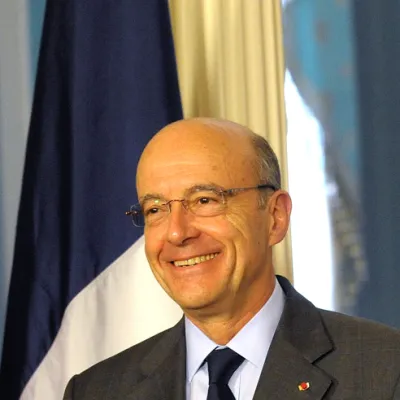
Alain Juppé
Human Design Chart
Biography
A member of the Rally for the Republic (RPR), he entered the Inspection des Finances in 1972. A protégé of Jacques Chirac, he was in charge of the Paris city budget during Chirac’s mayoralty and later followed him into national office. He has been budget minister, 1984-'86 and government spokesman, 1986-'88 and in 1993 he became foreign minister under Édouard Balladur, then succeeded him as premier in 1995.
That year he was also elected RPR president and mayor of Bordeaux, giving him strong national and local power bases. He lost his post as prime minister after the RPR’s 1997 defeat ; however, he is still mayor of Bordeaux and has since fought corruption inquiries relating to his Paris years.
What does Generator 4/6 mean for Alain Juppé?
Generator 4/6 — Design at a Glance
Alain Juppé's design points to a tendency towards great endurance and high energy potential, comparable to a workhorse that generates power when it is fueled by a task. As a Generator, he had a lot of sacral energy, which was released not through initiatives but through reactions to impulses from the environment. The motto was clear: not to initiate but to react. When a signal from life came and his sacral center responded with an inner 'yes', he could respond with action and thus use his energy effectively.
This mechanism brought two central stumbling blocks with it. On the one hand, there was the threat of frustration and energy loss if he continuously did things that did not intrinsically please him - a waste of his strength. On the other hand, there was conflict potential if he was prevented from working on his heart project, even though he still wanted to continue working with full power. If Alain Juppé lived in harmony with this design, by reacting to signals and acting from the gut, it rewarded him with a feeling of deep fulfillment. If he, on the other hand, constantly initiated without waiting for inner resonance, he would sooner or later encounter persistent frustration. His success therefore depended on whether he used his enormous endurance where he felt clear inner confirmation.
Emotional Authority
Alain Juppé's design points to a tendency towards emotional wavering, which manifests as inner authority. With his defined solar plexus center, he was subject to a constant emotional wave that colored his perception of the world through his current mood. What appeared inspiring in one moment could be seen as negative in the next. This configuration means that the immediate feeling only represents a snapshot and does not necessarily reflect the deeper truth. Quick, spontaneous decisions made from such an emotional state therefore carried the risk of negative consequences.
The mechanics of Emotional Authority require patience and conscious delay. Alain Juppé was naturally dependent on letting decisions ripen before acting. Sleeping on important questions served to let the intense feelings subside. Only with this temporal distance did he gain emotional distance, leading to clarity and calmness. This process was crucial for long-term decisions that influenced his life course. The emotional wave is always the primary source of decision-making help, regardless of other defined centers in the design. It functions as a filter that, through time and calm, leads from the superficial mood to deeper insight.
The 4/6 Profile — Opportunist / Role Model
Alain Juppé's design points to a tendency towards a complex tension between the desire for belonging and the need for detached wisdom. As a 4/6 profile ('Networker/Role Model'), he was more experimental in the first thirty years, similar to a 4/3, with relationships and friendships taking center stage. This phase served to prepare for the later development, in which the inner conflict between heart (line 4) and head (line 6) fully manifested.
The mechanics of this profile describe a lifelong process of synthesis. While line 4 represents the great heart that is cautious about opening up to the wrong people, line 6 demands a role as a wise role model that contemplates the meaning of life. For Alain Juppé, this meant that his later life was marked by the expectation of meeting these high standards, especially through cooperation with others. The energy of Gate 4 (Performance, Timing) met the sixth line of Hexagram 23 (Synthesis, Communication). This required a clear expression to transform individual insights into collective value. Without this fusion, there was a risk of atrophy; with it, he could learn despite possible 'youthful folly' or easy answers to uncover lies and bite through by freeing himself from revenge. His path was therefore characterized by the necessity of uncovering hidden connections and conveying them in a way that the community could embrace.
Triple Split Definition — Defined & Open Centers
Alain Juppé's design is characterized by constant mental activity combined with a profound, emotional authority. His defined Ajna Center ensures a steady, trustworthy form of conceptual thinking; he is not easily influenced from the outside and uses his mind to create concepts and mentally condition others. This mental energy flows directly into his defined Throat Center, allowing him to clearly and reliably express what he thinks.
At the same time, he possesses a defined Sacral Center, which provides him with an enormous vital energy source. However, his energy is only available when he reacts to external initiatives, not when he initiates himself. This is in tension with his defined Solar Plexus Center, which functions as an inner authority. Here, his truth does not lie in the 'now', but in the emotional wave. He relies on waiting for the up and down movement of his feelings to achieve emotional clarity before making decisions. Impulsive actions from emotional highs or lows often lead to chaos, while patient waiting allows for deep insights.
Additionally, his defined Spleen Center and defined Root Center have a firm way of dealing with existential warning signals and physical stress. His intuition is spontaneous and effective in the moment, while the root pressure propels him forward, but only healthily if guided by his strategy.
In contrast, his Head, G, and Heart Centers are open. The open Head Center makes him vulnerable to mental pressure and the questions of others, which he cannot identify as his own. His open G Center means that he does not have a fixed identity or direction, but rather adopts these through the environment and relationships; he tends to question who he is or where true love can be found if he is not at the right place. The open Heart Center lacks consistent willpower; he is not designed to give promises or prove his worth through competition, which makes him vulnerable to self-doubt when trying to assert himself against others.
Channels for intimacy, critical scrutiny and structured insight.
Alain Juppé's design tends towards intense, often unconscious attraction, paired with a sharp, correcting view of societal structures. This configuration creates a tension between the urge to merge and the necessity to question patterns.
The Channel of Union 59-6 connects the sacral sexuality with the emotional wave of the Solar Plexus. This generates an electromagnetic connection that emphasizes intimacy as the core of creative essence. Alain Juppé has the ability to quickly penetrate the aura of others and ease confidentiality. However, this energy requires patience; the emotional wave determines the timing for friendships and deeper bonds. Without this waiting period, the intensity can be misunderstood as if he were flirting or hitting on people without invitation, complicating social interactions. True fertility in relationships or projects only arises when he waits for the reaction of his sacral energy and prioritizes friendship over intimacy.
Simultaneously, the Channel of Judgment 58-18, which connects the Root Center with the Spleen, drives an insatiable urge to question, correct, and perfect patterns. Gate 58 enforces the maintenance of energy and joy of life, while Gate 18 acts as a sentry identifying unhealthy or unequal conditions. Alain Juppé is shown as someone who logically checks if what he perceives serves the collective. His sense of what needs correction keeps systems in motion. However, if this assessment enters uninvited, it appears as an endless stream of data about errors that no one wants to hear. The strategy is to offer his solutions only when explicitly asked for, to conserve energy and find acceptance.
Additionally, individual gates shape his attitude: Gate 4 seeks formulas for future security, Gate 49 reacts sensitively to principles and sacrifice, while Gate 44 fosters awareness and transformation through relationships. Gate 53 initiates new cycles, Gate 38 sets boundaries to defend integrity, and Gate 3 creates order from confusion. Gate 17 organizes for the future through logical teaching, Gate 47 seeks meaning in past experiences, Gate 52 pauses for concentration, Gate 39 provokes for mutation, Gate 35 learns through change, and Gate 33 reflects to avoid repetition.
Tribal Circuitry — Circuit Signature
Alain Juppé's design tends towards clear structuring and strategic judgment, flanked by a deep, instinctive bond to the protection of his environment. This configuration shows someone who not only processes information but brings it into tangible, understandable forms.
This character trait arises from his Triple Definition, where three separate, parallel existing power fields operate, which do not flow directly into each other. First, the Knowledge Circuit connects the Ajna Center (thoughts, vision) with the Throat Center (expression) via the Channel 'Structuring'. Here, it's about formulating inner concepts into clear, structured words and thus opening new paths of communication. It is a pulsating energy aimed at confirming one's individuality through precise expression.
Second, the Understanding Circuit works via the Channel 'Judgment', which connects the Spleen Center (instinct, choice) with the Root Center (tension, drive). This generates a focused, visual energy that shares logical and rational insights free from emotional coloring. The goal is to lead society or one's environment into a better future through strategic analysis and clear judgment.
Third, the Protector Circuit works via the Channel 'Union', which links the Sacral Center (life force) with the Solar Plexus Center (emotions). This is an ancient, timeless energy that revolves around the protection of the family and the continuation of genetics. It manifests as an instinctive need for care, nourishment, and emotional security in the close circle.
These three separate systems - structured expression, rational strategy, and emotional protective instinct - shape Alain Juppé's action patterns as parallel, independent forces, each pursuing its own logic and focus without mixing energies.
Right Angle Cross of Explanation 3
Alain Juppé's Human Design suggests a tendency towards strategic restraint, coupled with the ability to take clear, well-founded positions in decisive moments. This aligns with the mechanics of the right cross of Manifestation 3: It describes a life task that does not rely on constant, impulsive activity but rather on the quality of the right moment. Those who carry this configuration tend to process information and experiences internally before presenting them externally. The energy of this cross does not manifest through loud declarations but through a calm yet assertive presence that arises when inner clarity is achieved.
This is not about forcing results but about waiting for the maturity of a situation. Alain Juppé was someone who saw his strength in penetrating complex relationships and then articulating them precisely once the internal process was complete. This approach protects against hasty decisions and promotes deep, authentic communication. The challenge lies in not remaining passive but using inner certainty to act at the right moment. Thus, quiet observation turns into an effective explanation that informs others not just with information but also with conviction, because it is based on a solid, inner foundation.
Saturn Return · Uranus Opposition · Chiron Return · 2nd Saturn Return — Life Cycles
Alain Juppé's Human Design is characterized by a clear sequence of structuring, expansion, and fulfillment, which is reflected in his professional career. In 1972, at the age of 27, he began his career as a financial inspector. This marked his first Saturn Return, a phase where years of preparation condense into a solid professional foundation and the first real responsibility is taken on.
The dynamics shifted in 1984 with the Uranus Opposition. At the age of 39, he became Minister of Budget, a position he held until 1986. This astrological aspect often brings sudden changes or the desire for greater freedom and innovation within established structures, which is evident here in a rapid career acceleration and new political responsibilities.
A peak occurred in 1995 when, at the age of 50, he was elected Prime Minister and Mayor of Bordeaux. This coincided with his Chiron Return, a cycle of bloom and fulfillment. Here, it is shown that one's potential and life purpose, if lived up to this point, now come to full fruition, placing the person in a position where they can express their essence most clearly.
The structuring continued in 2004 with his second Saturn Return. At the age of 59, he was convicted of illegal interest representation and lost his position as Mayor. The second Saturn Return often demands a deep review of one's authority and structure, where external crises can reveal inner instability or flaws in the foundation, necessitating a painful but necessary realignment.
Generator · Emotional Authority — Synthesis
A central red thread runs through the design: the connection between sacral energy (Generator Type, Channel 59-6) and emotional depth (emotional authority, defined Solar Plexus Center). This combination points to a person capable of initiating profound transformations through intense experience and inner maturation. The energy is present to shape things but requires emotional clarity that arises through time and allowing one's own wave. The profile as a Networker/Role Model underscores this aspect by emphasizing the ability to inspire others through cooperation and sharing of insights – after a personal process of experience and reflection.
The central paradox lies in the tension between the need for deep connection and the search for individual definition. The channel of pairing indicates a strong longing for intimacy and fruitful relationships, while the knowledge circuit and Line 6 in the profile highlight the drive for independent thinking and exploring new perspectives. This creates an internal conflict between the desire to belong to a community (Line 4) and the need for isolation and reflection (Line 6), which is reflected in life cycles through career success and crises.
3 Defined Channels
Incarnation Cross - Right Angle Cross of Explanation 3
Solar Return
The Solar Return shows the moment when the sun returns to its exact birth position - your personal solar year.
Life Cycles
Discover the life cycles with a detailed triple view (birth chart, cycle chart, composite).
Human Design Profile
- Type
- Generator
- Strategy
- To respond - wait for something to respond to
- Authority
- Emotional Authority
- Profile
- 4/6 - Opportunist / Role Model
- Definition
- Triple Split
- Incarnation Cross
- Right Angle Cross of Explanation 3
- Date of Birth
- 15.08.1945 04:00
- Place of Birth
- Mont de Marsan, France
Frequently Asked Questions
What is Alain Juppé's Human Design type?
What Profile does Alain Juppé have in Human Design?
What Authority determines Alain Juppé's decisions?
What is Alain Juppé's incarnation cross?
When was Alain Juppé born?
Discover your own Human Design
Are you also a Generator? Find out in a personal reading how to use your sacral energy correctly and discover deep satisfaction.
More Personalities
Back to overviewAaliyah

Alexia

Angèle

Anne-Marie

Arcángel

Arno