
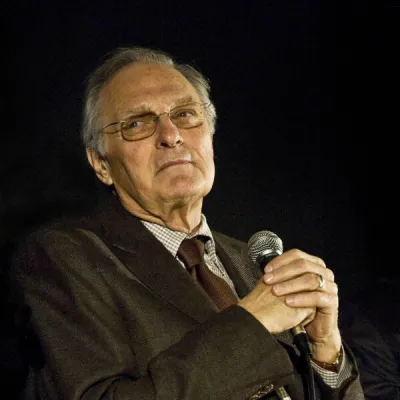
Alan Alda
Human Design Chart
Biography
After winning his battle with polio as a child, Alda took an interest in writing and acting while in high school. The son of actor Robert Alda and Joan Browne, he joined his dad on stage in the early '50s, first appearing with his father at the Hollywood Canteen in 1951, doing imitations of Abbott and Costello. A graduate of Fordham University in 1956, he studied at an Improv Workshop, worked at the Cleveland Playhouse and in "Second City" in New York.
He first appeared on Broadway in "Only in America," which opened on 19 November 1959. His film debut was in 1963 in "Gone Are The Days." "The Owl and the Pussycat" opened on Broadway in November 1964. During his early years of getting established, he had to work on the side as a cab driver and at a gas station to keep up on rent money.
Alda, 6'2" tall, is known as even tempered, easy-going, considerate and modest, valuing his family and privacy.
At home, he is a dedicated tennis player. Around the mid-'70s, Alda emerged as the prototype of a New Man: liberal, sensitive, pro-feminine, opposed to all kinds of inequalities or sexism. One of his special interests was his series of specials on PBS, "Scientific American Frontiers." He did five of these shows a year on location, visiting China, tagging sharks and handling strange animals.
Human Design Analysis: Alan Alda as Projector 6/2
Projector 6/2 — Design at a Glance
Alan Alda's design indicated a tendency towards dense and focused perception. His aura seemed like a bright flashlight that immediately identified system errors in others. This ability to uncover the 'dark' side of people was central to his Projector nature.
As a Projector, Alan Alda did not have a constant intrinsic energy source due to his undefined Sacral Center. Instead, he exhibited cyclical energy management: phases of high productivity alternated with necessary rest periods to prevent burnout. Directly correcting others would quickly provoke aggression in him because the bright light of criticism was perceived as unpleasant.
The effective strategy involved waiting for an honest and respectful invitation. Rather than addressing errors head-on, he utilized the attractive effect of harmonious radiance. When he himself served as a functioning role model, others actively sought his advice.
Living by this design brought Alan Alda success. Deviations from it led to his non-self theme: bitterness. The necessity of invitations was meant to avoid conflicts through direct error correction and respectfully incorporate his specific leadership abilities.
Emotional Authority
Alan Alda's design indicated a tendency towards the following: He appeared as someone who did not make decisions based on first impulses but required conscious time to gain clarity. Spontaneous reactions often seemed misleading; what appeared in one moment as passionate conviction could become negative or irrelevant in the next. This resulted from his emotional authority, carried by the defined Emotional Center. In Human Design mechanics, this authority always takes precedence over all other defined centers, regardless of further configurations in the chart.
Alan Alda was subject to a natural emotional wave, a permanent up and down of feelings. The world appeared colored by his current mood state. A first impression was not an ultimate truth but merely a snapshot. Quick decisions based on emotions risked negative consequences as they were based on transient states.
Instead, his process required patience and the conscious overnighting of important choices. The more time Alan Alda took, the deeper he could understand the situation. Over time, intense feelings subsided, emotional distance emerged, and calmness set in. This cycle was particularly relevant for long-term decisions that significantly influenced his life course. By waiting out the emotional waves, he arrived at a well-founded, clear decision rather than being guided by transient moods.
The 6/2 Profile — Role Model / Hermit
Alan Alda's design featured a clear developmental arc: from early experimentation to later role as a wise exemplar. In his younger years, before age 30, the sixth line of his profile acted like a third one. This shaped a phase of 'trial and error', during which he gathered numerous personal life experiences through direct practice.
Around thirty years in, the sixth line fully activated. Alan Alda then showed a strong desire for withdrawal and distance, akin to a stay in a 'cave on the mountain'. This period served intense reflection over his earlier experiments and was simultaneously a phase of healing and deep self-awareness. The sixth line brings here a new superiority that is often kept secret to avoid losing special advantages – a process of transcendence.
Once this inner clarity was achieved, Alan Alda emerged from his withdrawal. He became an 'role model', whose wisdom attracted others who wanted to learn from him. Through the integration of the second line, which prioritizes people orientation over pure goal orientation, he not only conveyed abstract insights but also showed how quality could be improved through respect for all involved. His role as a trendsetter arose from transforming his personal experiences into universal life wisdom that others emulated and benefited from.
Triple Split Definition — Defined & Open Centers
Alan Alda's Human Design profile is characterized by a high internal consistency and stable inner structure. Seven of his centers are defined, providing him with a solid mental and emotional framework. His defined Head Center and Ajna Center create a constant pressure to ask questions and form concepts; this mental stream is always active and serves as an inspiration for others but requires patience since there is no direct energy available for implementation. His identity and direction are clearly established by his defined G Center, making him feel secure in his self-love and enabling him to offer guidance to others. Additionally, he has accessible willpower in the Heart Center, allowing him to keep promises and use his resources autonomously.
His defined Solar Plexus serves as his inner authority. Alan Alda must learn to trust the emotional wave and make decisions only after experiencing highs and lows to gain clarity. His intuition (Spleen) and stress management (Root) are also firmly established, giving him strong body awareness and a specific drive.
In contrast to this stability, he has two open centers: Sacral and Throat. His open Sacral Center means that he does not have a constant generative energy source. He is susceptible to conditioning by the surrounding work environment and tends to overextend himself by trying to be constantly available or amplify others' energy. Instead, he should wait for invitations and respect his fluctuating energy flow. His open Throat Center leads to situational communication; he cannot predict when he will speak. Attempting to force attention through talking often results in frustration. Instead, his open center naturally attracts attention when he waits and receives an invitation to speak.
Channels for intuition, clarity, devotion and emotional depth.
Alan Alda's Human Design profile points towards a tendency for spontaneous and intuitive action, characterized by deep self-love and the ability to move through the world without existential burden. This quality is supported by Channel 57-10, which connects the Spleen Center with the G Center, enabling an acute sensitivity to the environment that allowed Alan Alda to let go of unfounded future anxieties and anchor himself in the present.
His mental functioning was mutative and inspiring, driven by Channel 61-24. This channel links the pressure of the Head Center with the rational response of the Ajna Center, producing sudden insights or "Satori." Alan Alda did not need to control his thinking; knowledge came when it was ready, breaking old patterns to inspire others with new perspectives.
In interpersonal dynamics, Alan Alda operated with instinctive persuasiveness, supported by Channel 44-26. This channel connects the intuitive awareness of the Spleen Center with the willpower of the Heart Center, allowing him to assess others and offer appropriate solutions or ideologies while sensing what resonated with them without forcing himself.
Emotionally, his landscape was marked by a pulsing wave generated by Channel 39-55. This channel connects the Root Center with the Solar Plexus, creating mood swings between ecstatic joy and melancholic uncertainty. Alan Alda learned to accept these waves rather than rationalize them, helping him wait for the right emotional climate before acting or forming relationships.
The Sun in Gate 41 propelled this entire process forward. As a gate of evolution and feeling, it focused Alan Alda on specific experiences and crises necessary to maintain inner calm despite emotional fluctuations. This configuration describes someone who perfects their unique form through personal development and learning self-acceptance.
Individual Circuitry — Circuit Signature
Alan Alda's Human Design profile as a Triple Defined Ruler shaped him into an Integrator who did not have a constant internal energy source like an inner motor. Instead, he reflected the energies of his environment situationally and processed them reflectively. This structure allowed him to absorb different impulses without primarily initiating or sending out a pulsing identity.
Within this framework, three separate energetic components worked in parallel alongside each other since there was no direct connection between the groups. The Knowledge Circuit showed itself in two isolated areas: once connecting the Head Center with the Ajna Center (Awareness), generating spontaneous mental impulses. Separately from that, the connection of Solar Plexus and Root Center (Release Emotions) produced emotional wave movements without being directly steered by the mind.
The Ego Circuit carried a direct link between Heart and Spleen Centers through the channel of Devotion. This promoted the ability to cooperate and jointly create resources in the Family context based on giving and taking, yet without constant life force from the Sacral Center, which required periods of rest.
Finally, the Integration Circuit connected Identity with the Spleen Center (Perfect Form). This supported securing his own survival through intuitive knowledge and proper behavior in the Now Moment. Alan Alda utilized these separate channels to absorb external information, reflect emotional and mental impulses, as well as maintain cooperative structures, always dependent on the current context and surrounding energies.
Left Angle Cross of the Alpha 2
Alan Alda's Human Design profile indicated a tendency towards identifying as an 'Alpha', characterized by the left cross of Alpha 2. This didn't manifest in traditional leadership dominance but rather in a deep-rooted connection to his role within the community and a sensitive perception of authority.
The left cross of Alpha 2 describes energy focused on connection and integration, less about individual power assertion than how one fits into the social fabric and what function they serve. Alan Alda operated through this configuration as someone who didn't primarily take authority from outside but defined it from his position within the collective. This dynamic emphasizes the importance of mutual interaction; it's about finding the right place and understanding one's impact on others.
This mechanism means that identifying as an Alpha here is less a title claimed than a function arising through resonance with the environment. Alan Alda thus adopted a stance aimed at building bridges and stabilizing structures by situating his own authority within the context of community. It's an approach based on harmony and mutual recognition, where personal integrity is defined by the quality of relationships.
Saturn Return · Uranus Opposition · Chiron Return · 2nd Saturn Return — Life Cycles
Alan Alda's Human Design profile indicated a tendency towards profound inner transformations often manifesting as a necessity to redefine one's identity. This dynamic was particularly evident during his Chiron Return period, a cycle not understood in Human Design mechanics as healing old wounds but rather as a phase of blooming and fulfilling the incarnation purpose. When a person lives according to their strategy and authority, around ages 49 to 51, there is an increasing experience of life's true meaning; it's a turning point where inner clarity manifests outwardly.
Alan Alda ended his role in M*A*S*H in 1983 at the age of 47. This event marks the immediate lead-up to his Chiron Return and signals the end of a long-standing relationship or identity figure, making way for the upcoming phase of self-actualization. Exiting this known structure was not a loss but a preparatory movement towards that time when his design could fully unfold. The mechanics clearly show: letting go of old roles is often the necessary step before the true blooming of the incarnation cross and experiencing one's individual purpose in life. Alan Alda thus showed himself to be someone willing to leave known paths to give more space to his essential nature.
Projector · Emotional Authority — Synthesis
A central red thread runs through the chart: the ability to recognize subtle patterns and convey them in a way that inspires or challenges others (Channel 61/24, Gate 41). This happens not through direct instruction but by casting light into darkness (Projector), prompting others to find their own answers. The defined mental authority (Head Center and Ajna Center) amplifies the impulse to process information and develop new perspectives – a capability particularly channeled through connection to the G Center, enabling deep understanding of identity and direction. The defined Solar Plexus reinforces this inner guidance as an emotional wave that needs time to unfold and gain clarity.
The central paradox lies in the combination of this inner depth and the need for recognition (Gate 26). While the chart points towards self-sufficiency and independent thinking, it is also geared towards influencing others and eliciting a reaction – a tension field between authentic expression and seeking validation. This dynamic is reinforced by Channel 44/26, which emphasizes the ability to recognize needs and mobilize resources but also carries the risk of being driven by external expectations.
4 Defined Channels
Incarnation Cross - Left Angle Cross of the Alpha 2
Solar Return
The Solar Return shows the moment when the sun returns to its exact birth position - your personal solar year.
Life Cycles
Discover the life cycles with a detailed triple view (birth chart, cycle chart, composite).
Human Design Profile
- Type
- Projector
- Strategy
- Wait for the respectful invitation
- Authority
- Emotional Authority
- Profile
- 6/2 - Role Model / Hermit
- Definition
- Triple Split
- Incarnation Cross
- Left Angle Cross of the Alpha 2
- Date of Birth
- 28.01.1936 05:07
- Place of Birth
- Manhattan, NY, United States
Frequently Asked Questions
What is Alan Alda's Human Design type?
What Profile does Alan Alda have in Human Design?
Which Authority guides Alan Alda?
What incarnation cross does Alan Alda have?
When was Alan Alda born?
Discover your own Human Design
Are you also a Projector? Find out in a personal reading how to unfold your leadership qualities and recognize the right invitations.
More Personalities
Back to overviewSissy Spacek

Alain-Fournier

Anémone

Ann-Margret

Arletty
Arno
