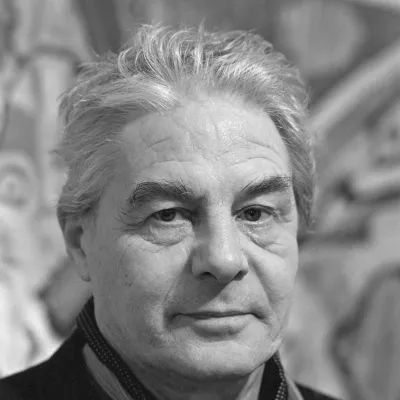
Photo: Wikimedia Commons
Alan Villiers
Human Design Chart
Biography
Alan Villiers as a Manifestor 1/3 in Human Design
Manifestor 1/3 — Design at a Glance
Alan Villiers was a Manifestor, a type designed to be a pioneer and visionary. His design saw him as someone who should lead the world into a new future, much like an emperor in ancient Rome, who had the vision of a great empire but did not wage the necessary wars himself, but instead delegated them to others. This role often put him in situations where he was misunderstood, as his thoughts reached further than those around him. He polarized: Some loved his big dreams and followed him, while others disliked him because of these visions or even hated him.
To find the right followers, it was crucial for him to inform others about his plans in a timely and precise manner. This was his ideal strategy. If he followed this strategy and his inner authority, he was rewarded with a feeling of inner peace. However, if he lived against his design, he likely felt a persistent, deep anger within himself. His life was thus characterized by this tension between the necessity of communicating his visions and the emotional reactions of his environment.
Splenic Authority
Alan Villiers showed himself to be someone who made decisions exclusively in the immediate moment. His design laid a tendency towards spontaneous, intuitive orientation, where the first impulse was considered the only correct one. This stance came from his inner authority in the Spleen Center. For the Spleen Center to take on this function, his Emotional and Sacral Centers were open. This limited this authority to Projectors or Manifestors. The Spleen Center acted as a health and alarm system, providing a pronounced survival intelligence. It showed itself as spontaneous inner knowledge about whether a situation, environment, or society was right for him. Physical well-being and intuition served as reliable indicators. This way, he took good care of himself and rigorously distanced himself from harmful influences. However, this Spleen impulse was very subtle and only occurred once in the moment. It could easily be overshadowed or ignored by other influences, requiring high vigilance. A retreat for decision-making was helpful. Since he only knew what was right in the moment, plans often changed at the last minute. Long-term commitments were difficult; he preferred flexibility and freedom to avoid unnecessary binding.
The 1/3 Profile — Investigator / Martyr
Alan Villiers showed himself to be someone who not only collected knowledge theoretically but also tested it through direct, often risky experimentation. His design as a Researcher and Experimenter (Profile 1/3) established a basic attitude based on the principle of trial and error. He learned through experience in the here and now, without being hindered by expectations or after-the-fact reflections. This corresponded to the energy of Line 1, which promotes dedication in the background and the discovery of potentials, even if they were not immediately recognized. At the same time, Line 3 drove him to test strategies and learn from mistakes. He had to deal with the danger of 'ego inflation,' which arose when recognition overshadowed his modesty. Alan Villiers often chose extreme strategies to test their effectiveness and used his ability to recognize the intentions of others to control them. His judgment was considered trustworthy because he had tested things both theoretically and practically. For him, happiness meant being true to himself and going through his own experience rather than validating himself externally. His life was characterized by this constant alternation between the accumulation of knowledge and the bold step into practical implementation, with each mistake understood as a necessary learning step.
Single Definition — Defined & Open Centers
Alan Villiers revealed himself as someone with a reliable inner compass and a clear will for self-determination. His defined G Center gave him a firm identity and the inner knowledge of his correct direction, independent of external expectations. This self-assurance was strengthened by his defined Heart Center, which gave him the willpower to keep promises and determine his own resources and work rhythms. He did not act out of compulsion but from a conscious decision about what he wanted to achieve.
At the same time, he had a sharp, intuitive perception through his defined Spleen Center. This allowed him to make spontaneous existential judgments in the here and now, protecting his survival and well-being without having to rationalize this intuition. His voice, guided by the defined Throat Center, served as a direct channel for these inner truths and his will to communicate clearly and honestly.
This stable inner foundation stood in contrast to his open centers, which made him vulnerable to external influences. His open Head and Ajna Centers meant that he absorbed mental inspirations and concepts from the environment but did not have a constant source for mental pressure or questioning. He tended to get caught up in the mental whirlwinds of others if he did not trust his inner authority. Similarly, his open Solar Plexus absorbed foreign emotions, which could make him appear emotionally unstable if he did not recognize these as not his own. His open Sacral Center had no constant energy flow, which led him to react to the energy of others and easily overextend himself, rather than relying on his own generative power. His open Root Center also took on external stress that he should not have experienced as his own but rather as a temporary environmental condition.
Channels for intuitive action, presence and courageous implementation.
Alan Villiers revealed himself as someone who through his spontaneous existence and way of speaking radiated a deep intuitive clarity. His design tended towards spontaneous, authentic expression that did not come from intellectual planning but from a deep inner knowledge.
This trait was rooted in the Awakening Channel 10-20, connecting the G Center with the Throat Center. Through the Gate of Appearance (10) and the Gate of Now (20), he spoke the truth of his existence in the moment: “I am”. This was not a conscious performance but a natural state of awakening, where self-love and self-confidence served as a foundation. By simply being himself, he inspired others to live their own truth, often without intending to do so.
This attitude was supported by the Channel of Perfect Form 10-57. Here, the intuitive insight of the Spleen Center (Gate 57) flowed directly into his behavior (Gate 10). This gave him an acute sensitivity to the environment and the ability to act spontaneously and appropriately to secure his survival and well-being. He did not live out of future fears but from a deep intuitive certainty that moved him through the world unburdened.
Additionally, the Channel of Brainwave 57-20 shaped the way he conveyed knowledge. The intuitive insight (Gate 57) found its clearest voice in the Now (Gate 20). Alan Villiers could articulate profound self-awareness and encourage others to awaken their own inner survival intelligence. His spontaneous verbal outbursts often hit the core of a matter faster than others' thoughtful analyses.
The Channel of Wavelength 16-48 showed his ability to connect intuitive depth (Gate 48) with technical skill (Gate 16). This allowed him to perfect skills through repeated experimentation and develop a genuine talent based on true dedication.
The Channel of the Money Line 21-45 brought in the aspect of will and material responsibility. Through the Gate of the Hunter (21) and the Gate of the Gatherer (45), he sought a balance between control and service, valuing independence to follow his natural rhythm.
Prioritized Gates like Gate 46 (Devotion, Body Love) and Gate 25 (Innocence, Centering) underscored his connection to the physical here and now and a mystical, centered attitude. Gate 15 (Collective Behavior, Natural Rhythm) and Gate 26 (Innovation, Sales) complemented his profile with adaptability to societal streams and the ability to integrate new ideas. Gate 7 (Leadership, Hierarchy) and Gate 18 (Correction, Human Rights) showed his potential to project patterns for the future and make corrections in the collective process without taking them personally.
Individual Circuitry — Circuit Signature
Alan Villiers revealed himself as someone whose inner logic and creative intuition directly flowed into his outer expression. His design connected the Throat Center with the Spleen through the Aha! Circuit (20-57). This allowed him to articulate intuitive insights and innovative ideas immediately and precisely, without long deliberation beforehand. Parallel to this, the Understanding Circuit worked: The Channel “The Wavelength” (16-48) also connected Throat and Spleen, promoting clear, rational communication based on logical insights. These two streams created the ability to make complex connections both intuitively and rationally understandable.
Additionally, the Ego Circuit shaped his actions. The Channel “The Money Line” (21-45) connected the Heart Center with the Throat Center. This gave him the strength to mobilize resources through willful decisions and push through projects, relying on mutual support and fair exchange processes. The integration completed this picture: Through the Channels “Awakening” (20-10) and “Perfect Form” (10-57), Throat, Identity, and Spleen were connected. This anchored his expressions deeply in his individual identity and survival instinct. Alan Villiers thus acted not only out of impulsive creativity but from a thoughtful, identity-strong conviction that he carried into the world with a clear voice. His simple definition meant that these energies worked as a coherent, stable flow, giving him a consistent and authentic presence.
Right Angle Cross of the Vessel of Love 3
Alan Villiers revealed himself through a deep, often silent dedication to what he considered sacred or profoundly valuable. His design carried the signature of the right cross of the Love Vessel, a configuration that described a specific kind of dedication. It was not a loud demand for attention, but an inner readiness to devote oneself entirely to a higher purpose or a deep connection. This energy created a kind of inner container that served to collect and preserve love and dedication, rather than letting it flow uncontrollably outward. Alan Villiers lived this dynamic by directing his strength towards protecting and nurturing what was at the heart of his being. It was a stance of quiet loyalty and deep connection that did not rely on external affirmations. His path was marked by this inner discipline, which allowed him to maintain a genuine, sustainable connection in a world that often acted superficially. The mechanics of this cross emphasized the importance of patience and inner collection. Alan Villiers intuitively understood that true dedication takes time and cannot be forced. His way of meeting life was infused with this calm, steady energy that helped him remain stable in difficult times and be a reliable support to others.
Saturn Return · Uranus Opposition · Chiron Return · 2nd Saturn Return — Life Cycles
Alan Villiers showed himself to be someone who found a deep inner alignment in the middle of his life, which crystallized in his public voice. This process corresponded to the Chiron Return, a cycle of fulfillment in which one's life purpose – assuming one lives according to their strategy – increasingly unfolds and becomes meaningful. In 1949, at the age of 46, he published his autobiography, "The Sailing Picture." This was not just a career peak, but the expression of this inner bloom: His life experience became a coherent whole that he could share.
Earlier, in 1940, another dynamic had been revealed. At the age of 37, he settled in Oxford with his wife Nancie. This fell during the time of the Uranus Opposition, a phase in which external circumstances often change abruptly and require new structures. While the Chiron Return brought confirmation of one's essence, the Uranus Opposition marked the necessary transformation of life circumstances. Alan Villiers responded to this external rupture by founding a stable relationship framework in Oxford. The mechanics show this contrast: The Uranus cycle demanded adaptation to changed circumstances, while the Chiron cycle later enabled the mature articulation of one's story. Both events were not coincidences, but expressions of the respective planetary influences on his design, guiding him from external restructuring to inner fulfillment.
Manifestor · Splenic Authority — Synthesis
Alan Villiers was a Manifestor, destined by his design to act as a pioneer and to chart new paths. This natural leadership role was intertwined with a deep, instinctive authority emanating from his Spleen Center, supporting him in spontaneous decisions that served his health and well-being. His profile as a researcher and experimenter (1/3) underscored this tendency, driving him to gain knowledge through personal experience and validate insights through trial and error. This process of learning and testing was not just intellectual but also physical, allowing him to make grounded judgments.
A central paradox in his design lay in the tension between the drive to initiate as a Manifestor and change the world (Channel of Awakening) and the necessity to heed the subtle impulses of his Spleen Center authority. While pursuing visions and recognizing principles, his inner guidance required a moment of stillness and spontaneous feeling to ensure that his actions were in alignment with his true self. This combination of proactive action and intuitive waiting shaped his path and led to a life marked by the pursuit of new insights and transformation through authentic expression.
5 Defined Channels
Incarnation Cross - Right Angle Cross of the Vessel of Love 3
Solar Return
The Solar Return shows the moment when the sun returns to its exact birth position - your personal solar year.
Life Cycles
Discover the life cycles with a detailed triple view (birth chart, cycle chart, composite).
Human Design Profile
- Type
- Manifestor
- Strategy
- To inform others before acting
- Authority
- Splenic Authority
- Profile
- 1/3 - Investigator / Martyr
- Definition
- Single Definition
- Incarnation Cross
- Right Angle Cross of the Vessel of Love 3
- Date of Birth
- 23.09.1903 01:30
- Place of Birth
- Melbourne, AUSTL
Frequently Asked Questions
What was Alan Villiers' Human Design type?
What profile did Alan Villiers have in Human Design?
Which authority guided Alan Villiers?
What incarnation cross was Alan Villiers assigned to?
When was Alan Villiers born?
Discover your own Human Design
Are you also a Manifestor? Find out in a personal reading how to use your initiation power peacefully and dissolve resistance.
More Personalities
Back to overviewAlain-Fournier
Angeli
Christian-Jaque

Juninho

Kesha

Lucebert