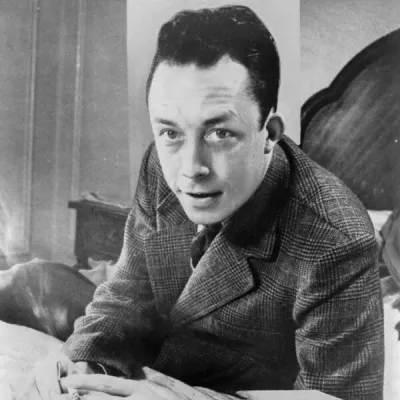
Albert Camus
Human Design Chart
Biography
Camus was born in French Algeria to pied-noir parents. He spent his childhood in a poor neighbourhood and later studied philosophy at the University of Algiers. He was in Paris when the Germans invaded France during World War II in 1940. Camus tried to flee but finally joined the French Resistance where he served as editor-in-chief at Combat, an outlawed newspaper. After the war, he was a celebrity figure and gave many lectures around the world. He married twice but had many extramarital affairs. Camus was politically active; he was part of the left that opposed Joseph Stalin and the Soviet Union because of their totalitarianism. Camus was a moralist and leaned towards anarcho-syndicalism. He was part of many organisations seeking European integration. During the Algerian War (1954–1962), he kept a neutral stance, advocating a multicultural and pluralistic Algeria, a position that was rejected by most parties.
Philosophically, Camus's views contributed to the rise of the philosophy known as absurdism.
Albert Camus as a Manifestor 1/4 in Human Design
Manifestor 1/4 — Design at a Glance
Albert Camus acted as a pioneer and visionary whose impact did not lie in direct execution but rather in initiating new directions. His design saw him more as an emperor carrying the vision of an empire, while others – comparable to soldiers – carried out the concrete work. This structure often led to misunderstandings and polarization: his far-reaching thoughts found enthusiastic followers among some, yet met with rejection or even hatred from others.
This conflict was no coincidence but a central aspect of his nature as a Manifestor. To minimize resistance and find the right following, his strategy involved informing others precisely about his intentions at the right time. Through this communication, he could build leading similarity and reduce misunderstandings.
The emotional consequence of this dynamic was clear: if Albert Camus followed this strategy of informing, his design rewarded him with a sense of inner peace. If he violated this principle, however, he reacted with persistent, deep anger. Thus, his life was marked by the tension between visionary leadership and the necessity to make it accessible through clear communication to maintain inner peace.
Emotional Authority
Albert Camus lived with an internal authority that fundamentally shaped his decision-making: the emotional wave. His design dictated that he always perceived the world through the filter of his current mood. What seemed absolutely right in one moment could appear completely negative in the next. These fluctuations were not mistakes but his natural mechanism.
The emotional authority means that the Solar Plexus Center is defined, taking over inner leadership – independent of all other defined centers on the graph. Anyone with this configuration experiences a constant up and down of emotions. Albert Camus’ immediate impulses were therefore often just snapshots, first impressions that did not yet reflect his deeper truth. Spontaneous decisions made in such an emotional state risked being misleading due to their distortion by transient moods.
His strategy was to allow time. He needed patience and the distance of several nights to sleep on a decision. Only when intense feelings subsided and emotional distance emerged, clarity and calmness set in for him. This process was essential for all long-term steps influencing his life course. By hesitating and not reacting immediately, he utilized the natural cycle of his emotions to reach true insight. This delay neutralized the distortion of the moment and allowed him a deeper understanding beyond current mood.
The 1/4 Profile — Investigator / Opportunist
Albert Camus revealed himself through a profound tension between the drive for fundamental knowledge and the longing for familiar community. His design as Profile 1/4, Researcher and Networker, laid out an intense research drive paired with the need to share these insights within a close circle. Line 1 conveyed the necessity of thoroughly researching things and building authority through deep understanding. Simultaneously, Line 4 fostered a strong emotional bond with a specific group. This also created a pronounced fear of being exposed as inadequate before these loved ones. For Albert Camus, therefore, a loving environment with a deep trust base was crucial. Only within such a protected framework could he fully unleash his potential and effectively use his ability to convey knowledge and network. Without this security, his influence remained blocked due to the fear of rejection and loss of recognition from the community. Only when his authority within this trusted network was recognized could he truly be influential; without this resonance, his actions lost significance. This configuration marked him as someone whose intellectual strength was inseparable from the emotional security of his social environment.
Single Definition — Defined & Open Centers
Albert Camus exhibited a firm, reliable self-identity and a clear sense of direction, characterized by his defined G Center. This endowed him with the ability to show others new perspectives without having to take over their paths. His communication was steady but limited; the defined Throat Center ensured that he spoke from his personal identity and clearly manifested messages in the world.
However, he did not make decisions impulsively. His defined Solar Plexus acted as an internal authority: He had to wait for the emotional wave to subside until clarity emerged. Only when emotions calmed down would he act correctly. This process required time since truth only revealed itself over the course of emotional cycles. Additionally, a defined Root Drive propelled him forward, serving as set stress to survive and advance in the material world.
In contrast, Camus's Head and Ajna Centers were open. He did not have a constant mental processing mode but rather a flexible mind receptive to inspiration from his surroundings. This allowed him to take on various concepts without identifying them as personal truth or falling into mental confusion. His open Heart Center lacked consistent willpower; he tended to avoid burdening himself with proving through promise spirals or pressure. Instead, he could sense the vibrations of others' egos without wanting to compete.
The open Sacral and Spleen Centers made him vulnerable to external influences. His energy level was variable; he absorbed the vitality of his environment, which could lead to exhaustion under stress as he lacked a generative response authority. The open Spleen Center provided situational intuition and health sense but also left him susceptible to survival fears. He tended to take on others' well-being or project their anxieties rather than rely on stable inner security. This configuration required being consciously separated from conditioning environments to maintain personal boundaries.
Channels for reflection, emotional turmoil and transformative expression.
Albert Camus was someone who pursued a restless search for new experiences, which he later reflected upon and integrated into a larger narrative structure. The tension between the emotional urge for immediate action and subsequent patient integration significantly shaped his design.
The Channel of Transience 36-35 acted as an emotional manifestor. It connected the Solar Plexus Center to the Throat Center through the Gate of Crisis (36) and the Gate of Transformation (35). This channel resisted restrictive patterns and actively sought adventures, often driven by the feeling “I’ve been there before; what’s new?” It generated unrest or crises to force movement and learned wisdom through deep emotional experiences.
Simultaneously, the Channel of the Lost Son 13-33 determined his stance. It connected the G Center to the Throat Center via the Gate of Listener (13) and the Gate of Withdrawal (33). Here it was about reflection and memory: Collecting life stories and secrets followed by withdrawal to process these experiences. This channel taught patience and the value of observation over immediate reaction, allowing one to see all sides of an experience before passing it on as historical or biographical truth.
The challenge lay in timing: Holding back the emotional drive of Channel 36-35 without speaking too soon, as Channel 13-33 demanded. Albert Camus used this configuration to first intensely experience events and then share them as a witness of conscious co-piloting life’s journey. The wisdom that emerged from this patient observation revealed truths about collective history and the meaning of life at the end of the experiential cycle.
Collective Circuitry — Circuit Signature
Albert Camus showed a tendency to emotionally penetrate past occurrences and reflect on their significance. His design connected the Throat, Solar Plexus, Root, and Identity Centers into one continuous flow in the Meaning Circuit. This configuration directed his energy away from cool logic towards processing experiences from the past. Emotions moved in wave-like patterns – with clear beginning, peak, and end – often perceived as illogical or inexplicable.
Through the Channel of the Lost Son (Gates 33-13), he sought the essence of his identity in the depths of emotional life. The Channel of Transience (Gates 35-36) in the Root Center brought acute awareness of finiteness and the transient nature of all things. This aligned with the Channel of Recognition (Gates 30-41), which articulated these emotional and existential impulses into words to share.
Since all four centers were grouped together, there was no internal conflict between feeling, instinct, identity, and expression. Albert Camus used this integrated energy to share felt insights with the collective. The aim was not rational analysis but learning from the past through communicating emotionally true experiences. His focus lay on making the visual and emotional truth of what had been experienced visible rather than seeking future-oriented solutions.
Right Angle Cross of the Sphinx 4
Albert Camus carried the right cross of the Sphinx 4 in his design. This configuration was characterized by a stance marked by deep intuition and a strong connection to the subconscious. In Human Design, this cross describes a specific energy distribution often associated with a certain air of mystery or the protection of inner truths.
The Sphinx 4 is known for not always revealing knowledge openly but instead preserving it and selectively passing it on. For Albert Camus, this meant carefully filtering internal processes and insights before they were expressed outwardly. It was like an inner guard ensuring that only what was truly mature and authentic came to light.
This structure fostered a deep trust in one's instincts, even when these could not always be explained rationally. Albert Camus thus emerged as someone who protected his truth and shared it only when the moment was right. It was less about publicly laying out all thoughts than about the integrity of the inner self.
The right cross of the Sphinx 4 bestows a certain distance from the outside world, which is not to be understood as coldness but rather as necessary space for self-reflection. Albert Camus used this energy to clearly define his own values and beliefs without being led by external expectations.
Overall, this cross shaped a way of life based on inner stability and authentic expression. It was a protective mechanism against superficial influences and helped Albert Camus preserve his own voice in a world often filled with noise.
Saturn Return · Uranus Opposition — Life Cycles
Albert Camus showed himself in his late twenties as someone seeking structure and commitment. In 1940, at the age of 27, he married Francine Faure in Lyon. This marked his first Saturn return, a phase where years of inner development often condense into concrete life structures. Saturn demands clarity about bonds and responsibility; the marriage was an expression of this necessary anchoring in daily life and interpersonal commitments.
Later, in 1952 at age 39, he published 'The Exile and the Kingdom'. This event fell within the Uranus opposition period. While Saturn anchors, Uranus acts as a force for sudden breakout or creative reorganization. During this phase of his life, there was a dynamic shift: established structures met the urge for individual, often disruptive expression. For Albert Camus, this did not mean abandoning earlier values but transforming them into new and unexpected forms. The Uranus energy here promoted publication as an act of liberation and creative leap from the purely private to public, surprising statement power. Both cycles shaped his path: Saturn created a foundation through relationships, while Uranus provided the impulse for literary development beyond old patterns.
Manifestor · Emotional Authority — Synthesis
Albert Camus' life was marked by a deep engagement with human experience, showing in a steady rhythm of emotional depth and detached observation. His emotional authority required time to let decisions mature, while the Manifestor type (Design View) propelled him forward with visions – an interplay enhanced by the Lost Son Channel (Channels/Gates). This channel points towards a process of experience collection, reflection, and ultimately shared knowledge, underpinning his ability for deep analysis and networking (Profile Role). He lived in the interplay between absorbing emotional waves and expressing transformative messages (Centers), always seeking meaning in an often absurd world (Meaning Circuit).
Camus' design revealed a central paradox: the tension between the desire for connection and the necessity of distance. The Heart Center, connected to the Throat, indicated the need to express his inner truth (Centers), yet Gate 33 in the Lost Son Channel signaled a tendency towards withdrawal to process experiences. This was evident in events like entering into a relationship (Saturn Return) and publishing works (Uranus Opposition), reflecting both personal bonds and intellectual independence – a life between closeness and demarcation, reinforced by the right cross of the Sphinx 4 (Cross).
3 Defined Channels
Incarnation Cross - Right Angle Cross of the Sphinx 4
Solar Return
The Solar Return shows the moment when the sun returns to its exact birth position - your personal solar year.
Life Cycles
Discover the life cycles with a detailed triple view (birth chart, cycle chart, composite).
Human Design Profile
- Type
- Manifestor
- Strategy
- To inform others before acting
- Authority
- Emotional Authority
- Profile
- 1/4 - Investigator / Opportunist
- Definition
- Single Definition
- Incarnation Cross
- Right Angle Cross of the Sphinx 4
- Date of Birth
- 07.11.1913 02:00
- Place of Birth
- Drean, Algeria
Frequently Asked Questions
What was Albert Camus' Human Design type?
Which Profile did Albert Camus have in Human Design?
What Authority guided Albert Camus' decisions?
What incarnation cross did Albert Camus have?
When was Albert Camus born?
Discover your own Human Design
Are you also a Manifestor? Find out in a personal reading how to use your initiation power peacefully and dissolve resistance.
More Personalities
Back to overviewAlain-Fournier

Angeli

Christian-Jaque

Juninho

Kesha

Lucebert