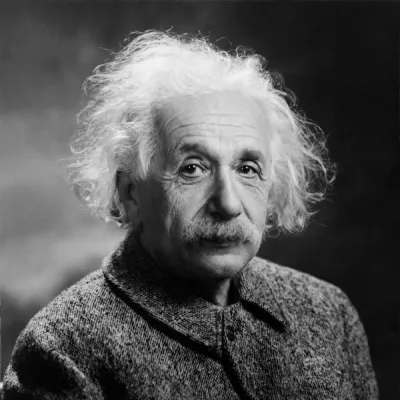
Albert Einstein
Human Design Chart
Biography
Albert Einstein — Generator with Profile 1/4
Generator 1/4 — Design at a Glance
Albert Einstein was a Generator, which meant he had high sacral energy and great endurance. He resembled an energetic workhorse if he could muster the necessary enthusiasm for his tasks. His design did not function through initiating – that is, starting processes independently – but rather relied on responding. The energy of his sacral center, his inner motor in the abdominal area, was primarily released when he responded to impulses from his life. When his abdomen answered with a “Yes!” and he acted upon it, this led to deep satisfaction and a feeling of fulfillment. If, however, he did things that he actually had no enthusiasm for or tried to initiate things actively, there was the risk of prolonged frustration or even burnout. His greatest strength thus unfolded when he did not force himself to take the first step but responded to signals from his environment.
Emotional Authority
Albert Einstein was someone whose perception of the world was strongly colored by his current mood. He experienced a constant up and down of his feelings, so that something could be perceived enthusiastically in one moment and negatively in the next. This configuration arose from his defined Emotional Center (the center for emotions), which functioned as his inner authority. Within the mechanics, this center always had precedence over all other defined centers.
Since first emotional impressions were merely snapshots and not yet the final truth, quick, spontaneous decisions based on an emotion could have negative repercussions. For Albert Einstein, it was therefore crucial to exercise patience and reconsider decisions multiple times “overnight.” Only when intense feelings subsided and an emotional distance emerged did clarity and calmness set in. This process allowed him, especially regarding long-term turning points in his life course, to gain a deeper and more comprehensive understanding.
The 1/4 Profile — Investigator / Opportunist
Albert Einstein showed a deep need for thorough knowledge that was particularly advanced through the exploration and overcoming of crises to enable progress. This inclination arose from Gate 36, Line 1, where the profound engagement with uncertainties served as a foundation. Since his design contained “Jupiter in Fall” – an exaggerated resistance against changes – this often led to crises whose resolution was necessary for any development.
As someone with Profile 1/4 (Researcher/Networker), he combined the urge for thorough exploration of things with the desire for a community of familiar people. This configuration brought with it the fear of being exposed as inadequate in knowledge before close acquaintances, making a trust foundation crucial so that he could take on his role as an authority. This was complemented by Gate 11, Line 4, which enabled him to convey knowledge at a transpersonal level – beyond the individual – to people without prior knowledge and to inspire strongly. Due to “Sun in Fall,” however, this access to valuable insights often remained selective and only accessible to a small circle.
Split Definition — Defined & Open Centers
Albert Einstein was someone with a reliable self-identity and a deep sense of his own direction in life. This characterization arose from his defined G-Center (the seat of identity). He possessed a powerful inner foundation: His defined Sacral Center, a source of vital energy, gave him enormous endurance and the need for satisfaction through his work. A defined Heart Center endowed him with strong willpower and self-esteem, while his defined Solar Plexus provided emotional depth, though clarity only emerged over time. Additionally, his defined Root Center gave him a constant pressure to move forward.
In contrast, his mental architecture was highly flexible. Through an open Head Center (no consistent way of processing information) and an open Ajna Center (lacking fixed concepts), he had an open mind capable of grasping myriad possibilities and opening up for diverse inspirations. This openness allowed a particular intellectual flexibility. At the same time, he was through an open Spleen Center vulnerable to fundamental survival anxiety and at risk of clinging to things that were not good for him. An open Throat Center also made him susceptible to the pressure to draw attention to himself.
Channels for pioneering spirit, intimacy and emotional clarity.
Albert Einstein showed a deep restlessness and constant desire for new experiences. This inclination arose from the Recognizing Channel 41-30, where the pressure of Gate 41 (Restriction) generated an energetic unrest that was transformed into an intense need for new experiences through Gate 30 (Recognizing Feelings).
Furthermore, he was characterized by the ability to transform strong emotional energies through crisis processes. This corresponded with the effect of his Personality Sun in Gate 36, which describes the “darkening of light.” For Einstein, crises were necessary, cyclical movements with a clear beginning, middle, and end that prepared the ground for personal development and new beginnings.
His design also included the Pairing Channel 59-6. This connection between the Sexual Gate (59) and the Friction Gate (6) endowed him with a strong ability to intimacy, enabling him to easily enter into the aura of others and promote creative processes.
His profile was further expanded by the Initiation Channel 51-25. Here, the competitive energy of the Shock Gate (51) met the Spirit of Self Gate (25), fostering a natural tendency towards individuation and the ability to develop deeper consciousness through transcendent experiences.
Individual Circuitry — Circuit Signature
Albert Einstein was shown as a personality with fortified and courageous convictions. This resulted from the Centering Circuit over Channel 25-51 (Initiation), which connected the Identity Center (seat of identity) with the Heart Center (self-esteem). Since there was no connection to the Throat Center (communication), these strong convictions were often hard to express.
Parallel to this, he experienced a cyclical reliving of the past. The Meaning Circuit linked over Channel 30-41 (Recognizing) the Solar Plexus Center (emotions) with the Root Center (pressure). This led to a wave-like emotional processing of past events to gain insights for the collective.
Additionally, there was an ancient instinct in him towards preserving and protecting genetics. This showed itself in the Guardian Circuit, which linked over Channel 59-6 (Pairing) the Sacral Center (life force) with the Solar Plexus Center.
Since Albert Einstein had a split definition, these energetic forces did not exist as a continuous flow. The individualistic self-strengthening of heart and identity stood as separate powers next to emotional and instinctive impulses from Solar Plexus, Sacral, and Root Centers; they worked as two parallel existing streams.
Right Angle Cross of Eden 1
Albert Einstein strove to create a personal paradise in his life and possessed the gift of uncovering truth in his surroundings. This orientation resulted from his Incarnation Cross, the right cross of Eden 1 – an energetic configuration that describes a life direction focused on searching for an ideal state and revealing truths. Parallel to this, he strongly felt the urge to share his gained insights for the benefit of others. His path was thus connected with the learning task of effectively communicating these insights while simultaneously respecting the different realities and perspectives of his fellow humans.
Saturn Return · Uranus Opposition · Chiron Return · 2nd Saturn Return — Life Cycles
Albert Einstein's life journey was marked by astrological cycles that served as markers for fundamental changes in his career and personal life. In 1907, at age 28, he published his work “On the Principle of Relativity and the Conclusions Drawn from It.” This coincided with his first Saturn Return, a phase where years of groundwork often condensed into a solid result. In 1919, at age 40, he divorced Mileva Marić. This event occurred during the Uranus Opposition, a cycle frequently marked by a drive for personal autonomy and sudden upheavals. At age 50 in 1929, Einstein declined an offered house from Berlin and instead built his own in Caputh. This happened during the Chiron Return, a fulfillment cycle or “bloom,” where the meaning and purpose of one's design increasingly unfolds in life. The culmination of these formative phases was marked by the year 1936 when his wife Elsa died. This loss fell on his second Saturn Return, a time often characterized by confrontation with structural limits and profound life changes.
Generator · Emotional Authority — Synthesis
Albert Einstein lived a life deeply influenced by reacting to current energy. As a Generator with emotional authority, he needed time to process his feelings and gain clarity before making decisions – an inner wisdom that was evident in his methodical approach. The connection between the defined G-Center (self-identity) and the defined Heart Center (willpower) points to a strong internal compass driving him to pursue his own visions while simultaneously using the energy of his sacral center for deep, meaningful work. His profile as Researcher/Networker reflected in his ability to explore complex ideas and share them with others – a process amplified by Gate 11 (visual memory), which helped him recognize patterns and synthesize knowledge. The recurring themes of crisis and mutation (Gate 36, Line 1) combined with the need for self-actualization (Channel 51-25) were evident in his constant search for new insights and willingness to challenge established paradigms.
A central paradox lay in the tension between his defined G-Center – a firm sense of direction – and open Head and Ajna Centers. While he had a clear inner vision, his mind was constantly open to new information and perspectives, leading to an ongoing engagement with complex ideas. This openness could inspire him but also risked confusion and doubt since he lacked fixed convictions and always sought truth from various angles. This dynamic field between internal clarity and intellectual flexibility shaped the power that defined his life and work.
3 Defined Channels
Incarnation Cross - Right Angle Cross of Eden 1
Solar Return
The Solar Return shows the moment when the sun returns to its exact birth position - your personal solar year.
Life Cycles
Discover the life cycles with a detailed triple view (birth chart, cycle chart, composite).
Human Design Profile
- Type
- Generator
- Strategy
- To respond - wait for something to respond to
- Authority
- Emotional Authority
- Profile
- 1/4 - Investigator / Opportunist
- Definition
- Split Definition
- Incarnation Cross
- Right Angle Cross of Eden 1
- Date of Birth
- 14.03.1879 11:30
- Place of Birth
- Ulm bei Tübingen, Germany
Frequently Asked Questions
What Type was Albert Einstein?
What Profile did Albert Einstein have?
What Authority did Albert Einstein have?
What Incarnation Cross did Albert Einstein have?
When was Albert Einstein born?
Discover your own Human Design
Are you also a Generator? Find out in a personal reading how to use your sacral energy correctly and discover deep satisfaction.
More Personalities
Back to overviewAaliyah

Alexia

Angèle

Anne-Marie

Arcángel

Arno