
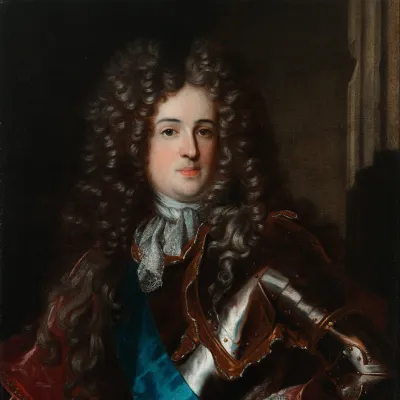
Aleksander Benedykt Sobieski
Human Design Chart
Biography
He was a candidate for election to the Polish throne in 1697, following his father's death, but was unsuccessful. In 1702, he declined Charles XII of Sweden's offer to set him up as a rival king to Augustus II of Poland. Aleksander fought at the side of Charles XII during his campaign in Saxony, in 1706.
In 1710 he settled in Rome. Still in 1709, under the pseudonym Armonte Calidio, he joined the Roman academy Arcadia and the congregation of writers, artists and scholars. During the meetings held in the Arcadian Roman Mansion he often recited his own poetry written in Latin. Aleksander throughout his life was passionate about theatre. He created his own version of the Arcadian dramma nobile. In the years 1710-1713 he completed the composition of several operas, in collaboration with the composer Domenico Scarlattim and set designer Filippo Juvarra. Occasionally, he starred in his plays.
He died in Rome on 16 November 1714, having recently become a Capuchin friar.
Aleksander Benedykt Sobieski — Manifesting Generator with Profile 6/2
Manifesting Generator 6/2 — Design at a Glance
Aleksander Benedykt Sobieski had a unique energy constellation that marked him as a hybrid of Generator and Manifestor. His design not only conveyed the constant power of the sacral center but also allowed for quick action capabilities through additional connections to the motor centers. This shaped him as someone who could draw things into his life without going through the usual step-by-step process.
However, this speed was a double-edged sword. Aleksander Benedykt Sobieski tended to skip important steps, forcing him to backtrack later and make up for missed steps. Such setbacks often led to frustration, his specific non-self experience. Additionally, he often reacted to multiple impulses simultaneously and started several projects in parallel. Without confirmation of his inner authority, his creative enthusiasm quickly turned into overextension.
The strategy of his design required him not to initiate but to react to life. He acted effectively only when his sacral center responded with a clear "yes." When he correctly applied this resonance test, Aleksander Benedykt Sobieski found deep satisfaction in his work. He flourished in a playful mode that sought variety rather than focusing on a single task. His strength lay in working with enthusiasm and speed, as long as he used his inner confirmation as a compass to avoid frustration and channel his diverse energy constructively.
Sacral Authority
Aleksander Benedykt Sobieski responded to external stimuli with an immediate physical reaction that served as the basis for his decisions. As a Generator, he possessed sacral authority, where his strategy and inner guidance were identical. This simplified his process: He waited for a reaction rather than actively planning.
This authority manifested as a gut feeling or surge of energy. Aleksander Benedykt Sobieski learned to pay attention to his own bodily signals such as grunting, humming, or a "Mhm." These sounds signalled that his sacral motor had kicked in. In these moments, he felt vital and alive. Then, he had seemingly inexhaustible energy at his disposal, which he infused into his activities with great enthusiasm. His design predisposed him to go through life with joy and satisfaction, fully immersed in his tasks, without the need for an external goal.
Additionally, his activated Spleen Center served as a supporting authority. As it might be directly connected to the Sacral Center, it allowed Aleksander Benedykt Sobieski particularly quick and spontaneous reactions. He had an immediate access to his physical well-being and instinctive perception. These instincts served him as a reliable compass, complementing his sacral energy and supporting his decision-making in the here and now.
The 6/2 Profile — Role Model / Hermit
Aleksander Benedykt Sobieski revealed himself in his early life phase through a tendency to experiment and learn from personal experiences. Before the Saturn return, the 6-line of his profile acted as a 3-line. This meant that his actions before the age of 30 were characterized by trial and error. Mistakes often led to a temporary withdrawal to reassess the situation. This phase served to gather a variety of life experiences.
With the entry into the third decade of life, the 6-line activated. Sobieski then likely withdrew into a phase of distancing himself to look back on his earlier experiments from a great height. This period of intense reflection served as a process of healing and deep self-knowledge. From this isolation, wisdom developed that he later shared with others. People sought him out to learn from his ability for deep introspection.
His configuration also included aspects of mental security. He maintained vigilance to avoid blind enthusiasm and used the variety of data as inspiration without necessarily providing immediate solutions. Parallel to this, there was a presence that was perceived as readiness for leadership. He developed methods that could serve others but rejected foreign approaches that contradicted his personal interests. This long-term process of selectivity and stock-taking shaped his path to becoming a role model and natural talent.
Single Definition — Defined & Open Centers
Aleksander Benedykt Sobieski revealed himself as someone who possessed a reliable inner energy source that allowed him to engage in tasks that brought him satisfaction. His design was marked by a defined Sacral Center, indicating a constant vital force that could only be correctly utilized through reactions to external impulses. Initiating actions without prior questioning often led to frustration and exhaustion, as the sacral energy was then unavailable. This ability for sustained endurance was linked to his defined Throat Center, which served as a pivot point for his communication and action, enabling him to express his truth with clarity and honesty, provided he trusted his inner authority. Additionally, he had a defined Spleen Center, which gave him a spontaneous, intuitive sense of health and well-being. He tended to listen to these momentary instincts to protect himself from danger and live in the present, rather than preferring rational considerations.
In contrast, Aleksander Benedykt Sobieski was open to external influences in several areas. His open Head Center made him vulnerable to mental pressure and confusion when trying to find answers to questions that were not his own. He tended to question whether he was inspiring enough or if he was missing something important that could divert him from his true path. Similarly, his open Ajna Center allowed flexibility in thinking but also brought the risk of holding foreign opinions as his own truth or feeling uncertain when he did not receive conceptual confirmation. His open G Center meant that he did not have a fixed, unchanging identity but changed according to his environment and the people around him. He often sought the right place to feel belonging and could easily empathize with the directions of others. The open Heart Center led to him not being consistently willful and sometimes feeling pressured to prove his worth through promises or performance, which often led to a cycle of self-doubt. Finally, his open Solar Plexus absorbed the emotions of his environment, making him emotionally vulnerable and likely to experience foreign moods as his own rather than recognizing them as passing waves. His open Root Center also made him susceptible to external stress, leading to feelings of pressure and unrest when he did not recognize that this pressure did not come from himself.
Channels for deep knowledge, experimentation and powerful manifestation.
Aleksander Benedykt Sobieski exhibited a fundamental approach that combined intuitive depth with persistent practice. His design inclined him to not only learn skills but refine them through repeated experimentation into unique mastery. This occurred through the Channel of Wave 48-16. Here, Gate 48, which seeks vital, instinctive information, connected with Gate 16, which experimentally tests and perfects new possibilities. This configuration described a life task of uncovering hidden connections and making them accessible through technical mastery. Talent arose here from the combination of inner intelligence and outer skill.
Simultaneously, Aleksander Benedykt Sobieski possessed a powerful, self-reinforcing energy that propelled him to act in the moment. The Channel of Charisma 34-20 connected the Sacral Center with the Throat Center. Gate 34 provided raw, physiological life force, while Gate 20 immediately transformed this energy into expression and manifestation. This connection generated a drive to be active and affirm himself through his own vitality, often independent of external affirmation.
His mental profile was further shaped by Gate 64, which sought clarity about past experiences, and Gate 63, which drove the process of improvement through doubt. These gates fostered a deep understanding of time and security. In the social field, Gate 45, which represented tribal energy and hierarchy, and Gate 26, which conveyed innovation within conservative structures, were at work. Gate 14 facilitated skillful power accumulation, while Gate 8 promoted the individual contribution to the group. Gate 18 worked on necessary corrections in the collective, and Gate 35 sought satisfaction through changing experiences and interaction.
Collective Circuitry — Circuit Signature
Aleksander Benedykt Sobieski was revealed through a clear, logical orientation aimed at improving structures and sharing rational insights. His design was marked by a simple definition, meaning that all his defined centers – Throat, Spleen, and Sacral – were connected in a single, coherent energetic flow. This unity allowed him to directly translate his intuition and survival instinct into communicative actions without internal conflicts.
The Understanding Circuit worked through him via the Channel 'The Wave', which connected the Throat Center with the Spleen Center. This conveyed the ability to translate intuitive perceptions and strategic insights into clear, focused messages aimed at future improvements. It was an emotionless ratio that pointed out logical connections free from conditioning.
Parallel to this, the Integration Circuit worked through the Channel 'Charisma', which linked the Throat Center with the Sacral Center. This channel ensured that the power of reacting to life (Gate 34) was effective in the present moment (Gate 20). Aleksander Benedykt Sobieski utilized this connection to manifest his energy in the current moment through authentic behavior and intuitive knowledge, thus securing his individual survival. Both circuits shared the Throat Center, thereby feeding his communicative expression both through strategic logic and through vital, immediate reaction.
Left Angle Cross of Dominion 2
Aleksander Benedykt Sobieski carried the design of the left cross of Authority Zone 2, which implied a specific orientation towards the establishment and maintenance of structures within a community or system. His character was marked by the drive to establish order and set boundaries necessary for the stability of a collective. It was not an individual search for freedom, but rather the responsibility for the whole that he co-created.
In Human Design, this cross denotes a configuration associated with the creation of authority zones and the definition of responsibilities. The energy of this pattern worked to have Aleksander Benedykt Sobieski take a stabilizing role in situations where clarity about roles and responsibilities was lacking. He intuitively understood how rules and hierarchies could serve to enable rather than suppress action. This mechanism shaped his way of interacting with others: he sought the framework within which cooperation became possible. His presence promoted the idea that true strength lies in the ability to create a safe foundation for others, rather than placing himself in the forefront. This was not a conscious strategy, but a natural consequence of his energetic configuration, which made him an architect of social and structural order.
Saturn Return — Life Cycles
Aleksander Benedykt Sobieski experienced his first Saturn return as a phase of structuring and solidification. During this life stage, typically between the ages of 28 and 30, the question of long-term stability and personal responsibility came to the forefront. His design suggested that he would move away from earlier, perhaps experimental, life designs and instead establish firm foundations for his future.
The first Saturn return marks in Human Design the transition from youth to full adult responsibility. It is a time when inner values and external circumstances collide to create a solid basis for the coming decades. Aleksander Benedykt Sobieski used this energy to gain clarity about his role in the world and focus on goals that promised stability. This cycle shaped his attitude: away from fleeting impulses, towards thoughtful, sustainable action. The experience of this return helped him to strengthen his own authority and make decisions that served not just the moment but a long-term perspective. It was a time of maturation, in which he learned to understand the burden of responsibility not as a burden, but as the foundation of his identity.
Manifesting Generator · Sacral Authority — Synthesis
Aleksander Benedykt Sobieski lived a life marked by a dynamic interplay between inner authority and the urge for rapid implementation. As a Manifesting Generator, he possessed constant sacral energy (sacral center), driving him to respond to impulses, yet the connection to the Throat Center also gave him the ability to skip steps and seize opportunities quickly. This hybrid mechanism led to a lifestyle where he could both dive deeply into activities and swiftly chart new courses – a pattern that intensified through early years of experimentation and later reflective phases (Profile 6/2). The defined communication (Throat Center) indicates that he carried his inner wisdom and insights gained from experience outward.
A central paradox in his design lay in the tension between the natural impulse for rapid response and the necessity not to skip steps (Manifesting Generator). The connection between Spleen and Throat (Channel of the Wavelength) pointed to a deep, instinctive intelligence, which could potentially be overwhelmed by the urge for rapid implementation. This tension between instinctive depth and swift action shaped his path, with the period after the age of 30 marking a phase of intense reflection and wisdom-seeking to integrate gained experiences and serve as an example.
2 Defined Channels
Incarnation Cross - Left Angle Cross of Dominion 2
Solar Return
The Solar Return shows the moment when the sun returns to its exact birth position - your personal solar year.
Life Cycles
Discover the life cycles with a detailed triple view (birth chart, cycle chart, composite).
Human Design Profile
- Strategy
- To respond - wait for something to respond to
- Authority
- Sacral Authority
- Profile
- 6/2 - Role Model / Hermit
- Definition
- Single Definition
- Incarnation Cross
- Left Angle Cross of Dominion 2
- Date of Birth
- 09.09.1677 02:00
- Place of Birth
- Gdansk, POL
Frequently Asked Questions
What was Aleksander Benedykt Sobieski's Human Design type?
What profile did Aleksander Benedykt Sobieski have in Human Design?
What authority did Aleksander Benedykt Sobieski possess?
What incarnation cross did Aleksander Benedykt Sobieski have?
When was Aleksander Benedykt Sobieski born?
Discover your own Human Design
Are you also a Manifesting Generator? Find out in a personal reading how to unfold your multi-talents and direct your energy wisely.
More Personalities
Back to overviewSissy Spacek

Aldair

Alizée

Anémone

Angeli

Ann-Margret
