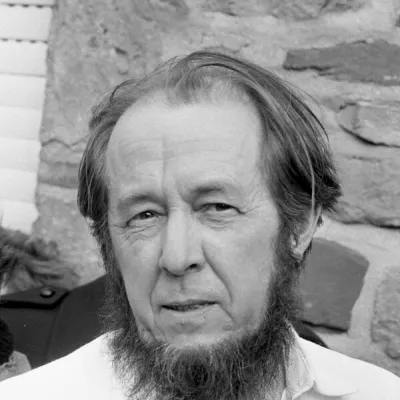
Aleksandr Solzhenitsyn
Human Design Chart
Biography
Solzhenitsyn was born into a family that defied the Soviet anti-religious campaign in the 1920s and remained devout members of the Russian Orthodox Church. At a young age he became an atheist and embraced Marxism–Leninism. While serving as a captain in the Red Army during World War II, Solzhenitsyn was arrested by SMERSH and sentenced to eight years in the Gulag and then internal exile for criticizing Joseph Stalin in private correspondence with another field officer. As a result of his experience in prison and the camps, he gradually became a philosophically minded Eastern Orthodox Christian.
During the Khrushchev Thaw, Solzhenitsyn was released and exonerated. He started writing novels about his experiences and repression in the Soviet Union. In 1962, he published his first novel, One Day in the Life of Ivan Denisovich—an account of Stalinist repressions—with approval from Soviet leader Nikita Khrushchev.
Aleksandr Solzhenitsyn — Reflector with Profile 2/4
Reflector 2/4 — Design at a Glance
Aleksandr Solzhenitsyn's Human Design lacked any constant personal energy. As a Reflector, he had no defined centers, making his identity a mirror that absorbed environmental and natural energies. He not only reflected the energies of other people but also those of nature, including seasons and celestial constellations.
This structure required living in harmony with natural cycles. For important decisions, at least one lunar cycle was necessary to wait out. This waiting strategy automatically allowed him access to people and environments that were beneficial for him. In this state, he could observe without attachment and was rewarded with joyful surprise.
If he lived against his design, deep disappointment would arise instead. This affected both himself and the condition of the world. Refusing to wait resulted in a persistent feeling of disappointment about himself or his surroundings. His nature was thus designed to gain clarity through patience and reflection rather than through constant personal power.
No Inner Authority
Aleksandr Solzhenitsyn's Human Design leaned towards external information intake; he did not have an internal, physical authority. As a mental projector, he lacked center activation below the Throat Center. His decision-making process was neither intuitive nor impulsive but rather involved intensive exchange with other people. In dialogue, dormant potentials in his open centers were activated, allowing him to view issues from numerous perspectives and express them differently. This high resonance ability served to identify the appropriate environment as well as the right conversation partners for this necessary exchange.
The evaluation of collected information was a complex process requiring time alone. Only then could Aleksandr Solzhenitsyn discern the thread running through the data, distinguishing what made sense and belonged to him. Through this method, he developed his specific intelligence: filtering out the essential from a mass of data, organizing it meaningfully, and structuring it. This information-filtering process formed his central capital as a projector. It was the way to develop an instinct for correctness that deepened over time when he remained in a trustworthy environment and continuously exchanged.
The 2/4 Profile — Hermit / Opportunist
Aleksandr Solzhenitsyn's Human Design leaned towards a constant tension between a deep desire for withdrawal and the urge for community. He appeared as someone oscillating between two poles: the wish for isolated reflection (Line 2) and the desire to spend time with his closest network (Line 4). For his Profile, it was crucial to create a safe environment where he could clearly communicate when he sought company or wanted solitude. During his 'cave phase', he immersed himself in internal processes to gain clarity. Once this need was satisfied, he returned to connect with his favorite people. This dynamic allowed him to evaluate external knowledge from his network during alone time and develop brilliant ideas from it. Line 2 promoted deep reflection and learning from painful experiences, while Line 4 focused him on his network and its influence. He often hoped for external support in times of distress but found the solution through processing these influences in isolation. His memory and discovery skills were central to drawing lessons from the past and making them useful in social contexts.
No Definition — Defined & Open Centers
Aleksandr Solzhenitsyn's design revealed itself as a system without internal, constant reference points: All nine centers were open. This corresponded to the profile of a Reflector whose entire energy was permeated by situational receptivity rather than fixed traits. His system did not function as a source of constant mental clarity, identity or willpower but acted as a mirror and amplifier of his environment.
As there were no defined centers, characteristics like emotional stability or consistent self-worth did not belong to his unchanging essence. Instead, he absorbed mental pressure waves, foreign emotions and stress. His open Head Center made him susceptible to doubting and confusion often stemming from others; he tended to engage with questions that weren't his own rather than observing them as transient phenomena. The open Ajna Center allowed for intellectual flexibility but led to the risk of holding concepts and opinions of the environment as personal truths.
In the emotional realm, the open Solar Plexus Center acted as a barometer: It absorbed the moods and feelings of others, leading him to identify with foreign anger or grief rather than recognizing these as external influences. His open Heart Center meant that he was not driven by consistent willpower; he tended to want to prove his worth by making promises which he could not always keep due to a lack of constant energy.
Physically and existentially, too, he was at the mercy of his environment. The open Sacral Center allowed him to take in and amplify foreign life energy leading to overexertion as he had no consistent boundaries for his availability. His open Root Center absorbed environmental stress; rather than using this pressure as personal drive, he often futilely tried to escape it through hyperactivity. The lack of a defined G Center meant that he adapted to people and places to find out who he was in which context. His open Throat Center naturally attracted attention without him actively seeking it while the open Spleen Center made him sensitive to health and survival signals, often conditioned by his environment. His wisdom lay in using this reflection rather than losing himself in the absorbed energies.
Channels & Gates
Aleksandr Solzhenitsyn's design inclined towards quiet observation and strategic commitment driven by a weak ego. This basic stance originated from Gate 26 (Sun), which focused on perception instead of self-assertion, allowing him to anchor innovations within conservative structures to prevent genetic retardation of the tribe. His solar presence dominated the energetic background.
Alongside this observational stance, he demonstrated an ability to distill collective meaning from past confusion. Gate 47 represented this process: It was about understanding random image sequences from the past and creating clarity. This task was not personal but served the understanding on a collective level. The challenge should be shared with others to enable a meaningful process of comprehension.
His expressive strength was shaped by Gate 45, which channeled willpower from the Heart Center through the Throat. This gate gathered energy at the tribal level and represented a royal hierarchy as well as material synthesis. It expressed willpower and promoted attraction of like forces, considered beneficial for the entire tribe.
Additionally, Gate 22 with its social openness came into play. It allowed individual mutations without intrusiveness. The grace of this gate was shown in the calmness to wait and listen until a conversation ended. This listening supported necessary changes in the social environment. Aleksandr Solzhenitsyn lived this configuration as someone who created clarity through commitment to perception and sharing challenges while balancing voluntary hierarchy and social composure.
Circuit Signature
Aleksandr Solzhenitsyn's Human Design charts did not show any defined circuits or energetic connections in this specific area. The absence of any defined channels and centers within the provided mechanics meant there was no continuous, automatic energy flow structuring his actions or perception here. Instead, this field remained open and undefined, indicating that Aleksandr Solzhenitsyn had no inherent mechanical tendency directed by these specific circuits. Without defined groups or connected centers, there was no cohesive stream linking various aspects of his personality in this area. This fundamentally differed from individuals with shared or triple definitions where parallel but separable energy flows exist. For Aleksandr Solzhenitsyn, this level was simply not activated; there was no set route for energy to move through here. Consequently, no specific character trait or behavior could be derived from this configuration due to the lack of mechanical foundation. The absence of data in fields for circles and streams confirmed this void; it wasn't suppression or blockage but a simple non-existence of corresponding definition in his chart. Aleksandr Solzhenitsyn thus moved in this area without support or compulsion from specific circuit energy dynamics.
Right Angle Cross of Rulership 4
Aleksandr Solzhenitsyn's Human Design profile featured the right cross of Governing, Type Four. This configuration established a specific orientation towards authority and leadership that was less about personal dominance than it was about stabilizing systems and enforcing order structures. His chart did not include further mechanical details such as defined Gates or Channels, so this characterization relied solely on the overarching Cross concept. The right cross of Governing implies a nature designed to take responsibility and act in positions where clear hierarchies and decisions are necessary. It described an energy that was effective through structure and control rather than expressing itself chaotically or purely individually. For Aleksandr Solzhenitsyn, this meant his inner mechanism was programmed to handle the dynamics of power and command, whether by adapting to them or establishing his own principles of order. The emphasis was on how leadership was exercised – not as arbitrary rule but as part of a larger structural framework. Without additional biographical events in the raw content, the description remains at this fundamental archetypal orientation: a person whose design influenced him regarding authority and governing structures.
Saturn Return · Uranus Opposition · Chiron Return · 2nd Saturn Return — Life Cycles
Aleksandr Solzhenitsyn's Human Design profile indicated a tendency towards deep inner integration that reached its peak around his Chiron Return phase. This cycle marked more than just overcoming pain; it was a fulfillment process where his life path and inner truth increasingly anchored in the outer world. The mechanics describe this period as one of bloom, during which the true essence becomes visible and finds its purpose if individual strategy is followed.
This unfolding process manifested concretely in 1970 when Aleksandr Solzhenitsyn, at age 52, received the Nobel Prize for Literature. This success was not a random event but evidence that his inner work and expression found full resonance during this life phase. The Chiron Return acted as a catalyst, condensing long-term development into a recognizable milestone. It was an affirmation of his way of existing by the world, a moment when private truth became publicly acknowledged. This recognition underscored the nature of the cycle: a period in which the inner core manifests outwardly – becoming visible and effective – thereby making tangible the meaning of previous life direction.
Reflector · No Inner Authority — Synthesis
He was a mirror of his time, an open receiver and reflector of surrounding energies. Without constant personal energy (Reflector Type), he lived in harmony with cycles – especially those of nature – which brought him joyful surprises when finding people and environments that resonated with him. This resonance capability, enhanced by the lack of inner authority, led him into dialogues from which he gained information and recognized various perspectives. His Profile as a Natural/Networker revealed an ongoing oscillation between the need for withdrawal (Line 2) and the search for community (Line 4), giving him clarity in internal processes to then reconnect with others.
A central paradox shaped his life: the undefined Head Center (open center) generated both deep confusion and the drive for meaning (Gate 47), as well as the ability to recognize collective patterns and draw clarity from seemingly arbitrary events. This tension between mental openness and the need for coherent understanding was intensified by the right cross of Governing Four, leading him to confront his past in order to develop a sense of present purpose – a process culminating in a documented success in 1970.
Incarnation Cross - Right Angle Cross of Rulership 4
Solar Return
The Solar Return shows the moment when the sun returns to its exact birth position - your personal solar year.
Life Cycles
Discover the life cycles with a detailed triple view (birth chart, cycle chart, composite).
Human Design Profile
- Type
- Reflector
- Strategy
- Wait a lunar cycle (approx. 28 days)
- Authority
- No inner authority - learn more
- Profile
- 2/4 - Hermit / Opportunist
- Definition
- No Definition
- Incarnation Cross
- Right Angle Cross of Rulership 4
- Date of Birth
- 11.12.1918 11:00
- Place of Birth
- Kislovodsk, Russia
Frequently Asked Questions
What was Aleksandr Solzhenitsyn's Human Design type?
What profile did Aleksandr Solzhenitsyn have?
What authority did Aleksandr Solzhenitsyn have?
What incarnation cross did Aleksandr Solzhenitsyn have?
When was Aleksandr Solzhenitsyn born?
Discover your own Human Design
Are you also a Reflector? Find out in a personal reading how to find the right environment and understand your unique mirror effect.
More Personalities
Back to overviewAlain-Fournier

Angeli

Baekhyun

Jihyo

Juninho
Martial