Alexander Fleming
Human Design Chart
Biography
After a two week holiday, in September 1928 he returned to his laboratory to find a strange mould growing on a specimen. He deduced the mould had antibacterial properties and identified Penicillium notatum calling it penicillin. Penicillin had been seen before, but Fleming's cognitive abilities allowed him to recognize what it could do. He published his findings in 1929 but abandoned the work in 1932 due to lack of expertise to purify the substance and he did not hold the conviction that drugs could cure a serious infection as the body's immune system should. In 1939 he provided some penicillin to Sir Howard Florey and Ernst Chain. They did the chemical work and in 1945 they all shared the Nobel prize in Medicine. As Fleming seemed to revel in publicity, he became the spokesman for the other scientists.
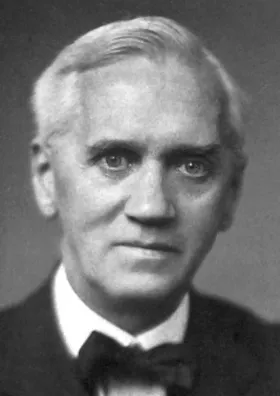
Born seventh of eight siblings and half-siblings to a sheep farming family, Alexander excelled in school. After his father's death he moved to London at about 14. As an adult he was short in stature, usually wore a bow tie and never mastered the conventions of polite society.
In 1900 he and two brothers joined a Scottish regiment to fight in the Boer War. In 1901 he entered medical school at Saint Mary's Hospital, London. He became a fellow of the Royal College of Surgeons in 1909. After serving as a captain in the Army Medical Corps in World War I, Fleming became a professor in 1919 and a research scientist with a profitable side practice of treating syphilis infections of prominent London artists.
Alexander Fleming as a Manifesting Generator 1/3 in Human Design
Manifesting Generator 1/3 — Design at a Glance
Alexander Fleming's Human Design is a hybrid nature that combines the speed of a Manifestor with the constant energy of a Generator. This configuration allows him to skip steps and achieve results quickly. He has a defined Sacral Center, giving him a steady source of power; however, like pure Generators, his strategy was not to initiate but to react to impulses.
This speed carries specific risks. Sometimes he acted too quickly and skipped necessary intermediate steps, which later required him to go back and fill in the gaps. This process could easily lead to frustration, a non-self theme for this type. Additionally, his design tended to pursue multiple projects simultaneously by reacting to various impulses at once. Without inner consent, his creative drive could turn into its opposite.
To use his speed effectively, it was essential that he first react to life and only act when his Sacral Center gave a clear 'yes'. By regularly reviewing his projects, he ensured they aligned with his inner authority. When this was the case, Alexander Fleming found deep satisfaction in his work. Parallel work then became no obstacle but rather fostered his creativity as he created most effectively in a playful mode and sought variety instead of fixating on one thing.
Emotional Authority
Alexander Fleming showed a decision-making stance that opposed spontaneous impulses and instead required emotional maturity time. His design carries Emotional Authority, meaning the defined Solar Plexus Center determines his inner truth. This configuration is subject to constant emotional waves with permanent ups and downs in feelings. The world appeared colored by current mood; enthusiasm could quickly turn into negative evaluation. A feeling at a moment was only a snapshot, not a reliable compass. Quick decisions from this emotional state often led to misjudgments.
The mechanics required patience: the more time he took, the deeper his understanding became. Decisions needed multiple reconsiderations and overnight sleep. Only when intense feelings subsided did he gain emotional distance. Then clarity and calmness set in – a sign that the process was complete. This approach was central for long-term life decisions. Emotional Authority always had priority over other defined centers in his chart, regardless of further configurations. Alexander Fleming learned to take proper time and ask himself multiple times rather than trust first impressions. Only this way did he succeed in seeing through the deceptive nature of immediate impulses and reach true inner truth.
The 1/3 Profile — Investigator / Martyr
Alexander Fleming's design points towards a cyclical process of careful theoretical research and practical experimentation by trial and error. He embodied both the role of scientist and adventurer – a person whose life revolves around learning and experimenting. This configuration stems from his Profile 1/3. The energy of Line 1 strives for authority through thorough knowledge and in-depth study, which sometimes led to hesitant planning as he felt he didn't know enough to move forward. At the same time, however, Line 3 urged him to practically test things and learn from mistakes. This dynamic between the need for complete preparation and the necessity of practical testing shaped his approach. Self-earned and tested insights were central. When Alexander Fleming made a judgment, he had thoroughly examined the matter both theoretically and practically beforehand. One could trust his judgment absolutely as his authority was born through lived experience and overcoming errors. This process of trial and error formed the foundation for his leadership role and deep understanding.
Single Definition — Defined & Open Centers
Alexander Fleming's Human Design reveals a deep, reliable identity driven by immense vitality. His defined G Center gave him clarity about his own direction and self-love, independent of external validation. This inner stability manifested in his defined Throat Center: He communicated and acted authentically from this personal truth without feeling the need to direct others or control their paths.
The energy for this came from his defined Sacral Center. As a Generator, he had a constant source of power that could only be activated through reaction. Initiated actions cut him off from this life force; it was only by waiting for a question or invitation that he could act with full satisfaction and endurance. These decisions were also filtered through his defined Solar Plexus. His emotional authority required patience: He needed to ride the waves of his feelings before clarity emerged. Impulsive judgments in emotional highs or lows were misleading for him; true insight showed itself only after the wave subsided.
This stable inner life contrasted with his open centers, making him vulnerable to external conditioning. His open Head and Ajna Centers meant he lacked a constant mental focus. He tended to engage with others' doubts or questions rather than having his own answers. His mind was flexible but not a source of truth. Additionally, in his open Heart Center, he lacked consistent willpower; he wasn't designed to make promises or prove his worth through competition. The open Root and Spleen Centers made him sensitive to environmental stress and the health conditions of others, necessitating distancing from conditioned fears.
Channels for rhythm, inspiration, reflection and emotional change.
Alexander Fleming operated as a leader who projected patterns for the future and validated them through experiments. His design was dominated by Gate 7, establishing hierarchies and creating visionary perspectives. This energy manifested in his ability to recognize and advance structures.
The Inspiration Channel 1-8 connected his G Center with his Throat Center. Through Gate 1 of Self-expression and Gate 8 of Contribution, he inspired others through his exemplary life. He showed courage to stand out and drew attention by living his unique identity. This was not just an explanation but a demonstrated reality that awakened new directions in others.
The Rhythm Channel 5-15 connected his Sacral Center with his G Center. Gate 5 of Fixed Rhythms held onto habits, while Gate 15 of Extremes integrated the diversity of society into the flow of life. This channel set his internal rhythm and drew others into a continuous energy flow. He moved vitally through the current of life, independent of intellectual or emotional fluctuations.
The Lost Son Channel 13-33 also connected G Center and Throat Center. Gate 13 of Listener gathered information and secrets while Gate 33 of Withdrawal created space for reflection. He patiently waited until deeper truths revealed themselves before sharing his insights. This process of collection and contemplation gave stability and continuity to his contributions.
The Transience Channel 36-35 connected his Solar Plexus Center with his Throat Center. Gate 36 of Crisis sought new experiences often by creating unrest, while Gate 35 of Change implemented these into action. This emotional dynamism propelled him to explore the depth of feeling and thereby advance collective progress.
This was supported by gates like 2 (Receptivity), 62 (Logical Details), 20 (Here and Now), 23 (Understanding), 45 (Tribe Hierarchy), and 27 (Care). These elements formed the background of his primary, future-oriented leadership impact.
Collective Circuitry — Circuit Signature
Alexander Fleming's design showed a tendency to develop a unique identity through his own path. The Knowledge Circuit connected his Throat and Identity Centers via the Inspiration Channel (Gate 1-8). This promoted creative insights and the ability to transform and express new knowledge to initiate change.
Parallel to this, the Understanding Circuit was active. Here, the Rhythm Channel (Gate 15-5) linked the Identity with the Sacral Center. This connection stood for logical, strategic structures and the will to lead society towards a better future driven by constant energy.
A third aspect was the Meaning-Making Circuit. It connected Throat, Solar Plexus, and Identity Centers in a group. Through the Lost Son Channel (Gate 33-13) and Transience (Gate 35-36), Alexander Fleming reflected on past experiences. Emotional waves from the Solar Plexus enabled him to share these insights emotionally filtered with the collective to learn together from the past.
In simple terms, these forces existed as a continuous flow between Throat, Identity, Solar Plexus, and Sacral Centers. The mechanics described a process: From inspired insight through deviating mutations to an emotional-driven expression of new knowledge for changing the collective.
Right Angle Cross of the Sphinx 3
Alexander Fleming's Human Design featured the Right Cross of the Sphinx. This configuration was characterized by a deep, often unconscious search for the essential, coupled with a tendency to emerge in moments of highest clarity or crisis. It wasn't about superficial adaptation but rather an internal process of purification and breaking through illusions.
In Human Design, this cross describes a specific energetic structure. It points towards the ability to navigate challenging life phases toward higher truth or new understanding. The focus was less on external control than on inner resonance and authenticity of one's path. It was about not being led by external expectations but developing an internal stability that held up under pressure.
This mechanism created a fundamental attitude of patience and trust in one's own rhythm. Alexander Fleming showed himself to be someone who didn't force his insights, but allowed them from a place of openness and inner peace. The energy of this cross promoted the ability to penetrate complex connections while maintaining a calm, almost sphinx-like composure. It was a path of transformation where old structures were dismantled to make way for something new and genuine. This internal work shaped his approach to challenges and led him to take a clear, unbiased perspective in decisive moments.
Saturn Return · Uranus Opposition · Chiron Return · 2nd Saturn Return — Life Cycles
Alexander Fleming's Human Design structured itself through clear cyclical milestones marking professional consolidation and knowledge dissemination. These phases followed an inner logic of his Human Design.
The first Saturn Return around the age of 25 functioned as a phase of professional anchoring. Here, years of learning processes condensed into a solid foundation. In 1906, Fleming completed his medical studies – a concrete proof for this initial consolidation that gave him the necessary stability for further progress.
The Chiron Return, which begins around age 48, is in Human Design not a healing process in psychological terms but an achievement cycle. During this phase, one's incarnation cross unfolds increasingly; meaning and purpose become tangible if lived according to strategy and authority. It is a time of bloom when life's mission shows its full effect. In 1929, Fleming published his results. This was not an isolated event but the visible expression of internal maturity: His knowledge became effective and recognized.
The second Saturn Return around age 58 brought another level of structuring. Here it wasn't just about personal development but also passing on to the next generation or institution. In 1939, Fleming provided Sir Howard Florey and Ernst Chain with penicillin. This action underscores the role of the second Saturn Return as a moment of transmission: The acquired knowledge was stabilized and passed on for further progress there. Thus, Fleming's life showed clear developmental stages, each marked by a specific astrological-Human-Design return point.
Manifesting Generator · Emotional Authority — Synthesis
Alexander Fleming was a Manifesting Generator whose life was characterized by an ongoing interplay between rapid initiation and the need for emotional maturity. His design points to someone driven by sacral energy (defined in the Sacral Center) who often seized opportunities swiftly (Manifestor aspect), then validated them through emotional waves and thorough examination (emotional authority). This combination of quick action and deep reflection formed the thread of his work, showing repeatedly in phases of discovery and refinement – from completing studies to providing critical research results and supporting others in their further development.
A central paradox lay in the tension between the urge to explore and experiment with new things (Profile 1/3, Channel Inspiration) and the necessity not to rush decisions (emotional authority). He lived a knowledge circuit that drove him to forge his own path and effect transformation, yet he also needed time to emotionally process his insights and ensure they were truly solid. This internal tension occasionally led to setbacks but also allowed him to learn from mistakes and make lasting contributions.
4 Defined Channels
Incarnation Cross - Right Angle Cross of the Sphinx 3
Solar Return
The Solar Return shows the moment when the sun returns to its exact birth position - your personal solar year.
Life Cycles
Discover the life cycles with a detailed triple view (birth chart, cycle chart, composite).
Human Design Profile
- Strategy
- To respond - wait for something to respond to
- Authority
- Emotional Authority
- Profile
- 1/3 - Investigator / Martyr
- Definition
- Single Definition
- Incarnation Cross
- Right Angle Cross of the Sphinx 3
- Date of Birth
- 06.08.1881 02:00
- Place of Birth
- Darvel, United Kingdom
Frequently Asked Questions
What was Alexander Fleming's Human Design type?
What Profile did Alexander Fleming have in Human Design?
Which Authority guided Alexander Fleming's decisions?
What incarnation cross did Alexander Fleming have?
When was Alexander Fleming born?
Discover your own Human Design
Are you also a Manifesting Generator? Find out in a personal reading how to unfold your multi-talents and direct your energy wisely.
More Personalities
Back to overviewAldair

Alizée

Angeli

Arletty

Artus

Balthus