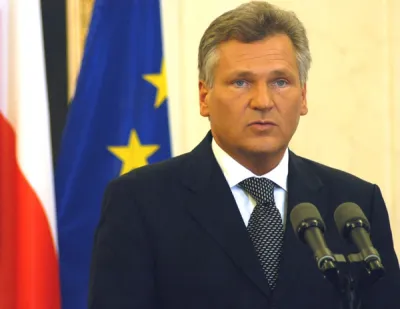
Alexander Kwaśniewski
Human Design Chart
Biography
In an often bitter campaign, Kwaśniewski won the presidential election on 5 November 1995, collecting 51.7 percent of votes in the run-off, against 48.3 percent for the incumbent, Lech Wałęsa, the former Solidarity leader. He was re-elected to a second and final term as president in 2000 in a decisive first-round victory. His term ended on 23 December 2005, when he handed over power to his elected successor, conservative Lech Kaczyński.
The Human Design of Alexander Kwaśniewski: Projector 5/1
Projector 5/1 — Design at a Glance
Alexander Kwaśniewski presented himself as someone who influenced his environment with a dense, focused aura. His design indicated a tendency to quickly identify areas where others were still in the dark or not functioning optimally – similar to a bright light beam that shines directly on its target. However, this ability to immediately find errors in the system could be misunderstood if addressed directly and abruptly.
As a Projector, he did not have a constant internal source of life energy through his undefined Sacral Center. Instead, he worked in phases of high intensity followed by necessary rest periods to avoid exhaustion. The best strategy for him was to wait for a respectful invitation from his environment. By shining harmoniously himself, he attracted others who then actively sought his leadership and insights.
If he lived according to this principle of recognition and waiting for the invitation, he was rewarded with success. Ignoring this dynamic and acting without an invitation or trying to impose his viewpoint against the resistance of others led sooner or later to his non-self theme: Bitterness. His influence was thus not defined by constant action but by the quality of his perception and trust in other people's invitations.
Splenic Authority
Alexander Kwaśniewski's design inclined towards immediate, intuitive decision-making. His inner authority resides in the Spleen Center, an area that functions as a health and alarm system. For this specific authority to be effective, both the Emotional and Sacral Centers must be open – a configuration only Projectors or Manifestors exhibit. This structure grants him pronounced survival intelligence: A spontaneous internal knowledge signals immediately whether a situation, environment, or person is beneficial. The first impulse is considered the right path and serves directly the physical well-being as well as the demarcation from harmful influences. However, this Spleen impulse is subtle and appears only once in each moment. It can easily be ignored or overshadowed by external advice, making high vigilance necessary. Since the correct choice becomes clear only at the moment of confrontation, plans may change short-term. Long-term commitments are therefore difficult; instead, his design requires a lot of space and flexibility. A temporary withdrawal can help to hear this subtle inner voice before a decision is made. Thus, he effectively takes care of himself by relying on his immediate physical signals.
The 5/1 Profile — Heretic / Investigator
Alexander Kwaśniewski was someone who gathered deep knowledge to offer it to others for problem-solving – a classic pattern of the 5/1 profile 'Hero/Researcher'. His Line 1 drove him to build a solid knowledge base through persistence and experiential values. This phase of research was not only private but served to be perceived as an authority later on. Line 5 gave him almost magnetic radiance: Others actively sought his solutions and projected expectations onto him.
This interplay also created tensions. Like an expert suffering under the weight of constant inquiries, there was a risk that Alexander Kwaśniewski would be overwhelmed without clear boundaries. His energy depended on when he shared his insights. Gate 43 (Line 5) showed that his knowledge was particularly effective in crisis times or as a last resort; new insights could carry conflict potential and had to be conveyed carefully. At the same time, Gate 29 (Line 1) demanded not seeing the struggle as a permanent state but taking time to grow. The balance between the urge to help others and the necessity of withdrawing to gather new experiences shaped his dynamics. Only through learning to say no could he maintain the beneficial tension between research for himself and problem-solving for others.
Split Definition — Defined & Open Centers
Alexander Kwaśniewski's design is characterized by persistent mental clarity and direct expressiveness. His defined Ajna Center ensured a continuous, trustworthy thought process; he was not easily influenced in his concept formation. This mental structure flowed directly into his also defined Throat Center, allowing him to immediately and reliably articulate what he thought. His communication style thus became a direct manifestation of his mind, without emotional or intentional distortion.
Additionally, Alexander Kwaśniewski had a defined Spleen Center, which endowed him with spontaneous, intuitive bodily intelligence. He could make healthy judgments in the moment and respond to instinctive warning signals, strengthening his survival awareness. His defined Root Center provided constant adrenergic pressure to move forward in the world and cope with stress; the connection to the Spleen enhanced existential awareness.
In contrast, his open Head Center revealed a vulnerability to mental pressure and confusion when he did not trust his inner authority. He tended to engage with questions that were not his own or sought external inspiration to fill mental gaps. His open G Center meant he did not carry a fixed identity but rather adopted it through relationships and places; false environments often led to feelings of disorientation.
His open Heart Center made him susceptible to trying to prove his worth through promises or competition, which ended in self-doubt if unsuccessful. His open Sacral Center lacked consistent generative energy; he was sensitive to the vitality of others and tended to exhaust himself by taking on their workload instead of listening to his own rhythm. Finally, his open Solar Plexus absorbed the emotions of the environment, making him vulnerable to foreign moods and emotional waves that he could misinterpret as his own if he did not calm down.
Channels for structuring, insatiable curiosity and lifelong struggle.
Alexander Kwaśniewski was someone who not only gathered information but translated it into narrative structures that prompted others to reflect. His energy was geared towards making abstract ideas tangible through stories, always seeking new perspectives. This curiosity drove him to prepare experiences in such a way that they could serve as life parables – less to prove facts than to appeal to imagination and emotion.
This attitude was shaped by the Channel of Curiosity 11-56, which connects Ajna with Throat Center. It grants the ability to weave individual ideas into a coherent narrative that can teach or entertain others. Simultaneously, the Channel of Structuring 23-43, also between Ajna and throat, acted as a mechanism for spontaneous insights. Here it was about clearly and efficiently expressing innovative thinking, often in key concepts that could change collective understanding. Both channels required proper timing: The impact of his statements depended on whether they were shared at the right moment rather than preempted.
In addition to this communicative level, Alexander Kwaśniewski carried an internal tension stemming from the Channel of Life Struggle 28-38. This connects Root with Spleen Center and drives one to find personal meaning in life – often through conscious resistance against external expectations. It was not about blind struggle but recognizing which confrontations were worth pursuing to maintain integrity. This stubborn resolve to follow his own path created a driving force that encouraged him to break free from conventions and defend individuality as the highest value.
Additionally, Gates like 30 (Recognizing Feelings) and 29 (Persistence), enhanced his emotional perception and endurance, along with Gate 58 in Root Center, which combined experimental enthusiasm with a need for perfection. This combination of narrative creativity, structural clarity, and combative integrity shaped how he experienced the world and moved within it.
Individual Circuitry — Circuit Signature
Alexander Kwaśniewski's design tended towards structured, combative communication. His Knowledge Circuit connected two separate segments: The connection between Ajna and Throat Center (Channel 43-23) allowed for clear formulation of inner concepts. Simultaneously, energy flowed between Spleen and Root Center (Channel 28-38), creating an instinctive urgency for survival. These two streams were not directly connected but existed as parallel forces: on one hand the ability to articulate thoughts into words, on the other a strong impulse to overcome crises or stressful situations.
Additionally, the Meaning Circuit worked through Channel 11-56 (Curiosity). It also connected Ajna and Throat Center, but here it fostered curiosity about visual details and sharing experiences from the past. As Alexander Kwaśniewski had a Split Definition, these energetic fields did not merge into one continuous flow but formed separate modules. Communication (Ajna-Throat) thus stood in tension between the need for structured expressiveness and instinctive search for security as well as reflective exchange of the past. This shaped an attitude that could be both analytically clear and emotionally deeply rooted without these aspects automatically transitioning into each other.
Left Angle Cross of Dedication 2
Alexander Kwaśniewski was marked by the design of the left cross of devotion 2, a configuration that points to deep emotional connection and loyalty. This pattern describes a path where personal relationships and the feeling of belonging are at the center. The energy of this cross directs attention to how one integrates into communities and finds stability there, often through sharing values and nurturing long-term bonds. It's not about superficial contacts but rather substantial devotion to people or groups that feel like safe harbors. Alexander Kwaśniewski thus appeared as someone who drew his identity strongly from these relational contexts and sought his greatest strength and stability within them. The mechanics of this design underscore that true fulfillment for him did not lie in isolated success, but in the ability to open unconditionally to others and thereby forge a deep, almost fateful connection. This shaped his approach to the world: less through detached analysis, more through an intuitive grasp of emotional currents within social environments. His actions were often driven by a strong desire for harmony and mutual support, making him a figure who builds bridges and fosters cohesion rather than divides or dominates.
Saturn Return · Uranus Opposition · Chiron Return · 2nd Saturn Return — Life Cycles
Alexander Kwaśniewski showed a decisive shift in his middle life phase coinciding with the Uranus Return cycle. This period often brings sudden changes and a need for individual freedom or a break from established structures. In 1995, at age 41, he was elected President of Poland – an event that translated this disruptive yet liberating impulse of Uranus into concrete political reality. The energy of this planet not only promoted innovation but also the enforcement of a new direction deviating from the status quo.
Later, during his Chiron Return between 2005 and his 51st year, another process came into play. In Human Design, this cycle is not a moment of psychological healing but rather a phase of fulfillment and bloom where the incarnation cross – or the deepest meaning of the design – unfolds fully if one follows their own strategy. The end of his term as President marked this transition. It was less a loss than the conclusion of a chapter that served to express his inner purpose. The Chiron Return confirmed maturity and integration of experiences gathered in previous years, opening the way for a new, meaningful orientation beyond political office.
Projector · Splenic Authority — Synthesis
A central red thread in this design is the focus on recognizing and passing on knowledge. As a projector with defined mental center (Ajna) and the channel of curiosity (Gate 11/56), there lies a natural aptitude to recognize patterns, find solutions, and make these accessible to others. The line 5\/1 in Profile strengthens this aspect by bringing a deep need for knowledge building and sharing – always on the lookout for new perspectives and challenges. This ability to 'bring light into darkness' seems to be a constant reinforced by spontaneous inner authority in the spleen (health alarm system) to ensure that this knowledge is passed on in harmony with one's well-being.
Simultaneously, a central paradox reveals itself between the need for recognition of one's own knowledge and the potential danger of irritating others through direct address. The magnetic quality of the Profile attracts seekers, yet the projector strategy requires indirect invitation and patience. This stands in tension to the defined Ajna Center that formulates concepts and also communicates them. The left cross of devotion 2 points to an inner dynamic between the desire for autonomy and the necessity to serve others – a continuous balancing act between giving and taking.
3 Defined Channels
Incarnation Cross - Left Angle Cross of Dedication 2
Solar Return
The Solar Return shows the moment when the sun returns to its exact birth position - your personal solar year.
Life Cycles
Discover the life cycles with a detailed triple view (birth chart, cycle chart, composite).
Human Design Profile
- Type
- Projector
- Strategy
- Wait for the respectful invitation
- Authority
- Splenic Authority
- Profile
- 5/1 - Heretic / Investigator
- Definition
- Split Definition
- Incarnation Cross
- Left Angle Cross of Dedication 2
- Date of Birth
- 15.11.1954 19:45
- Place of Birth
- Bialogard, Poland
Frequently Asked Questions
What is Alexander Kwaśniewski's Human Design type?
What profile does Alexander Kwaśniewski have?
What authority determines Alexander Kwaśniewskis decisions?
What incarnation cross does Alexander Kwasniewski have?
When was Alexander Kwasniewski born?
Discover your own Human Design
Are you also a Projector? Find out in a personal reading how to unfold your leadership qualities and recognize the right invitations.
More Personalities
Back to overviewSissy Spacek

Alain-Fournier

Anémone

Ann-Margret

Bourvil
Hergé