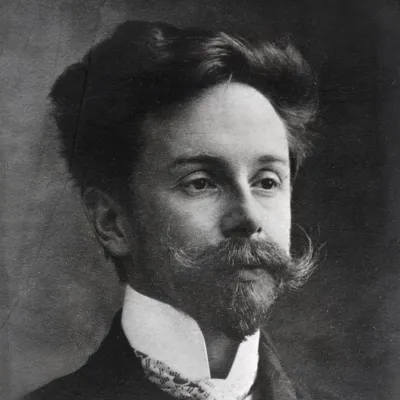
Photo: Wikimedia Commons
Alexander Scriabin
Human Design Chart
Biography
Scriabin married Vera Isakovitch, a pianist in 1897.
He died on 27 April 1915 in Moscow.
Alexander Scriabin as a Generator 1/3 in Human Design
Generator 1/3 — Design at a Glance
Alexander Scriabin possessed an immense and enduring source of energy that made him a powerful creative force. As a Generator, he had a lot of sacral energy, comparable to a strong workhorse that made its strength available as soon as it was motivated for its task. His design dictated that this energy was primarily released in response to impulses from the environment, not through self-initiated action. His motto was therefore: not to initiate, but to react.
When he responded to a signal from life and his sacral center gave the inner 'yes', he could work with deep satisfaction and a sense of fulfillment. In these moments, his endurance was inexhaustible. Conversely, ignoring this principle led to two specific pitfalls. Either he spent his energy on things that did not bring him joy, leading to exhaustion, or he was prevented from working on his heart project, even though he still had plenty of power to continue.
Living against his design and constantly trying to initiate things instead of waiting for inner signals led to a feeling of persistent frustration and a lack of energy. His successful strategy was to act from the gut: to react to life and then respond with action. Only in harmony with this reactive strategy could no one stop him.
Sacral Authority
Alexander Scriabin showed himself to be a Generator whose decision-making was shaped by sacral authority. This inner voice functioned as a direct response to external stimuli, manifested in physical signals like a surge of energy or an inner confirmation. His design required him to listen to this gut feeling to act with vitality and energy. The condition for this was an open emotional center, meaning he did not make decisions based on emotional waves but waited for the immediate, physical resonance.
When his sacral motor was engaged, he felt alive and had inexhaustible energy for his tasks. He was born to go through life with joy and satisfaction, fully immersed in his tasks, without having to pursue strict goal-orientedness. The Generator's strategy of reacting seamlessly merged with authority here, simplifying his process.
Additionally, an activated spleen center acted as a supportive authority. This gave him the ability to react particularly quickly and spontaneously. He had direct access to his physical well-being and instinctive perception. This combination allowed him to reliably be guided by these deep, physical impulses, making his actions authentic and in harmony with his nature.
The 1/3 Profile — Investigator / Martyr
Alexander Scriabin showed himself to be a Researcher and Experimenter, whose design was based on Profile 1/3. This pattern defined a lifestyle characterized by constant learning and practical experimentation. Line 1 drove him to gather theoretical knowledge, while Line 3 compelled him to test these insights in reality. His judgment was considered reliable, as he had verified things both intellectually and through his own experience.
A specific dynamic in his chart involved Gate 54 in Line 1. This was about rising within a group or structure, supported by hidden relationships and secret alliances. This energy allowed him to gain influence as long as these connections were not made public. Revealing such secrets would have weakened his power.
Parallel to this, Gate 57 in Line 3 represented the process of trial and error. This line helped him adapt to life and sharpen his intuition through clear experiences. Although this energy was self-referential, it was not about egoism but a necessary focus on his own survival and learning. In emergencies, this configuration could lead him to care for others if certain additional gates were active. Overall, Alexander Scriabin learned through mistakes and rigorously tested his theories in practice.
Split Definition — Defined & Open Centers
Alexander Scriabins Design points towards a tendency for consequent, conceptual clarity, paired with a deep dependence on inner confirmation. His defined Ajna Center ensured a constant, specific mental function; he processed data and creativity in a trustworthy way that protected him from external mental influence. This intellectual structure flowed directly into his defined Throat Center, enabling him to reliably express what his mind conceptualized. His voice was thus a direct expression of his thoughts, not impulsive, but reasoned.
The driving force of his actions came from his defined Sacral Center. As a Generator, he possessed an enormous source of vital energy, which felt like a constant hum. His strategy was to not initiate, but to react to questions or offers to check if energy was available. A confirming sacral response guaranteed him the endurance needed to master skills and endure stagnation phases until a breakthrough occurred. Without this reaction, he would have encountered resistance and frustration.
Additionally, defined Spleen and Root Centers shaped his essence. The Spleen provided spontaneous, intuitive judgments in the present, protecting his survival and well-being. The Root Center generated a firm, adrenalized pressure that propelled him materially and nourished existential awareness.
In contrast, his open Head Center revealed a vulnerability to mental pressure and confusion. He tended to get entangled in questions that were not his own, or sought inspiration to resolve uncertainties rather than trusting his inner authority. His open G Center meant he did not have a fixed identity. He was vulnerable to blending with his environment and adopting "borrowed" identities, leading him to often seek his direction through the reflection of others rather than determining it himself.
Channels for seeking, intuitive power and maturation.
Alexander Scriabin revealed himself as someone driven by an insatiable curiosity, not just finding ideas but transforming them into stories that inspired others to think. This attitude stemmed from the Channel of Curiosity 11-56, which connected the Ajna Center with the Throat Center. Here, the Gate of Ideas (11) worked together with the Gate of Inspiration (56), leading him to constantly seek new perspectives to share as parables. His creativity lay less in dry fact-repetition and more in the ability to weave abstract information in ways that stimulated the imagination and emotions of his audience.
Parallel to this, he possessed a deep, intuitive awareness that guided his actions in the moment. The Channel of Power 34-57 connected the Sacral Center with the Spleen Center. Through the Gate of Power (34) and the Gate of Intuitive Insight (57), he responded spontaneously to his environment, free from mental delay. This configuration kept him physically fit and acoustically alert, based on a primal survival instinct that warned him of dangers and helped him navigate daily life without being led by external expectations.
Furthermore, he lived life as a series of cycles, fully experiencing each before moving on. The Channel of Ripening 42-53 connected the Root Center with the Sacral Center. The Gate of Beginnings (53) and the Gate of Growth (42) propelled him to carry experiences through to their end, gaining wisdom from them. He did not seek quick results but rather the depth that comes from fully traversing and later reflecting on processes.
Additionally, other Gates shaped his Profile: Gate 54 linked worldly success with mystical insight, while Gate 51 showed a strong willpower that reacted to shocks. Gate 45 gathered energy on a tribal level, Gate 62 ensured logical detail work and pattern recognition. Gate 38 set boundaries to preserve integrity, Gate 12 enabled individual mutation through emotional mood, Gate 9 focused on perfection through detail work, Gate 23 translated inner sound into language, and Gate 58 experimented with pressure and humor to secure the future.
Collective Circuitry — Circuit Signature
Alexander Scriabins Design shows a tendency towards emotional wave movements that cyclically draw from the past. This structure was evident through two separate energetic segments, as he had a split definition. In the Perception Circuit, Channel 14 connected the Ajna Center with the Throat Center, while Channel 33 linked the Sacral Center with the Root Center. These two groups were not directly connected to each other but existed parallel. Thus, the energy did not flow as a unified stream but as separate impulses: on one hand, the visual, emotional reflection of past experiences that wanted to be shared, and on the other hand, the deeper, maturing power of the Root and Sacral centers. Additionally, in the Integration Circuit, Channel 35, which connected the Sacral Center with the Spleen Center, allowed him to draw strength from reactions to life and guide it through intuitive knowledge. The mechanics described a person navigating between processing emotional waves from the past and acting in the present, supported by inner intuition and life force. The split groups meant that these processes did not automatically flow into one another but worked as distinct, parallel forces. Alexander Scriabin lived this tension by seeking and sharing meaning in the past while also acting in the present, guided by his inner intuition and life force.
Right Angle Cross of Penetration 4
Alexander Scriabin's Human Design profile indicated a tendency towards profound, often painful inner work that aimed at the essence of human nature and its spiritual dimension. This configuration, known as the right Cross of Penetration 4, described a life task that was less focused on external recognition or material security, but rather on the consistent penetration of one's own soul and human nature.
In Human Design, this specific Cross configuration meant that the energy was focused on the connection between psychological understanding and spiritual awareness. It was not superficial intellectualism, but a process that led through suffering and deep insights. The energy of this configuration acted like a drill that had to overcome obstacles on the path to true understanding. For Alexander Scriabin, these mechanisms shaped an attitude that was prepared to face the darkest and most complex aspects of existence to extract a higher truth from them.
This orientation created an internal tension between the mind and the spirit, which could only be resolved through radical honesty with oneself. The energy of the right Cross of Penetration 4 demanded that every experience, especially the painful ones, be used as a tool for transformation. Alexander Scriabin thus showed himself to be someone whose inner compass was directed towards the decryption of the human soul, with the path there defined by intensive self-reflection and the willingness to confront one's own darkness. This was not a choice, but an inherent property of his design that determined his entire life direction.
Saturn Return · Uranus Opposition — Life Cycles
Alexander Scriabin's Human Design profile indicated a tendency towards intense, fateful turning points that structured his life. His first Saturn return, which typically occurs around the age of 30 and often marks the crystallization of long-term life paths, took place in 1902. In this year, he marked Tatjana de Schloezer, who became his lover. This event underscores the mechanics of the Saturn ring: it forces confrontation with one's identity and the resulting obligations, which in Scriabin's case was visible through a defining, passionate relationship.
Later, at the age of 43, he was hit by the Uranus opposition. This planet stands for sudden, unexpected breaks and the dissolution of old structures. In 1915, Alexander Nikolajewitsch Skrjabin died. For Human Design, this is a classic expression of Uranus energy: it often brings abrupt endpoints or radical changes that cannot be reversed. Scriabin's chart thus shows a life span that was shaped and ended by these two major astronomical influences – first the consolidation and binding through Saturn, then the sudden dissolution through Uranus. These constellations describe not random data, but the archetypal forces that formed and ended his existence.
Generator · Sacral Authority — Synthesis
He was a Generator who, through his Profile as a Researcher and Experimenter (1/3), had a deep need for independent, practical experience. This line drove him to grasp knowledge not just theoretically, but to validate it through experimentation and verification. The sacral authority, which paid attention to physical reactions to external stimuli, reinforced this impulse by providing him with an immediate, energetic confirmation of the correctness of his decisions – as long as he devoted himself to his own energy and did not sink into unsatisfying work. This led to a lifestyle characterized by a constant search for new impressions and the willingness to learn from mistakes.
A central paradox in his design lay in the combination of the defined Ajna Center, which generated consistent concepts and ideas, and the Perception Circuit, which focused on cyclical emotional experiences from the past. While the mind constantly explored new possibilities (Channel of Curiosity), there seemed to be a deep need to anchor these ideas in the context of personal history and felt truth. A constant oscillation between the conception of new worlds and the processing of past experiences shaped his path, with the connection to the Sacral Center being crucial for whether the energy was available for implementation.
3 Defined Channels
Incarnation Cross - Right Angle Cross of Penetration 4
Solar Return
The Solar Return shows the moment when the sun returns to its exact birth position - your personal solar year.
Life Cycles
Discover the life cycles with a detailed triple view (birth chart, cycle chart, composite).
Human Design Profile
- Type
- Generator
- Strategy
- To respond - wait for something to respond to
- Authority
- Sacral Authority
- Profile
- 1/3 - Investigator / Martyr
- Definition
- Split Definition
- Incarnation Cross
- Right Angle Cross of Penetration 4
- Date of Birth
- 06.01.1872 14:07
- Place of Birth
- Moscow, Russia
Frequently Asked Questions
What was Alexander Scriabin's Human Design type?
What Profile did Alexander Scriabin have in Human Design?
Which Authority guided Alexander Scriabin's decisions?
What incarnation cross was assigned to Alexander Scriabin?
When was Alexander Scriabin born?
Discover your own Human Design
Are you also a Generator? Find out in a personal reading how to use your sacral energy correctly and discover deep satisfaction.
More Personalities
Back to overviewAaliyah

Alexia

Alizée

Angèle

Anne-Marie

Arcángel