
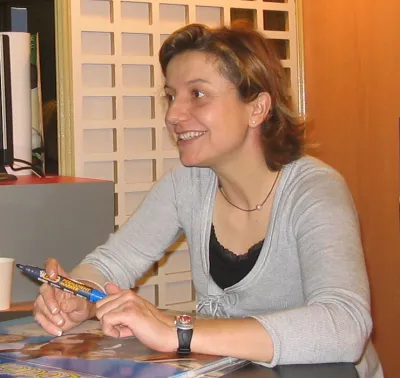
Alexandra Ledermann
Human Design Chart
Biography
She grew up around horses as her parents own a horse riding school in Huest, France where she was trained by her father.
In February 2000 she was the first woman to win the FEI European Show jumping Championships.
Alexandra Ledermann — Generator with Profile 6/2
Generator 6/2 — Design at a Glance
Alexandra Ledermann's design indicates a tendency towards great endurance and inner strength, comparable to a workhorse that generates energy as soon as it is fueled for its task. This configuration describes the Generator type, which has a lot of sacral energy. Crucial, however, is how this strength is released: not through initiating, but through responding. The strategy lies in waiting for signals from life and then acting when the sacral center gives a clear "yes."
If Alexandra Ledermann lived in harmony with this principle, she was rewarded with deep satisfaction and a sense of fulfillment. Her design shows that no one could stop her if she responded to impulses from her gut. If, however, a different pattern emerges—such as constantly initiating or performing tasks without inner resonance—this quickly leads to frustration and energy loss for Generators. Another stumbling block is when she is prevented from working on her heart's project, even though she is still full of power. Then a conflict arises between the desire to keep working and external limits. The design warns against wasting energy on things that do not receive inner approval, which tends to lead to burnout. The key, therefore, lies in the ability to wait until life asks a question and then to respond with full force.
Sacral Authority
Alexandra Ledermann's design points to a tendency towards direct, physical decision-making. As a Generator, her strategy was identical to her inner authority: the sacral authority. This simplified her process, as she did not have to switch between different inner voices. Her leadership came from the defined Sacral Center, felt as an inner gut feeling or a sudden surge of energy.
This reaction always occurred in response to an external stimulus. Alexandra Ledermann showed herself through physical signals like an inner grunting, humming, or a loud "Mhm" when in resonance. When her sacral motor kicked in, she felt vital and energized. She then had an inexhaustible energy source that allowed her to immerse herself with great enthusiasm and joy in activities. It wasn't about being task-oriented, but rather about fully engaging in the activity and experiencing satisfaction.
Additionally, the activated Spleen Center acted as a supportive authority. It connected with the Sacral Center and enabled her to have particularly quick, spontaneous reactions. Alexandra Ledermann had immediate access to her instinctive perception and physical well-being. She could reliably guide herself from these deep impulses, which enhanced her ability to make quick and intuitive decisions. This configuration marked her as someone who navigated through physical resonance and instinctive security.
The 6/2 Profile — Role Model / Hermit
Alexandra Ledermann's design suggests a two-phase life path: initially characterized by active experimentation and learning through experience, followed by wise detachment and deep introspection. Before the age of 30, the 6/2 line acted as a 3-line, prompting Alexandra Ledermann to practice through trial and error. This early period was marked by the necessity to gather many personal life experiences and to withdraw after setbacks to digest the lessons.
After the age of 30, the sixth line activated, which relates to the circuit of individual knowledge. Alexandra Ledermann then showed a need to reflect on past experiments from a distance. This phase of intense reflection served for healing and gaining deeper self-knowledge. The mechanics describe this as a process of synthesis and integration of knowledge, which is crucial for mutations in Human Design. Through clear communication of this synthesis, Alexandra Ledermann was able to create individuality and contribute to collective value.
The underlying energy of Line 2, represented by Gate 30, promoted objectivity and pragmatism. It helped to find balance between extremes by withdrawing to unfold her own flame. This selectivity and preparation enabled her to make the right experiences without wasting energy. When the time was ripe, Alexandra Ledermann emerged from this inner "cave," not as an impulsive experimenter, but as a wise person whose life wisdom and ability for deep introspection became recognizable and teachable to others. This shift from productive experience collection to wide synthesis shaped her entire design.
Split Definition — Defined & Open Centers
Alexandra Ledermann's design indicated a tendency towards constant mental activity and clear communication. Her defined Ajna Center ensured a reliable, specific way of thinking that was not easily influenced from the outside. This mental preference flowed directly into her defined Throat Center, allowing her to express what she conceptualized. Her voice was thus an expression of her mind, steady but limited to her own mental reality.
At the same time, Alexandra Ledermann had a vast source of vital energy through her defined Sacral Center. This center generated a specific amount of power daily, feeling like a constant hum. For her, it was essential to use this energy by reacting to external requests to find satisfaction. Her defined Root Center also provided a set pressure to move forward in the material world and nourish existential awareness.
In contrast, her vulnerability was evident in open centers. Her open Head Center lacked a consistent way to process mental information; she tended to be influenced by others' doubts and confusion rather than having her own inspiring questions. Her open Heart Center lacked consistent willpower, making her susceptible to the pressure to prove herself to be valuable. Additionally, her open Solar Plexus absorbed the emotions of the environment, leading her to feel others' moods as her own and avoid confrontation out of fear of rejection. Finally, her open Spleen Center was marked by a fundamental survival fear, causing her to cling to things that were not good for her just to gain a sense of security.
Channels for insight, transformation and inner resolve.
Alexandra Ledermann's design indicated a tendency towards evolutionary change, but this was marked by an internal tension between the drive for innovation and the necessity of patience. The Channel of Mutation 60-3 connected the Root Center with the Sacral Center, bringing a powerful, pulsating energy often accompanied by melancholy. This configuration required the acceptance of limitation (Gate 60) and the perseverance through confusion at new beginnings (Gate 3) to realize evolutionary possibilities. The energy was unpredictable and could trigger personal frustration and profound changes in the environment if it did not mature patiently.
At the same time, there was an ability to efficiently structure and express complex connections. The Channel of Structuring 43-23 connected the Ajna Center with the Throat Center and allowed spontaneous insights (Gate 43), which were processed and clearly communicated through assimilation (Gate 23). This promoted innovative thinking that increased efficiency, but required the right timing to be understood and accepted by others. Without this waiting period, the unique knowledge risked being rejected.
Another aspect was the inclination towards discovery through deep experience. The Channel of Discovery 29-46 connected the Sacral Center with the G Center and was based on a positive reaction (Gate 29) and the determination of self (Gate 46). This allowed her to lose herself in experiences and gain new perspectives through persistence, enriching the collective. It was important to let go of expectations and trust in her own life force.
Additionally, Gates like 30 (Recognition of Feelings), 27 (Care), 35 (Change through Interaction), 5 (Rhythm), 47 (Purpose), 42 (Completion of Processes), 25 (Innocence), and 14 (Power and Direction) influenced her design. They supported emotional depth, a caring attitude, and the ability to handle power with grace, while also emphasizing the need to respect one's own rhythms and draw meaning from past experiences.
Individual Circuitry — Circuit Signature
Alexandra Ledermann's design indicated a tendency towards a divided, not directly connected energy structure. Her strength consisted of two parallel, independent strands that did not merge but worked alongside each other.
The first strand, the Knowledge Circuit, connected her Ajna and Throat Centers (Channel 43-23). This created a direct line from internal processing to external articulation. This was complemented by the connection of Sacral and Root Centers (Channel 3-60), which provided a driving, mutating force. This configuration promoted the expression of new, individual ideas, but the emotional wave from the Solar Plexus was missing; the focus was on the structuring and mutation of knowledge, not emotional resonance.
The second, separate strand was the Purpose Circuit. Here, the Channel 46-29 connected the Identity and Sacral Centers. This generated a cyclical energy dealing with the past and the search for meaning. As this area was isolated from the first strand, creative articulation and emotional purpose existed as separate, non-fusing experiences. Alexandra Ledermann thus showed herself as someone who, on one hand, structured and mutated new paths, and on the other hand, reflected on past experiences in closed cycles, without these two processes directly merging energetically.
Left Angle Cross of Dedication 1
Alexandra Ledermann's design indicates a tendency towards surrendering to a higher purpose or deeper truth. Her inner compass was not primarily focused on external control or strategic planning, but rather on letting go of the ego in favor of a more comprehensive whole. This attitude did not manifest as passive submission, but as an active, conscious decision to open up to something greater.
The left cross of surrender 1 describes a life task that involves transcending one's own identity. It is about the courage to step back from the ego to make room for a spiritual or existential truth. For Alexandra Ledermann, this meant that her greatest strength lay in her ability to fully commit to a cause, a belief, or a vision without losing touch with reality.
This configuration demands a constant balance between intellect and feeling. It is a path of transformation where old structures are dismantled to make way for deeper insights. The challenge was to experience this surrender not as a loss of independence, but as an expansion of consciousness. Through this openness, she could gain access to wisdom that goes beyond pure rationality. Her design shows that true power often lies in the ability to yield – not to circumstances, but to one's inner truth and what lies beyond it. This shapes an attitude of humility and trust in the flow of life.
Saturn Return · Uranus Opposition · Chiron Return · 2nd Saturn Return — Life Cycles
Alexandra Ledermann's design indicates a tendency towards structural confirmation, which manifests in concrete, measurable results. Her first Saturn return around the age of 27 marked a turning point where years of groundwork condensed into a viable outcome. In 1996, at the age of 27, she won a bronze medal at the Olympic Games in Atlanta. This success was no coincidence, but the logical consequence of her inner architecture: The Saturn cycle demands integration and maturity. It requires consolidating one's resources and bringing them into a stable form. For Alexandra Ledermann, this meant that her physical and mental discipline reached its full effectiveness in this period of her life. The medal stood for the recognition of her ability to maintain a clear structure under extreme pressure and carry it outward. It was the moment when her potential was not only a possibility but a tangible reality. This cycle anchored her identity in capability and created a foundation for future developments that could build upon this solid base. The experience of the Olympic Games reinforced her self-understanding as someone who achieves success through endurance and precision.
Generator · Sacral Authority — Synthesis
Alexandra Ledermann's life seems to be marked by a deeply rooted, sacral energy that expresses itself in an unceasing flow of activity (sacral energy, Generator type). This power, fueled by the mutation (Channel 3-60), drives her to constantly explore and experiment, with a process of experimenting followed by withdrawal for reflection (6/2 Profile) being characteristic. The defined Ajna Center points to a persistent, conceptual way of thinking that frames these experiences and contributes to the development of a unique life philosophy – wisdom that she can share with others later on.
A central tension field lies in the combination of this creative, mutative energy and the need for deep reflection. While the mutation channel stimulates constant change and the crossing of boundaries, the profile points to a phase of intense self-reflection and distancing, especially after the age of 30. This dynamic between the drive for the new and the withdrawal for integration manifests in a pulsating, melancholic format of self-discovery (Knowledge Circuit). A documented event, a bronze medal at the Olympic Games, could be an expression of this energy manifesting in a concrete success.
3 Defined Channels
Incarnation Cross - Left Angle Cross of Dedication 1
Solar Return
The Solar Return shows the moment when the sun returns to its exact birth position - your personal solar year.
Life Cycles
Discover the life cycles with a detailed triple view (birth chart, cycle chart, composite).
Human Design Profile
- Type
- Generator
- Strategy
- To respond - wait for something to respond to
- Authority
- Sacral Authority
- Profile
- 6/2 - Role Model / Hermit
- Definition
- Split Definition
- Incarnation Cross
- Left Angle Cross of Dedication 1
- Date of Birth
- 14.05.1969 22:30
- Place of Birth
- Évreux, France
Frequently Asked Questions
What is Alexandra Ledermann's Human Design type?
What Profiles does Alexandra Ledermann have in Human Design?
What authority does Alexandra Ledermann have?
What incarnation cross does Alexandra Ledermann have?
When was Alexandra Ledermann born?
Discover your own Human Design
Are you also a Generator? Find out in a personal reading how to use your sacral energy correctly and discover deep satisfaction.
More Personalities
Back to overviewAaliyah

Aldair

Alexia

Angèle

Anne-Marie

Arcángel
