
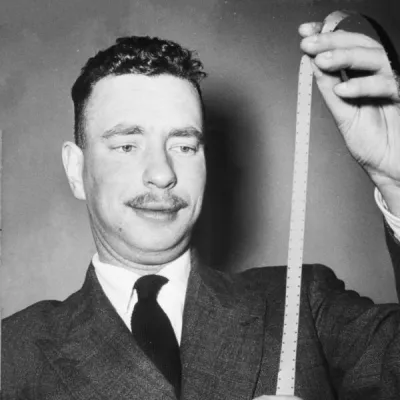
Alexandre Astruc
Human Design Chart
Biography
Alexandre Astruc — Generator with Profile 5/1
Generator 5/1 — Design at a Glance
Alexandre Astruc revealed himself as someone with high, enduring sacral energy. His design clearly indicated a tendency: he did not primarily initiate actions but rather responded to impulses from his environment – often described as answers 'from the gut'. His strength lay in the ability to materialize things once he responded to signals that his Sacral Center confirmed with an inner 'yes'.
This dynamic of responding instead of initiating was central to his functioning. As a Generator, Alexandre Astruc had plenty of energy and was very enduring, comparable to a strong workhorse that unleashes power when it has the right task. His successful strategy involved reacting to a signal from life and then acting upon it when his inner self called for action.
Living in harmony with this pattern brought him deep satisfaction and fulfillment. However, deviating from it – whether by tackling tasks he disliked or ignoring internal signals in favor of external pressures – led to frustration and energy depletion. The risk lay in wasting energy on things that did not resonate intrinsically, which can quickly lead to burnout for Generators. Conversely, it was also a stumbling block when he was prevented from working on his heart projects despite still having plenty of power left to work with. His energy became free and effective primarily when he responded rather than initiated.
Sacral Authority
Alexandre Astruc revealed himself as someone whose authenticity and vitality did not stem from intellectual analysis but through trust in spontaneous physical responses. His design indicated a tendency towards making decisions via sacral authority – the primary decision-making instance for Generators. This inner leadership manifested as gut feelings or bursts of energy, often audible as grunts or soft 'mmms'.
The strategy involved waiting for this internal impulse before reacting. Once his sacral motor responded to a stimulus, he felt vital and alive. He had an inexhaustible supply of energy that enabled him to tackle tasks with great enthusiasm. The joy arose from the act itself rather than external goal orientation. He was born to immerse himself in his activities.
This mechanism greatly simplified his decision-making process since strategy and inner authority were one and the same. A prerequisite for this was an open emotional center ensuring that these physical signals weren't distorted by emotional waves. By adhering to this immediate, instinctive perception rather than premeditated thoughts, Alexandre Astruc could experience his natural zest for life and contentment. His well-being depended directly on whether he listened to or contradicted this bodily compass.
The 5/1 Profile — Heretic / Investigator
Alexandre Astruc revealed himself as someone standing between the urge for private knowledge deepening and a magnetic attraction towards others. His design was marked by Profiles Line 5 (Hero) and Line 1 (Explorer). This configuration gave him almost an irresistible aura: Others actively sought solutions from him, sensing his inner treasure trove of knowledge. However, this created constant tension. While Line 1 promoted the need for a deep, protected research process, Line 5 drew him into service to others. Without clear boundaries, exhaustion quickly followed. The risk was becoming overburdened like an expert model, constantly answering questions and ending up drained while new inquiries awaited. The challenge lay in balance: He had to learn to say 'no' to preserve his own energy for necessary knowledge work. Only then could he maintain the beneficial connection between personal learning and helping others. This evolutionary process of assertion (Line 5) was inseparable from developing security through ending and storing experiences (Line 1). By learning to consciously take on and conclude commitments rather than getting lost in endless inquiries, he could optimally utilize his gifts without exhausting himself.
Triple Split Definition — Defined & Open Centers
Alexandre Astruc revealed himself through a design characterized by high inner stability and continuous cognitive activity. His system was marked by defined mental inspiration (Head and Ajna Centers), reliable self-identity (G Center) as well as immense vital energy for reaction (Sacral Center). Combined with defined Spleen (Intuition) and Root (Stress Management), this resulted in a source of energy that, however, relied on correct reactions rather than initiation. The tension between constant mental pressure and the necessity to not initiate but wait until the Sacral Center reacted shaped his experience; the G Center provided the stable anchor point.
In contrast, Alexandre Astruc revealed himself in areas without their own energy: His open Heart Center made him vulnerable to attempts to prove his worth through promises or competitive pressure, although he was not designed to be willful. He tended to question whether he had to keep up to appear valuable – a pattern of non-self that could draw him into spirals of self-disapproval when trying to meet expectations. Similarly, his open Solar Plexus absorbed the emotions of his surroundings. He relied on identifying these feelings as not his own and using them as information before letting go in order to avoid emotional conditioning. This openness allowed him to perceive the emotional climate of others but challenged him to avoid confrontations or losing himself in foreign moods rather than trusting his inner authority.
Channels for inspiration, ambition, maturation and mental comprehension.
Alexandre Astruc revealed himself as someone whose impact primarily relied on the vibrant radiance of his individuality. He was inclined to inspire through his authentic life and unique style rather than rational argumentation. This approach drew from Channel 1-8, connecting the G Center with the Throat Center. Gate 1 brought in the mutative perspective of self-expression, while Gate 8 marked a contribution to community. For Alexandre Astruc, it was an art to live as an individual and attract attention; his leadership showed when others emulated his unique direction or were inspired to realize their own potential.
At the same time, he was driven by a deep urge for growth through experience. Channel 53-42 connected the Root Center with the Sacral Center, challenging him to complete cycles fully. Gate 53 initiated the beginning of an experience, while Gate 42 steered growth and completion. Alexandre Astruc had to reflect on each phase to gain wisdom; premature ending led to having to repeat the cycle. This process created a collective history from which he could learn.
His ambition was closely tied to recognition by his environment. Channel 54-32 connected the Root Center with the Spleen Center. Gate 54 brought in the drive to move up, while Gate 32 secured continuity and survival of the "tribe". Alexandre Astruc worked hard to prove his talents and gain support; his success depended on being recognized as valuable by his environment.
His mind was constantly engaged in a process of abstraction. Channel 64-47 connected the Head Center with the Ajna Center. Gate 64 brought confusion and searching for meaning, while Gate 47 enabled understanding. Alexandre Astruc filtered every experience through mental images; only when clarity emerged could he tell an inspiring story or share a new perspective. This mental pressure was necessary to develop a coherent viewpoint from the abundance of possibilities.
Collective Circuitry — Circuit Signature
Alexandre Astruc's Human Design revealed a Triple Definition, indicating high susceptibility to external influences. His Mental Circuit connected the Throat and Identity Centers through the Channel of Inspiration (1-8), promoting the expression of unique individuality through impulsive mind. The Personality Circuit consisted of two separate segments: Head and Ajna were linked via Abstraction (64-47), while Sacral and Root Centers flowed through Maturity (42-53). This configuration dealt with emotional waves and reflection on past experiences, separated from the cognitive level. The Ego Circuit connected Spleen and Root Centers through Transformation (32-54). Without a direct Sacral connection, this required periods of rest to generate resources for cooperation. Astruc emerged as someone who emotionally transformed and expressed new insights while simultaneously reflecting on the past. The separate groups in his design meant that these forces existed alongside each other without directly flowing into one another. His identity was marked by inspired impulses, his emotional processing determined by cyclical waves. The absence of a continuous connection between circuits underscored the necessity to experience different life domains as independent streams rather than merging them into a single experience.
Left Angle Cross of Cycles 1
Alexandre Astruc's Human Design chart indicated a tendency towards recurring, cyclical patterns. His life did not follow a straight line but moved within an archetypal framework defined by the left cross of Cycle 1. This configuration formed the deepest background of his existence and shaped the fundamental dynamics of his being.
In Human Design terms, such a cross describes an overarching structure that does not exhaust itself in individual events but manifests as a recurring rhythm throughout life. For Alexandre Astruc, this meant that certain energetic themes and challenges would repeatedly arise, yet each time in a new variation or phase. It was a cyclical nature requiring understanding and acceptance of these patterns.
The emphasis lay on recognizing this framework. Individual Gates or Channels did not determine his fate separately; rather, the interplay within this specific cross created a consistent background. Alexandre Astruc lived in a system that used repetition as a means to deepen understanding. Each cycle offered an opportunity to grasp the same archetypal lesson from a different perspective. This structure was no coincidence but a fixed part of his design, significantly influencing his life's direction and imparting him with a unique, recurring rhythm.
Saturn Return · Uranus Opposition · Chiron Return · 2nd Saturn Return — Life Cycles
In 1974, at the age of 51, Alexandre Astruc directed 'The Great Detectives' and 'A Wild Life'. For his Human Design chart, this marked the Chiron Return, a cyclical turning point towards personal fulfillment. This return cycle did not signal mythical healing of old wounds but rather entering a phase of blooming where his inner life purpose increasingly unfolded outward.
The Chiron Return occurs roughly between ages 49 and 51. It functions as the fulfillment cycle of the incarnation cross. Prior to this, Alexandre Astruc had lived according to his strategy and authority; now, the meaning of his design became experiential and concretely effective. The mentioned directorial works served as concrete evidence for this mechanism: they were not isolated career events but expressions of a deeper alignment with his mission.
During this phase, previous efforts condensed into sustainable results. Focus shifted from searching or experimenting to clear implementation of individual purpose. His direction in that year demonstrated how abstract design potentials translated into tangible creative achievements. It was confirmation of his path embedded within the natural rhythm of the Human Design chart. This period shaped further work through enhanced clarity and authenticity in action.
Generator · Sacral Authority — Synthesis
Alexandre Astruc lived deeply in reaction – a Generator whose sacral authority guided him through life when responding to external impulses with an inner yes. This reactivity was not isolated; it linked with a pronounced ability for mental processing and abstraction (defined Head and Ajna Centers), enabling him to analyze experiences and transform them into creative expressions. His defined G Center indicated a strong internal direction, a magnet for others who he could show new paths through his unique perspective – especially when amplified by the Channel of Inspiration (Gate 1/8). The combination of sacral energy and mental depth allowed him to immerse in creative processes and find deep fulfillment.
A central paradox lay in the tension between his need for reaction and drive towards transformation (Channel 54-32). While the Sacral Center prompted him to respond to the here and now, his mind constantly sought new possibilities, recognized patterns, and changed the world around him. This dynamic may have led to phases of intense activity followed by a necessity to withdraw and reflect – a cyclical process reinforced by the Knowing Circuit.
4 Defined Channels
Incarnation Cross - Left Angle Cross of Cycles 1
Solar Return
The Solar Return shows the moment when the sun returns to its exact birth position - your personal solar year.
Life Cycles
Discover the life cycles with a detailed triple view (birth chart, cycle chart, composite).
Human Design Profile
- Type
- Generator
- Strategy
- To respond - wait for something to respond to
- Authority
- Sacral Authority
- Profile
- 5/1 - Heretic / Investigator
- Definition
- Triple Split
- Incarnation Cross
- Left Angle Cross of Cycles 1
- Date of Birth
- 13.07.1923 01:45
- Place of Birth
- Paris, France
Frequently Asked Questions
What was Alexandre Astruc's Human Design type?
What Profile did Alexandre Astruc have in Human Design?
What Authority did Alexandre Astruc have?
What incarnation cross did Alexandre Astruc have?
When was Alexandre Astruc born?
Discover your own Human Design
Are you also a Generator? Find out in a personal reading how to use your sacral energy correctly and discover deep satisfaction.
More Personalities
Back to overviewAaliyah

Alexia

Angèle

Anne-Marie

Arcángel

Arno
