
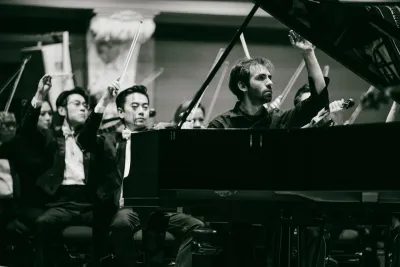
Alexandre Kantorow
Human Design Chart
Biography
He won the 16th international Tchaïkovsky competition in 2019.
Alexandre Kantorow as a Manifesting Generator 6/2 in Human Design
Manifesting Generator 6/2 — Design at a Glance
Alexandre Kantorow's design showed a tendency towards fast, hybrid energy application. As an Manifesting Generator, he had constant sacral power but this was accelerated by his active connection of the Motor Centers to the Throat Center. This configuration allowed him to skip steps and quickly pull things into his life, showing that he not only reacted but acted with speed that pure generators did not possess.
This quickness brought specific challenges. Often, Alexandre Kantorow's actions were too fast, skipping important intermediate steps. In such cases, he had to backtrack and make up for missing parts, leading quickly to frustration – the classic non-self-experience of this type. Additionally, his design tended to react simultaneously to many impulses, starting multiple projects at once without clear internal consent. Without a clear inner yes, this creative drive could turn frustrating.
Alexandre Kantorow's strategy was to wait for life and then act only when the sacral center gave a clear 'yes'. With correct application of this reaction loop, he could use his parallel work streams without getting distracted. Instead of proceeding linearly, he found deep satisfaction in a playful mode by seeking variety and pursuing different tasks simultaneously as long as inner authority supported it. His energy then did not appear chaotic but rather as powerful, versatile creative force.
Emotional Authority
Alexandre Kantorow's design showed a tendency towards emotional wave movement that significantly influenced his perception and decision-making. His inner authority carried the defined Solar Plexus Center. In Human Design mechanics: If this center is colored, it always takes on the role of internal leadership regardless of other definitions in the chart.
This meant for Alexandre Kantorow that he encountered the world through the filter of his current mood. His feelings were subject to constant ups and downs; a topic could appear absolutely inspiring at one moment and deeply negative the next. This emotional intensity was often only a temporary coloring, not yet the deep truth of the situation. Quick, spontaneous reactions based on these initial impressions risked resting on unstable ground and causing negative consequences.
The mechanics of his emotional authority required patience and time. Instead of acting immediately, decisions needed to ripen – ideally over several nights. Only when the initial emotional wave subsided and a certain distance was established did clarity and calmness set in. This process of 'sleeping on it' was not a sign of hesitation but rather the necessary path to authentic insight. Only through this temporal distance could Alexandre Kantorow distinguish between temporary mood fluctuations and his true inner voice, which was especially crucial for long-term life decisions.
The 6/2 Profile — Role Model / Hermit
Alexandre Kantorow's design showed a tendency towards two-phase development: initially experimenting by trial and error, later withdrawing into reflection. Before the age of 30, line 6 acted as line 3. During this phase everything revolved around collecting personal experiences. A withdrawal after mistakes was the driving principle. After about three decades, line 6 activated itself. Then Alexandre Kantorow metaphorically retreated to a cave on a mountain to look back at earlier experiments from a distance. This period served for healing and deep self-knowledge. Finally, he emerged as a wise person out of this isolation. Others sought him out to partake in his life wisdom and learn introspection.
This dynamic connects mutability with authenticity. The first phase of the sixth line at Gate 8 involved living through hypocrisy and searching for the right moment to contribute. Only after 'coming down from the roof' did an authentic stance without hypocrisy emerge. The goal was to bring mutation into social structures by individually contributing to group goals. Correct timing was crucial – both in the collective context as well as relative to his internal clock.
Simultaneously, Gate 55, line 2 had an effect. Here Alexandre Kantorow projected his emotional mind-set outward and showed indecision. Emotional balance depended on others' trust, which was often not given. Attempts to insist on reliability could have the opposite effect. Slander or gossip diminished fullness. The configuration thus describes a path from external dependence and mistrust towards internal wisdom and collective benefit through authentic timing.
Single Definition — Defined & Open Centers
Alexandre Kantorow's Human Design profile inclines towards a clear and resolute way of expression, supported by his defined Throat Center. This center serves as a focal point for messages and gives him the ability to transform information from various internal sources into communication and action. His voice is steady and reliable, meaning he expresses himself consistently but in limited ways.
This expressive capability is reinforced by his defined Heart Center, which provides willpower and ego. Alexandre Kantorow has shown himself to be someone who enjoys controlling his life and resources. With this center, it's natural for him to make promises and keep them, thereby building trust. He tended to acknowledge his own worth and used his willpower to provide for family and community when appropriate.
Another defining characteristic is his defined G Center, which gives him a firm sense of self-identity and direction. He had a deep feeling of connection with his higher self, enabling him to comfort others or offer new perspectives without becoming dependent on them. His inner love for himself was stable, allowing him to love others without losing his own identity.
In contrast, his open Head Center reveals a vulnerability to mental pressure and confusion. Without consistent mental inspiration, he tended to get entangled in questions that weren't his own or overwhelmed by doubts that belonged to others. His open Ajna Center amplified this tendency, making it likely for him to interpret concepts and opinions as personal truths rather than using them flexibly as intellectual toys.
Additionally, his open Spleen Center can generate a fundamental fear of survival or well-being. He was sensitive to the health vibrations of his environment and tended to cling to people with defined spleens to gain a sense of security, even if this attachment wasn't healthy. Spontaneous decisions were risky for him as they often stemmed from conditioned fears rather than genuine intuition.
Channels for change, intimacy, reflection, mysticism and pioneering spirit.
Alexandre Kantorow's Human Design suggests a tendency towards intense, emotionally driven experiences of life, coupled with the need to later transform these paths into collective wisdom. This dynamic is evident in Channel 36-35, which through Gate of Crisis and Gate of Change drives an insatiable desire for something new. Here, experience is often gained only through emotional turbulence or even self-induced crises, to explore the depths of feeling. Simultaneously, Channel 59-6 connects sacral sexuality with waves of pleasure and pain, seeking intimacy as the core creative essence but requiring patience: Only by waiting for emotional clarity do lasting, fruitful connections form rather than superficial entanglements.
In interpersonal relations, Channel 19-49 shapes a sense of belonging and tribal loyalty. Through Gate of Claims and Gate of Principles, there develops a keen awareness of who belongs to the "we" and what values secure cohesion – an emotional frequency that holds family and community together through loyalty and mutual protection. Parallel to this, Channel 13-33 gathers life stories and secrets. As a listener, Alexandre Kantorow withdraws to reflect on experiences, sharing deeper truths only after maturation, thus transforming individual biographies into collective learning.
The Initiation Energy 51-25 adds: a competitive drive that leads through the "shock" of individuation and connects universal love with the will to win. This is complemented by prioritized Gates such as Gate 8 (Contribution/Leadership) and Gate 14 (Power/Directing), describing skilled handling of influence for group goals, along with Gate 55, marking extreme emotional mood swings as part of genetic mutation.
Collective Circuitry — Circuit Signature
Alexandre Kantorow's Human Design suggests a tendency towards more stable and courageous individuality. His Defined Circuit connected the Identity Center with the Heart Center (Channel Initiation). This connection strengthened self-worth and inner convictions but lacked the direct expression channel to the Throat Center, making firm views often hard to verbalize.
Parallelly, two other streams were at work. The Manifestor Circuit linked the Throat, Solar Plexus, and Identity Centers (Channels Lost Son, Transience). Here it was about emotionally reflecting on the past: feelings were processed cyclically to gain insights that could then be shared with the collective. This stood in contrast to pure logic and focused on learning from experienced situations.
The Ego Circuit only connected Alexandre Kantorow's Solar Plexus Center with his Root Center (Channel Synthesis). As part of the Family Energy, this was about cooperation and resources, yet without a connection to the Sacral Center, rest periods were essential to regenerate energy for these support tasks. It was a relationship of giving and taking within a community.
Finally, the Projector Circuit linked Alexandre Kantorow's Sacral with his Solar Plexus Center (Channel Pairing). This brought in primal energies of survival, care, and preservation. It was about protecting one’s own genetics and family, coupled with instinctive life force and emotional intensity.
Together, these four circuits created a complex picture: strong inner identity (Heart/Identity), emotional processing of the past (Throat/Solar Plexus/Identity), cooperative Family Energy with a need for pauses (Solar Plexus/Root), and instinctual protective drive (Sacral/Solar Plexus). All these defined centers formed one cohesive energetic group in Alexandre Kantorow.
Left Angle Cross of Uncertainty 1
Alexandre Kantorow's Human Design profile indicated a tendency towards inner orientation, which was expressed through the left cross of uncertainty. This configuration did not describe external ambiguity in terms of chaos or lack of planning but rather a specific internal attitude towards the unknown.
In Human Design, this cross represents a process of trusting one's own inner compass even when the path ahead is unclear. It required patience and endurance because answers often became visible only retrospectively or through silent observation. Alexandre Kantorow demonstrated an ability to work with this uncertainty without immediately resolving it through external action.
The mechanics of this cross emphasized the need to respect one's own rhythm and not rely on external validation. It was about staying present and trusting that clarity would emerge if one allowed space for the process. This internal attitude shaped his approach to challenges: less through direct confrontation and more through deep, inward reflection. Thus, the left cross of uncertainty acted as a stabilizing force during uncertain times by fostering the ability to remain in ambiguity and develop new perspectives.
Saturn Return — Life Cycles
Alexandre Kantorow's Human Design profile indicated a tendency towards structural consolidation and the acceptance of long-term responsibility, particularly around his first Saturn return. This cycle typically marks the end of an experimental phase and the beginning of serious engagement with one's life work. During this period, earlier impulses coalesced into stable structures; Alexandre Kantorow showed himself willing to face the consequences of past decisions and build a solid foundation for the future.
The first Saturn return is a universal milestone in Human Design often associated with maturation. It is not about external fame but inner coherence. For Alexandre Kantorow, this meant that his natural authority and strategy were anchored in new awareness. The restlessness or uncertainty of earlier years gave way to a clear sense of role. He learned to set boundaries and prioritize, not out of compulsion but as an expression of his true nature. This process significantly shaped his further development by helping him distinguish between what truly fit him and external expectations. Thus, potential energy became ordered power that stabilized his life in the following years, enabling him to act with more calmness and clarity.
Manifesting Generator · Emotional Authority — Synthesis
A central red thread runs through the design: the dynamic connection of initiation and reaction. As a Manifesting Generator (MG), he possesses both the ability to quickly initiate things – a characteristic of the Manifestor – as well as sacral energy to react to impulses (like a Generator). This combination is reinforced by the defined Throat, which enables powerful expression once clear internal signals are present. The profile as role model and natural talent suggests that this process was marked in youth by an experimental spirit, followed by a phase of intense reflection and wisdom-seeking, which then gets passed on to others.
The central paradox lies in the interplay between emotional authority and the potentially hasty action of the MG type. Emotional wave requires time for decision-making to gain clarity, while the defined channel of pairing suggests immediate reaction to stimuli. This creates tension between the need for inner maturity and the urge to set sacral energy into motion – a dance between waiting and acting that demands constant adaptation.
5 Defined Channels
Incarnation Cross - Left Angle Cross of Uncertainty 1
Solar Return
The Solar Return shows the moment when the sun returns to its exact birth position - your personal solar year.
Life Cycles
Discover the life cycles with a detailed triple view (birth chart, cycle chart, composite).
Human Design Profile
- Strategy
- To respond - wait for something to respond to
- Authority
- Emotional Authority
- Profile
- 6/2 - Role Model / Hermit
- Definition
- Single Definition
- Incarnation Cross
- Left Angle Cross of Uncertainty 1
- Date of Birth
- 20.05.1997 20:40
- Place of Birth
- Clermont Ferrand, France
Frequently Asked Questions
What is Alexandre Kantorow's Human Design type?
What profile does Alexandre Kantorow have in Human Design?
What authority does Alexandre Kantorow possess?
What incarnation cross is assigned to Alexandre Kantorow?
When was Alexandre Kantorow born?
Discover your own Human Design
Are you also a Manifesting Generator? Find out in a personal reading how to unfold your multi-talents and direct your energy wisely.
More Personalities
Back to overviewAaliyah

Aldair

Alexia

Alizée

Angèle

Angeli
