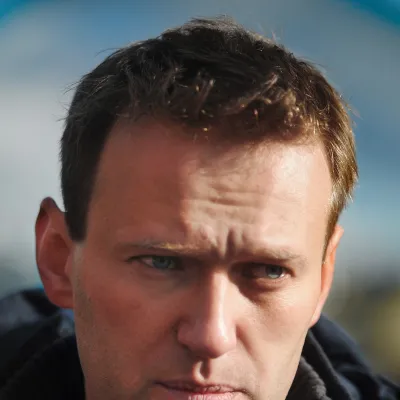
Alexei Navalny
Human Design Chart
Biography
Since 2009, he gained prominence within Russia, and notably within the Russian media, as a critic of corruption in Russia, and especially of Russian leader Vladimir Putin. He used his LiveJournal blog to organize large-scale demonstrations to address these issues. He also regularly wrote articles in several Russian publications, such as Forbes Russia. In a 2011 interview with Reuters, he claimed that Putin's political system was so weakened by corruption that Russia could face an Arab Spring-style revolt within five years. Navalny was a Russian Opposition Coordination Council member and informal leader of unregistered Russian political party People's Alliance. He was an officially registered candidate (supported by the RPR-PARNAS party) in the election for Mayor of Moscow to be held on 8 September 2013.
Navalny was named "Person of the Year 2009" by Russian business newspaper Vedomosti. In 2010, with the recommendation of Garry Kasparov, Yevgenia Albats, Sergei Guriev and Oleg Tsyvinski, Navalny enrolled in Yale University's six-month "Yale World Fellows" training program. In 2011, the BBC described Navalny as "arguably the only major opposition figure to emerge in Russia in the past five years". He was the only Russian to be named in Time magazine's 2012 list of the world's 100 most influential people.
But also in 2012, a cumulative three embezzlement and fraud accusations were brought against Navalny by Russian federal authorities. All three were vigorously denied by Navalny. On 18 July 2013, he was sentenced to five years in a corrective labor colony for embezzlement. Russian Memorial Human Rights Center recognized Alexei Navalny as a political prisoner.
Alexei Navalny — Projector with Profile 3/5
Projector 3/5 — Design at a Glance
Alexei Navalny revealed himself as someone who exposed systemic flaws with unusual sharpness. His Human Design type, the Projector, shaped this attitude: He did not have a continuous source of life energy like a Generator but rather acted more like a focused flashlight that shone into dark corners. This mechanism allowed him to immediately recognize where systems failed or operated inefficiently.
However, this design also carried specific risks within it. When a Projector expresses their observations directly and abruptly, it can be perceived as aggressive by others – similar to shining bright light directly in someone's face. The strategy for Projectors is not direct confrontation but waiting until others ask them for advice based on their clear insights. Navalny lived this dynamic in a way that often met resistance because he actively spread his diagnoses rather than passively waiting for invitations.
This conflict between his natural ability to identify problems and social expectations led him to frequently go against the flow. Projectors also require downtime to avoid burnout, as their energy level fluctuates. In Navalny's case, this lack of adaptation to his own strategy seems to have promoted the non-self theme of bitterness – a feeling that arises when one feels unheard or unrecognized despite having clear insight into flaws. His design offered him the ability for precise analysis but also demanded enormous patience and tactics in dealing with his environment.
Splenic Authority
Alexei Navalny demonstrated a decision-making approach based on immediate, intuitive perception. His inner authority lay in the defined Spleen Center, which presupposed that his Emotional and Sacral Centers were open – a characteristic of Projectors or Manifestors. The Spleen acted as a fine health and alarm system: It provided spontaneous internal knowledge about whether a situation, environment, or person was right for him. This impulse served directly to protect his physical integrity and enabled him to rigorously distance himself from harmful influences.
Since this spleen voice was a very subtle, singular impulse in the moment, its use required high vigilance. It could easily be drowned out by external noise or ignored. Often, a short retreat helped to hear this fine signal tone clearly again. Because Alexei Navalny only knew what was right for him at each moment, his plans often changed frequently. This made long-term commitments difficult; his design therefore preferred much freedom and flexibility over rigid structures. The first spontaneous impulse was considered the correct path to protect his health and well-being.
The 3/5 Profile — Martyr / Heretic
Alexei Navalny appeared as a figure whose authority stemmed from lived practice rather than theoretical superiority. His design indicated a tendency to initially test everything himself – including mistakes – before offering solutions to others. As someone with Profile 3/5, he followed an experimental path (Line 3) that led him through crises and chaos to distill concrete knowledge. This self-acquired understanding then served as the basis for the role of helper or 'savior' (Line 5).
The mechanics of this profile require that doubts be expressed only if they lead to practical answers. Navalny used his experiences from trial and error to ask precise questions in uncertain times and propose solutions based on real-world experience. This authenticity was attractive to others because it awakened a desire to learn from his concrete life lessons. However, this profile also carried the risk of public failure: If experiments failed before the community, the painful side of the hero role was present. His influence thus rested on not discussing problems abstractly but acting out of direct engagement with crises and development lines, which made him appear as a trustworthy source for practical guidance.
Single Definition — Defined & Open Centers
Alexei Navalny appeared as someone who acted with a deeply rooted inner direction and a clear self-image. His defined G Center gave him a consistent identity; he knew who he was and where his path led, without needing external confirmation. This inner security allowed him to guide others into their own truth rather than leading them. Simultaneously, his defined Spleen Center served as an intuitive instance: it provided spontaneous, momentary warning signals and judgments about what was healthy or dangerous in the present moment. This body intelligence protected him from rational misjudgments, as he trusted the subtle alarms of his body before his mind could analyze them.
His voice, guided by the defined Throat Center, served as a reliable channel for these inner truths. He did not speak out of the urge to say everything but articulated clearly and honestly what came from his identity or intuition. However, his design also revealed specific vulnerabilities. His open Heart Center lacked consistent willpower; he tended to get entangled in spirals of proof, wanting to demonstrate his worth through promises and performance, which often led to failure and self-doubt. Additionally, his open Solar Plexus absorbed the emotions of the environment. He amplified foreign anger or fear and suffered from interpreting these as his own instability rather than recognizing them as passing fields.
His open Head Center made him vulnerable to mental pressure; he often sought answers to questions that were not his, which led to confusion. At the same time, his open Root Center absorbed external stress. He reacted with hyperactivity, trying to unload the adrenalized pressure through overwork, leading to long-term exhaustion. His open Sacral Center lacked a constant energy flow; he worked in spurts and was dependent on others' energy, making him vulnerable to exploitation if he did not strictly listen to his inner authority.
Channels for inspired presence and profound mastery.
Alexei Navalny appeared as someone who attracted attention simply by exercising his individual identity. This aligned with the Inspiration Channel 1-8, which connected the G Center with the Throat Center and predisposed him to act as a living role model. His impact did not rely on explanatory words but rather on courageously demonstrating his unique direction and thereby inspiring others for creative confrontation. Such leadership required patience in timing and developed through recognition of his individuality by those around him.
Parallel to this, Alexei Navalny possessed the Wave Length Channel 48-16, which linked the Spleen Center with the Throat Center. Through Gate 48, he instinctively sought life-critical information while Gate 16 drove him to perfect skills through repeated experimentation. This configuration transformed intuitive depth into a communicated talent that required recognition and resources for further development. It was a process of master-apprentice dynamics where technical mastery served a deeper purpose.
Additionally, prioritized gates shaped his profile: Gate 35 promoted change through interaction and new experiences, while Gate 63 advanced mental processes through doubt to improve uncertain patterns. Gate 64 helped translate past experiences into clear concepts. In the personality realm, Gates 44 with awareness and transformative power as well as Gate 33 requiring reflection and withdrawal for strength were influential. Gate 18 emphasized correcting collective processes while emphasizing human rights without confusing them with personal attacks. Further influences came from Gate 12 (restraint/creativity), Gate 2 (openness to new directions), Gate 56 (pictorial storytelling), and Gate 28 (awareness of risk in the here and now).
Individual Circuitry — Circuit Signature
Alexei Navalny appeared as a person whose expression was marked by two separate, parallel energetic streams. As he had a Simple Definition, these energies did not merge but existed as independent forces alongside each other.
The Knowledge Circuit connected his Throat Center with the Identity Center through the Inspiration Channel (Gates 1 and 8). This created a pulsating, acoustic energy that urged him to loudly express his unique individuality. It was about the inherent path and sharing new insights through emotional waves poured directly into words.
Parallel to this, the Understanding Circuit connected his Throat Center with the Spleen Center (Wave Length Channel, Gates 16 and 48). Here focused visual logic took precedence. This energy sought strategic structures and rational insights to improve the future – free from emotional conditioning.
While one stream carried the emotional necessity of individual expression, the other provided cool analytical strategy. Both converged in his Throat Center but did not form a cohesive unit. Alexei Navalny lived with tension between the impulsive urge to manifest his identity and the cold rational approach to develop logical solutions for societal problems. This separation meant that inspiration and strategy did not automatically blend but stood as two separate tools available to him.
Right Angle Cross of Consciousness 2
Alexei Navalny's Incarnation Cross as the 'Right Cross of Consciousness 2' indicated a strong inner compass directed towards seeking deeper truths and hidden connections. This Human Design configuration describes an energetic alignment where the individual often feels a powerful urge to look beyond superficial phenomena, delving into the underlying principles and structures of life. It was a driving force that encouraged him to analyze complex systems and dig for the 'truth' behind things.
This Cross is part of a larger pattern associated with the development of consciousness and the pursuit of authenticity. For Alexei Navalny, this meant his actions and thoughts were always marked by a deep desire to bring clarity to seemingly opaque or manipulative situations. He did not seek simple answers but rather aimed to understand the mechanisms of power and society down to their foundations. This energetic signature suggested that his focus was less on superficial success and more on developing a coherent and truthful perspective, which he also carried outward. The energy of this Cross supported him in maintaining a thread of deeper logic during phases of uncertainty or chaos, significantly shaping how he interpreted and responded to the world.
Saturn Return · Uranus Opposition — Life Cycles
Alexei Navalny's Design indicated a tendency towards sudden, disruptive turning points where established structures were questioned and new directions forced. This dynamic was concretely seen in 2016, at age 40, when he announced his candidacy for the 2018 presidential election. For his design, this step marked a typical Uranus Opposition Cycle: a phase where inner maturation and external circumstances collided to break old patterns. Uranus represents the unpredictable, the impulse towards freedom from convention, and the ability to change systems through radical innovation. The opposition in the chart signaled not a harmonious development but friction that built pressure until a breakthrough occurred. Navalny did not use this energy for adaptation but as a catalyst for change. His actions during this period were marked by the necessity of pushing against resistance and bringing an often uncomfortable truth into focus. Announcing his candidacy was thus not an isolated political maneuver, but the logical outcome of an astrological configuration that drove him to test boundaries and challenge established orders. This cycle profoundly shaped his patterns of action: he acted where change had to be initiated through shock or surprise rather than gradual reforms.
Projector · Splenic Authority — Synthesis
He was a Projector whose life seemed marked by a deep need to recognize and expose patterns where systems were failing (Throat Center, Gate 1). This recognition went beyond mere observation; he projected his energy directly onto what was flawed and revealed it to others. His Profile as an Experimenter/Hero (3/5) suggests that he learned through experience and used this knowledge to empower others – a cycle of personal experimentation and sharing insights. The connection between the G Center and Throat Center (Channel of Inspiration) strengthened this tendency by giving him a voice to make creative contributions and inspire others.
A central tension lay in his Spleen Authority. This intuition instinctively signaled what was right for him, yet the Projector strategy required waiting for an invitation before bringing his knowledge forward. This likely led to internal conflict between the urge to immediately point out shortcomings (Gate 1) and the necessity of waiting for the right moment – a discrepancy amplified by his defined Throat Center, which compelled him to express his observations.
2 Defined Channels
Incarnation Cross - Right Angle Cross of Consciousness 2
Solar Return
The Solar Return shows the moment when the sun returns to its exact birth position - your personal solar year.
Life Cycles
Discover the life cycles with a detailed triple view (birth chart, cycle chart, composite).
Human Design Profile
- Type
- Projector
- Strategy
- Wait for the respectful invitation
- Authority
- Splenic Authority
- Profile
- 3/5 - Martyr / Heretic
- Definition
- Single Definition
- Incarnation Cross
- Right Angle Cross of Consciousness 2
- Date of Birth
- 04.06.1976 13:30
- Place of Birth
- Solnechnogorsk, Russia
Frequently Asked Questions
What Human Design type was Alexei Navalny?
What Profile did Alexei Navalny have in Human Design?
Which Authority guided Alexei Navalny?
What incarnation cross did Alexei Navalny have?
When was Alexei Navalny born?
Discover your own Human Design
Are you also a Projector? Find out in a personal reading how to unfold your leadership qualities and recognize the right invitations.
More Personalities
Back to overviewSissy Spacek

Alain-Fournier

Anémone

Ann-Margret

Bourvil
Hergé