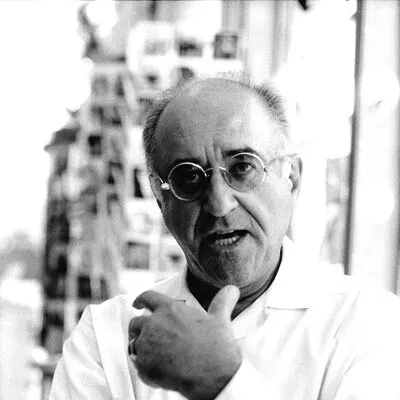
Alfred Biolek
Human Design Chart
Biography
After expulsion from Czechoslovakia in 1946, the Biolek family moved to Waiblingen near Stuttgart, where Biolek's father practiced law again. Biolek was raised a Catholic and was an altar boy. He temporarily joined later the German conservative party CDU.
In 1967, Biolek acted as an assessor in the legal department of the German TV channel ZDF and switched soon to editorial tasks. He became anchor man of the TV show Drehscheibe and produced since 1974 the show Am laufenden Band for Bavaria Film GmbH, together with Rudi Carrell. That led to his career breakthrough. In 1975 with the journalist Dieter Thoma they started the talk show Kölner Treff for the channel WDR in Cologne. Since 1978 he aired his first self-produced and moderated show with the title Bios Bahnhof (Bio's railway station). In the 1980s, commercially unsuccessful shows followed: Bei Bio, Show Bühne and the game show Mensch Meier.
On 10 December 1991, the director Rosa von Praunheim outed Biolek as a gay man among other celebrities on a TV show. Biolek lived with his partner in Cologne and Berlin. In 2010, Biolek suffered brain injuries from a fall on a stair. Scott Ritchie took care of him, and he adopted him. Biolek died on 23 July 2021 in Cologne, aged 87.
Human Design Analysis: Alfred Biolek as Manifestor 3/5
Manifestor 3/5 — Design at a Glance
Alfred Biolek lived as a pioneer and visionary whose design predisposed him to actively steer the world in new directions. His Human Design type was that of a Manifestor, often compared to the metaphor of an emperor: He had a clear vision of the whole but did not personally fight every battle himself; instead, he used his energy to mobilize others and achieve goals. This superior perspective brought with it a specific inner conflict. As he often thought further ahead than his surroundings, Alfred Biolek was frequently misunderstood. His great dreams polarized: While they attracted some who followed him, they also met with rejection or even hatred from others.
This divide between supporters and opponents was a central pain point of his design. The path to inner peace lay in the strategy of informing. By communicating his intentions and visions clearly and early on, he could find the right followership and minimize unnecessary friction. When Alfred Biolek followed this principle, he was rewarded with deep feelings of inner calm. Deviating from it and acting without prior information, however, produced a lasting, profound anger in him. His life thus revolved around the tension between his powerful pioneering role and the necessity to create understanding through communication rather than polarization.
Emotional Authority
Alfred Biolek exhibited an internal decision-making structure that was marked by emotional waves. His design indicated that the defined Solar Plexus Center carried his authority – regardless of which other centers were also defined. This configuration meant he was subject to a permanent up-and-down of emotions; his perception of the world was always colored by the current mood; a topic could appear inspiring in one moment and negative in another.
This mechanism highlighted that feelings in the moment are merely snapshots, not the final truth. Quick, spontaneous decisions resulting directly from this emotional arousal carried a high risk of negative consequences. His design strategy therefore required time and patience. By letting decisions rest overnight multiple times, he created space for intense emotions to subside.
Only when this emotional distance was gained did true clarity and calm set in. This process of maturation was particularly crucial for long-term life decisions; only through waiting for the initial emotional impulses to fade could he recognize his true inner truth and become action-ready rather than succumbing to temporary mood swings.
The 3/5 Profile — Martyr / Heretic
Alfred Biolek revealed himself as someone who gained knowledge not from books but through personal, often public experimentation. His design indicated a tendency to initially remain skeptical and experience everything firsthand – the Line 3 of the experimenter. He learned through trial and error, gathered practical experiences, and even accepted failures. This phase of personal testing was indispensable for him; only in this way did he build a trustworthy treasure trove of life wisdom.
Later, his attitude shifted. The Line 5, the Hero's Line, led to universalizing this knowledge. Alfred Biolek presented his accumulated insights to others, making him an attractive authority figure. People sought his advice because he could solve problems from lived practice. This role as a helper or 'rescuer' flattered him but also carried a burden: The external pressure was high. If he failed publicly, it was seen as a failure; if successful, he was hailed as a hero. The tension between the necessary private experimentation and public pressure to always provide the right solution shaped his path. He had to learn to deal with these expectations and convey his insights in such a way that others could adopt them – without breaking under the weight of general judgment.
Single Definition — Defined & Open Centers
Alfred Biolek revealed a design based on inner stability and emotional depth. His defined throat ensured reliable communication; he did not speak impulsively but from a clear source. This voice was fed by his defined G Center, giving him a firm identity and direction – knowing who he was and where his path led without needing to control others.
His emotional compass lay in the defined Solar Plexus Center. Here resided his inner authority: He learned to wait out the waves of his feelings before acting or deciding. This patience lent clarity to his judgments, unattainable in the heat of the moment.
At the same time, Alfred Biolek carried six open centers that made him a mirror of his environment. His open Head and Ajna Centers received situational mental inspirations and concepts; he tended to imagine questions not originating from himself or get lost in seeking answers rather than accepting them as personal truth. The open Heart Center made him vulnerable to the pressure of proving his worth through willpower – a cycle of promises and disappointments if he did not listen to his inner guidance.
His open Sacral Center meant that he lacked consistent vital energy, instead absorbing and amplifying others' life force. This often led to overextension or fatigue as he understood foreign energies as his own. Similarly, his open Spleen and Root Centers took on fears about well-being and external stress. Alfred Biolek was thus constantly tempted to make spontaneous decisions or be driven by external pressure rather than maintaining the calm offered by his defined centers. The challenge lay in not misinterpreting these open receptivities as part of his nature.
Channels for emotional drama and reflective memory.
Alfred Biolek's social presence and communicative effectiveness were closely tied to his emotional state. His design suggested a tendency towards emotionally-driven openness that did not arbitrarily set in but relied on the right timing. This dynamic was shaped by Channel 22-12, connecting the Solar Plexus Center with the Throat Center, enabling him to express passion, melancholy, or romance creatively. The quality of his voice directly impacted others' emotions. However, Gate 12 regulated this openness through inner caution; he sought out people with great potential for change specifically. If not in the mood, his communication could come across as abrupt or misunderstood. Authentic interaction was only possible when he waited for the flood of his own emotional wave.
Parallel to this, Channel The Lost Son 13-33 determined his listening and reflection. Through Gate 13, Alfred Biolek collected life stories, secrets, and information while through Gate 33 he created space to withdraw and process these impressions. This channel emphasized the importance of patience and memory. He did not use his experiences immediately but let them mature before sharing the wisdom gained. This lent depth to his utterances based on long observation and integration.
Additionally, Gates like 53 (Freedom for New Cycles), 54 (Connection between worldly success and spirituality) as well as 51 (Willpower and adaptation to shocks) contributed to his personality. Gate 57 promoted intuitive clarity in the here and now while Gate 15 supported logical structures in collective contexts. This configuration underscored his need to gather experiences, reflect them patiently, and then pass them on with emotional presence – always dependent on his inner mood and the right moment for articulation.
Individual Circuitry — Circuit Signature
Alfred Biolek revealed a split internal dynamic: One impulse drove him to create and express new things while another process aimed at emotionally processing past experiences. These two forces existed parallel without directly connecting.
The Knowledge Circuit in him linked the Throat Center with the Solar Plexus Center via Channel 22-12, creating pulsating energy aimed at bringing individual identity and new insights into the world through authentic expression. It was about innovation and transforming knowledge through emotional waves.
Simultaneously, the Meaning-Finding Circuit connected his Throat Center to the Identity Center – specifically through Channel The Lost Son. This area was cyclical and visually marked. It served to reflect on the past, experience emotions from earlier events, draw meaning from them, and ultimately share these insights with others.
Although both circuits utilized the Throat Center, their energies did not merge. Alfred Biolek had to live the urge for creative renewal (Knowledge) and the need for emotional processing of the past (Meaning-Finding) as two separate, parallel processes. The tension lay in living out these different formats – one impulsive-auditory, the other reflective-visual – each within their own cycles without mixing them.
Right Angle Cross of Penetration 2
Alfred Biolek's design revealed a tendency towards strategic intuition and the ability to recognize patterns in chaos. He demonstrated an ability to penetrate through apparent disorder to the essence of things. This capability was based on a deep, often unconscious competence to unravel complex situations and create strategic clarity without getting lost in details.
This attitude stemmed from his right-hand crossover at Gate 2. In Human Design mechanics, this configuration represents the gift of filtering out the essential elements from an entangled whole. It wasn't about superficial analysis but rather an intuitive insight that allowed him to see through the facade of the visible and recognize underlying structures. Alfred Biolek used this energy to draw clear lines from the noise of information. The mechanics described less a conscious, logical deduction process than a direct perception of connections. This enabled him to offer orientation to others in moments of great confusion or uncertainty by isolating and naming core issues. The strength lay in not being overwhelmed by complexity but using it as material for deeper insight. Thus, out of chaos emerged an ordered understanding that could guide action.
Saturn Return · Uranus Opposition · Chiron Return · 2nd Saturn Return — Life Cycles
Alfred Biolek's life journey was structured as a series of fundamental transformations driven by four prominent astrological cycles. Each phase marked a profound shift in his professional identity and public perception. The first Saturn return around the age of 28 crystallized years of groundwork into a solid outcome: In 1962, he submitted his dissertation at the Albert-Ludwigs-University Freiburg, marking the conclusion of an intensive period of testing.
With the Uranus return at the age of 40, there was a sudden breakthrough that shattered old structures and opened new paths. In 1974, he produced "Am laufenden Band" with Rudi Carrell; this show brought him critical professional success and established him as an innovative force in television.
The Chiron return around the age of 49 ushered in a phase of bloom where his incarnation purpose increasingly became tangible and meaningful. This was concretely evident in 1983 when he received the Adolf-Grimme-Award with Gold for "Bio’s Bahnhof," an acknowledgment of his long-term work and vision.
The second Saturn return around the age of 57 brought another period of testing and restructuring, this time intertwined with a profound personal crisis. In 1991, he was outed in the RTL-plus talk show "Explosiv" by Rosa von Praunheim. This event forced him to confront his identity publicly and marked a painful but necessary turning point in his life story.
Manifestor · Emotional Authority — Synthesis
Alfred Biolek lived a life marked by the tension between inner authenticity and the desire for connection. His design as a Manifestor with emotional authority points to someone destined to give impulses and forge new paths – yet always mindful of communicating his visions in ways that resonated with others. The open definition of several centers, particularly the Root, Sacral, and Spleen Centers, amplified this dynamic by making him strongly influenced by the energy around him while also developing a special sensitivity for the well-being of others. This circumstance led to a profound ability to perceive the emotions and needs of those he interacted with, which was evident in his professional successes.
Central to Alfred Biolek was a paradox between the drive for individuality and the desire for validation. The combination of manifesting authority and open Heart and Root Centers indicates someone who could be strongly willful but also vulnerable to external influences and had a need to adapt. The undefined Spleen Center further amplified this tendency by making him particularly sensitive to the fears and uncertainties of others. Thus, he navigated between the desire to be authentic and pursue his own goals and the challenge of finding recognition and security in a world that demanded conformity.
2 Defined Channels
Incarnation Cross - Right Angle Cross of Penetration 2
Solar Return
The Solar Return shows the moment when the sun returns to its exact birth position - your personal solar year.
Life Cycles
Discover the life cycles with a detailed triple view (birth chart, cycle chart, composite).
Human Design Profile
- Type
- Manifestor
- Strategy
- To inform others before acting
- Authority
- Emotional Authority
- Profile
- 3/5 - Martyr / Heretic
- Definition
- Single Definition
- Incarnation Cross
- Right Angle Cross of Penetration 2
- Date of Birth
- 10.07.1934 04:00
- Place of Birth
- Freistadt, Czech Republic
Frequently Asked Questions
What is Alfred Biolek's Human Design type?
What Profile did Alfred Biolek have?
Which authority guided Alfred Biolek?
What incarnation cross did Alfred Biolek have?
When was Alfred Biolek born?
Discover your own Human Design
Are you also a Manifestor? Find out in a personal reading how to use your initiation power peacefully and dissolve resistance.
More Personalities
Back to overviewChristian-Jaque
Kesha

Lucebert
Marilyn

Masaccio

Papus