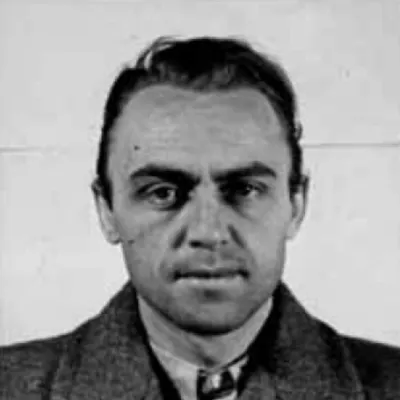
Alfred Naujocks
Human Design Chart
Biography
In November 1944 Naujocks was captured by the Allies and put into a war criminal camp, however he never was brought to trial for his war crimes against humanity. He escaped and later settled in Hamburg, where he died on 4 April 1960.
Alfred Naujocks as a Manifesting Generator 4/6 in Human Design
Manifesting Generator 4/6 — Design at a Glance
Alfred Naujocks' Design shows a tendency towards hybrid energy: As an Manifestor Generator, he possessed the constant power of the sacral center combined with the ability to skip steps and produce results quickly. This configuration marked him as someone who not only reacted but actively shaped – yet at the risk of missing important stages through excessive speed.
The mechanics of his type required waiting for impulses before acting, only proceeding when the sacral center gave a clear "yes." If he responded to this inner confirmation, Alfred Naujocks could pursue multiple projects simultaneously without falling into frustration. His work flourished in the "play mode," where variety fed his energy. However, if he acted impulsively or ignored feedback from his center, setbacks loomed: Missing steps had to be retraced, which slowed down his natural dynamism and led to his specific form of frustration – the non-self theme of the Manifestor Generator. His effectiveness thus depended on maintaining a balance between rapid implementation and necessary responses to inner signals.
Emotional Authority
Alfred Naujocks lived with an inner authority that was shaped by his defined Emotional Center. This center carried his inner guidance, independent of other defined areas in his design. His emotional landscape followed a natural ebb and flow of highs and lows, which meant that his perception of reality always filtered through the lens of his current mood.
What seemed absolutely right at one moment could appear wrong or negative in the next; this initial impression was merely a fleeting reaction, not yet the deeper truth.
Quick, spontaneous decisions made directly from an emotional wave often proved problematic for his design and led to negative consequences. The mechanics of his authority required patience: he had to take time to let decisions mature. By repeatedly sleeping on important questions, Alfred Naujocks gained emotional distance from initial intense feelings. Only when these waves subsided and calmness set in did clear insight emerge.
This process was especially crucial for long-term turning points that significantly influenced the course of his life. The strategy involved hesitating and not following the first emotional urgency but waiting until the end of the wave cycle to act with clarity.
The 4/6 Profile — Opportunist / Role Model
Alfred Naujocks revealed himself through his Profile 4/6 as someone who acted experimentally in the first three decades of life. During this phase, the sixth line still functioned like a third: he actively sought validation in relationships and friendships to shape his identity. This aligned with the typical pattern of a networker who learns through social interaction.
After Saturn's return, this dynamic fundamentally changed. Alfred Naujocks now experienced an inner conflict between the deep need for belonging (Line 4) and the urge to adopt a distant, wise position (Line 6). His design marked him as someone who had to weigh heart against head. The fourth line brought emotional dominance – a strength he carried outward and was reinforced by his environment. This created a field in which he could both connect and emotionally lead.
At the same time, the sixth line demanded trust in change. Alfred Naujocks was programmed to accept societal mutations and adapt rather than resist them. In his later years, it was expected of him to serve as a role model. This meant not only embodying wisdom but also making it visible through cooperation with others. His big heart remained cautiously open; his design instructed him to connect only with those who shared his values to prevent injury. Thus, he combined social integration with a critical distance essential for his role as an example.
Triple Split Definition — Defined & Open Centers
Alfred Naujocks was characterized by a design that emphasized mental processes and vital energy. His defined Head and Ajna Centers created a constant pressure to ask questions and form concepts. This mental activity was present continuously, regardless of external stimuli. At the same time, he had a defined Sacral Center, which gave him an enormous source of generative energy. His strength lay in reacting to life rather than taking initiative.
The connection between this mental definition and his Throat Center allowed him to articulate his thoughts and concepts directly. He spoke from his mind, creating a consistent yet limited form of expression. However, he lacked the direct energy to implement these ideas alone; he needed others to take over the implementation.
In contrast, his G-Center, Heart Center, and Spleen Center were open. The open G-Center meant a lack of a fixed identity or direction. Alfred Naujocks tended to blend with his environment and often sought a 'borrowed' identity rather than waiting for initiation by others. His open Heart Center led him not to be driven by constant willpower. He risked getting entangled in promises to prove his worth, which often resulted in failure and feelings of inadequacy.
The open Spleen Center made him vulnerable to survival fears and spontaneous decisions that did not rely on his inner authority. He tended to cling to people or situations that gave him a false sense of security rather than developing his own intuition. This combination of strong mental pressure and generative energy, alongside vulnerability in identity and security, shaped his essence significantly.
Channels for change, clarity and emotional truth.
Alfred Naujocks exhibited a basic disposition of sudden, often melancholic renewal. His design featured the Mutation Channel 60-3, connecting the Root Center with the Sacral Center. This configuration generated an inner rhythm of tension and release: Gate 60 brought limitation and the pressure of the unforeseen, while Gate 3 tried to impose order on this change. Alfred Naujocks had to learn not to intellectually control this pulsating energy but to trust the reaction from his Sacral Center, even when long phases of silence or depression obscured the next impulse.
Parallel to this, he was marked by the Awareness Channel 61-24 between Head and Ajna Centers. Here, his mind did not seek logical conclusions but sudden 'aha experiences'. Gate 61 received inspiration from the unknown, which was rationalized in the Ajna Center through Gate 24. Alfred Naujocks could not force these insights; they only emerged when he let mental noise subside and gave space to inner truth. His thinking was geared towards recognizing new things without analyzing the past or predicting the future.
Emotionally, Alfred Naujocks was driven by the Impermanence Channel 36-35 between Solar Plexus and Throat Centers. This channel created a strong desire for new experiences. Gate 36 felt emotional inadequacy as crisis, which should be balanced by the adventurousness of Gate 35. Alfred Naujocks sought to experience and feel things to gain wisdom. Yet, since feelings are impermanent, this search often led to disappointment when the experience did not meet expectations. His path involved trusting the emotional wave and making decisions only once clarity had emerged.
Additional facets such as Gate 6 (Friction/Fertility), Gate 12 (Creativity/Retreat), and Gate 11 (Visual Memory) underscored his ability for individual mutation and harmonious assessment of situations before acting.
Individual Circuitry — Circuit Signature
Alfred Naujocks' design showed a Triple Definition, meaning three separate, parallel operating energy blocks. These were not interlinked but existed as independent fields of power. In the Knowledge Circuit, two isolated segments connected: Head and Ajna Centers on one side, Sacral and Root Centers on the other. This promoted innovative flashes of insight along with mutative deviations from the known without these impulses being directly linked to physical endurance. Parallel to this, in the Meaning-Finding Circuit, a direct connection between Throat and Solar Plexus Centers operated. Here, the emotional wave of experiencing flowed immediately into expression. Alfred Naujocks reflected on past experiences to grasp their meaning and share these insights with others. The separation of knowledge energy from the ability for emotional expression shaped his essence: creative ideas and mutative forces remained energetically independent of the capacity to articulate emotional past processes verbally. This created a profile in which intellectual innovation and emotional communication acted as separate, non-fusing areas.
Right Angle Cross of Eden 3
Alfred Naujocks was marked by the Royal Cross of Eden 3, a configuration that in Human-Design is an archetypal structure for the 'Conqueror' or Pioneer. This design laid out a tendency towards radical action and the imposition of new orders, often at great risk or with moral ambiguity. The mechanics of this cross combine instinctual energy with strategic planning abilities and the will to change existing systems. Alfred Naujocks lived this dynamic not as a passive trait but as a driving force that propelled him to transcend boundaries and challenge established norms.
The specific manifestation of this cross promoted an attitude where the goal often outweighed the means. Alfred Naujocks did not act purely on impulse, but followed an inner logic of expansion and control. This energy supported him in asserting himself in chaotic or volatile situations by setting clear, though controversial, directions. It was not a search for harmony, but rather an orientation towards efficiency and results. Alfred Naujocks used this internal architecture to create structures around him that aligned with his ideas of strength and order, where the human costs of these actions were part of the dynamic tension of this design.
Saturn Return · Uranus Opposition · Chiron Return — Life Cycles
Alfred Naujocks showed a life dynamics marked by sharp turning points and breaking old structures. His design laid out a tendency to become active in crisis situations to question or destroy outdated orders. This was evident in 1939, at age 28, when he carried out the staged Polish attack on the Gleiwitz radio station, marking not only a historical watershed but also aligning with the energy of his first Saturn Return. In this cycle, years of groundwork often condenses into a solid yet confrontational result. Naujocks acted here within a deep crisis that brought his inner structure to the surface and established a new, harsh reality.
Later, in 1952 at age 41, he settled in Hamburg. This coincided with his Uranus Opposition, a time when the need for freedom and individual determination often breaks previous bonds. For Naujocks, this step meant reorienting his career and life environment. The opposition to Uranus challenged him to break away from collective expectations and forge his own path. This phase was less marked by external conflicts than by the necessity of inner detachment. His design thus showed two clear phases: first, enforcing a new order in crisis, later finding personal space beyond old commitments. Both events illustrate how his astrological cycles triggered concrete actions that profoundly changed his life.
Manifesting Generator · Emotional Authority — Synthesis
Alfred Naujocks lived a life marked by an internal drive towards transformation and the expression of individual energy. The defined sacral center provided a constant source of vitality (Manifesting Generator), yet this required emotional authority for maturation through a process of refinement. This combination led to dynamics where quick impulses – enabled by the Manifestor component – collided with the need for emotional clarity. The Knowledge Circuit amplified this inner drive to discover new things and break existing structures, with Channel 3-60 playing a central role in continually presenting him with new challenges and encouraging experimentation. His profile as Networker/Role Model suggests he sought relationships to share his insights but also felt a need for distance and reflection (Line 6).
A central paradox in his design lay in the interplay of initiation and reaction. As a Manifesting Generator, he had the ability to quickly initiate things while his emotional authority urged him to carefully weigh decisions. This tension was particularly evident during crises (Saturn Return 1939), where quick action was required but also risked skipping important steps. The Uranus Opposition at age 41 pointed towards a phase of reorientation motivated by the desire for expression of individual energy and creative unfolding (Knowledge Circuit).
3 Defined Channels
Incarnation Cross - Right Angle Cross of Eden 3
Solar Return
The Solar Return shows the moment when the sun returns to its exact birth position - your personal solar year.
Life Cycles
Discover the life cycles with a detailed triple view (birth chart, cycle chart, composite).
Human Design Profile
- Strategy
- To respond - wait for something to respond to
- Authority
- Emotional Authority
- Profile
- 4/6 - Opportunist / Role Model
- Definition
- Triple Split
- Incarnation Cross
- Right Angle Cross of Eden 3
- Date of Birth
- 20.09.1911 04:30
- Place of Birth
- Kiel, GER
Frequently Asked Questions
What was Alfred Naujocks' Human Design type?
What Profile did Alfred Naujocks have in Human Design?
What Authority did Alfred Naujocks have?
What incarnation cross did Alfred Naujocks have?
When was Alfred Naujocks born?
Discover your own Human Design
Are you also a Manifesting Generator? Find out in a personal reading how to unfold your multi-talents and direct your energy wisely.
More Personalities
Back to overviewAldair
Alizée

Angeli
Arletty
Artus

Balthus