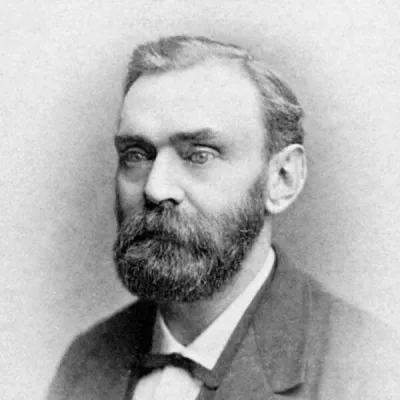
Alfred Nobel
Human Design Chart
Biography
Born into the prominent Nobel family in Stockholm, Nobel displayed an early aptitude for science and learning, particularly in chemistry and languages; he became fluent in six languages and filed his first patent at the age of 24. He embarked on many business ventures with his family, most notably owning the company Bofors—which was an iron and steel producer that he had developed into a major manufacturer of cannons and other armaments. Nobel's most famous invention, dynamite, was an explosive made using nitroglycerin, which was patented in 1867. He further invented gelignite in 1875 and ballistite in 1887.
Upon his death, Nobel donated his fortune to a foundation to fund the Nobel Prizes, which annually recognize those who have "conferred the greatest benefit to humankind". The synthetic element nobelium was named after him, and his name and legacy also survive in companies such as Dynamit Nobel and AkzoNobel, which descend from mergers with companies he founded.
Alfred Nobel as a Generator 2/4 in Human Design
Generator 2/4 — Design at a Glance
Alfred Nobel's design established a tendency towards high, enduring energy that required specific conditions to be effective. As a Generator, he possessed considerable sacral energy, comparable to that of a workhorse: strong and resilient as long as he had the necessary inner fire for his task. This configuration did not describe spontaneous initiative but rather reactive dynamics. His energy primarily became free when he responded to external impulses instead of taking the first step independently. The strategy involved waiting and then reacting from the gut once an internal signal gave a clear "yes."
This mechanism carried two significant risks for him. First, exhaustion or burnout threatened if he invested energy in endeavors that internally repelled him – doing things he actually had no desire to do. Second, frustration and a sense of energy deficiency arose when he was prevented from working on his heart project even though he still wanted to continue with full power. If Alfred Nobel lived in harmony with this reactive nature, his design rewarded him with deep satisfaction and a feeling of fulfillment. Conversely, if he initiated against his inner rhythm, he encountered persistent frustration. His endurance thus was not an arbitrary trait but the result of correctly reacting to life signals.
Emotional Authority
Alfred Nobel's decision-making followed a rhythmic pattern of emotional waves that dictated patience as a central requirement. His inner authority lay in the defined Emotional Center, meaning he was always in a state of rising and falling emotions. This emotional wave colored his perception of the world; something could excite him for a moment, only to seem negative the next. Since his immediate feeling was just a fleeting snapshot and not necessarily the deeper truth, spontaneous reactions were unreliable and risky for him.
The mechanics of his emotional authority required time. Alfred Nobel had to sleep on decisions to distinguish between transient mood and true clarity. The longer he waited, the more intense feelings subsided, allowing for greater emotional distance and calmness. This process of "sleeping on it" was essential, especially for long-term choices with significant influence on his life path. Only after this maturation process could he discern his true direction, free from distortion by his current emotional state.
The 2/4 Profile — Hermit / Opportunist
Alfred Nobel's design revealed a tendency towards tension between the need for withdrawal and community. He was someone who constantly oscillated between two poles: the urge to be alone and the desire to spend time with chosen people. For Alfred Nobel, it was therefore essential to create a safe environment where he could communicate clearly: when he sought company and when he wanted to remain undisturbed.
During his solitary times, he immersed himself in internal processes to gain clarity. Once this need was satisfied, he returned from "his cave" to connect with his network. This alternating behaviour allowed him to reflect on the knowledge of his network during quiet periods and develop brilliant ideas from it.
His second line projected personal content outwardly and showed determination. Yet, as this value could encounter resistance, he withdrew resolutely when not accepted. At the same time, he used the intelligence of his presentation to overcome this resistance with friends.
In communication, Alfred Nobel acted like a storyteller. He conveyed messages through stories while employing clever calculation and self-interest. He waited for or seized appropriate opportunities to effectively convey his ideas. This configuration described a life task: uncovering hidden connections and passing them on to others, where the balance between solitude and network building was key to effectiveness.
Single Definition — Defined & Open Centers
Alfred Nobel's design inclined towards constant mechanical energy that was directed through waiting and spontaneous intuition. His defined Sacral Center functioned as the motor of immense vitality; he had a daily reserve of power which he utilized by reacting to what came his way rather than initiating it himself. This energy was only available when his inner response was affirmative - a mechanical process beyond rational thought.
Parallel to this, his defined Solar Plexus Center acted as an emotional authority. Nobel's decisions required waiting for the emotional wave; truth revealed itself over time, not in impulsive moments. His inner clarity emerged from experiencing highs and lows before acting. This was complemented by his defined Spleen Center, which gave him spontaneous intuitive intelligence for health and well-being. This existential perception in the 'now' protected him from false influences. Additionally, his defined Root Center provided a firm internal pressure that propelled him forward in the material world and helped him deal with stress in a specific way.
In contrast, his undefined centers revealed areas of situational receptivity. His open Head Center made him vulnerable to mental confusion or the pressure to find answers not coming from him; he tended to get entangled in other people's questions rather than trusting his own authority. The open Ajna Center meant that his conceptual thinking was flexible but did not offer a constant truth - he absorbed concepts from the environment without fixating them as part of his identity. His open Throat Center showed an attraction that drew attention when he didn't try to force it through speaking; he spoke spontaneously when invited. The open G Center revealed no fixed direction or identity; instead, he learned who he was through places and people initiating him. Finally, the lack in his open Heart Center meant a constant willpower was missing; he wasn't designed to give promises or prove his worth but received confirmation from the environment without having to compete.
Channels for clear logic, change, intimacy and care.
Alfred Nobel's design inclined towards synthesis of radical change and traditional stability. This tension manifested through Channel 60-3, generating evolutionary change via Gate 60 (Limitation) and Gate 3 (Order). This energy was unpredictable and melancholic; it required patience with one's pulse as innovation only appeared in the right rhythm. Simultaneously, Channel 27-50 created stability through care (Gate 27) and traditional values (Gate 50). Here lay responsibility for creation: change had to occur within a framework of community sense.
Channel Judgment 58-18 added that logical perfection was necessary. Via Gate 58 (Vitality) and Gate 18 (Correction), he checked patterns for errors, but this correction only occurred on invitation or in clear necessity to conserve energy. Channel Pairing 59-6 connected sexuality (Gate 59) with emotional friction (Gate 6). This generated a drive towards merging and intimacy that required waiting for the emotional wave to gain clarity.
Mental processes strongly shaped Alfred Nobel's inner work. Gate 56 translated abstract concepts into vivid narratives, while gates like 52 (Concentration), 41 (evolutionary feeling) and 44 (transformation through relationship) fostered deep pattern correction. Additional gates such as 39 (Provocation/Analysis), 38 (Boundaries), 48 (deep pattern recognition), 29 (Persistence) and 49 (principles/opposition) supported this dynamic through selective pressure, resistance capability, and responding to collective principles. Alfred Nobel thus processed complex changes through intellectual stimulation and narrative structuring while balancing the impulse towards mutation with the duty of preservation.
Tribal Circuitry — Circuit Signature
Alfred Nobel's design inclined towards individual transformation paired with rational focus and instinctive protection. This dynamics arose from three active circuits. The Knowledge Circuit connected his Sacral Center to his Root Center via Channel Mutation (Gates 3-60). This promoted deviation from the known and expression of a unique identity, carrying new insights into the world through emotional waves from the Solar Plexus.
Parallelly, the Understanding Circuit linked his Spleen and Root Centers via Channel Judgment (Gates 18-58). Here logical strategy was in focus: sharing rational insights for future improvement free from emotional influence.
The Protector Circuit closed the energetic landscape by directly connecting Sacral, Solar Plexus, and Spleen Centers. Through Channel Preservation (Gates 27-50), it concerned care and preservation of family while Channel Pairing (Gates 59-6) activated primordial protective energies for genetic continuity.
In simple definition, these forces - innovation, strategy, and protection - flowed in a cohesive stream from Sacral, Root, Spleen, and Solar Plexus Centers. Alfred Nobel thus emerged as someone who not only generated new knowledge but strategically organized it while instinctively defending the family's existence.
Right Angle Cross of Laws 3
Alfred Nobel's design indicated a tendency towards deep, structural order. He was someone whose inner compass was not guided by fleeting impulses but rather by an architectural fundamental order. This configuration corresponds to the right cross of Laws 3, which describes the lawfulness underlying individual expression.
For Alfred Nobel, this meant that his actions and decisions always took place within a larger logical framework. It wasn't about arbitrary freedom but adhering to internal logic that created stability and coherence. His design called for clarity in structure; he sought out rules that could tame chaos and provide a solid foundation for his actions.
This mechanical quality shaped the way he dealt with challenges: not through spontaneous reaction, but by fitting them into an existing system of laws. Alfred Nobel lived in a world defined by clear lines. The emphasis was on the architecture of being – how one can meaningfully unfold within given boundaries. His energy flowed where structure and lawfulness met, giving him a consistent yet rigid internal stance. It was a life in harmony with the necessary form that made content possible.
Saturn Return · Uranus Opposition · Chiron Return · 2nd Saturn Return — Life Cycles
Alfred Nobel's life structured itself through three decisive astrological cycles marking development and success. In 1863 at age 30, he experienced his first Saturn Return. This cycle condensed years of groundwork into solid results; here he developed the initial ignition for nitroglycerin – a concrete success born from the maturity of this phase.
Twelve years later in 1875 at age 42, the Uranus Opposition came to pass. This point often demands breaking with established structures in favor of new freedoms or innovations. Alfred Nobel used this energy to develop dynamite. Again, it was a clear success showing how he transformed disruptive phases into groundbreaking technical solutions.
The second Saturn Return followed in 1891 at age 58. While the first return often lays the professional foundation, the second frequently signals consolidation or relocation for life anchoring. Alfred Nobel moved to Sanremo in Italy to live there. This step was not a narrow career breakthrough but a personal arrangement reflecting the internal structuring of this cycle. The sequence of these events – from the first major invention through radical development to a change of residence – illustrates how these mechanical points concretely shaped his actions and decisions.
Generator · Emotional Authority — Synthesis
He was a Generator with emotional authority, deeply rooted in his own sacral energy (Sakral-Zentrum defined). This power source fueled a continuous search for fulfilling work, where the willingness to follow one's gut feeling was crucial for success. The emotional wave required time for decision-making but ultimately led to deeper insights and an authentic expression of inner truth (Knowledge Circuit). The profile as a natural talent and networker points towards a rhythm between the need for withdrawal into internal processes and the desire to exchange with others – renewing creative energy.
A central paradox lay in the connection between Mutation (Channel 3-60) and emotional depth. On one hand, it propelled him toward innovation and change, marked by a pulsating format of creativity and melancholy. On the other hand, emotional authority required mature consideration to ensure that these mutative impulses were not rashly released into the world. Successes such as developing new substances (documented events) demonstrated this tension between the drive for progress and the necessity of emotional clarity.
4 Defined Channels
Incarnation Cross - Right Angle Cross of Laws 3
Solar Return
The Solar Return shows the moment when the sun returns to its exact birth position - your personal solar year.
Life Cycles
Discover the life cycles with a detailed triple view (birth chart, cycle chart, composite).
Human Design Profile
- Type
- Generator
- Strategy
- To respond - wait for something to respond to
- Authority
- Emotional Authority
- Profile
- 2/4 - Hermit / Opportunist
- Definition
- Single Definition
- Incarnation Cross
- Right Angle Cross of Laws 3
- Date of Birth
- 21.10.1833 06:40
- Place of Birth
- Stockholm, Sweden
Frequently Asked Questions
What was Alfred Nobel's Human Design type?
Which Profile did Alfred Nobel have in Human Design?
What was Alfred Nobel's Authority?
What incarnation cross was assigned to Alfred Nobel?
When was Alfred Nobel born?
Discover your own Human Design
Are you also a Generator? Find out in a personal reading how to use your sacral energy correctly and discover deep satisfaction.
More Personalities
Back to overviewAaliyah

Alexia

Angèle

Anne-Marie

Arcángel

Arno