
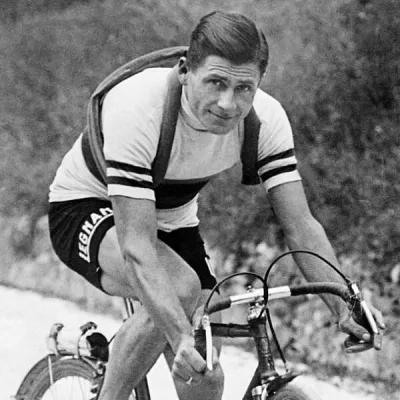
Alfredo Binda
Human Design Chart
Biography
Along with Giovanni Brunero and Carlo Galetti, Binda was among the first multiple Giro d'Italia champions, securing five victories between 1925 and 1933 that redefined the way stage races were ridden.
Binda achieved three road world championship titles, five Giro wins, two Milan – San Remo crowns and four Giro di Lombardia victories.
He died on 19 July 1986, aged 83, in Cittiglio, Italy.
The Human Design of Alfredo Binda: Generator 5/1
Generator 5/1 — Design at a Glance
Alfredo Binda revealed himself as someone with immense, almost inexhaustible endurance – comparable to a workhorse. This strength was not freely available for spontaneous initiatives but unfolded exclusively in the moment of reacting to impulses from his environment. His Generator design determined that his energy source, the sacral center, only became effective when he responded to an external signal and felt inner agreement.
The mechanics of his design were clear: Not initiating but responding. When Binda reacted to offers or situations from life and gave a clear internal “yes,” deep satisfaction set in. In these moments no one could stop him; he possessed the power to shape things sustainably and materialize them.
However, if he deviated from this strategy – for example by initiating himself or pushing through against his inner resistance – it quickly resulted in frustration and a noticeable loss of energy. The danger lay in wasting resources on tasks that did not find internal resonance, leading to long-term exhaustion over time. Conversely, it was exhausting for him when he was prevented from engaging in activities where he still had full power and enthusiasm to continue working. His success depended on learning to wait for life’s signals and then acting from the gut.
Sacral Authority
Alfredo Binda revealed himself as someone who did not make decisions through intellectual deliberation but waited for an inner confirmation. His design established sacral authority, meaning that he received answers from his body. This mechanism only worked correctly when he reacted to an external stimulus and waited until a physical signal occurred – often audible as grunting, humming or an affirming “Mhm.” When this reaction took place, he felt a surge of energy and vitality.
This inner voice guaranteed him access to seemingly inexhaustible energy and great enthusiasm in the execution of his tasks. Alfredo Binda lived the joy of doing itself without the need for external purpose. His satisfaction arose from immersing himself in work, driven by this sacral confirmation.
Additionally, his activated spleen center supported this process. The connection to sacral authority allowed him quick, spontaneous reactions and immediate access to instinctive perception. He could reliably guide himself with this physical well-being. This combination of waiting strategy and instinctive speed shaped the way he moved through life: not by planning but by recognizing what made him alive in the moment and provided energy.
The 5/1 Profile — Heretic / Investigator
Alfredo Binda revealed himself through his Profile 5/1 as a person with magnetic presence, possessing deep, introspective knowledge treasures that he offered others for problem-solving. Line 1 anchored him in research and introspection, while line 5 predisposed him to bring this knowledge into play as an authority or “general” during crisis times. This projection generated high pressure: fulfilling the collective’s expectations grew his reputation; failing made him a scapegoat. A central tension field existed between the need for private research and external demand for solutions. Without clear boundaries, this could lead to exhaustion, similar to a scientist who answers questions for hours and is then drained. The challenge lay in maintaining balance between the “researcher” for himself and the “hero” for others. It was important to exercise authority without violating his own limits or becoming the target of negative consequences from new ideas that undermined established value systems. Alfredo Binda had to learn to say no to maintain this beneficial balance and use his gifts optimally, rather than being overwhelmed by unbridled projection.
Split Definition — Defined & Open Centers
Alfredo Binda's Human Design shows a tendency towards constant mental pressure coupled with enormous physical endurance. As a person of Strategy, he had six defined centers: Head, Ajna, Throat, Sacral, Spleen, and Root. This created a clear mechanical process for thinking, communication, and action based on a constant energy foundation from the Sacral Center. His intuition (Spleen) and his handling of stress (Root) were set in stone, giving him sharp perception of the moment and resilience.
At the same time, there was a strict separation between inspiration and execution. The definitions in Head and Ajna generated permanent questions and concepts but did not provide energy for direct implementation. Binda had to wait to react correctly; hasty action led to frustration. His defined Throat allowed him to express these mental processes reliably when responding to an external request.
Three centers remained open: G Center, Heart, and Solar Plexus. This meant that identity, willpower, and emotions were not set in stone. Binda tended to reflect his environment rather than having a fixed direction or stable ego. He was prone to seeking love and affirmation (open G) or making promises to prove worth (open Heart). Additionally, he absorbed foreign emotions (open Solar Plexus), which could make him feel emotionally unstable if he did not let go of others' moods. His mechanics required vigilance: no identity search in the G Center, no promises in the Heart, and no emotional identification in the Solar Plexus. Instead, it was about trusting his inner authority and strategy to avoid resistance and effectively use his sacral energy.
Channels for change, clarity, intuition and caring values.
Alfredo Binda appeared as someone characterized by a pulsating on-and-off energy accompanied by internal tension and melancholic phases. This basic attitude resulted from Channel Mutation 60-3, connecting the Root Center with the Sacral Center. Gate 60, the Gate of Limitation, served as an anchor point for evolutionary possibilities, while Gate 3, the Gate of Order, tried to realize new, potentially valuable paths. This combination generated a powerful frequency that carried innovation and change into his environment but only became effective when he accepted the limitation of not knowing when the next impulse would come. Instead of rationalizing these moods, it was about patiently waiting for the inner pulse to bring evolutionary change.
At the same time, Alfredo Binda had the ability to express spontaneous insights clearly and efficiently, facilitated by Channel Structuring 43-23. This channel connected Ajna Center (mind) with Throat Center. Gate 43, the Gate of Insight, received inspired knowledge as sudden breakthroughs, while Gate 23, the Gate of Assimilation, processed and articulated these perspectives. His thinking often felt
Individual Circuitry — Circuit Signature
Alfredo Binda's Human Design presented two parallel but not directly connected energy systems. The Split Definition required a constant integration of these different streams for action capability. On one hand, the Knowledge Circuit drove the urge towards individual identity and innovation. Here, Head Center linked with Ajna Center (conceptual thinking) as well as Throat Center (expression), separate from the second part of this circuit: Sacral and Root Centers, which sought new paths through the Channel of Mutation (3-60). This flow promoted creative flashes of insight and emotional transformations.
Parallel to this, the Archer Circuit acted as a primal force for preservation. Through the Channel of Preservation (27-50), it connected the Sacral Center with the Spleen Center. This connection secured survival through protection, care, and sustenance for genetics. It was about instinctive energies of preserving and defending the family.
The tension lay between the innovative drive towards new understanding in the Knowledge Circuit and the conscientious responsibility in the Archer Circuit. Alfredo Binda had to integrate these separate forces – the pulsating search for change on one side, the timeless instinct of protection on the other – in his life since there was no direct energetic bridge between these two systems.
Left Angle Cross of Masks 2
Alfredo Binda's design carried the signature of the left cross of Masks 2. This configuration set a specific dynamic characterized by the tension field between inner truth and outer presentation. In Human Design, this cross marks a process of identity formation where it is about integrating one's facets without hiding behind roles or fixing them in place. It was an energy that demanded staying authentic while simultaneously wearing the various masks life and social context required.
Binda's chart shows here not a static property but a continuous flow. The mechanics of this cross describe the path from innocence to wisdom through conscious confrontation with oneself. It wasn't about finding one true identity and rejecting all others, but understanding that each mask represents part of the truth. Alfredo Binda lived in this tension: He had to learn to acknowledge his different sides without letting them define or limit him. This dynamic shaped his inner self as a constant movement between being and appearing, with the integration of both poles forming the goal. It was a life task that required depth to avoid falling into superficial role-playing, but rather to make one's essence visible through the diversity of experiences.
Saturn Return · Uranus Opposition · Chiron Return · 2nd Saturn Return — Life Cycles
Alfredo Binda's design set a tendency towards structured phases of maturation where public identity and responsibility gradually solidified. This development unfolded along his Saturn return cycles, which acted as times of consolidation. The first cycle, from ages 28 to 30, established his professional reputation. This was concretely shown in 1930: He declined the Giro d'Italia and won two stages at the Tour de France instead. This step marked the transition from pure competition to targeted positioning of his name in public, a typical feature of this first maturation phase.
The second Saturn return cycle, from ages 58 to 60, led him into an authoritative position within his community. Here the focus shifted from individual sporting success towards a leading role in social structures. This became effective in 1962 when he was elected mayor of Cittiglio. This election confirmed the mechanics of the second cycle: Taking over an advisory or leading function based on years of recognition and trust-building. Alfredo Binda lived these cycles not as abstract concepts but as concrete turning points that shaped his path from athlete to community leader. His lifespan illustrates how these temporal windows brought structure and meaning into taking responsibility.
Generator · Sacral Authority — Synthesis
Alfredo Binda lived a life deeply marked by the dynamics between inner drive and the need for external validation. As a Generator with sacral authority, he primarily responded to impulses from his environment, found his energy in action, and achieved deep satisfaction through endurance. However, this responsiveness was strengthened by the presence of defined Head and Ajna Centers – a constant source of inspiration and mental pressure to generate and share knowledge (Knowledge Circuit). Thus, he was someone who lived both in the present moment as well as driven by an inner necessity to express and disseminate his insights. The combination of sacral energy and mental sharpness points towards a capacity to tackle complex tasks with endurance while always seeking new solutions.
A central paradox in Alfredo Binda's design lies in the tension field between the need to respond to external impulses (Generator) and the inner drive to generate and communicate knowledge (defined Head and Ajna Centers). While his sacral center prompted him to act when the right energy was present, his mental centers created a constant pressure to actively seek new insights. This tension manifested in the ability to take on challenges and persevere (Gate 52), but also in a possible inner conflict between the desire for spontaneity and the wish for control over thought processes.
4 Defined Channels
Incarnation Cross - Left Angle Cross of Masks 2
Solar Return
The Solar Return shows the moment when the sun returns to its exact birth position - your personal solar year.
Life Cycles
Discover the life cycles with a detailed triple view (birth chart, cycle chart, composite).
Human Design Profile
- Type
- Generator
- Strategy
- To respond - wait for something to respond to
- Authority
- Sacral Authority
- Profile
- 5/1 - Heretic / Investigator
- Definition
- Split Definition
- Incarnation Cross
- Left Angle Cross of Masks 2
- Date of Birth
- 11.08.1902 10:30
- Place of Birth
- Cittiolio, Italy
Frequently Asked Questions
What Human Design type was Alfredo Binda?
Which Profile did Alfredo Binda have?
What Authority did Alfredo Binda have?
What incarnation cross was Alfredo Binda assigned to?
When was Alfredo Binda born?
Discover your own Human Design
Are you also a Generator? Find out in a personal reading how to use your sacral energy correctly and discover deep satisfaction.
More Personalities
Back to overviewAaliyah

Aldair

Alexia

Angèle

Anne-Marie

Arcángel
