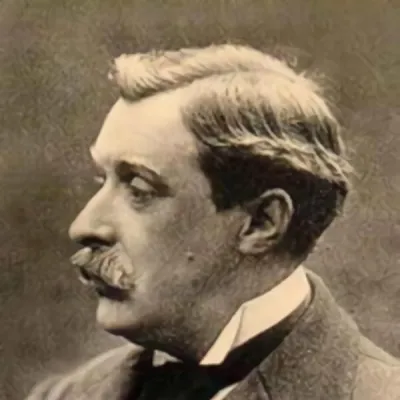
Alphonse Allais
Human Design Chart
Biography
He is the author of many collections of whimsical writings. A poet as much as a humorist, he cultivated the verse form known as holorhyme, i.e. made up entirely of homophonous verses, where entire lines are pronounced the same. For example:
Par les bois du djinn où s'entasse de l'effroi,
Parle et bois du gin, ou cent tasses de lait froid.
Allais wrote the earliest known example of a completely silent musical composition. His Funeral March for the Obsequies of a Deaf Man of 1897 consists of nine blank measures. It predates similarly silent but intellectually serious works by John Cage and Erwin Schulhoff by many years. His prose piece "Story for Sara" was translated and illustrated by Edward Gorey.
Allais participated in humorous exhibitions, including those of the Salon des Arts Incohérents of 1883 and 1884, held at the Galerie Vivienne. At these, inspired by his friend Paul Bilhaud's 1882 exhibit of an entirely black painting entitled "Negroes fight in a tunnel" (which he later reproduced with a slightly different title), Allais exhibited arguably some of the earliest examples of monochrome painting: for instance his plain white sheet of Bristol paper Première communion de jeunes filles chlorotiques par un temps de neige (First Communion of Anemic Young Girls In The Snow) (1883), and a similar red work Apoplectic Cardinals Harvesting Tomatoes on the Shore of the Red Sea (Aurora Borealis Effect) (1884).
He died in Paris on 28 October 1905.
Alphonse Allais as a Generator 1/3 in Human Design
Generator 1/3 — Design at a Glance
Alphonse Allais had the architecture of a Generator. His design indicated high endurance and an enormous amount of sacral energy, comparable to the strength of a workhorse. This configuration defined his basic functioning: He was not primarily designed to initiate impulses but rather to react to signals from his environment.
The mechanics of his design required him to wait for external stimuli before acting; he only acted when his Sacral Center signaled a clear 'Yes'. This strategy of reacting instead of initiating was the key to his effectiveness. If Alphonse Allais followed this inner guidance, he could effectively use his energy to achieve things in his life, leading to a deep sense of satisfaction and fulfillment.
However, his design had two specific pitfalls. The first occurred when he engaged with tasks for which he did not feel an internal desire. In such cases, he wasted valuable energy, making him vulnerable to exhaustion. The second danger was being prevented from working on his heart projects while still full of power and wanting to continue. If Alphonse Allais lived against this design – for example, by constantly initiating without prior reaction to a signal – it resulted in frustration and a noticeable lack of energy. His strength lay in responding instinctively when life called.
Sacral Authority
Alphonse Allais demonstrated decision-making that did not occur in his head but arose from direct physical resonance with external stimuli. As a Generator, his design gave him sacral authority, an inner guidance unique to this type whose strategy – waiting for the signal – simultaneously represented his authority. This configuration simplified his process: He needed no lengthy analysis but reacted to impulses from outside with an immediate bodily response.
This reaction often resembled a gut sound, like a grunt or hum that could be understood as 'Yes' or 'No'. When his sacral motor kicked in, he felt vital and alive. A surge of energy occurred, providing him seemingly inexhaustible power. In these moments, he accomplished his work with great enthusiasm. He was born to go through life with joy and satisfaction, fully immersed in his activities without them being bound by strict purpose.
His open emotional center was the prerequisite for this sacral guidance. Rather than overwhelming his mind, he trusted the spontaneous, energetic response of his body. Joy served as a clear indicator that an action was correct. Through this trust in his inner resonance, Alphonse Allais could act efficiently and use his energy where it naturally flowed instead of fighting against resistance or blocking himself through mental deliberation.
The 1/3 Profile — Investigator / Martyr
Alphonse Allais showed himself to be someone whose judgments only fully held validity when they were both theoretically grounded and practically tested. His design established a specific dynamic: the constant interplay between the deep need for solid knowledge and the unavoidable necessity of practical experimentation, including all associated errors.
This pattern stemmed from his profile as an Investigator and Experimenter. The first line of his profile drove him to build a solid foundation and refine laws and connections. Often, however, this intense theoretical preparation led him to hesitate in moving towards implementation – out of fear of not knowing enough yet. Yet the third line of his profile demanded exactly the opposite: adaptation through trial and error. It taught him wisdom through direct experience and showed him that control over one's expression only arises through action.
For Alphonse Allais, this tension between planning and acting was constitutive. When he expressed an opinion or made a decision on something, you could absolutely trust his judgment. This did not happen based solely on intuition but because he had thoroughly examined the matter intellectually as well as validated it in reality beforehand. His credibility arose exclusively from this combination: theoretical examination needed to be confirmed through practical validation. Only when both sides agreed was his insight complete and reliable.
Split Definition — Defined & Open Centers
Alphonse Allais had a constant, vital energy source through his defined Sacral Center. As a Generator, his strategy was to wait for external stimuli before responding correctly; initiatives without this confirmation led to exhaustion. His mind (defined Ajna) operated as a continuous process of concept creation but not as a decision-making authority. Through the defined Throat, he spoke what he thought, a connection that had to be slowed by his sacral strategy to avoid impulsiveness.
His defined G Center gave him a firm identity and direction, while the defined Spleen Center provided a reliable, momentary instinct for health. The also defined Root Center supplied the physical pressure for forward movement.
Challenges arose from his open centers. His open Head Center meant situational inspiration or mental confusion that could not be personalized; he tended to wonder if he had to find answers to foreign questions. His open Heart Center warned against getting entangled in competitions or promises to prove one's worth – a mechanism that was missing with him. Additionally, his open Solar Plexus absorbed environmental emotions, which could lead to emotional instability if he identified with them; recovery through solitude was essential to let go of these foreign waves and regain clarity.
Channels for clarity, rhythm, change and care.
Alphonse Allais showed himself as someone whose energy came in pulsing waves, often accompanied by deep melancholy when the impulse ceased. This structure primarily arose from Channel Mutation 60-3, which forces evolutionary change by combining acceptance of limitation with a drive to create order out of new chaos. This power was reinforced by Channel Beat 14-2, a tantric channel that provides innovative directions and material resources for mutation but is only available in unpredictable pulses.
The challenge lay in dealing with the waiting time between these bursts of inspiration. Alphonse Allais found support in Channel Structuring 43-23, which provided unique, metaphorical insights. These insights needed time to assimilate before they could be expressed; otherwise, they remained misunderstood. At the same time, Channel Preservation 27-50 ensured deep care and responsibility towards the tribe, stabilizing creative chaos through traditional values and selflessness.
Additionally, personality aspects like Gate 56 with its ability for abstract storytelling and Gate 48 with its impulse to perfect patterns shaped his expression. This led to a person who mutated others through their aura but felt pressure to communicate these profound changes at the right moment without being repelled by the collective status quo.
Individual Circuitry — Circuit Signature
Alphonse Allais showed a basic attitude that swung between the urge for individual innovation and deep responsibility for what exists. His design laid out a tendency towards pulsing, acoustic creativity, flanked by ancient protective mechanisms. The Knowledge Circuit shaped him through two separate segments: On one hand, it connected Ajna and Throat Center, enabling the expression of unique identity through innovative flashes and emotional waves. On the other hand, Identity, Sacral, and Root Centers worked together, supported by mutations (deviations from the known) and structural beat. This promoted the ability to transform and express new knowledge. Parallel to this, the Protector Circuit existed as an independent force. Here it connected Sacral and Spleen Center through Channel Preservation. This connection emphasized instinctive care, preservation, and nurturing of genetics and survival. It dealt with archaic themes like protection and nourishment. As Alphonse Allais had a split definition, these energies did not exist as a continuous flow but as parallel, side-by-side forces: on one hand the innovative, loud search for the self, on the other hand silent, instinctive care for the foundation. This duality created tension between manifesting new paths and preserving old structures, with both areas working independently yet together determining his energetic profile.
Right Angle Cross of Laws 3
Alphonse Allais' design carried the structural imprint of the right cross of laws. This configuration formed the archetypal background of his character and deeply anchored him in certain recurring life patterns. The right cross of laws represents a specific energetic orientation, often associated with a sense of fate or the pursuit of order within rules. It was not an accidental feature but rather a fundamental component of his inner architecture that significantly influenced his experience and actions. Without further mechanical details or biographical evidence, it was impossible to precisely deduce the precise impact of this specific cross on Alphonse Allais' concrete life path and work. The structure itself was present and acted as a constant companion shaping his perception of the world. It created a framework within which he operated, even if the external manifestations of these inner laws varied individually. This archetypal background provided a stable basis for his personal development and connected him to a more universal level of human experience patterns that transcended the purely individual.
Saturn Return · Uranus Opposition · Chiron Return — Life Cycles
Alphonse Allais' design was characterized by a cyclical development that correlated with concrete biographical turning points. His first Saturn return marked the founding moment of an independent art movement: in 1880, at age 26, he founded Fumismus together with Arthur Sapeck. This cycle condensed years of preparatory work into a viable result and established his artistic identity.
The Uranus opposition around the 43rd year presented itself as a phase of intense creative publication. In 1897, Allais published the booklet *Album primo-avrilesque*. This astrological point often promoted the need to question established structures and make new, provocative content publicly visible, which found expression here in the publication of this specific work.
The Chiron return cycle between the ages of 49 and 51 described the phase of fulfilling his incarnation purpose. For Allais, this cycle ended with his death from a pulmonary embolism in Paris at age 51 in 1905. In this context, the event marked the conclusion of his individual developmental path, where his life journey had culminated up to that point. The correlation of these three astrological phases – founding, publication, and end – underscored the structural imprinting of his lifespan through these specific temporal windows.
Generator · Sacral Authority — Synthesis
Alphonse Allais' life was characterized by a deep interplay between generative energy and the drive to explore new paths through creative innovation. As a Generator with sacral authority, he responded to impulses from the environment, where the connection of his Sacral Center to the G Center gave him a strong identity and direction. This combination manifested in an indefatigable spirit of research (Profile 1/3), always striving to expand knowledge through experiments and find new forms of expression – a process amplified by the connections in the Knowledge Circuit. The ability to react spontaneously through the Spleen Center allowed him to adapt to dynamic environments and use his energy effectively.
A central paradox lay in the tension between the need for creative freedom and the inner commitment to create something new (Channel 3-60). While the open definition of certain centers made him receptive to external influences, his defined Root Center enabled him to channel the pressure of change into a concrete direction. This dynamic led both to moments of inspiration and innovation as well as phases of melancholic reflection, which ultimately shaped his unique expression and contribution to the creative landscape.
4 Defined Channels
Incarnation Cross - Right Angle Cross of Laws 3
Solar Return
The Solar Return shows the moment when the sun returns to its exact birth position - your personal solar year.
Life Cycles
Discover the life cycles with a detailed triple view (birth chart, cycle chart, composite).
Human Design Profile
- Type
- Generator
- Strategy
- To respond - wait for something to respond to
- Authority
- Sacral Authority
- Profile
- 1/3 - Investigator / Martyr
- Definition
- Split Definition
- Incarnation Cross
- Right Angle Cross of Laws 3
- Date of Birth
- 20.10.1854 15:00
- Place of Birth
- Honfleur, France
Frequently Asked Questions
What was Alphonse Allais' Human Design type?
What Profile did Alphonse Allais have?
What Authority did Alphonse Allais have?
What incarnation cross did Alphonse Allais have?
When was Alphonse Allais born?
Discover your own Human Design
Are you also a Generator? Find out in a personal reading how to use your sacral energy correctly and discover deep satisfaction.
More Personalities
Back to overviewAaliyah

Alain-Fournier

Alexia

Angèle

Angeli

Anne-Marie