
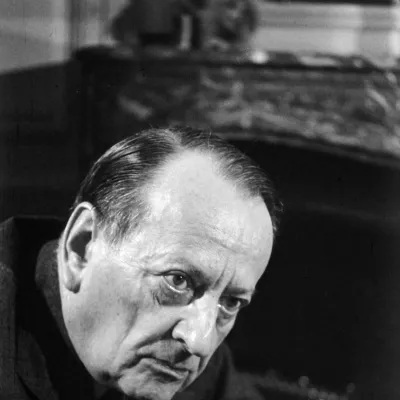
André Malraux
Human Design Chart
Biography
When he was young, his dad committed suicide and he was brought up by three women. Malraux spent his life obsessed with death from his family experiences as well as the wars in which he fought; the Chinese revolution, the Spanish Civil War and in the French underground.
Malraux first came to prominence in 1924 when he was sentenced to three years in prison in Indochina. He was caught trying to smuggle Cambodian sculptures stolen from the temples of Angkor Wat. Malraux had lost his wife’s money in the stock market and was trying to recoup his loses.
He had married Marie-Madeleine Lioux in 1948, a concert pianist and widow of his half-brother. He was plagued by personal losses, including the deaths of his two teenage sons in an automobile accident in 1961. He’d planned to marry his longtime companion, writer Louise de Vilmorin, but she died shortly before the wedding in 1969.
He acknowledged an intermittent problem with alcohol and his drug addiction. Malraux was physically handicapped by a stroke and passed over for the Nobel Prize.
His complex novel, "Man’s Fate," 1933, is set in China. Malraux claimed to have been personally involved in fighting between Communists and the Kuomintang in the late 1920s. He became more leftists in his politics in the 1930s, organizing an air squadron to fight with the anti-Fascists in the Spanish Civil War. He openly supported the Communist Party and wrote "Man’s Hope" about this war.
During his long career as a writer, Malraux became legendary for joining many different causes. He aided refugees from Germany and helped found the "World League Against Anti-Semitism."
He served with the French army in WW II and was captured in 1940.
The Human Design of André Malraux: Generator 4/6
Generator 4/6 — Design at a Glance
André Malraux revealed himself as someone who possessed immense and enduring strength - comparable to a workhorse that unleashes its power when it has the right task. As a Generator, he had abundant sacral energy, but this was not released through his own initiative; rather, it only became active when he responded to signals from his environment. His strategy involved waiting for life to offer him an opportunity and then responding with a clear 'yes' from within. Only in this moment of reaction could he effectively utilize his energy and bring things into reality.
This mechanism shaped his life path decisively: When he reacted to impulses from the gut, he experienced deep satisfaction and a sense of fulfillment. Conversely, ignoring these inner signals or forcing himself led to persistent frustration and energy loss. Two specific risks lay in his design: Either he would expend his strength on things that did not truly matter to him - leading to exhaustion - or he was held back from his heart's project despite still being full of drive. His success depended on learning not to take the first step himself, but rather to wait patiently for the right moment and then respond with full force.
Sacral Authority
André Malraux lived as a Generator whose decision-making was shaped by sacral authority. This inner guidance lay in his defined Sacral Center and functioned simultaneously as a strategy: He reacted to external stimuli instead of initiating action himself. With his open Emotional Center, he could not rely on short-term moods; instead, he trusted the physical resonance in his gut. This 'gut feeling' manifested in immediate physiological reactions like grunting or a palpable surge of energy. When this energy felt right, he acted with vitality and inexhaustible enthusiasm, fully immersed in his activities without planning them purposefully.
Especially relevant was the connection between his activated Spleen and Sacral Centers. This configuration gave him quick, spontaneous reaction capability. His instinctive perception from the Spleen Center supported the sacral response, enabling him to make decisions that were directly attuned to his physical well-being. He relied reliably on this inner compass, which allowed him to move through life with joy and satisfaction. The mechanics of his design simplified the process of choosing: It was not about thinking or analyzing but waiting for clear physical confirmation before investing energy.
The 4/6 Profile — Opportunist / Role Model
André Malraux's design inclined towards experimental behavior in his early decades. Profile 4/6 acted like a pure 4er profile before Saturn Return, driving him to an intense search for relationships and friendships. With the activation of Line 6, however, an internal conflict emerged: The desire for community (Line 4) clashed with the need for detached reflection on life's meaning (Line 6). This tension between heart and mind shaped his later development.
The fourth line from Gate 44 conveyed a fixed honesty. It showed as direct, impartial communication without hypocrisy, rooted in the trunk. In matters of survival, this stance developed into an abrasive sharpness while it faced censorship and self-importance on the other side. Simultaneously, Line 6 from Gate 33 demanded withdrawal and reflection on the entire human experience. This created a detached attitude that could not be swayed by external pressure.
In his later years, André Malraux was expected to meet the demands of a wise role model. His large heart remained cautiously guarded to avoid being hurt by false people. The mechanics described a path from an experimental networker to a cooperative authority who shared insights only after a long withdrawal phase.
Single Definition — Defined & Open Centers
André Malraux's design showed a tendency towards firm self-determination coupled with profound vulnerability to external emotional and mental currents. His defined G Center gave him a reliable inner identity and a clear sense of his life direction; he knew where he came from and where he belonged without having to seek this security from others. This stable foundation was fueled by his defined Sacral Center, which provided an enormous source of vital energy. Malraux lived as a Generator whose power could only unfold when he reacted to life rather than initiating it himself; his satisfaction depended on using sacral energy for tasks that found his inner approval.
At the same time, his chart revealed a high susceptibility to conditioning by the environment. His open Head Center made him receptive to inspirations and mental pressures from others, leading him to get entangled in issues that were not his own. The open Ajna Center amplified this: He adopted concepts and opinions without always recognizing them as his own truth, which could lead to inner confusion when he sought intellectual certainty where none existed mechanically. Particularly defining was his open Solar Plexus, which absorbed and intensified the emotions of his surroundings. Malraux tended to experience foreign feelings as his own, drawing him into emotional waves of others; he learned not to personalize these moods but rather view them as transient information. His open Heart Center also led him often to feel the need for validation despite lacking a consistent willpower to keep promises long-term. The combination of strong inner identity and these open fields created a tension between his clear direction and constant engagement with mental and emotional influences in the world around him.
Channels for fixed rituals and extreme life span.
André Malraux emerged as someone whose energy flow was deeply rooted in the biological rhythms of life, giving others the impression of an unique internal timing. This fundamental stance stemmed from Channel Rhythm 5-15. This connection between Sacral and G Centers united the firm habits of Gate 5 with a love for variety and extremes of Gate 15. As a result, a magnetic impulse arose that drew people into a continuous energy flow, moving them forward without relying on intellectual arrogance or emotional waves.
Alongside this central rhythm, other energies were at work. Gates 44, 24, and 33 in the cross-section promoted awareness, mental mutations, and reflective withdrawal. Gate 44 reminded of transformations from cellular memory, while Gate 24 sought new knowledge and Gate 33 required calm to process experiences. In the Root Center, Gate 19 supported the search for resources, territory, and spiritual connection within the community.
On a personality level, Gate 7 projected leadership patterns and hierarchies for the future. Within his design, Gate 42 ensured that experience and completing processes were crucial to taking on new commitments. The externalizing Gates 1 and 2 rounded out the picture: Gate 1 brought forth unique creativity at the right moment, while Gate 2 functioned as a receiver of new directions and evolutionary mutations. Together, these configurations created an individual who acted according to their own rhythm, incorporated others into this flow, and responded both to stable structures and extreme changes.
Collective Circuitry — Circuit Signature
André Malraux's design inclined towards strategic, logical action aimed at guiding society toward a better future. This orientation was evident through the Understanding Circuit, which he had in its simple definition form. The energy of this circuit focused on rational insights free from emotional conditioning or influence from the Solar Plexus Center.
In André Malraux's case, this circuit directly linked his Identity and Sacral Centers together. This connection was established through Channel Rhythm (Gates 15 and 5). This channel allowed for coupling inner intuition and strategic planning with a sustained rhythmic life energy. The ability to not only think logical concepts but also implement them with consistent power characterized how he shared knowledge and visions. Since both centers were directly connected, this energy flowed as an integrated stream: His identity found expression through persistent, rhythmic endurance in action. This was not a separate experience of idea and implementation, but an integrated force that allowed him to pursue future-oriented strategies with a stable, recurring energy base. The focus on visual and structural understanding always served the goal of formatting insights so they could be effective.
Right Angle Cross of the Four Ways 3
André Malraux's design set a tendency towards a complex, multi-layered identity. The 'Right Cross of the Four Paths' did not describe a linear development but rather an ongoing back-and-forth between different life areas and roles. This configuration often created the feeling of having to lead several lives simultaneously or finding oneself in contradictory demands. It was not fragmentation in a negative sense, but rather a deep ability to integrate various perspectives. André Malraux showed himself as someone who carried this multi-layeredness – without it always appearing clearly structured outwardly. The mechanics of this cross emphasized the need to learn acceptance that unity does not mean taking on only one role. There were moments when these different aspects of his nature briefly harmonized. In such phases, he could unfold his full breadth without being overwhelmed by internal tensions. The right cross demanded patience with one's own process: it was not a path of simple answers but one of constant reorientation. André Malraux lived this dynamic by not limiting himself to a single path but embracing the totality of his varied experiences. This shaped his way of seeing the world – less through clear boundaries and more through overarching connections.
Saturn Return · Uranus Opposition · Chiron Return · 2nd Saturn Return — Life Cycles
André Malraux's design set a tendency towards structural consolidation followed by later deep transformation. This dynamic was evident in his Saturn Returns as phases of consolidation. In 1926, at the age of 25, he began with his first literary essays and novels – a typical moment of the first Saturn Return when years of groundwork often condenses into a viable result. This marked the beginning of his career as an author.
The mechanics of his design also included a phase of radical upheaval energy through the Uranus Opposition. In 1940, at age 39, he was captured by the Germans but managed to escape in November of the same year with the help of his half-brother Roland. This crisis corresponded to an astrological pressure point that tears apart old structures and forces adaptation to completely new realities.
His second Saturn Return around 1958 brought another phase of institutional anchoring. In this year, he was appointed Information Minister and in January 1959 became Minister for cultural affairs, a position he held until de Gaulle's resignation in 1969. This cycle confirmed his design's ability to take on stable, long-term roles after the crisis and carry responsibility within established systems. The sequence of creative beginnings, existential testing, and political establishment illustrated the rhythmic nature of his life task: building up, tearing down, and restructuration.
Generator · Sacral Authority — Synthesis
André Malraux lived an impetus through sacral energy (Generator Type), which was shown in a constant flow of activity and engagement. This was reinforced by the defined G Center, giving him clear direction and identity – an inner compass that propelled him forward and inspired others (Rhythm Channel). The profile as Networker/Role Model suggests he increasingly embodied the expectation to achieve something through cooperation and share his experiences over time. Recurring turning points in cycles (career start, crisis experience, political appointment) indicate a person who continually faced new challenges and grew from them – fueled by inner vitality and the desire for authentic expression.
Central for André Malraux was the tension field between the need for connection (Line 4 in Profile) and the drive to go his own way and think about larger contexts (Line 6). This created an internal conflict that led him, on one hand, to seek relationships and communities, but also maintained a certain distance and desire for independent reflection. This dualism was evident in how he both actively participated in societal life while continually recognizing the need to reflect upon its meaning and direction (Intellect Circuit).
1 Defined Channel
Incarnation Cross - Right Angle Cross of the Four Ways 3
Solar Return
The Solar Return shows the moment when the sun returns to its exact birth position - your personal solar year.
Life Cycles
Discover the life cycles with a detailed triple view (birth chart, cycle chart, composite).
Human Design Profile
- Type
- Generator
- Strategy
- To respond - wait for something to respond to
- Authority
- Sacral Authority
- Profile
- 4/6 - Opportunist / Role Model
- Definition
- Single Definition
- Incarnation Cross
- Right Angle Cross of the Four Ways 3
- Date of Birth
- 03.11.1901 16:00
- Place of Birth
- Paris, France
Frequently Asked Questions
What was André Malraux's Human Design type?
What Profile did André Malraux have in Human Design?
Which Authority guided André Malraux?
What incarnation cross was assigned to André Malraux?
When was André Malraux born?
Discover your own Human Design
Are you also a Generator? Find out in a personal reading how to use your sacral energy correctly and discover deep satisfaction.
More Personalities
Back to overviewAaliyah

Alexia

Angèle

Anne-Marie

Arcángel

Arno
