
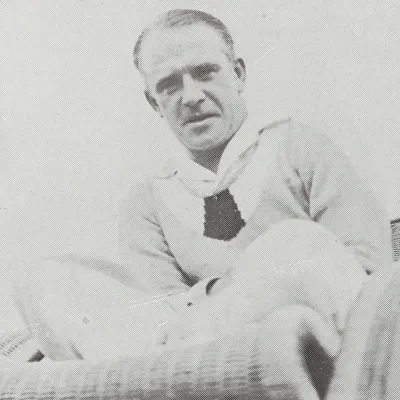
André Obey
Human Design Chart
Biography
Human Design Analysis: André Obey as Projector 6/2
Projector 6/2 — Design at a Glance
André Obey revealed himself as someone with a focusing aura that directly addressed his environment. His Human-Design type was Projektor, meaning he did not have his own constant life energy source but rather functioned like a bright flashlight: He illuminated areas in other people's systems that were still in the dark or not functioning properly. This ability allowed him to recognize errors in structures or relationships immediately.
However, this sharpness required tact. If André Obey had expressed his observations abruptly, it would often have been perceived as unpleasant by those around him - comparable to a light beam directly into someone's face. The most effective strategy for him was therefore to wait for an honest and appreciative invitation before offering his knowledge or leadership. By living harmoniously himself, he naturally became attractive; others came to him of their own accord to seek advice.
Since his Sacral Center was undefined, André Obey did not have a consistent energy supply. He experienced phases of high activity and fast workability, followed by necessary rest periods for regeneration. Ignoring this rhythm would quickly exhaust him. If he adhered to his strategy of invitation, he was rewarded with success; deviating from it sooner or later led to bitterness as an expression of his non-self. His design thus shaped a life based on targeted leadership and respectful distance rather than constant self-generated effort.
Splenic Authority
André Obey showed decision-making based on a fine, spontaneous impulse. His design carried authority in the Spleen Center, which presupposed that both the Emotional and Sacral Centers were open - a configuration only Projectors or Manifestors can have. The defined Spleen Center functioned as his internal alarm system and health monitor. It provided him with immediate knowledge about whether a situation, environment, or person was healthy and right for him. However, this impulse was extremely short-lived; it appeared only once in the current moment and could easily be overshadowed by other influences. Therefore, his inner voice required high vigilance. André Obey had to learn to recognize and immediately follow this first intuitive nudge, as delays destroyed the clarity of the signal. This enabled him to rigorously isolate harmful influences and protect himself effectively. Since his knowledge about what was right was always only available in the present moment, long-term plans were often hindering or unreliable for him. His design favored flexibility and spontaneous decisions over rigid commitments. He needed a lot of space to follow this inner guidance rather than getting entangled in fixed structures. A short retreat sometimes helped him hear the fine impulse of his Spleen Center more clearly before acting.
The 6/2 Profile — Role Model / Hermit
André Obey revealed himself as someone who throughout his life was torn between the urge for individual security and the necessity of deep transformation. In his youth, before the age of 30, the experimental phase of his design dominated: he sought his place through trial and error, withdrew after failures, and thus gathered a broad range of personal experiences. This early period served less to solidify than to exclude paths that did not fit him.
With the entry into the third decade of life, his basic attitude changed fundamentally. The wisdom of his configuration awakened as he internally withdrew to look at his earlier experiments with distance. This phase of intense introspection was for him neither a retreat from the world nor an escape but rather a process of healing and self-discovery. He learned not to resist mutation - that is, change - as a threat to his individuality but to accept it as a necessary part of his development.
His way of making decisions was characterized by selectivity and a certain inflexibility towards compromises touching on his core values. He rigorously examined possibilities before committing himself, knowing that every step could bring sacrifices or losses with it. Ultimately, André Obey emerged as a figure of wisdom whose deep insights and ability for self-reflection attracted others. People sought him out to learn from his clear perspective, which arose from years of inner work and the preservation of his own identity.
Single Definition — Defined & Open Centers
André Obey was marked by a defined Ajna Center, which endowed him with a constant and trustworthy mental function. His mind was always active; he processed data and creativity in a specific way that was barely influenced by others. This trait allowed him to create concepts and inspire others to think through his intellect. His thoughts were not fleeting but formed a stable foundation for his perception of the world.
This mental stability directly impacted his defined Throat Center. André Obey spoke what he thought; his communication was the direct translation of his conceptual processes into the outside world. He possessed a reliable voice that allowed him to articulate his inner images and theories clearly. There was no discrepancy between his thinking and speaking – whatever arose in Ajna found its way out through the Throat.
Another central aspect of his design was the defined Spleen Center, which gave him strong body awareness and spontaneous intuition for health and well-being. André Obey could make intuitive judgments in the “now,” based on a deep sense of survival and vitality. His immune system and instinct worked together to protect him from what was not healthy, giving him a feeling of inner comfort.
In contrast, André Obey revealed himself through several open centers as susceptible to external conditioning. His open Head Center meant he did not have consistent mental pressure or inspiration; he tended to take on the pressure of others and get entangled in questions that were not his own. Without a firm identity in the open G Center, he often adapted to his environment, sought direction through others, and was vulnerable regarding relationships and places.
His open Heart Center led him not to be consistently willful; he could fall into a cycle of proving his worth by making promises he couldn’t keep. The open Sacral Center made him sensitive to the energy of others, which could lead to exhaustion if he used “lent” vitality and ignored his own boundaries. Additionally, his open Solar Plexus absorbed emotions from the environment, causing him to fluctuate between moods without recognizing them as his own. Finally, his open Root Center took on the stress and adrenaline of his surroundings, driving him into cycles of frenzy followed by exhaustion when he tried to shed this non-own pressure.
Channels for intuitive perception, experiments and structured insight.
André Obey showed a fundamental approach that combined intuitive depth with technical perfectionism. His design suggested that through repeated experimentation and practice, he built his skills into unique talents. This occurred via the Channel of Structure 48-16, linking the Spleen Center to the Throat Center. Gate 48 always sought vital information while Gate 16 considered new experimental possibilities and perfected abilities. This combination allowed him to translate intuitive insights into precise, masterful performances, with recognition and resources being crucial for continuing this process.
Parallel to this, André Obey had the ability to express innovative perspectives clearly and efficiently. The Channel of Structure 23-43 connected his Ajna Center to the Throat Center. Gate 43 received spontaneous insights that were assimilated and articulated through Gate 23. This enabled him to formulate complex thoughts in a way that could change others’ thinking. Timing was key; only when his statements aligned with the flow of his design did his unique knowledge get accepted rather than rejected.
Additionally, specific gates influenced him. Gate 2 emphasized receptivity and the ability to transform mutations into new evolutionary directions. Gate 1 promoted his uniqueness and creative expression in the here and now without restrictions. Gate 49 brought a sensitive reaction to principles and emotional waves while Gate 4 developed logical formulas for future security. Finally, Gate 28 stood for making decisions in the present moment whether or not to take risks based on hard listening in the current situation.
Individual Circuitry — Circuit Signature
André Obey's design leaned towards precise structuring and logical analysis. His energy flowed through three directly connected centers: Ajna, Throat, and Spleen Center. This formed a continuous stream from mental formulation to expression to intuitive selection.
The Knowledge Circuit worked through him via the Channel 43-23 (Structure), linking the Ajna with the Throat Center. This connection allowed for pouring inner thoughts and concepts into clear, structured words. It was not about impulsive speaking but conscious shaping of knowledge for transmission.
Parallel to this, the Understanding Circuit operated through the Channel 16-48 (The Wave Length), connecting the Throat with the Spleen Center. Here came the ability to carry logical insights and strategic visions so articulately that they were practically applicable. The Spleen Center provided intuitive filtering of what was relevant; the Throat Center brought it into speech.
Since all three centers lay in a single group, André Obey had no internal conflict between thinking and expressing. His mental impulses (Ajna) could be directly translated into words that were finely tuned to a deep-seated intuitive truth (Spleen). This marked his style of communication: focused, structured, and reduced to essentials. He showed himself as someone who not only understood complex connections but articulated them in ways that became tangible and useful for others. His energy was geared towards connecting logical clarity with intuitive security to initiate change through precise expression.
Left Angle Cross of Defiance 1
André Obey's Human-Design profile established a foundational disposition marked by an awareness of obstacles. He was someone who did not perceive conflicts and resistances as mere disruptions but rather as necessary catalysts for his development. This configuration, known as the left cross of Challenge 1, described an internal dynamic where difficulties always acted as catalysts.
The mechanics of this design meant that André Obey only found his true strength and clarity through encounters with problems or resistances. Without these friction points, his potential remained latent; it was only in dealing with the challenge that his specific way of acting and reacting unfolded. This was not a passive acceptance of fate but an active engagement that shaped him.
This aspect of his Human-Design profile highlighted that his path was not free from obstacles, but rather that these obstacles were integral to his identity and growth. The challenge was no coincidence but a structural given in his chart, driving him to continually prove himself and find solutions in seemingly unsolvable situations. His strength lay precisely in the ability to transform resistance into forward motion.
Saturn Return · Uranus Opposition · Chiron Return · 2nd Saturn Return — Life Cycles
André Obey's Human-Design profile marked a tendency towards profound transformation processes that crystallized in specific life stages. In 1930, at age 38, he experienced worldwide success with the premiere of his play “Noé.” This coincided with the Uranus opposition, a cycle often forcing unexpected breaks or new perspectives and dissolving old structures to make way for innovation.
Another defining pattern emerged in 1941 during his Chiron Return at age 49. In this fulfillment cycle where one's incarnation cross unfolds and meaning becomes tangible, he wrote “800 Métres.” The play was based on his sports reports from the 1924 Olympics and marked a creative bloom phase that made his life mission palpable.
Confirmation of this development came in 1947 when André Obey, at age 55, was named a Knight of the Legion of Honour. This timing coincided with his second Saturn Return. While the first return often solidifies personal identity, the second return condenses years of groundwork into a sustainable, socially recognized outcome. This recognition underscored the stability and maturity that his design achieved in this life phase.
Projector · Splenic Authority — Synthesis
André Obey was a Projector whose life was marked by a deep ability to recognize patterns and point others towards their potential (Gate 48/16). This gift went hand-in-hand with an acute instinct for what is right - a Spleen Authority that provided him spontaneous inner knowledge. His defined Ajna Channel points to a continuous thought process enabling him to form concepts and challenge others through his perspective. This combination of perception, instinct, and mental clarity led him to deeply analyze the world around him and recognize new possibilities, as evidenced by concrete successes (1930, 1947).
A central paradox in his design lay in the interplay between projection and a need for withdrawal. As a Projector, he was destined to shine light on others and reveal their blind spots, yet the Profile as Role Model/Natural Talent also pointed towards an intense phase of self-reflection (Line 6), where he had to withdraw to process his own experiences. This oscillation between offering leadership and the need for distance formed a recurring rhythm in his life - a tension field between the desire to make something happen and the need for inner healing and wisdom.
2 Defined Channels
Incarnation Cross - Left Angle Cross of Defiance 1
Solar Return
The Solar Return shows the moment when the sun returns to its exact birth position - your personal solar year.
Life Cycles
Discover the life cycles with a detailed triple view (birth chart, cycle chart, composite).
Human Design Profile
- Type
- Projector
- Strategy
- Wait for the respectful invitation
- Authority
- Splenic Authority
- Profile
- 6/2 - Role Model / Hermit
- Definition
- Single Definition
- Incarnation Cross
- Left Angle Cross of Defiance 1
- Date of Birth
- 08.05.1892 15:00
- Place of Birth
- Douai, France
Frequently Asked Questions
What Human Design type did André Obey have?
Which Profile did André Obey have?
What Authority did André Obey possess?
What incarnation cross did André Obey have?
When was André Obey born?
Discover your own Human Design
Are you also a Projector? Find out in a personal reading how to unfold your leadership qualities and recognize the right invitations.
More Personalities
Back to overviewSissy Spacek

Alain-Fournier

Anémone

Angeli

Ann-Margret

Bourvil
