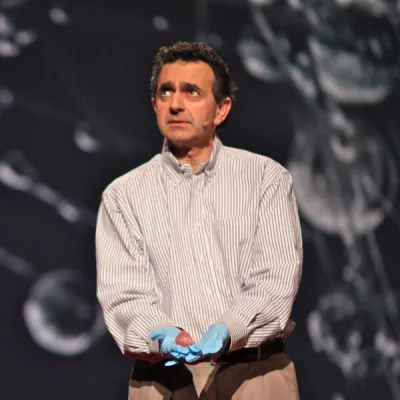
Anthony Atala
Human Design Chart
Biography
He is the W.H. Boyce professor of urology, the founding director of the Wake Forest Institute for Regenerative Medicine, and the chair of the Department of Urology at Wake Forest School of Medicine in North Carolina. His work focuses on the science of regenerative medicine: "a practice that aims to refurbish diseased or damaged tissue using the body's own healthy cells".
As director of the Wake Forest Institute for Regenerative Medicine, Dr. Atala leads a team of more than 400 researchers dedicated to developing cell therapies and engineering replacement tissues and organs for more than 40 different areas of the body.
Dr. Atala is Editor of 3 journals and 25 books including Principles of Regenerative Medicine, Foundations of Regenerative Medicine, Methods of Tissue Engineering and Minimally Invasive Urology. He has published over 800 journal articles and has received more than 250 national and international patents. Fifteen technology applications developed in Dr. Atala's laboratory have been used clinically.
Anthony Atala as a Projector 1/4 in Human Design
Projector 1/4 — Design at a Glance
Anthony Atala's design showed a tendency towards focused perception. As a projector, his aura acted like an intense beam of light that uncovered system errors and hidden connections immediately. However, this ability to bring 'light into the dark' for others was often perceived as unpleasant, akin to shining directly into someone's face. Instead, his design demonstrated the effectiveness of harmonious self-illumination. By setting a positive example, he attracted others rather than confronting them.
The central strategy involved waiting for an appreciative and honest invitation from the environment before taking on a leadership role. This was closely tied to his energy distribution: His open Sacral Center indicated the absence of a constant life-energy source. Instead, he worked in phases of high intensity followed by mandatory rest periods for recharging. This rhythm was essential to avoid burnout and prevent bitterness as a theme of non-self. Living according to this pattern – through restraint from unwanted illumination and respect for his energy cycles – rewarded him with success. Thus, the design did not demand constant action but strategic presence and the ability to maintain one's frequency so that others would seek advice on their own.
Self-Projected Authority
Anthony Atala's design showed a tendency towards extreme openness, coupled with the risk of losing energy in motoric environments or being distracted by external influences. This configuration marks the Projector Authority 'Authority in Self', a rare mechanism where inner truth stems directly from identity.
Decision-making here does not occur through logical analysis but rather distinguishes between spontaneous self-expression and reflective thought. What Anthony Atala spoke spontaneously, without prior consideration – whether in monologues or animated dialogues – expressed his true essence. This unmediated expression also served to make his uniqueness visible to others.
Alternatively, this authority manifested through physical attraction or repulsion. Anthony Atala felt a physical pull towards specific geographic or thematic directions. By following this inner compass rather than orienting externally, he could act as a guide for others. The specific success potential lay in staying true to one's own direction and not falling into the trap of constant energy chasing within an open structure. The challenge always was to separate the spontaneous impulse of self from the noise of the mind to act authentically.
The 1/4 Profile — Investigator / Opportunist
Anthony Atala's design showed a tendency towards synthesis, combining deep, detail-oriented research with the urge to share this knowledge in a familiar network. As a 1/4 profile, he sought thorough understanding (Line 1) to then disseminate it within a community of trusted individuals (Line 4). This configuration also created specific vulnerability: The fear of exposure due to incomplete knowledge. Since Line 4 is the 'big heart' emotionally connected to the social environment, failure or lack of knowledge in front of loved ones would cause intense pain.
Therefore, for Anthony Atala, a loving environment with deep trust was crucial. Only within such secure frameworks could his authority in the Heart theme fully come into play. Line 1 emphasized detailed work, caution, and routine as the foundation for lifelong rituals, while Neptune fostered creativity in handling details. Simultaneously, the design warned against hasty experiments without careful scrutiny (Mars).
The fourth line functioned as a mediator in collective processes and supported others' growth. Here, pragmatism and maturity were necessary not only to maintain social exchange but actually be effective. Without this inner development, lack of maturity could hinder personal growth. Anthony Atala thus emerged as someone who fulfilled his role as an authority and network announcer through careful preparation and trusting relationships, with the balance between detail accuracy and social connection shaping his path.
Single Definition — Defined & Open Centers
Anthony Atalas Design laid the foundation for inner clarity: His defined Throat gave him a constant, reliable voice that spoke directly from his also defined G Center. This meant that his communication and actions were always guided by his personal identity and direction, not by mental analyses or emotional impulses. He showed himself to be someone who acted from a deep sense of unity with his Higher Self and could show others authentic directions without needing their approval.
This stability contrasted with his seven open centers – Head, Ajna, Heart, Sacral, Solar Plexus, Spleen, and Root. These were designed as sensors to pick up inspiration, willpower, vital energy, emotions, and stress from the environment without possessing them. The challenge lay in not personalizing these absorbed energies. So he tended to question whether mental confusion or pressure was his own problem or if he unconsciously absorbed others' uncertainty. Similarly, his open Heart Center made him vulnerable to wanting to prove his worth through promises, a pattern that did not align with his nature. Likewise, his open Solar Plexus picked up foreign emotions, leading him to swing between happiness and depression without clearly identifying the source of these feelings.
His design challenged him to use these open windows as informative mirrors rather than identifying with the states reflected in them. By making decisions from the calmness of his G Center instead of mental haste or emotional impulse, he could utilize the wisdom of his open centers: He became an observer of mental inspiration and emotional climate without being trapped within it. His strength lay in his ability to make these external influences permeable while his voice remained clear and unwavering from his inner core.
Channels for logical, future-oriented leadership.
Anthony Atala's Human Design profile indicates a tendency towards collective, logical leadership. He is someone who does not exercise authoritarian rule but gains influence by recognizing established patterns and communicating with a voice that inspires trust. His leadership role is based on invitation from the group; it only functions when recognized as beneficial for the common path.
This dynamic is determined by Channel 7-31, The Alpha Animal. This channel connects the G Center to the Throat Center. Gate 7 provides the logical role of pattern recognition and understanding current trends—often described as "the power behind the throne." Gate 31 lends the voice a valuable influence that invites cooperation. Together they enable leadership based on shared responsibility: Anthony Atala demonstrates competence to win the majority's trust. As long as he receives this acknowledgment and correctly interprets current patterns, he can guide the way. Authority is thus representative and conditional upon collective consent, not imposed.
Additionally, other energies shape his profile. Cross Gate 62 emphasizes logic, detail, and patience in pattern recognition to clearly articulate facts. Gate 61 represents inner truth and the struggle for silence amidst internal noise. Gate 42 highlights experience as a key to growth and concludes processes. Gate 32 ensures continuity and evaluates situations for material stability while implementing radical changes when necessary. On a personality level, Gate 12 acts with restraint and mutative creativity, influenced by emotional mood. Gate 45 consolidates tribal energy and expresses willpower connected to material security. Gate 33 promotes reflection and active withdrawal to process experiences.
Collective Circuitry — Circuit Signature
Anthony Atala's Human Design profile indicates a tendency towards logical strategy and structured future visioning. His focus was on improving societal conditions through rational thinking that operated free from emotional influence. This manifested as a clear separation between cognitive analysis and affective reactions; the mind took precedence, unclouded by the Solar Plexus, which did not play a role in his circuitry.
This approach stemmed from the Understanding Circuit. In Anthony Atala's case, this specifically connected the Throat Center with the Identity Center via Channel "The Alpha Animal." This connection created a direct bridge between his inner core and external articulation. He could share structured energy focused on visual thinking and future possibilities. The mechanics described communicating rational insights as a central drive – ideally unburdened by conditioned patterns or social expectations.
Given that Anthony Atala had a simple definition, these connected centers formed a coherent, continuous flow. There were no separate energetic poles within this system; instead, the energy worked linearly and purposefully from identity to verbal or action-oriented expression in the Throat Center. This supported a consistent way of structuring and conveying complex logical connections, always with the implicit goal of steering positive change into the future through clarity and strategic focus.
Right Angle Cross of Maya 2
Anthony Atala's Human Design shows a tendency to deeply identify with the collective heritage and spiritual dimension of humanity. His configuration, the right cross of the Maya, marks him as a custodian of wisdom, tradition, and cultural continuity. This is not just about preserving old things but actively carrying the responsibility for knowledge accumulated over generations.
This structure describes a life task: The deep connection to the past serves as a foundation to lead humanity towards a higher level of consciousness. It involves understanding hidden connections from earlier times and conveying these insights in ways that remain relevant today. Anthony Atala, through this design, is someone who does not just look at the present but always looks back for strength to move forward.
The need to pass on knowledge is central here. It's a bridging function between the past and future. Through this approach, he becomes an intermediary of values that transcend individual horizons. His focus lies in ensuring that important lessons do not get lost but remain as living parts of human development. Thus, his presence stabilizes and guides during times of change.
Saturn Return · Uranus Opposition · Chiron Return · 2nd Saturn Return — Life Cycles
Around 2006, Anthony Atala showed a clear shift from internal preparation to concrete, tangible implementation. His design indicated that long-held visions would now transform into real results – a process experienced not as healing old wounds but as fulfilling one's purpose.
The Chiron Return in Human Design marks a fulfillment cycle: Those who have lived according to their strategy and authority experience a period of flourishing where the incarnation cross fully unfolds its power. It is the transition from seeker to giver, with inner clarity manifesting outwardly.
This mechanical background reflects concretely: In 2006, at age 48, the first lab-grown bladder was transplanted into a human. This event does not stand alone but embodies the peak of a maturation phase. The long preparatory work condensed into a viable result that went beyond mere theory. Anthony Atala's chart points to such turning points as serving to transform abstract concepts into real action. Here, the focus is on effectiveness and benefit for others – exactly what characterizes the Chiron Return as a giving phase. The connection between scientific precision and human impact became visible.
Projector · Self-Projected Authority — Synthesis
A central red thread runs through the design: the ability to recognize patterns and convey this information. This manifests in the combination of defined G-Center (Identity) and Throat Center (Communication), reinforced by the Alpha Animal Channel. A focus on details (Gate 62) and a quest for inner truth (Gates 61, 42) underpin this drive to explore knowledge and logically present it – a skill given naturally in the context of defined centers. The openness of many other centers points to high sensitivity to the environment, which strengthens pattern recognition but also necessitates periods of rest to process absorbed information.
The central paradox lies in the tension between the urge for leadership and the lack of sacral authority. The design indicates a natural ability to initiate collective processes (Alpha Animal Gate), yet open centers – especially Root and Sacral – make it difficult to sustain energy for these initiatives or make spontaneous decisions. This discrepancy leads to potential dependence on external energies and constant oscillation between activity and exhaustion, while inner authority relies on self-conversations and internal signals.
1 Defined Channel
Incarnation Cross - Right Angle Cross of Maya 2
Solar Return
The Solar Return shows the moment when the sun returns to its exact birth position - your personal solar year.
Life Cycles
Discover the life cycles with a detailed triple view (birth chart, cycle chart, composite).
Human Design Profile
- Type
- Projector
- Strategy
- Wait for the respectful invitation
- Authority
- Self-Projected Authority
- Profile
- 1/4 - Investigator / Opportunist
- Definition
- Single Definition
- Incarnation Cross
- Right Angle Cross of Maya 2
- Date of Birth
- 14.07.1958 08:25
- Place of Birth
- Lima, Peru
Frequently Asked Questions
What is Anthony Atala's Human Design type?
What profile does Anthony Atala have in Human Design?
What authority determines Anthony Atala's decisions?
What is Anthony Atala's incarnation cross?
When was Anthony Atala born?
Discover your own Human Design
Are you also a Projector? Find out in a personal reading how to unfold your leadership qualities and recognize the right invitations.
More Personalities
Back to overviewSissy Spacek

Alain-Fournier

Anémone

Ann-Margret

Bourvil
Hergé