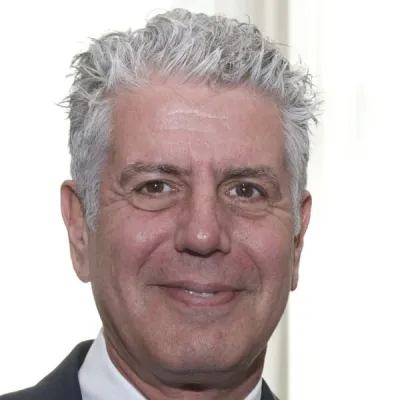
Anthony Bourdain
Human Design Chart
Biography
Bourdain married his high school girlfriend, Nancy Putkoski, in 1985, and they remained together for two decades, divorcing in 2005. On April 20, 2007, he married Ottavia Busia, a mixed martial artist. The couple's daughter, Ariane, was born in 2007. Bourdain noted that having to be away from his wife and child for about 250 days a year working on his television shows became a strain. Busia appeared in several episodes of No Reservations—notably the ones in Sardinia (her birthplace), Tuscany (in which she plays a disgruntled Italian diner), Rome, Rio de Janeiro, and Naples. The couple separated in 2016. In 2017, Bourdain began dating the Italian actress Asia Argento, whom he met when she appeared on the Rome episode of Parts Unknown.
On 8 June 2018, Bourdain was found dead of an apparent suicide by hanging in his room at Le Chambard hotel in Kaysersberg, France. The public prosecutor for Colmar said that Bourdain's body bore no signs of violence, that toxicology tests would determine whether drugs or medications were involved, but that the suicide appeared to be an "impulsive act.
Anthony Bourdain — Manifesting Generator with Profile 1/3
Manifesting Generator 1/3 — Design at a Glance
Anthony Bourdain revealed himself as someone who united a hybrid energy: the constant power of a Generator paired with the lightning-fast assertiveness of a Manifestor. His design suggested that he could draw things into his life by skipping steps and acting quickly. This ability, however, came with a specific danger. If he acted too fast or skipped important phases, it often led to frustration – his theme of not-self. Additionally, he tended to pursue multiple projects simultaneously, driven by various impulses.
The mechanics of his design as a Manifesting Generator required a clear strategy: He should not initiate but react to external stimuli. Only when his Sacral Center – the source of his constant energy – gave a clear "yes" was it advisable to proceed. Without this inner approval, his creative enthusiasm quickly turned into exhaustion. With proper application of this reactive tactic, however, he could experience deep satisfaction. His design benefited from variety and a playful approach to parallel tasks. The pressure to complete one thing before starting the next stood in opposition to his natural work style. Instead, his energy flourished when operating in "play mode" and embracing impulses that were internally reinforced. This allowed him to effectively function despite the complexity of his hybrid nature, advancing his projects with passion as long as he respected the rhythm of his inner approval organ.
Emotional Authority
Anthony Bourdain was guided by an internal rhythm that revealed quick judgments as deceptive. His emotional authority defined his decision-making process: the defined Emotional Center always served as a compass, independent of other defined areas in his design. He moved in waves of intense enthusiasm and deep disappointment. What fascinated him one moment could appear negative the next. These mood swings were not mistakes but rather the natural mechanism of his perception.
However, his current emotional state was only a snapshot, not the final truth. Spontaneous reactions to these passing waves would often lead him astray. Instead, his structure required patience and time. Anthony Bourdain had to let decisions mature, ideally overnight. Only through "sleeping on it" did intense feelings subside, creating an emotional distance. In this calm, true clarity emerged. This process was particularly crucial for long-term steps that influenced the course of his life. He learned to hesitate and ask himself multiple times until the emotional flood subsided. Only then could he act calmly, detached from the passing wave. This need for time served to distinguish deeper insights from superficial impulses.
The 1/3 Profile — Investigator / Martyr
Anthony Bourdain revealed himself as someone whose judgments were based on a rare combination of deep theoretical knowledge and hard practical experience. His design indicated a tendency to not just superficially examine things but to thoroughly investigate them both intellectually and empirically. This aligned with his Profile 1/3, the Researcher and Experimenter. Line 1 urged him to pause, focus, and assess the consequences of his actions before acting. There was an inner pressure to know enough to avoid wasting energy on hasty decisions. At the same time, Line 3 drove him to actively experiment and learn from mistakes. This dynamic meant that Anthony Bourdain despised shortcuts; he believed that only detailed work and direct experience created true understanding. When he spoke out about something or made a judgment, he had previously examined it thoroughly. His authority did not come from mere theory but from having experienced the consequences of his actions firsthand. This process of learning through trial and error gave his assessments high credibility because they were both logically sound and practically validated.
Triple Split Definition — Defined & Open Centers
Anthony Bourdain revealed himself as someone whose energy was generated by responding rather than initiating. His defined Sacral Center provided a vital source of power that was only available when he gave affirmative responses to questions; ignoring these sacral tones led to frustration and resistance. At the same time, he carried a constant mental pressure through his defined Head and Ajna Centers. This configuration produced continuous inspiration and questions, but without direct energy for implementation, it required patience to endure this pressure and wait for the right moment to offer ideas rather than hastily expelling them.
His decision-making was marked by the defined Solar Plexus Center as an inner authority. Here, there is no truth in the now. Anthony Bourdain had to wait out the emotional wave until clarity emerged before acting; impulsive decisions at the peak or trough of emotions led to chaos and later regret.
In contrast to this internal structure, his open centers marked situational vulnerabilities. His open G Center meant that identity and direction were not fixed but reflected by environment and place; he tended to question whether the current context was correct rather than proving a firm "I" structure. Similarly, his Heart Center was open regarding willpower and promises. Anthony Bourdain did not have the consistent energy to bolster self-worth through competition or keeping promises; attempting to prove himself through performance would have exhausted him. His strength lay in using these open areas as mirrors for others rather than trying to fill them with mental constructs.
Channels for logical clarity, focus, judgment and emotional change.
Anthony Bourdain revealed himself as someone whose mind was marked by an unbending logical scrutiny and precise focus. His design suggested a skeptical mind that accepted answers only if they were verifiable. The Channel of Logic 63-4 connected the Gate of Doubt with the Gate of Formulation; this doubting mind constantly filtered patterns to test their consistency. Skepticism here was not an obstacle but an essential filter: An answer was considered logical only if it presented a consistent, practical pattern. Unfounded belief found little space; the pressure to understand patterns served to make useful predictions for the collective.
This analytical stance was deepened by the Channel of Concentration 52-9. As Format Energy, this channel carried the qualities of the entire circuit and enabled deep focus on details. Through the Gate of Non-doing (52) and the Gate of Focusing (9), a calm pressure arose to stay still and keep distractions at bay. Anthony Bourdain constantly evaluated the details of what he was devoted to, gathered his energy like in a yoga pose, and perfected patterns through sustained attention. This concentration was the prerequisite for applying logic step by step.
The urge for correction came from the Channel of Judgment 58-18. It connected the Gate of Vitality with the Gate of Correcting and drove the insatiable impulse to improve patterns ("better and more"), while simultaneously checking what was out of balance. This judgment served as a sentry for collective satisfaction. Criticism was effective only if it was requested; unsolicited evaluations often led to rejection, whereas answering the question "Is something wrong here?" could bring great joy. The synthesis of skeptical logic, unshakable concentration, and correcting judgment defined a personality that penetrated patterns and shared solutions only when they were logically sound.
Collective Circuitry — Circuit Signature
Anthony Bourdain's Human Design profile inclined towards a cooler, strategic analysis driven by the desire to rationally improve things. This was evident through the Understanding Circuit, which emphasized logic and structure. In his case, this circuit connected two separate segments: on one hand, the Head Center with the Ajna Center (Channel 63-4), generating quick, focused ideas; on the other hand, the Sacral, Root, and Spleen Centers (Channels 9-52, 18-58), providing logical judgment and concentrated energy. This connection created an "emotionless ratio," acting without conditioned feelings.
Parallel to this was a completely independent area: the Defining Circuit. As Anthony Bourdain had a Triple Definition, this right side of his chart was energetically disconnected from the logical centers. Here he connected the Throat Center with the Solar Plexus Center (Channel 35-36). This channel highlighted transience and cyclical emotional waves from the past. While the left side of the chart was future-oriented and rationally structured, the right side reflected past experiences in a wave-like manner. Both systems ran alongside each other: on one hand sharing clear, logical strategies for a better future; on the other hand expressing emotional insights from the past to learn from them. This separation meant that rational planning and emotional reflection did not merge but rather worked as parallel independent forces.
Right Angle Cross of Service 2
Anthony Bourdain's identity was deeply shaped by the need to serve and help others. His self-worth did not stem from isolated achievements but rather from doing good for others. This attitude formed the foundation of his life: he sought meaning in concrete support and service to communities or individuals.
This orientation arose from the configuration of the right Service Cross 2 in Human Design. This aspect describes not passive subordination, but an active, deeply rooted necessity to realize oneself through service. For Anthony Bourdain, helping was not a mere hobby; it was a central mechanism for self-validation. When he could be useful to others, he felt most aligned with himself. The energy of this cross drives one to take responsibility for the well-being of others and thereby affirm one's own existence.
It was an intrinsic motivation: doing good was the path on which he felt his own dignity. Without this service to others, his inner foundation would have been shaken. His design suggested that he functioned best where he was needed and could make a concrete contribution. This structure created a clear direction – away from egoism towards dedication – which profoundly shaped his actions and helped him find his place in the world.
Saturn Return · Uranus Opposition · Chiron Return · 2nd Saturn Return — Life Cycles
Anthony Bourdains professional development followed a clear cyclical structure marked by recurring planetary influences. His design showed the ability to use external milestones as internal reference points.
1985, at age 29, his first Saturn Return occurred. This cycle often marks the transition from playful experimentation to serious commitment. Bourdain enrolled in a writing workshop with author Gordon Lish – a concrete decision that steered his career towards literature and condensed years of groundwork.
Ten years later, in 1995 at age 39, the Uranus Opposition took effect. This aspect often demands sudden changes or breaking away from established patterns. That year he published his first book, the culinary crime novel "Bone in the Throat." The success confirmed his new identity as an author and demonstrated how disruptive energies could be creatively channeled.
In 2005 at age 49, he experienced his Chiron Return. This cycle is not a healing process in a medical sense but rather a phase of fulfillment where one's life purpose unfolds. Bourdain began moderating culinary and cultural adventure programs on the Travel Channel. His work became a visible expression of his purpose.
His second Saturn Return in 2013 at age 57 solidified this role. The premiere of the series "Anthony Bourdain: Parts Unknown" on April 14 symbolized the maturity and consistency of his professional identity, which had been structured over decades.
Manifesting Generator · Emotional Authority — Synthesis
Anthony Bourdain's life was marked by a deep longing for authenticity and experience, fueled by the combination of a Manifesting Generator with emotional authority, an Investigating Profile, and defined centers for thinking, speaking, and sacral energy. This configuration created an unrelenting drive to explore the world, recognize patterns (Gate 63), and express these insights through communication (defined Throat Center). The ability to quickly adapt to new impulses – a trait of the Manifesting Generator – was always accompanied by the necessity to let emotions mature before making decisions. This led to a life full of intense experiences and an ongoing search for the "true" taste of things, both culinary and cultural.
Central to Anthony Bourdain was an inner paradox: the tension between the need for control and letting go into the flow of life. His defined Root Center constantly demanded action and engagement, while his emotional Solar Plexus required clarity through waiting out the emotional wave. This field of tension manifested in a life equally marked by quick decisions and deep reflection – a constant interplay between initiating and reacting to the world around him.
4 Defined Channels
Incarnation Cross - Right Angle Cross of Service 2
Solar Return
The Solar Return shows the moment when the sun returns to its exact birth position - your personal solar year.
Life Cycles
Discover the life cycles with a detailed triple view (birth chart, cycle chart, composite).
Human Design Profile
- Strategy
- To respond - wait for something to respond to
- Authority
- Emotional Authority
- Profile
- 1/3 - Investigator / Martyr
- Definition
- Triple Split
- Incarnation Cross
- Right Angle Cross of Service 2
- Date of Birth
- 25.06.1956 08:35
- Place of Birth
- New York, NY, United States
Frequently Asked Questions
What was Anthony Bourdain's Human Design type?
What profile did Anthony Bourdain have in Human Design?
Which authority guided Anthony Bourdain's decisions?
What incarnation cross did Anthony Bourdain have?
When was Anthony Bourdain born?
Discover your own Human Design
Are you also a Manifesting Generator? Find out in a personal reading how to unfold your multi-talents and direct your energy wisely.
More Personalities
Back to overviewAldair
Alizée

Angeli

Arletty
Artus
Balthus