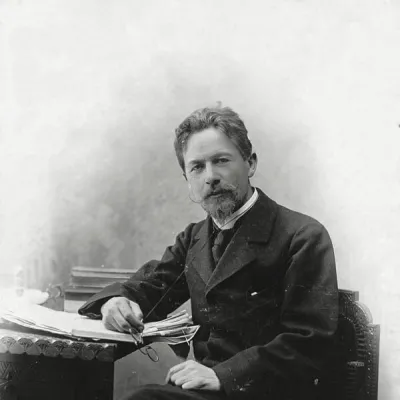
Anton Chekhov
Human Design Chart
Biography
29 January [O.S. 17 January] 1860 – 15 July [O.S. 2 July] 1904) was a Russian playwright and short story writer, widely considered one of the greatest writers of all time. His career as a playwright produced four classics, and his best short stories are held in high esteem by writers and critics. Along with Henrik Ibsen and August Strindberg, Chekhov is often referred to as one of the three seminal figures in the birth of early modernism in the theatre. Chekhov was a physician by profession. "Medicine is my lawful wife," he once said, "and literature is my mistress."
Chekhov renounced the theatre after the reception of The Seagull in 1896, but the play was revived to acclaim in 1898 by Konstantin Stanislavski's Moscow Art Theatre, which subsequently also produced Chekhov's Uncle Vanya and premiered his last two plays, Three Sisters and The Cherry Orchard. These four works present a challenge to the acting ensemble as well as to audiences, because in place of conventional action Chekhov offers a "theatre of mood" and a "submerged life in the text."
Chekhov began writing stories to earn money, but as his artistic ambition grew, he made formal innovations that influenced the evolution of the modern short story. He made no apologies for the difficulties this posed to readers, insisting that the role of an artist was to ask questions, not to answer them.
Anton Chekhov — Projector with Profile 1/3
Projector 1/3 — Design at a Glance
Anton Chekhov's design tends towards a dense, focused aura that immediately recognizes systemic errors. As a projector, his energy acts like a bright flashlight, illuminating areas in others that are still in the dark. However, this ability to identify inconsistencies directly is often met with a specific challenge: direct confrontation frequently leads to feelings of attack and negative reactions from those around him.
Therefore, the mechanics of his design require waiting for an honest invitation rather than imposing his observations. Anton Chekhov was most effective when he led by example, living harmoniously and attracting others naturally; they sought his advice voluntarily because they valued the clarity of his perspective. This approach avoided unnecessary conflicts and utilized his natural charisma.
Furthermore, Anton Chekhov lacks a defined Sacral Center, meaning he does not have constant intrinsic life energy. His energy flow is cyclical: phases of high productivity and quick workability alternate with necessary rest periods. These pauses are essential to prevent burnout. Living according to this rhythm and waiting for others' invitations rewarded him with success; deviations from this strategy eventually led to experiencing his non-self theme, bitterness. Thus, his design demanded patience and respect for his own energy balance to fully realize his potential.
Self-Projected Authority
Anton Chekhov's design tends towards extreme openness coupled with the constant danger of losing himself in external motoric energies. As a projector with rare 'authority in self', his inner truth is anchored in his identity. This configuration requires high vigilance against being distracted by others' energy; the central trap lies in not misusing this openness to constantly chase external validation.
His decision-making occurs through two channels: first, through self-dialogues or dialogues when invited. Crucial here is listening to his own speech and distinguishing spontaneous thoughts – expressions of true essence – from reflective thinking. This spontaneous expression makes his uniqueness recognizable to others. Second, a physical attraction or repulsion guides him geographically or thematically in certain directions. By following this inner direction faithfully, he can become a guide for others and unlock his specific success potential. This mechanism describes less active action than reactive clarity: Anton Chekhov is strongest where he listens to his own identity rather than being carried away by surrounding energy.
The 1/3 Profile — Investigator / Martyr
Anton Chekhov's design tends towards a cyclical learning process: first, careful theoretical examination, then practical experimentation. As a researcher and experimenter (Profile 1/3), he seeks self-tested, reliable insights. The tension lies between the urge for thorough preparation and the necessity of learning through mistakes.
Line 1, marked by Gate 19, emphasizes mutual dependence and careful scrutiny of resources and partners before engagement to avoid identity loss due to one-sided dependency. Chekhov scrutinized approaches with heart and soul to ensure individual peculiarities were recognized without losing himself.
Simultaneously, Line 3, featuring Gate 44, focuses on adaptation through direct experience. Here it's about breaking illusions and projections. Consciousness alone is not enough; willpower in the trunk is necessary to recognize obstacles and enter or break bonds consciously.
Trust with Anton Chekhov only arises after combining theoretical examination (Line 1) and practical validation through mistakes (Line 3). His judgments are only absolutely trustworthy when both processes are complete. He learns not just intellectually but must test reality to understand what truly works.
Split Definition — Defined & Open Centers
Anton Chekhov's Design created a tendency for constant mental pressure that drove continuous questioning and understanding. This configuration established a reliable way of communication as defined Head Center and Ajna Center provided the inspiration which was articulated through a defined Throat Center. His inner identity was set; a defined G Center offered him clear direction in life along with stable self-love, independent of external validation.
The challenge lay in not balancing this permanent mental pressure through hasty actions. Since Head and Ajna do not have direct energy for implementation, attempting to realize thoughts immediately often led to frustration or inner worry. Instead, this pressure served as a source of ideas that could inspire others if processed with patience. The defined G Center protected his direction but required vigilance: the risk was forcing others to follow this path or giving up on himself to meet other people's expectations.
At the same time, Anton Chekhov was exposed to several open centers making him susceptible to conditioning. His open Heart Center tended towards wanting to measure worth through proof, which could lead into a cycle of promises and disappointment. The open Sacral Center received foreign vital energy, promoting overexertion as no consistent personal power was available. Furthermore, the open Solar Plexus Center absorbed the emotions of the surroundings, causing him to waver between others' moods and make emotional decisions that he later regretted. These mechanisms appeared as a tension field: while his mind and identity were clearly structured, he had to learn to deal with fluctuating energies of willpower, vitality, and emotion without personalizing them or directing them against himself.
Channels for inner reflection and rational clarity.
Anton Chekhov's Design established a foundational disposition of patient observation, paired with a mental process that relied on spontaneous insight rather than logical planning. His mechanics were evident through two dominant channels: Channel Lost Son 13-33 and Channel Awareness 61-24.
The first established a cyclical process of listening (Gate 13), gathering secrets and experiences, followed by withdrawal for reflection (Gate 33). Anton Chekhov patiently waited for hidden truths to surface beneath the surface before he communicated them. This was not an act of prediction but rather the result of maturation until the end of the cycle when he observed the sequence of events to gain wisdom.
Parallel to this, Channel Awareness 61-24 acted as his mental engine. Inspiration from the unconscious (Gate 61) was processed through rationalizing thought (Gate 24), leading to a spontaneous mutation or sudden insight. This process was uncontrollable; Anton Chekhov had to surrender to his own pace because "insight" only occurred when it did. It was not about discovery through analysis but rather the transformation of auditory inspiration into rational response.
These core channels were modified by Personality Gates: Gate 19 brought a need for resources and spiritual community connection; Gate 44 added vigilance and cellular memory; Gate 4 sought logical formulas for future security; Gate 20 focused on authenticity in the here-and-now. These elements underlay the energy of the main channels, so Anton Chekhov's essence was primarily shaped by gathering life experiences and digesting them until clear, often unexpected insights emerged.
Individual Circuitry — Circuit Signature
Anton Chekhov's Design presented a tension between the pulsating search for new knowledge and the cyclical, emotional reflection on past experiences. This shared definition created two parallel existing yet not directly connected energy fields.
In the Knowledge Circuit, Channel 24-61 (Awareness) linked the Head Center with the Ajna Center. This promoted innovative flashes of insight and deviation from the known. The energy was pulsating and acoustic, driven by the urge to express unique identity and transform new knowledge. It was an immediate creative intuition that heralded change.
Completely separate from this, the Meaning Circuit operated. Here, Channel 33-13 (The Lost Son) connected the Throat Center with the Identity Center. This connection channeled cyclical emotions and experiences from the past into expression. The energy followed a wave-like structure with beginning, middle, and end, often accompanied by melancholy or descending emotional currents. The goal was to find meaning behind past events and share these insights with the collective to learn together.
While one field was based on innovation and individual creativity, the other focused on emotional learning and processing of the past. Anton Chekhov lived in the integration of these two different rhythms: the acoustic, impulsive creation of new connections on one hand and the visual, cyclical immersion into emotional truths on the other. Both aspects shaped his way of living identity and sharing knowledge without overlapping energetically.
Right Angle Cross of the Four Ways 4
Anton Chekhov's Design established an existential landscape that was marked by the archetypal structure of the "Right Cross of Four Paths." This configuration created an inner dynamic in which the search for one’s own path stood at the center—not as a straightforward journey, but as an ongoing process through a world full of possibilities and dead ends. For him, orientation was not a given state, but something that emerged through action.
The Right Cross of Four Paths describes a life task of searching, wandering, and finding. It is about the tension between the desire for clarity and the reality of multifaceted options. Anton Chekhov showed himself to be someone who did not simply find his path, but had to carve it out through trial and error. The experience of getting lost was thus not a mistake, but an integral part of development. This structure emphasized the necessity of finding one’s way in the jungle of alternatives without an external authority pointing the way. The lack of orientation was therefore not a weakness, but the starting point for authentic self-discovery. His Design challenged him to accept this multifaceted reality and develop his own direction within it by understanding various paths not as obstacles, but as necessary steps on his individual journey.
Saturn Return · Uranus Opposition — Life Cycles
Anton Chekhov's Design showed a clear dynamic between the drive for inner structure and the simultaneous need to free oneself from external constraints. At the age of 28, during his first Saturn return, he received the Pushkin Prize for "At Dusk." This cycle typically marks a phase of maturation in which years of hard work condense into stable recognition and establish one's authority in life.
In contrast, around the age of 40, he faced a Uranus opposition, a time of breaking with established structures. In 1900, Anton Chekhov was elected an honorary member of the Academy of Sciences. This institutional affiliation did not align with his inner mechanics of freedom and independence. Two years later, he resigned from membership. This step illustrates the Uranus energy: it questions authoritative or rigid systems and forces a separation when they contradict individual essence. While the Saturn return brought validation through achievement, the Uranus opposition demanded the rejection of titles that were felt as limiting. This configuration describes a life path oscillating between the necessity to prove oneself and be recognized, and the imperative drive to reject any form of mental or social bondage. The mechanics here do not show contradiction but two necessary poles: building through discipline and liberation through distancing.
Projector · Self-Projected Authority — Synthesis
Anton Chekhov lived a lifestyle characterized by a profound urge to explore and a desire for authentic understanding. As a Projector with defined authority in Self, he constantly sought the truth not through external validation but through listening inwardly (Self-Authority) and careful observation (Line 1). This process was amplified by the Channel of the Lost Son, which encouraged him to gather experiences, reflect on them, and ultimately gain deep insights – insights that he could then share. The Knowledge Circuit drove him to explore new paths and express his unique perspective, even if this came with melancholy or internal pressure (defined Head Center).
Chekhov's design revealed a central paradox: He projected light onto the flaws of others, immediately recognizing imbalances (Projector), yet withdrew to process these observations and transform them into deeper truths (Gate 33). This tendency towards reflection was in tension with the explorer’s drive (Profile 1/3) to make direct experiences and learn from them. The recognition through the Pushkin Prize and election as an honorary member of the Academy, followed by his resignation, pointed to a ambivalence toward external success – he sought validation for his work but remained true to his inner truth.
2 Defined Channels
Incarnation Cross - Right Angle Cross of the Four Ways 4
Solar Return
The Solar Return shows the moment when the sun returns to its exact birth position - your personal solar year.
Life Cycles
Discover the life cycles with a detailed triple view (birth chart, cycle chart, composite).
Human Design Profile
- Type
- Projector
- Strategy
- Wait for the respectful invitation
- Authority
- Self-Projected Authority
- Profile
- 1/3 - Investigator / Martyr
- Definition
- Split Definition
- Incarnation Cross
- Right Angle Cross of the Four Ways 4
- Date of Birth
- 29.01.1860 00:10
- Place of Birth
- Taganrog, Russia
Frequently Asked Questions
What was Anton Chekhov's Human Design type?
What Profile did Anton Chekhov have in Human Design?
What Authority guided Anton Chekhov's decisions?
What incarnation cross was assigned to Anton Chekhov?
When was Anton Chekhov born?
Discover your own Human Design
Are you also a Projector? Find out in a personal reading how to unfold your leadership qualities and recognize the right invitations.
More Personalities
Back to overviewSissy Spacek

Alain-Fournier

Anémone

Angeli

Ann-Margret

Bourvil