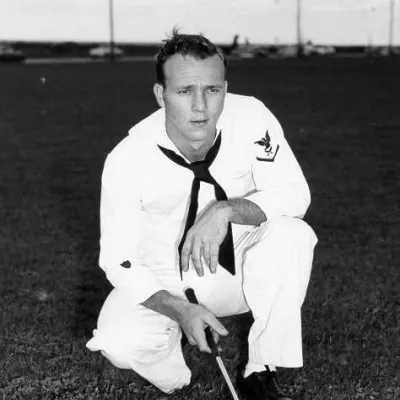
Arnold Palmer
Human Design Chart
Biography
Palmer experienced the hard times of the Great Depression in Pennsylvania. His dad, Deke Palmer, a professional golfer and his mother, Doris instilled the importance of patriotism, manners, and values into his young son. As a three-year-old, Palmer was swinging his first golf club. He taught himself an unusual corkscrew swing and won several local tournaments during his school years. In 1951, Palmer went into the Coast Guard for three years. The single most important demand Palmer placed on himself was to make his father proud. He was elated when his father told him, "You did pretty good, boy," when he won the U.S. Amateur in 1954. That same year, Palmer turned professional golfer.
Over the next ten years, from 1954 to 1964, Palmer won four Masters titles, two British Opens and the U.S. Open. His swing was powerful and he attacked the game with every ounce of strength. He soon developed a loyal band of followers called "Arnie's Army" which would cheer for their hero at all the major tournaments. An influential golfer, he helped to change the image of golf as an elitist sport into a bold athletic event in the '50s and '60. Palmer's youthful charm and easy-going nature won him contracts to promote products on television. He slowly built his golf-related business empire specializing in golf clubs and equipment. His company has a net worth of $100 million.
Arnold Palmer — Manifestor with Profile 1/3
Manifestor 1/3 — Design at a Glance
Arnold Palmer revealed himself as a visionary and pioneer whose role was less about hands-on execution but rather in inspiring others to initiate change. His design aligned with that of a Manifestor, akin to an emperor in ancient Rome: he had the vision for a grand whole yet delegated the concrete implementation to his followers. This configuration inevitably led to polarization; while some people loved and followed his far-reaching plans, others rejected or hated him because his thinking often surpassed the horizon of the majority. This misunderstanding formed a central pain point in his life.
The key to navigating this dynamic lay in his strategy of informing. By Arnold Palmer sharing his intentions and visions timely and precisely, he enabled the right followership to find him and join him. This communication was crucial for reducing friction and misunderstandings. When he followed this path of informing in alignment with his inner authority, his design rewarded him with a deep sense of inner peace. Deviating from this strategy, however, resulted in persistent, profound anger. His life journey thus illustrated the necessity of clear communication as a means to find the right community and achieve emotional balance.
Ego Authority
Arnold Palmer's design tended towards finding his truth in spontaneous will, revealed through immediate, uncensored speech. As a Projector or Manifestor with defined ego-authority and open Emotional, Sacral, and Spleen centers, he showed himself as someone who had to learn to listen to himself while speaking. This mechanism clearly distinguished between the mind – serving the interests of others in the open centers – and the actual will of the Ego Center. What came out of him spontaneously was his inner truth; thought constructs were often distractions due to his great influenceability.
This structure promoted a strong drive towards material success or status as 'First'. It mattered to him to challenge himself with special tasks and leave conventional paths, while also leading others into new directions. His actions appeared egoistic to outsiders because they primarily followed his own interest. Crucial for his health was balance: after achieving a goal, he had to pause. Continuous work without these regenerative phases led to exhaustion and illness in him. His willpower only showed its effectiveness when he consistently followed what truly mattered and paid off.
The 1/3 Profile — Investigator / Martyr
Arnold Palmer's design tended towards not just accumulating knowledge theoretically but validating it through direct practice. As a person with Profile 1/3, the Researcher and Experimenter, his life task was a cyclical process: first laying the foundation (Line 1), then testing through trial and error (Line 3). This profile carried an inner conflict between the need for complete preparation and the urge to act immediately. Often, the energy of Line 1 led him to hesitate because he felt he didn't know enough yet. But Line 3 demanded experimentation.
This dynamic made his later judgments particularly credible. When Arnold Palmer valued something as good, he had previously examined it both intellectually and empirically on heart and soul. Mistakes were not seen in this system as defeats but as necessary data points for finding meaning. The authenticity of his opinion emerged only through this combination of planning and failed attempts.
Line 1 sought meaning in the past and tried to eliminate negative factors, which sometimes led to blame assignment. Simultaneously, Line 3 from Gate 45 brought themes like bonds and humiliation; here it was about being included despite difficulties and being useful for the tribe. This mechanism shaped him as someone who worked out his insights through hard experience before sharing them.
Single Definition — Defined & Open Centers
Arnold Palmer's design tended towards a stable, unshakeable presence that acted as a fixed island in the sea of situational sensitivities. Four defined centers – Ajna, Throat, G-Center, and Heart – created a reliable identity, willpower, and expressiveness. His mental function was steady; he conceptualized consistently and spoke what he thought because his throat was connected to Ajna. This gave him the ability to communicate concepts clearly and inspire others mentally. His defined G-Center provided a clear sense of self-identity and inner direction, while the Heart Center supplied strong willpower and the need for control over resources. He tended to determine his own life and keep promises, which strengthened his self-esteem.
In contrast, he was extremely sensitive to environmental influences in the five open centers – Head, Sacral, Solar Plexus, Spleen, and Root. The open Head Center made him vulnerable to mental pressure and doubt; he often questioned whether he had the right answers or needed to find inspiring solutions to resolve confusion. His open Sacral Center absorbed foreign vital energy until exhaustion, leading to a pattern where he overexerted himself and struggled to set boundaries as he amplified others' energy. The open Solar Plexus made him absorb emotional waves from his environment; he tended to personalize moods of others as his own feelings and avoid confrontations out of fear of rejection. The open Spleen Center made him sensitive to intuitive fears and survival signals of others, which could make him cling to uncertain situations for a sense of well-being. Finally, his open Root absorbed stress and adrenaline; he tended to try to release this pressure through hyperactivity though he was not designed to withstand such force long-term. The challenge lay in not losing his defined strength by identifying with these conditioned states of the open centers.
Channels for inspiration, curiosity, structure and material security.
Arnold Palmer acted as a living role model that inspired through authentic presence rather than words. His design featured Channel of Inspiration 1-8, connecting G-Center and Throat Center. Gate 1 enabled the bold expression of a creative perspective while Gate 8 made this contribution visible to the community. This configuration created a public impact by living his unique identity; others were inspired by his example to discover their own uniqueness, much like an extraordinary performance can inspire listeners.
This role model function worked in tandem with Channel of Curiosity 11-56, connecting Ajna Center and Throat Center. Here he constantly sought new ideas and stories to share further. Gate 11 provided the abstract vision while Gate 56 offered narrative fascination for discovery. This helped him convey complex connections as compelling parables that emotionally touched others and prompted reflection without relying on dry facts.
In the material realm, Channel of the Money Line 21-45 shaped his attitude. Connecting Heart Center with Throat Center, Gate 21 linked the will to control with Gate 45, which protects and manages resources. Palmer aimed to master the material plane and achieve independence while working hard but wanting to set his own rhythm to avoid stress and ensure loyalty in exchange for support.
Additionally, Channel of Structuring 23-43 connected Ajna Center with Throat Center. Gate 43 received spontaneous insights that were assimilated and clearly expressed through Gate 23. This allowed him to communicate innovative perspectives that promoted efficiency provided the timing was right. Additional gates like 47 (Insight) and 26 (Tribe's Conviction for Innovation) supported his ability to transform confusion into clarity and implement changes, while Gate 35 prepared him for interaction and experience collection.
Individual Circuitry — Circuit Signature
Arnold Palmer's design combined pulsating creativity with cyclical emotional depth embedded in cooperative structures. The Knowledge Circuit linked Ajna, Throat, and Identity Centers in him. This promoted the expression of a unique individuality through structured inspiration (Channel 1-8) and mental formation (Channel 23-43). New insights did not arise in isolation but were directly articulated.
Parallelly, the Meaning-Finding Circuit worked, connecting Ajna and Throat Centers via Channel of Curiosity (11-56). Arnold Palmer reflected past experiences wave-like through this channel. This emotional processing served to draw meaning from the past and share it with others. The connection between both circuits through shared centers allowed anchoring innovative ideas through emotional validation.
The Ego Circuit added cooperation. Here, Arnold Palmer connected Throat Center with Heart Center via 'Money Line' (Channel 21-45). This involved accumulating material resources and cooperative creation in the tribe. Since this circuit did not connect to Sacral Center, rest phases were essential to sustain energy for these cooperative resource tasks. The mechanics showed a clear separation: creative-emotional expression processes on one side and resource-oriented cooperation on the other, both anchored through Throat Center as an expression point but energetically separated from the constant life force of the Sacrum.
Right Angle Cross of Rulership 3
Arnold Palmer carried the right cross of Governing 3. This configuration was a specific energetic marker in his design but did not provide detailed information about his individual behavioral patterns or character traits. In Human Design, this cross represents a structural given without allowing for conclusions about his actions, motivations, or life path.
Since the underlying mechanics of this cross are not specified in the available data, interpretation is limited to merely stating the structure. There are no documented indications of how this specific cross configuration impacted Arnold Palmer's daily life or played a role in his decisions. His design included this aspect as neutral information without attributing any concrete psychological or behavioral significance.
The absence of a description does not mean that this part of the design was irrelevant, but rather that available facts do not provide a basis for deeper analysis. Arnold Palmers design encompassed this component as a given element whose impact cannot be reconstructed from the existing information. Therefore, characterization is limited to noting the existence of this cross without making further assumptions about its function or influence on his life.
Saturn Return · Uranus Opposition · Chiron Return · 2nd Saturn Return — Life Cycles
Arnold Palmer's design structured his career path through two clear astrological turning points marking the transition from training to established recognition. This cyclical development was evident in his professional golfing career and later accolades.
In 1954, at age 25, he became a professional golfer, coinciding with his first Saturn return. In Human Design mechanics, this cycle condenses years of groundwork into a solid result; it is the moment when inner maturity meets outer structure. For Arnold Palmer, this was the definitive step from the learning phase to professional practice.
Another significant point occurred in 1971 when he received the Bob Jones Award at age 42. This correlated with his Uranus opposition. This aspect often brings sudden insights or public validation following a period of internal upheaval. The award was not merely an honor but a visible reflection of his established position and respect within his field.
The mechanics show a clear line: first, the creation of the foundation through Saturn (1954), followed by public validation and breakthrough through Uranus (1971). Arnold Palmer's design utilized these cyclical energies not only to find his role in life but also to anchor it sustainably. The events were no coincidences but expressions of his inner architecture manifesting outwardly at specific times.
Manifestor · Ego Authority — Synthesis
Arnold Palmer was a Manifestor who, through his defined ego-authority (and open centers), demonstrated a strong will reflected in spontaneous utterances mirroring his inner truth – a tendency that also made him vulnerable to external influence. His profile as an Investigator and experimenter (1/3) underscored this dynamic nature; he continuously learned and tested new paths, with practical experimentation being as important as theoretical knowledge. This combination of internal drive and the need for validation through experience shaped his approach to challenges.
A central paradox in his design lay in the interplay between trailblazer role (Manifestor) and the necessity to gather experiences (1/3 profile). He was destined to pioneer new paths and inspire others (Channel 1-8), yet he also needed the process of experimentation and testing to validate his visions. This led to a tension between an impulsive desire for change and careful validation through experience, evident in documented successes but also revealing a continuous need for learning.
4 Defined Channels
Incarnation Cross - Right Angle Cross of Rulership 3
Solar Return
The Solar Return shows the moment when the sun returns to its exact birth position - your personal solar year.
Life Cycles
Discover the life cycles with a detailed triple view (birth chart, cycle chart, composite).
Human Design Profile
- Type
- Manifestor
- Strategy
- To inform others before acting
- Authority
- Ego Authority
- Profile
- 1/3 - Investigator / Martyr
- Definition
- Single Definition
- Incarnation Cross
- Right Angle Cross of Rulership 3
- Date of Birth
- 10.09.1929 05:30
- Place of Birth
- Latrobe, PA, United States
Frequently Asked Questions
What is the Human Design type of Arnold Palmer?
Which Profile did Arnold Palmer have in Human Design?
What Authority guided Arnold Palmer's decisions?
What incarnation cross did Arnold Palmer have?
When was Arnold Palmer born?
Discover your own Human Design
Are you also a Manifestor? Find out in a personal reading how to use your initiation power peacefully and dissolve resistance.
More Personalities
Back to overviewChristian-Jaque
Kesha

Lucebert
Marilyn

Masaccio

Papus