
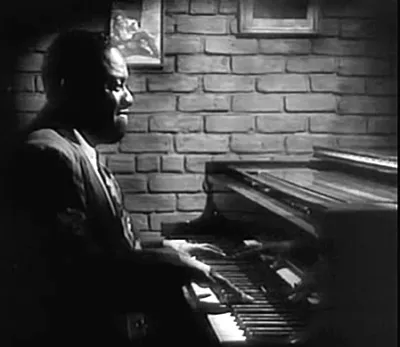
Art Tatum
Human Design Chart
Biography
Tatum was born to musician parents and suffered through numerous eye operations due to cataracts on both eyes, retaining limited vision in one eye.
He died on 5 November 1956 in Los Angeles, California.
Art Tatum — Manifesting Generator with Profile 5/1
Manifesting Generator 5/1 — Design at a Glance
Art Tatum revealed himself as someone who through a hybrid configuration combined the endurance of a Generator with the direct impact of a Manifestor. His design featured a defined Sacral Center, providing him with a constant energy source and the counsel not to initiate things himself but rather to wait for external impulses. At the same time, he had active connections from Motor Centers to Throat Center, enabling him to skip steps and quickly draw changes into his life. This speed was a double-edged sword: it could lead to overlooking important stages, causing residues and frustration – that feeling known in Human Design as the Non-Self theme for this type. Additionally, his system tended to pursue multiple projects simultaneously, driven by various impulses. When strategy and inner authority did not align, creativity quickly turned into overwhelm. However, when he was in alignment with his strategy – reacting only to what his Sacral Center clearly said "yes" to – Art Tatum drew deep satisfaction from his work. In this state, parallelism was no barrier but a source of playfulness and variety, fueling his creative power sustainably.
Emotional Authority
Art Tatum's inner guidance came from his defined Solar Plexus Center, giving him an emotional authority. This configuration fundamentally determined his decision-making process: He was subject to an emotional wave that manifested in a constant up and down of his feelings. The world appeared colored by his current mood; the same thing could inspire him one moment and seem negative the next. His immediate feeling was merely a snapshot, a first impression that did not necessarily represent his truth yet. Quick, spontaneous decisions based on such emotions would have been very detrimental to him. Instead, his design required patience and multiple reconsiderations of decisions. The more time he took to let a choice mature, the deeper and more comprehensive his understanding of the situation became. Over time, intense feelings subsided, emotional distance was gained, clarity emerged, and calmness set in. Only then had he gone through the process. This mechanism held absolute priority: Whenever the Emotional Center is activated, it functions as inner authority, regardless of which other centers are defined in his design. This rule applies to every type except Reflectors and served Art Tatum primarily for long-term decisions that significantly influenced his life path.
The 5/1 Profile — Heretic / Investigator
Art Tatum's Design as a 5/1 "Hero/Researcher" established a specific dynamic: He possessed the profound, detail-oriented knowledge base of Line 1 and used this to provide solutions for others. This configuration gave him almost magnetic appeal; people actively sought him out to find answers to their problems. His intuition and ability to develop further in crisis times (Gate 57) served the community.
At the same time, this role required strict boundaries. Without them, he risked being overwhelmed by a constant influx of questions and expectations, similar to an expert who is exhausted after intensive consultation. His strength lay in meticulous detail work and routine (Gate 62), which served as the foundation for his insights. Only by learning to selectively say "no" could he maintain balance between his private research phase and public problem-solving. Thus, his deep, often intuitive knowledge transformed into generalizable forms that not only benefited him but also the collective without draining him. His life task was to maintain this balance: deeply researching for himself and purposefully helping others.
Single Definition — Defined & Open Centers
Art Tatum's design tended towards a consistent and reliable expression. His defined Throat Center ensured that messages from within were clearly communicated to the world, independent of momentary moods. This worked in conjunction with his defined G Center, which gave him a firm sense of self-identity and direction. He knew who he was and where it led him, allowing him to carry others not through dependency but by his own presence.
His defined Sacral-Motor generated daily vital energy that was only available through reacting to external questions. Rather than taking the first step himself, he waited for an inner yes or no response to avoid frustration. This physical strength was supported by his defined Root Center, which provided a constant pressure to move forward and master existential challenges.
At the same time, he showed openness towards mental processes with his open Head and Ajna Centers. Here, he tended to absorb inspirations from the environment rather than producing constant thought streams of his own. He could reflect in others' ideas without identifying them as absolute truth. His open Heart Center lacked consistent willpower; he was not designed to make promises or prove his worth through competition. Instead, he learned to free himself from the need for self-justification and trusted instead in the inner guidance of his defined centers.
Channels for intuition, rhythm, emotional power and growth.
Art Tatum's design tended towards a firm rhythm. The Rhythm Channel 5-15 connected his Sacral Center with his G Center, making him magnetic through internal habits and love for human diversity. This flow determined his timing and drew others into his energy field.
His personality sought hidden truth. The Wavelength Channel 48-16 linked Spleen to Throat; Gate 48 scanned intuitively while Gate 16 perfected skills. This required long-term practice to develop talent and pass it on as mastery.
Simultaneously, Art Tatum possessed a strong survival intuition. The Power Channel 34-57 connected Sacral with Spleen. Gate 57 scrutinized the environment intensely while Gate 34 acted. This combination secured his individual vitality through spontaneous reactions to dangers.
In the Juxta-area, he showed a tension field between experience and completion. The Transience Channel 35-36 drove him emotionally towards seeking newness often through crises. In contrast, the Maturity Channel 42-53 demanded completing cycles and drawing wisdom from them before starting anew.
Additionally, specific Gates shaped his essence: Gate 51 brought willpower and adaptability in shock situations. Gate 62 focused on logical details and pattern recognition. Gate 61 sought inner truth amidst mental noise. Gate 9 enabled detailed work in the Sacral Center while Gate 46 called for dedication to the process. Gate 45 expressed tribal energy, Gate 33 promoted reflection. Gate 54 connected worldly success with spirituality, and Gate 12 brought creative mutation into communication.
Collective Circuitry — Circuit Signature
Art Tatum revealed through his design as someone who combined logical structures with emotional depth. It was a Simple Definition; all defined centers – Sacral, Identity, Spleen, Throat, Solar Plexus, and Root – were energetically directly connected to each other. This created a continuous flow of power from the mind to emotional perception.
The Understanding Circuit shaped his ability to share rational insights. Through the Channels 'Wavelength' (Throat–Spleen) and 'Rhythm' (Identity–Sacral), he combined intuitive perception with the strength to express it clearly. Parallel, the Meaning Circuit worked: The Channels 'Transience' (Throat–Solar Plexus) and 'Maturity' (Sacral–Root) allowed him to reflect on emotional waves from the past as collective learning. Both Circuits used the Throat Center for articulation but connected separate aspects – cool ratio on one side, felt experience on the other.
Additionally, integration stabilized his existence. The Power Channel (Sacral–Spleen) gave him the ability to draw strength from reacting to life and guide it through intuitive knowledge. Since all these energies converged in a single group, they did not work isolated but as unified power that allowed Art Tatum to grasp complex connections both intellectually and emotionally and convey them authentically.
Left Angle Cross of the Clarion 2
Art Tatum carried the left cross of Fanfare 2 in his design. This configuration endowed him with a profound, often unspoken longing for higher spiritual truth and the meaning of life. He did not seek superficial answers but rather aimed to understand the hidden connections of existence and share these insights with others.
In Human Design, this cross describes a specific life task: uncovering knowledge that goes beyond everyday experience and sharing it with the community. It is not mere curiosity but a driving impulse to shed light on dark corners of human experience. For Art Tatum, this meant his energy was directed towards conveying complex spiritual or philosophical connections in ways that made them tangible and useful for others. He served as a bridge between the abstract and the comprehensible.
This structure shaped his way of interacting: less through dominant leadership but rather by sharing insights that helped others better understand their own reality. It was a path of teaching through revealing inner truths. His design suggested he worked best when sharing his personal discoveries about the meaning of existence with those ready to listen and integrate this information into their lives. Thus, his individual quest for significance became a gift for his environment.
Saturn Return · Uranus Opposition — Life Cycles
Art Tatum's design indicated a tendency towards structured, recurring phases of professional anchoring. In 1937, at age 28, he returned to New York and played in the Famous Door Club – marking his first Saturn return. During this cycle, years of groundwork often crystallized into a solid result; the internal architecture of his design sought stability and validation through external structures. For Art Tatum, this meant less spontaneous unfolding but rather taking a clear position within an established framework. The Saturn return functioned here as a mechanism for consolidation: what was previously experimental or fluid now gained form and permanence. His return to New York was not merely a geographical change but the acceptance of a role that integrated his talents into a stable system. Playing in the Famous Door Club represented this positioning – a stage allowing him to unleash his potential within defined boundaries. This phase was marked by a quest for recognition and security, with his design aiming to solidify identity through concrete achievements. The focus lay on creating stability; Art Tatum used this time to secure his position and transform his artistic expression into a lasting context. The mechanics of the first Saturn return here acted as a catalyst for professional maturity, providing necessary structures so that individual potential could have sustained impact.
Manifesting Generator · Emotional Authority — Synthesis
Art Tatum was an Manifesting Generator whose life was characterized by a steady flow of sacral energy (Sakral Center defined). This energy was channeled through his connection to the Throat Center (defined), giving him an extraordinary ability to quickly turn ideas into reality – a hybrid of initiation and reaction. His profile as Hero/Researcher (5/1) further reinforced this trait: he continuously deepened his knowledge and shared it willingly with others, always seeking new challenges and solutions. This combination of sacral availability, rapid implementation, and thirst for knowledge created a dynamic that made him an indefatigable shaper of his life.
Tatum lived in an internal tension between the need to be guided by emotions (Emotional Authority) and the tendency to act quickly through his defined throat and sacral energy. The emotional wave required time for decision-making, while his design urged him to seize opportunities immediately (Channel Rhythm). This paradox led him to gain profound insights but occasionally overlook necessary steps or rush into actions. The left cross of Fanfare 2 indicates a natural ability to communicate visions and bring them into the world – an expression of the internal conflict between deep contemplation and swift action.
5 Defined Channels
Incarnation Cross - Left Angle Cross of the Clarion 2
Solar Return
The Solar Return shows the moment when the sun returns to its exact birth position - your personal solar year.
Life Cycles
Discover the life cycles with a detailed triple view (birth chart, cycle chart, composite).
Human Design Profile
- Strategy
- To respond - wait for something to respond to
- Authority
- Emotional Authority
- Profile
- 5/1 - Heretic / Investigator
- Definition
- Single Definition
- Incarnation Cross
- Left Angle Cross of the Clarion 2
- Date of Birth
- 13.10.1909 09:00
- Place of Birth
- Toledo, OH, United States
Frequently Asked Questions
What was Art Tatum's Human Design type?
What Profile did Art Tatum have in Human Design?
What Authority did Art Tatum possess?
What incarnation cross did Art Tatum have?
When was Art Tatum born?
Discover your own Human Design
Are you also a Manifesting Generator? Find out in a personal reading how to unfold your multi-talents and direct your energy wisely.
More Personalities
Back to overviewAaliyah

Aldair

Alexia

Alizée

Angèle

Angeli
