Arthur Ashe
Human Design Chart
Biography
Raised in the iron-clad grip of legal segregation governing Virginia of the '40s and '50s, Ashe lost his mother at age six. Taking up tennis with total dedication, he tenaciously broke through a white dominion to become the first and only black man to win one of the game's Grand Slam titles when, at 25, he won the U.S. Open. Proving his championship ability at Wimbledon, he defeated the supposedly invincible Jimmy Connors, playing one of the most innovative matches of his career and one of the more influential matches in tennis history.
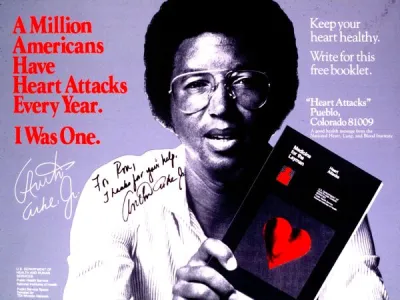
He married photographer Jeanne Moutousamy in March 1977; their daughter Camera, whom he totally adored, was born in 1986. He had a heart attack on 31 July 1979, and heart by-pass surgery on 22 June 1983, effectively ending his sports career. Life had selected him for a broader message, that of his calm dignity and abiding belief in humanity.
As early as 1973, Ashe made a visit to South Africa, grateful that he "could be a rally point" for struggling South Africans. By the '80s, he was actively engaged in the anti-apartheid movement. In 1982, Ashe was invited to join the board of directors of insurance giant Aetna Life and Casualty, providing insights into company policy, management and programs.
When teaching a class on African-Americans and sports, he was disturbed to find there was no suitable text on the subject, so he wrote a three-volume history of black athletes, "A Hard Road To Glory," 1988. He wrote that, "At some point, each individual is responsible for his or her fate. At some point, one cannot blame history. Does the legacy of slavery explain why Mr.
Arthur Ashe — Generator with Profile 3/5
Generator 3/5 — Design at a Glance
Arthur Ashe possessed immense endurance, but this was not driven by spontaneous initiative; rather, it unfolded exclusively as a reaction to external impulses. His Generator design dictated that he generate energy – comparable to a sturdy workhorse – yet this power became effective only when he responded to signals from his environment and received an inner confirmation from his Sacral Center. The motto was clear: react instead of initiate.
This mechanism created two central dynamics in his life. On one hand, there was the risk of burnout if he continuously performed tasks that did not bring him joy or internal desire; here, his energy would be wasted. On the other hand, he suffered from the suppression of his heart project when, despite being fully powered and wanting to continue working, he was forced to pause.
The successful use of his energy depended on waiting for a life signal and then responding with concrete action once the Sacral Center gave an internal “yes.” When Arthur Ashe lived in harmony with this reactive strategy from the gut, his design rewarded him with deep feelings of fulfillment and satisfaction. Deviations from it – especially constantly trying to take initiative himself – inevitably led to prolonged frustration and a noticeable lack of energy. His strength lay not in pushing forward but in consistently responding affirmatively to life.
Sacral Authority
Arthur Ashe was a Generator whose decision-making was shaped by sacral authority. This inner instance replaced complex logical deliberations with direct physical reactions to external stimuli. His design required waiting for this signal: a grunt, a hum or a noticeable surge of energy in the lower abdomen that acted as a clear “yes” or “no.” Only when this resonance occurred did he feel vital and energized; without it, enthusiasm was lacking.
This mechanism greatly simplified his process, as strategy and authority were identical: react, do not initiate. Energy only emerged through confirmation from the sacral motor, allowing him to perform tasks with great enthusiasm and without obsessive purposefulness. This perception was supported by an active Spleen, which functioned as an additional instance. It provided a quick, instinctive access to physical well-being and allowed for spontaneous decisions. Arthur Ashe could thus reliably orient himself towards this immediate physiological feedback rather than anticipating or emotionally reacting. His life demonstrated his ability to accept only what resonated internally.
The 3/5 Profile — Martyr / Heretic
Arthur Ashe was someone who gained knowledge not from books but through personal experimentation. His design inclined him to initially be skeptical and experience everything firsthand before passing it on to others. This attitude stemmed from Line 3 in his Profile: learning here occurred purely through trial and error. Mistakes were not seen as failure, but rather as necessary steps of development.
Over time, this individual experience transformed into a public resource. Through Line 5, private experimenting became a treasure trove of practical life experiences that he presented to others. People were drawn to his authenticity; they sought solutions for their own problems from him because his knowledge was based on real practice. He thus appeared attractive and heroic by showing how to deal with reality.
However, this dynamic contained tension. While Line 3 in the learning process sought harmony and avoided conflict, Line 5 faced public expectations. Arthur Ashe could be perceived as a hero or a failure. If he failed publicly, it was harshly felt because it threatened his authority. Yet, this public failure was part of the process: Only through experimentation and the associated visibility could he fulfill the role of rescuer and help others master their own challenges. His attractiveness lay precisely in this rich repository of lived experience.
Split Definition — Defined & Open Centers
Arthur Ashe revealed himself as someone with a constant presence and clear self-definition. His design established a massive, consistent energy base: The defined Sacral Center provided vital power for reacting to life, while the defined G Center anchored inner direction and identity. This combination created a reliable voice; the defined Throat allowed him to clearly communicate and manifest his truth from this internal source. The also defined Spleen Center ensured spontaneous intuition in the present moment, and the defined Root Center offered stress resistance as well as the pressure for forward movement.
This firm structure contrasted with his open Centers Head, Ajna, Heart, and Solar Plexus. These were situationally active and reflected their environment. Arthur Ashe tended to take mental inspiration or doubts from the outside world without identifying them as his own truth. He was prone to getting entangled in questions that did not originate from him, or amplifying emotional currents of others instead of valuing them as his own feelings. His open Heart Center meant he lacked a consistent willpower to keep promises or prove worth through competition; rather, he absorbed the ego vibrations of his surroundings. The open Solar Plexus also made him a barometer for emotional moods, leading him to oscillate between joy and sadness depending on the atmosphere around him.
This configuration shaped a character that was internally stable and energetic but always remained open to external influences. He had to learn not to personalize the thoughts and emotions he absorbed. His strength lay in acting and speaking from his defined core while using the open fields as an information source without getting lost in their whirlwinds. Thus, he could maintain his own direction even when his mind was full of foreign questions or his Solar Plexus was filled with others' moods.
Channels for leadership, intuitive clarity and cyclical growth.
Arthur Ashe displayed a fundamental stance of collective, logical leadership based on waiting for the invitation from the community. His design featured the Alpha Channel 7-31 connecting the G Center to the Throat Center. This configuration required him to demonstrate confidence and competence in proven patterns before the majority chose him as a leader. He could lead but only within a shared context; absolute authority was not his, rather influence through logical argumentation and understanding current trends. His leadership role thus always depended on recognition from those he represented.
Parallel to this, the Maturity Channel 53-42 between Root and Sacral Center shaped him. This mechanism drove him to complete experiences – from start to finish – to gain wisdom from them. Prematurely breaking cycles was counterproductive for his system; only a full completion allowed reflection and transition into new phases. This process of cyclical maturation served not just himself but contributed to collective history by promoting empirical learning.
Additionally, the Flash of Insight Channel 57-20 translated intuitive insight from the Spleen Center directly into communication in the Throat Center. This gave him the ability to speak to the moment and encourage others to activate their own inner survival intelligence. His words could quickly hit the core of an issue when he aligned with present consciousness. This combination of logical, invitation-dependent leadership, the discipline of a complete experience cycle, and intuitive clarity in the moment formed his specific way of interacting with the world.
Collective Circuitry — Circuit Signature
Arthur Ashe's design showed a duality between impulsive innovation and reflective meaning-making. These separate energetic poles shaped his expression without directly flowing into each other.
The Knowledge Circuit connected his Throat Center to the Spleen. This created a Flash of Insight Channel: innovative, creative impulses arose spontaneously and were immediately expressed verbally or through actions. It was about manifesting individual identity through new insights – pulsating energy that acted in the moment.
Parallel to this, the Understanding Circuit linked the Throat Center with the Identity Center. Here logical structure and strategic thinking took precedence. Arthur Ashe could share rational insights free from emotional coloring to clearly formulate future perspectives. Both circuits used the same expression organ (Throat) but provided different content: once creative innovation, once focused logic.
On the other side of his design was the Meaning Circuit connecting Sacral and Root Centers. This circuit worked cyclically with emotional waves from the past. It served to process past experiences, undergo maturation, and recognize the deeper meaning of these events. This emotional condensation was separate from rational circuits; it formed an independent force enabling inner stability and sharing lived lessons.
Arthur Ashe thus moved between the quick, creative intuition of the Knowledge Circuit and the deep, emotion-based reflection of the Meaning Circuit – two parallel, unconnected systems within his defined structure.
Right Angle Cross of Penetration 2
Arthur Ashe demonstrated a pronounced ability to penetrate obstacles and uncover deeper structures or truths. His design emphasized efficiency and direct impact when strategically entering systems or situations. This attitude stemmed from the configuration of the right penetration cross 2, which connected the Identity Center with the Personality Center, enabling a specific kind of strategic access. Arthur Ashe used this energy not for superficial interactions but to grasp the core of an issue and act upon it precisely. The mechanics of this cross promoted the ability to quickly discern complex interconnections and derive precise actions. It was a form of intellectual and strategic penetration that allowed him to overcome barriers others saw as insurmountable. Arthur Ashe lived this tendency toward direct penetration by analyzing situations and finding efficient ways to achieve his goals. This channel's energy shaped his approach, not just recognizing problems but actively solving them by focusing on the right points. Strategic clarity was a central aspect of how he interacted with the world and exerted influence.
Saturn Return · Uranus Opposition · Chiron Return — Life Cycles
Arthur Ashe lived a life structured around three precise astronomical cycles. His first Saturn return at around 30 years marked a condensation of responsibility and public presence. This was reflected in 1973 when he traveled to South Africa and became a voice of hope – a moment where years of groundwork led to a tangible, visible position.
The Uranus opposition, typically occurring around age 40, often brings sudden realignment or calling into new structures. For Arthur Ashe, this shift occurred in 1982: he was appointed to the board of Aetna Life and Casualty. This step signaled a move towards institutional leadership and strategic influence, away from pure athletic arenas.
The Chiron return, a cycle between ages 49 and 51, does not describe healing in a medical sense but rather the fulfillment of an individual's incarnation purpose. Arthur Ashe died in 1993 at age 50 from pneumonia linked to AIDS. This timing falls exactly within this fulfillment cycle. The design suggests that his life path reached its deepest architectural logic by this point; death here was not an interruption, but a conclusion of the specific life task shaped by his previous stations.
Generator · Sacral Authority — Synthesis
Arthur Ashe lived a life deeply marked by the dynamics between inner power and outer reaction. As a Generator, he possessed immense, sacral energy that propelled him to take on tasks when his gut said
3 Defined Channels
Incarnation Cross - Right Angle Cross of Penetration 2
Solar Return
The Solar Return shows the moment when the sun returns to its exact birth position - your personal solar year.
Life Cycles
Discover the life cycles with a detailed triple view (birth chart, cycle chart, composite).
Human Design Profile
- Type
- Generator
- Strategy
- To respond - wait for something to respond to
- Authority
- Sacral Authority
- Profile
- 3/5 - Martyr / Heretic
- Definition
- Split Definition
- Incarnation Cross
- Right Angle Cross of Penetration 2
- Date of Birth
- 10.07.1943 12:55
- Place of Birth
- Richmond, VA, United States
Frequently Asked Questions
What was Arthur Ashe's Human Design type?
What Profile did Arthur Ashe have in Human Design?
Which Authority guided Arthur Ashe?
What incarnation cross did Arthur Ashe have?
When was Arthur Ashe born?
Discover your own Human Design
Are you also a Generator? Find out in a personal reading how to use your sacral energy correctly and discover deep satisfaction.
More Personalities
Back to overviewAaliyah

Alexia

Angèle

Anne-Marie

Arcángel

Arno