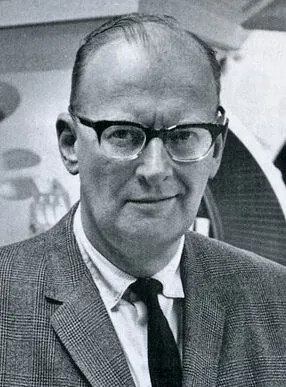
Arthur C. Clarke
Human Design Chart
Biography
Clarke was a science fiction writer, an avid populariser of space travel, and a futurist of distinguished ability. He wrote many books and many essays for popular magazines. In 1961, he received the Kalinga Prize, a UNESCO award for popularising science. Clarke's science and science fiction writings earned him the moniker "Prophet of the Space Age". His science fiction writings in particular earned him a number of Hugo and Nebula awards, which along with a large readership, made him one of the towering figures of the genre. For many years Clarke, Robert Heinlein, and Isaac Asimov were known as the "Big Three" of science fiction. Clarke co-wrote the screenplay for the 1968 film 2001: A Space Odyssey, widely regarded as one of the most influential films of all time.
Clarke was a lifelong proponent of space travel. In 1934, while still a teenager, he joined the British Interplanetary Society (BIS). In 1945, he proposed a satellite communication system using geostationary orbits. He was the chairman of the BIS from 1946 to 1947 and again in 1951–1953.
Clarke emigrated to Ceylon (now Sri Lanka) in 1956, to pursue his interest in scuba diving. That year, he discovered the underwater ruins of the ancient original Koneswaram Temple in Trincomalee.
What does Projector 2/4 mean for Arthur C. Clarke?
Projector 2/4 — Design at a Glance
Arthur C. Clarke appeared through his dense, focused aura like a bright flashlight casting light into dark corners of the environment. His design suggested that he immediately recognized where systems or people were 'in the dark' and exhibited flaws. However, this ability to confront core issues directly could be perceived as unpleasant if used without invitation – similar to a blinding beam in someone's face.
As a Projector, Arthur C. Clarke lacked a defined Sacral Center and thus had no constant intrinsic energy source. Instead, he worked in phases of high intensity followed by necessary rest periods to prevent burnout. The conventional system with its expectation of continuous performance did not fit this rhythm. His optimal strategy was to wait for an honest invitation from others. Rather than directly addressing his observations – which could be potentially hurtful – he was most effective when living harmoniously himself, becoming so attractive that others would seek out his insights on their own.
If Arthur C. Clarke lived according to the pattern of patience and waiting for invitations, he was rewarded with success. If he ignored this dynamic and tried to impose his insights without invitation, he risked the non-self theme of bitterness. His nature was designed to illuminate others' paths, not force them to follow it.
Emotional Authority
Arthur C. Clarke's design indicated a tendency towards emotional wave motion. He appeared as someone whose inner truth did not lie in immediate reactions but became visible only after moods subsided. His emotional authority carried the defined Solar Plexus Center. In Human Design mechanics, this authority always takes precedence over other defined centers regardless of what else is active on the chart. This meant for him that spontaneous decisions based on intense emotions were often misleading. His design required patience: he had to give himself time to let a decision mature. Only through multiple sleepovers and waiting out emotional highs and lows did he gain necessary distance. Once the strong feelings subsided, clarity set in. This process was particularly important for long-term decisions that significantly influenced his life path. Arthur C. Clarke lived according to this mechanism: he consciously delayed, allowed himself to be asked repeatedly, and did not seek immediate certainty. His design described a life task of using emotional turbulence as a necessary filter to reach deep, comprehensive insight. He saw the world colored by his current mood but understood that this first impression was not necessarily his truth. Through enduring the process, he ultimately found calmness and made decisions aligned with his inner structure.
The 2/4 Profile — Hermit / Opportunist
Arthur C. Clarke's profile 2/4 was characterized by a constant interplay between the deep need for withdrawal and the desire to connect with his closest community. This configuration created an internal tension: on one hand, line 2, the Hermit Line, dominated, pushing him to retreat into his 'cave' to clarify inner processes and find peace. On the other hand, line 4, the Community Line, acted as a counterbalance, demanding time with chosen favorite people. For Clarke, it was crucial to clearly communicate these needs – when he sought company and when he needed solitude – to maintain a safe environment. In his alone time, he could reflect on and evaluate the knowledge of his network, leading to brilliant idea development.
This ability for ideation was supported by the second line in Gate 11, which demanded strictness and inflexibility towards his own process. Here it was about overcoming boredom by letting ideas mature rather than projecting them undeveloped onto others. Simultaneously, the fourth line in Gate 6 acted as a dominant emotional force. This 'emotional steamroller' projected its intensity outward seeking validation from the environment. Clarke had to learn to channel this strong emotional presence to not only dominate but also foster wisdom and kindness in his relationships. The balance between necessary withdrawal for idea maturation and active, emotional engagement with his network shaped how he processed and shared knowledge.
Split Definition — Defined & Open Centers
Arthur C. Clarke's Human Design profile indicated a tendency towards clear, identity-driven communication that was filtered through deep emotional authority. His defined G Center provided him with reliable self-assurance and a clear sense of direction in life; he knew who he was and where he stood. This inner security flowed into his defined Throat Center, allowing his voice to speak not impulsively but from a stable identity. Simultaneously, his defined Solar Plexus determined his internal authority: He tended to make decisions not in the moment but by waiting for an emotional wave to clarify before acting. This combination allowed him to process complex topics with patience and depth rather than reacting superficially.
His defined Spleen Center provided spontaneous intuition in the present moment, while his defined Root Center supplied a steady push to advance in the material world and master existential challenges. These stable energy sources contrasted with his open centers. His open Head and Ajna Centers made him vulnerable to mental confusion or absorbing foreign ideas; he tended to engage with questions that were not his own or interpret concepts as personal truth rather than merely intellectual playthings. Additionally, his open Heart Center left him susceptible to the pressure of proving his worth through willpower or promises – a trap he was exposed to if he did not trust his emotional authority. Finally, his open Sacral Center reflected the energy of his environment; he could easily overextend himself by taking on foreign vitality and misinterpreting it as personal achievement, leading to exhaustion when he failed to respect that his own generative energy was inconsistent.
Channels for awakening, leadership, mysticism and life purpose.
Arthur C. Clarke exhibited a foundational approach based on logical, collective leadership: He sought patterns that had proven effective in guiding others into the future. This stemmed from the Alpha Animal Channel 7-31, which connected his G Center with his Throat Center. Gate 7 provided the role of manager or general – often described as “the power behind the throne” – while Gate 31 represented the voice of the collective leader. Clarke had to earn trust and demonstrate that he understood trends before exercising influence; absolute authority was less important than being invited by the majority to lead.
Parallel to this, Channel Awakening 10-20 also ran between G and Throat Centers. Here it was about the principle “I am now.” Gate 10 (Appearance) connected with Gate 20 (Now), allowing Clarke to translate individual wisdom into concrete action. His survival and self-affirmation resulted from accepting himself and projecting this clarity outward. Others sensed his alertness, which brought him genuine invitations and minimized resistance.
Emotionally grounded was Clarke through Channel Synthesis 19-49 between Root and Solar Plexus Centers. Gate 19 (Claims) pushed for belonging, while Gate 49 (Principles) rejected anything that did not align with the tribal spirit. This created an emotional glue for loyalty and resource protection; Clarke sought balance between feasibility and fairness within his community.
The drive came from Channel Life Struggle 38-28 between Root and Spleen Centers. Gate 38 (Fighter) generated pressure to maintain individual integrity, while Gate 28 (Players) recognized which fights had value. Clarke found meaning in fighting external forces that distracted him from his true nature and used this determination to advance evolution.
Additionally, Gates like 11 (visual memory) and 52 (concentrated pause for pattern correction) shaped his work approach: He analyzed situations harmoniously and reflected in silence before acting.
Individual Circuitry — Circuit Signature
Arthur C. Clarke's Human Design profile indicated a tendency towards strategic clarity and emotional intensity that operated within separate energetic blocks. As someone with Split Definition, he had two independent power centers: one for communication and identity, the other for instinct and survival. These areas did not merge but existed parallel.
The Understanding Circuit connected his Throat to Identity Center (Channel 31-7). This created a direct line from logical strategy to external expression form. He shared rational insights free of emotional coloring to communicate structures and future visions. The Integration Circuit supported this through Channel 20-10 between Throat and Identity Centers. Here it was about “Awakening” in the present moment: Power from reacting to life was translated into the present by intuitive knowledge and proper behavior, shaping his individual expression strength.
His second block worked differently. The Knowledge Circuit connected Spleen with Root Center (Channel 28-38). This was the Life Struggle Channel: a pulsating energy aimed at following one's true path and gaining new knowledge through deviation from the known. Parallel to this, the Ego Circuit operated over the Synthesis Channel (49-19) between Solar Plexus and Root Centers. Here it was about emotional understanding of connections and supporting others, yet without direct connection to the constant life force of the Sacral Center. This required pauses for resource regeneration.
Clarke's design thus showed a clear separation: The ability to communicate logically and intuitively in the present (Throat/Identity) stood alongside the instinctive search for new knowledge and emotional synthesis (Spleen/Root/Solar Plexus). These separate systems shaped his way of processing both strategic visions as well as deep emotional or intuitive impulses without them directly mixing.
Right Angle Cross of Eden 4
Arthur C. Clarke's design carried the imprint of the right cross of Eden 4, anchoring a specific inner dynamic within him. This configuration is not a biographical fact itself but rather describes an archetypal energy: the impulse to make the invisible visible and to bring spiritual or abstract truths into tangible form.
In Human Design, this cross represents the connection between pure spirit and the material world. It's about the ability to hold ideas in one's mind not just as thoughts but to structure them so that others can understand and apply them. Arthur C. Clarke showed through this mechanism a tendency to translate complex connections into clear, understandable images or concepts.
The energy of this cross often acts like a bridge. It takes the infinite – whether cosmic or spiritual – and gives it form accessible to human understanding. For Arthur C. Clarke, this meant that his inner work was oriented towards uncovering secrets and formulating them in language that resonated. It was less an act of mere thinking than a process of embodying ideas.
This structure fostered an attitude of humility toward the great, coupled with the practical necessity to explain it. Arthur C. Clarke lived this tension between grasping the universal and conveying it to the individual. His design suggested that he worked best where he functioned as a translator – between the unknown space beyond experience and the everyday reality of his fellow humans.
Saturn Return · Uranus Opposition · Chiron Return · 2nd Saturn Return — Life Cycles
Arthur C. Clarke showed himself to be someone whose creative phases were closely tied to planetary cycles, forcing structure and renewal. His design laid out a tendency towards strategic milestones driven by external discipline and internal transformation.
In 1946, at age 29, he published “Loophole” and “Rescue Party.” This marked his first Saturn return, a cycle in which years of groundwork often condenses into a viable result and early professional structures solidify. The publication of these works signaled the establishment of his position in the literary field.
Yet the design also demanded breaks. In 1957, at age 40, “Moving Spirit” appeared. This fell during the Uranus opposition, a phase of necessary detachment from old patterns and sudden change. Here was shown the ability to break established boundaries and open new perspectives, crucial for his further career.
The peak of this development came in 1967 with the Chiron return at age 50. With the publication of “Technology and the Future” and other works, his incarnation purpose became experiential. This fulfillment cycle brought the flowering of his life's work, where meaning and purpose increasingly unfolded if he followed his strategy.
Finally, this line condensed in 1973 with the second Saturn return (age 56). With “Rendezvous with Rama,” he created a work later known as “Rendezvous with 31/439.” This cycle confirmed previous achievements and solidified his reputation through further structural milestones in his career.
Projector · Emotional Authority — Synthesis
Arthur C. Clarke was a projector, destined by his design to bring 'light into the dark' for others (Design View). His ability to immediately recognize errors in the system (Design View) was modulated by emotional authority: he needed time to let his perceptions mature and not speak them prematurely (Authority). This led to an inner dynamic between the need to gain insight and share it with the world, and the simultaneous need for withdrawal and reflection (Profile Role), which showed up in recurring career cycles – from publications to new works (Cycles).
A central paradox shaped his life: the connection between logical leadership and transformative knowledge (Switch/Channels/Gates). The G Center, connected with the Throat Center, gave him natural authority regarding future patterns and collective direction. Yet he was also a projector who needed the energy of others to communicate his visions (Design View). This tension between independent leadership strength and the need for recognition and invitation defined his expression and created a unique voice in his respective field.
4 Defined Channels
Incarnation Cross - Right Angle Cross of Eden 4
Solar Return
The Solar Return shows the moment when the sun returns to its exact birth position - your personal solar year.
Life Cycles
Discover the life cycles with a detailed triple view (birth chart, cycle chart, composite).
Human Design Profile
- Type
- Projector
- Strategy
- Wait for the respectful invitation
- Authority
- Emotional Authority
- Profile
- 2/4 - Hermit / Opportunist
- Definition
- Split Definition
- Incarnation Cross
- Right Angle Cross of Eden 4
- Date of Birth
- 16.12.1917 06:00
- Place of Birth
- Minehead, England, United Kingdom
Frequently Asked Questions
What was Arthur C. Clarke's Human Design type?
What Profiles did Arthur C. Clarke have?
Which Authority guided Arthur C. Clarke?
What incarnation cross did Arthur C. Clarke have?
When was Arthur C. Clarke born?
Discover your own Human Design
Are you also a Projector? Find out in a personal reading how to unfold your leadership qualities and recognize the right invitations.
More Personalities
Back to overviewSissy Spacek

Alain-Fournier

Anémone

Angeli

Ann-Margret

Bourvil