
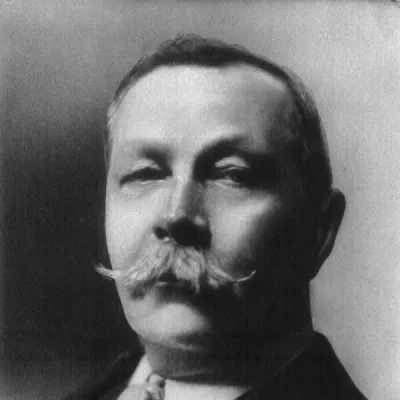
Arthur Conan Doyle
Human Design Chart
Biography
The son of a civil servant who worked hard to support his brood of seven kids, Conan Doyle escaped the family domestic tension by reading for hours. He was a student at Stonyhurst Jesuit school, noted for its discipline, followed by a year of study in Austria. When he came home to enroll at Edinburgh University's school of medicine, he was met by the sad spectacle of his dad, broken by depression, epilepsy and alcoholism. His dad was institutionalized for the rest of his life, causing great sorrow and hardship for the family.
Upon graduation, Conan Doyle served for a seven-month voyage as ship's doctor on an Arctic whaler. His income helped the family but it was almost more of an adventure than he could handle. He nearly died of typhoid fever, fought a ship's fire and had a close call in meeting a shark. Back on dry land, he resolved to stay there and opened a practice in Portsmouth, England. Conan Doyle was beginning the dark periods of depression, like his father, that plagued him the rest of his life.
As his practice built slowly, Conan Doyle filled his time with sports; cricket, rugby, golfing, boxing, billiards, as well as writing. His first short story was published in 1879 while he was still in school, but he primarily wrote as a diversion.
Conan Doyle married his first wife, Louise Hawkins, in 1885 and their daughter Mary Louise was born two years later.
The Human Design of Arthur Conan Doyle: Manifesting Generator 1/3
Manifesting Generator 1/3 — Design at a Glance
Arthur Conan Doyle revealed himself as someone who quickly brought things to life, driven by a hybrid energy. His design combined the constant power of a Generator with the direct impact of a Manifestor. This configuration allowed him to skip steps and push multiple projects forward simultaneously. Yet this speed carried risks: Without inner confirmation, skipping phases or pursuing many impulses at once led quickly to frustration.
The mechanics of his design required strict reaction to the sacral impulse. Only when his inner self signaled a clear "yes" could he effectively use his energy. If he acted hastily or ignored this confirmation, he would stall and often had to return to make up for missed steps. When the strategy was followed – that is, reacting only to what truly spoke to him – he found deep satisfaction in variety. He then worked in a "play mode," where parallel activities were not a burden but a source of his creative power. His energy was powerful, but it needed the discipline of waiting for the inner signal to avoid self-frustration. Thus, his design shaped a lifestyle where speed served only when guided by authentic confirmation.
Emotional Authority
Arthur Conan Doyle exhibited an internal decision-making structure that required time and emotional distance. His design featured Emotional Authority, meaning the defined Solar Plexus Center determined his inner truth. This configuration was subject to a constant wave motion of feelings: moods swung between enthusiasm and rejection, with the current perspective always colored by this emotional tinting. A feeling in the moment was not an ultimate truth but merely a snapshot.
Quick, spontaneous reactions based on these initial impressions risked being misleading. The mechanics of his design dictated the necessity of patience. Arthur Conan Doyle had to let decisions rest so that the emotional highs and lows could dissipate. Only through repeatedly "sleeping on" an issue did the intense feelings sufficiently subside. This process created the necessary distance for clarity and calmness to emerge.
This rule held with absolute priority: Since the Solar Plexus Center was defined, this emotional authority overrode all other potential inner voices or logical considerations. Regardless of further definitions in his chart, he had to wait for the emotional subsiding before a decision could be considered authentic and viable. This particularly applied to long-term life decisions, where the depth of emotional processing was crucial for the quality of the choice.
The 1/3 Profile — Investigator / Martyr
Arthur Conan Doyle revealed himself as someone whose judgments only gained validity through practical testing. His design indicated a tendency towards a cycle that combined theoretical learning with the necessary experimentation. As a carrier of Profile 1/3, the researcher and experimenter, he was naturally dependent on validating knowledge not just by accumulating it but also through trial and error.
Line 1 provided the theoretical foundation and promoted peripheral perception as a survival strategy in the here and now. This allowed him to react quickly to situations without getting lost in endless planning. At the same time, Line 3 demanded adaptability and accepted failure as an indispensable step towards authenticity. If he deemed something good, he had previously tested it both intellectually and practically.
This configuration created tension between the desire for a complete knowledge base and the necessity of action. Arthur Conan Doyle lived this dynamic: He was a scientist-adventurer type who only gained trustworthy insights through the real testing of his theories. His life revolved around learning through experience; errors were not defeats but essential components of his path to self-earned, solid conclusions.
Single Definition — Defined & Open Centers
Arthur Conan Doyle showed himself through a closed system of five defined centers: Sacral, Root, Solar Plexus, Spleen, and Throat. This configuration gave him a stable energy base and the ability to manifest reliably. His defined Sacral Center generated vital force based on reactions; he had energy only for what he responded to with an inner "yes." The Root Center provided constant pressure to maintain this life impulse and move forward.
Emotionally, Doyle was marked by his defined Solar Plexus Center. His inner authority lay in emotional depth; he needed time to wait out waves of feelings before clarity emerged. Spontaneous intuition came from the defined Spleen Center, which gave him existential security and well-being in the present moment. All these energies flowed into the defined Throat Center, which served as a pivot point for communication. His voice was reliable and manifested the truth of his other centers directly in the world.
In contrast to this inner stability stood four open centers: Head, Ajna, G, and Heart. The open Head and Ajna Centers meant that mental inspiration and conceptual thinking were not constant. Doyle tended to be inspired or confused by external ideas; he was a mirror for the thought life of his environment rather than following his own fixed intellectual source.
The open G Center showed situational openness to identity and direction. Doyle did not seek a fixed "I," but learned through encounters and places who he could be in each moment. He was vulnerable to blending with others or questioning a lost identity, instead of owning his own firm center.
The lack of a defined Heart Center meant a lack of constant willpower in the sense of ego assertion. Doyle tended to make promises to prove his worth, which often ended in frustration as he lacked the energy to maintain these commitments long-term. He was dependent on not defining himself through competition or the need for recognition, but rather trusting his emotional and sacral authority.
Channels for change, charisma, care and emotional expressiveness.
Arthur Conan Doyle showed himself to be someone characterized by an immediate, charismatic ability to act. This energy came from the Channel of Charisma 34-20, which combined raw physiological power (Gate 34) with the capacity for instantaneous expression in the present moment (Gate 20). His design required waiting for an inner sacral reaction to properly channel this driving force; without this pause, the energy tended to break out chaotically or lead to obsession.
These impulse-driven actions were deepened and complicated by the Channel of Mutation 60-3. This channel connected the Root Center with the Sacral Center and brought about evolutionary change through limitation (Gate 60) and the necessity to create order from confusion (Gate 3). This configuration generated an unpredictable, melancholic flow. Arthur Conan Doyle had to learn not to intellectually rationalize this inner tension and moodiness but rather patiently wait until the mutative energy was ready to unfold.
The synthesis of these two channels meant that his ability for rapid manifestation was always connected with a deep urge for renewal. The sacral reaction served as a filter: it channeled the often chaotic, mutative energy into constructive paths. When he followed this inner guidance, he could bring about change; if he resisted or acted out of intellect, this led to frustration and instability. His design was thus a balance between the urgent need to act in the moment and the discipline to wait for the rhythmic pulse of change.
Individual Circuitry — Circuit Signature
Arthur Conan Doyle emerged as someone who pioneered new paths through pulsating, acoustic energy. His Simple Definition connected the Sacral, Root, Throat, Solar Plexus, and Spleen Centers into a cohesive flow. The Knowledge Circuit operated via Channel 3-60 (Mutation), linking the Sacral with the Root Center, promoting deviation from tradition and the expression of a unique identity through transformation. Simultaneously, the Meaning Circuit flowed via Channel 35-36 (Transience) between the Throat and Solar Plexus Centers. Here he processed emotional waves from the past visually and cyclically to share insights with others. The Protector Circuit integrated via Channel 27-50 (Conservation), connecting the Sacral with the Spleen Center, giving a timeless, instinctive drive for protection and preservation of genetics as well as care. Finally, the Integration through Channel 20-34 (Charisma) linked the Throat and Sacral Centers. This connection enabled him to express power from reacting to life in the present moment charismatically, securing individual survival strategies. Together, these mechanisms shaped a person who connected innovation with emotional reflection, embedded within a deep instinct for preservation and direct expression in the current moment.
Right Angle Cross of the Sleeping Phoenix 2
Arthur Conan Doyle carried the energetic signature of the right cross of the sleeping phoenix. This configuration was characterized by a deep, often unconscious connection to spiritual or transcendent dimensions. The design promoted strong inner knowledge about the invisible and the ability to gain new perspectives in times of darkness or failure.
The right cross of the sleeping phoenix is a rare constellation in Human Design. It arises through specific channels that connect the G-Sun Center with the Root Center while simultaneously activating the Sacral Center. This mechanism generates a strong impulse to engage with questions about existence, death, and rebirth. People with this cross tended to develop exceptional resilience in crisis situations and find new paths from seemingly hopeless circumstances.
The energy of this cross often worked subtly in the background. It shaped Arthur Conan Doyle's inner attitude and his understanding of reality beyond the material world. This was not an obvious charisma but a deep, quiet power that became effective during moments of uncertainty or change. This configuration supported him in looking beyond the everyday horizon and recognizing connections that remained hidden to others.
The right cross of the sleeping phoenix gave him a unique perspective on life and its challenges. It was a source of inner strength and wisdom that came into play particularly in difficult times. This energetic endowment shaped his entire existence and contributed to his engagement with profound themes while always maintaining a connection to the transpersonal.
Saturn Return · Uranus Opposition · Chiron Return · 2nd Saturn Return — Life Cycles
Arthur Conan Doyle went through three structural turning points marking identity formation, radical change, and later fulfillment of purpose. These cycles shaped his life path not as mere age stages but as specific phases of development.
The first Saturn return around the 28th year condensed years of groundwork into a solid result. In 1887, Arthur Conan Doyle published “A Study in Scarlet,” the first story about Sherlock Holmes and Dr. Watson. This success signaled the consolidation of his creative identity and transition from seeking to established creative force as this cycle typically brings.
The Uranus opposition around the 40th year of life demanded a radical break with the known. In 1899, Arthur Conan Doyle went to South Africa to serve as a doctor in the Second Boer War and work as a reporter. This step highlighted the urgent need for change: The previous structure was no longer sufficient; it was necessary to take on new perspectives through direct confrontation with reality and redefine one's role.
The Chiron return around the 46th year is a fulfillment cycle in which the incarnation cross unfolds. In 1905, Arthur Conan Doyle published “The Empty House,” revising the literary death of Holmes. This was not an act of healing old wounds but the late bloom of his purpose: Returning to his core substance and affirming his true creative mission after completing previous phases of consolidation and change.
Manifesting Generator · Emotional Authority — Synthesis
Arthur Conan Doyle lived a life path marked by constant interplay between the urge for rapid implementation and the necessity of emotional maturation. As an Manifestor Generator (MG), he possessed the ability to realize ideas swiftly—an impulse strengthened by defined sacral energy. Simultaneously, his emotional authority required careful consideration and allowing emotional waves before decisions were truly grounded. This led to a dynamic tension between the desire for immediate manifestation and the need to let things mature over time, repeatedly showing in documented successes that required time and reflection.
A central paradox lay in the combination of experimental curiosity (Profile 1/3) and the Mutation Channel. Doyle was eager to generate new knowledge through research and experimentation, yet this process was always accompanied by a certain melancholy and acceptance of limitations. The ability to embrace unconventional paths and learn from mistakes allowed him creative breakthroughs—a constant struggle between seeking new possibilities and processing the associated emotional complexity.
4 Defined Channels
Incarnation Cross - Right Angle Cross of the Sleeping Phoenix 2
Solar Return
The Solar Return shows the moment when the sun returns to its exact birth position - your personal solar year.
Life Cycles
Discover the life cycles with a detailed triple view (birth chart, cycle chart, composite).
Human Design Profile
- Strategy
- To respond - wait for something to respond to
- Authority
- Emotional Authority
- Profile
- 1/3 - Investigator / Martyr
- Definition
- Single Definition
- Incarnation Cross
- Right Angle Cross of the Sleeping Phoenix 2
- Date of Birth
- 22.05.1859 04:55
- Place of Birth
- Edinburgh, United Kingdom
Frequently Asked Questions
What was Arthur Conan Doyle's Human Design type?
What Profile did Arthur Conan Doyle have?
Which Authority guided Arthur Conan Doyle?
What incarnation cross did Arthur Conan Doyle have?
When was Arthur Conan Doyle born?
Discover your own Human Design
Are you also a Manifesting Generator? Find out in a personal reading how to unfold your multi-talents and direct your energy wisely.
More Personalities
Back to overviewAlain-Fournier

Aldair

Alizée

Angeli

Arletty

Artus
