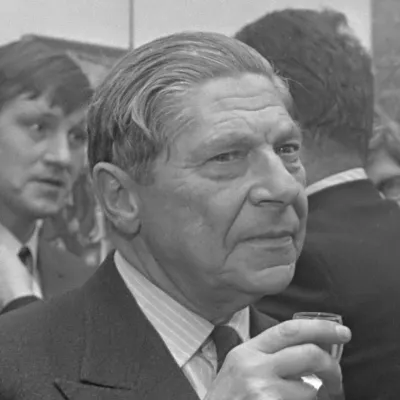
Arthur Koestler
Human Design Chart
Biography
Koestler was the son of Hungarian industrialist and inventor Henrik Koestler and Adele (Jeiteles) Koestler. As a child, he grew up without any religious instruction from his Jewish parents. In 1922, he went to the University of Vienna and became interested in the Zionist movement. Before finishing his degree, he left to Palestine where he worked as a farm laborer. From there, he worked as a Jerusalem-based reporter for a German newspaper. In 1929, he left to Paris and then to Berlin where he became the science editor of "Vossische Zeitung." In 1931, he joined the communist party and would later write about his experiences in "Arrow in the Blue." He was with the German Communist Party for seven years but broke with the movement during the Moscow trials. While participating in the Spanish Civil War, he captured by Franco forces and sentenced to death. Rescued from a Seville jail by the British Foreign Office, he claimed to have a mystical liberation while imprisoned and wrote his account in "Spanish Testament," 1937. In 1940, he was arrested by the Vichy government. Released from prison, he moved to England and wrote his first book in English, his autobiography, "The Scum of the Earth," 1941.
Koestler garnered international success with his "Darkness at Noon," 1940.
What does Generator 1/3 mean for Arthur Koestler?
Generator 1/3 — Design at a Glance
Arthur Koestler possessed immense inner endurance and strength, making him seem like a workhorse. As a Generator, he had abundant sacral energy that was not released through independent initiative but only in response to external impulses. His strength lay in reacting to signals from the environment; when his gut feeling gave a clear 'yes', he could act with full power and materialize projects.
This mechanism carried two specific risks: On one hand, exhaustion threatened if he invested energy into tasks that did not resonate internally. On the other hand, frustration arose when he was prevented from pursuing his heart's project despite having abundant energy available. Initiating against this inner logic or acting without this sacral impulse led to persistent dissatisfaction and a lack of vitality.
Living in harmony with this strategy – waiting for the impulse and then responding consistently – rewarded him with a deep sense of fulfillment. No one could stop him in this state, as his energy flowed efficiently and purposefully. His success thus depended less on constant planning than on whether he managed to react from the gut and not against his inner resistance.
Emotional Authority
Arthur Koestler was influenced by an emotional wave that significantly shaped his perception and decision-making. His design featured an emotional authority carried by the defined Solar Plexus Center. In Human Design mechanics, this configuration is prioritized: Regardless of other defined centers in the chart, the Solar Plexus Center always served as the decisive instance for inner guidance.
This structure meant that Arthur Koestler saw his world through the filter of his current mood. His feelings fluctuated constantly; what appeared inspiring at one moment could be perceived negatively in the next. Since this initial emotional impression was merely a snapshot and not necessarily reflective of deeper truth, spontaneous decisions based on immediate emotion were often problematic.
The mechanics of his authority required patience and time. Long-term decisions matured only after the initial intense emotions subsided. Through conscious hesitation and repeated 'sleeping' on questions, he gained emotional distance. Only when these waves had ebbed did clarity and calm set in. This process of waiting was not a sign of weakness but the necessary strategy to reach the true inner truth lying beneath the surface of transient moods.
The 1/3 Profile — Investigator / Martyr
Arthur Koestler's design was characterized by a deep inclination towards research and experimental learning. As Profile 1/3, the Researcher and Experimenter, he lived the principle of trial and error. His nature was geared towards not just theoretically collecting insights but practically testing them on heart and gut.
This attitude resulted from the dynamics of his lines. The first line laid a foundation for abstract mental processes, aiming to find the crux in confusion. Without the available energy from Gate 47, no progress was possible; instead, pressure often led to rash actions and heightened inner uncertainty. Arthur Koestler had to endure this mental tension to gain clarity.
Simultaneously, the third line, which worked through Gate 35, demanded personal development through chaos and crises. This line required involving others in contexts of boredom and progress. Through intense shifts and extreme situations during his youth, Arthur Koestler learned that change could only be advanced through active experimentation and tolerating mistakes.
The result of this constellation was a high credibility of his judgments. When he deemed something correct, he had previously analyzed it theoretically as well as practically tested it. His life task consisted in uncovering hidden connections and conveying them so others could embrace them. Thus, his design manifested as an ongoing process of learning through direct experience and resolving confusion.
Single Definition — Defined & Open Centers
Arthur Koestler's Human Design profile indicated a tendency towards a deeply rooted, unshakable self-identity. His defined G Center gave him a clear sense of direction and the ability to show others new perspectives without relying on their approval. This inner security was reinforced by his defined Sacral Center with constant, generative energy; he was designed to find satisfaction through reacting to life rather than initiating action. However, his decisions were subject to the emotional authority of his defined Solar Plexus Center: truth revealed itself for him only after experiencing an emotional wave, requiring patience and waiting before clarity emerged. The persistent pressure from his defined Root Center propelled him forward, nourished existential awareness, and ensured he met challenges with consistent energy.
At the same time, Arthur Koestler was open to external influences and conditioning in several areas. His open Head and Ajna Centers meant that he did not have a fixed mental structure; he tended to get entangled in other people's questions or adopt concepts without identifying them as his own truth. This could lead to mental confusion when trying to find answers that were not his own. His undefined Heart Center lacked consistent willpower; he was vulnerable to the pressure of proving himself or making promises to demonstrate his worth – a trap that led to frustration if unfulfilled. Additionally, his undefined Spleen Center revealed deep survival fears and a tendency to cling to uncertain situations because they provided a false sense of security or well-being from others. Finally, his open Throat Center relied on waiting for invitations rather than actively seeking attention; attempting to speak up or act often led to unpredictable results and stress due to the lack of consistent energy for manifestation.
Channels for focus, self-acceptance and emotional release.
Arthur Koestler's Human Design profile indicated a tendency towards extreme, almost static focus. The Channel of Concentration 52-9 connected his Root Center with his Sacral Center and generated a steady pressure to hold still and avoid distractions. This formative energy compelled him to evaluate details precisely until his Sacral Center reacted; without such a project, he felt restless or depressed. Parallel to this, the Channel of Exploration 34-10 between Sacral and G Centers drove the search for inner confirmation by teaching him to follow his own convictions, no matter how unusual they seemed. This fostered deep self-love and independence, which he demonstrated through authentic behavior.
Emotionally, his inner world was marked by the pulsating wave of the Channel Emotions Release 39-55 connecting Root Center with Solar Plexus. This channel set moods in motion, a continuum between ecstatic joy and melancholic uncertainty. Arthur Koestler learned not to rationalize these moods but to accept them as transformative power; his provocation helped him sense others' minds and make appropriate connections.
Additionally, specific Gates shaped his experience: Gate 64 in Ajna Center tried to transform past experiences into clear concepts while Gate 63 through doubt propelled the mental process forward to gain security. Gate 35 demanded change through interaction, and Gate 5 set a foundational rhythm for habits that built energy. On the personality side, Gate 30 reflected longing and recognition of feelings, while Gate 27 in his design embodied a genetic caretaking role. Gate 59 in Sacral Center also contributed to strategic bonding oriented towards pairing.
Individual Circuitry — Circuit Signature
Arthur Koestler's Human Design profile showed an unbroken, coherent energetic structure. As a simply defined person, he had a clear, undivided flow between Sacral, Root, Solar Plexus, and G Centers. This created an integrated basis for his ability to act and process emotions.
The Knowledge Circuit was active through Channel 55-39 ("Emotions Release"). This connected the Solar Plexus with the Root Center. The energy of this channel promoted the ability to translate inner emotional waves into concrete impulses, making his individual identity pulsing and rooted in the present moment.
In the Focusing Circuit, Channel 10-34 ("Exploration") was active. It directly connected Sacral with Identity Centers. This connection strengthened his self-worth and deep convictions from within. Since this circuit did not connect to Throat Center, these firm inner convictions often remained unspoken or hard to verbalize but strongly shaped his essence.
The Understanding Circuit manifested through Channel 9-52 ("Concentration"). This connected Sacral with Root Center. Here it was about focused, rational strategies and improving structures free from emotional influence of Solar Plexus. This energy-saving concentration served logical analysis and future planning.
All three circuits contributed to the expression of his unique individuality. The energies colored his entire design: emotional intensity, inner focus, and rational concentration worked as parallel but interconnected forces that determined his way of perceiving and responding.
Right Angle Cross of Consciousness 3
Arthur Koestler's Human Design profile created a specific tension in his perception, which is described by the right cross of consciousness 3. This configuration shaped his inner stance as someone who oscillated between different poles and constantly sought synthesis. The right cross in the third level of consciousness represents a dynamic interaction of forces that was often experienced as an internal conflict or driving restlessness. Arthur Koestler was marked by this structure: He wasn't simply active, but his energy arose from the friction between opposites – for example, between intuition and logic, between the individual and the masses. This mechanical arrangement meant that calmness was often felt by him as stagnation; only through navigating these tensions did he find clarity. The cross functioned not as a static characteristic but as a motor driving him to confront and integrate contradictions. His way of penetrating the world was characterized by this constant back-and-forth, which however didn't represent disintegration in a negative sense, but rather a necessary movement towards gaining insight. Without this inner friction, his specific form of perception would not have been possible; it also required the willingness to expose himself to these tensions instead of fleeing from them. Thus, the right cross of consciousness 3 became a central factor determining his mental and emotional dynamics.
Saturn Return · Uranus Opposition · Chiron Return · 2nd Saturn Return — Life Cycles
Arthur Koestler's life followed a clear rhythmic structure marked by recurring planetary cycles. His design foresaw that his development would condense and transform in defined phases. The first Saturn return marked the transition from an experimental phase to a stable life structure; here, the foundation for long-term commitments was laid. Shortly after came the Uranus opposition, a period often experienced as one of rupture or liberation. During this time, Arthur Koestler questioned existing bonds and patterns to gain new freedom.
With the Chiron return, another turning point occurred. This cycle is not a place of injury but of bloom: The individual incarnation cross unfolds increasingly if the personal strategy is observed. Meaning and purpose became tangible; the inner logic of the design revealed its full scope. Finally, the second Saturn return concluded these developmental arcs. In this phase, it was about integration and maturity; what had been achieved was stabilized, old burdens shed or transformed into new responsibility. This sequence of consolidation, liberation, fulfillment, and integration characterized Arthur Koestler's path as a process of gradually approaching his essence, driven by the temporal windows of these astronomical constellations.
Generator · Emotional Authority — Synthesis
Arthur Koestler was a Generator whose life was marked by a deep drive to generate knowledge through experience and experimentation (Profile 1/3) and bring it into the world. However, the sacral energy available to him was always colored by an emotional wave (Emotional Authority), which ripened decisions and provided an inner compass. This process of weighing and testing information corresponded with the defined G Center, imparting a strong sense of direction and purpose – an internal security that enabled him to walk his own path and inspire others. The Channel of Concentration (52/9) supported this ability to focus on details and create formats through perseverance.
Central to his essence was a paradox from the knowledge circuit: the drive for innovation and transformation clashed with the need for emotional clarity and patience. The energy to gain new insights (Channel 1-8) required the patience to filter these through the emotional wave before they could be expressed. This likely led to internal tensions between the desire for rapid progress and the obligation to weigh decisions carefully – a dance of pulsating creativity and melancholic reflection.
3 Defined Channels
Incarnation Cross - Right Angle Cross of Consciousness 3
Solar Return
The Solar Return shows the moment when the sun returns to its exact birth position - your personal solar year.
Life Cycles
Discover the life cycles with a detailed triple view (birth chart, cycle chart, composite).
Human Design Profile
- Type
- Generator
- Strategy
- To respond - wait for something to respond to
- Authority
- Emotional Authority
- Profile
- 1/3 - Investigator / Martyr
- Definition
- Single Definition
- Incarnation Cross
- Right Angle Cross of Consciousness 3
- Date of Birth
- 05.09.1905 08:30
- Place of Birth
- Budapest, Hungary
Frequently Asked Questions
What was Arthur Koestler's Human Design type?
What Profile did Arthur Koestler have in Human Design?
Which Authority guided Arthur Koestler?
What incarnation cross did Arthur Koestler have?
When was Arthur Koestler born?
Discover your own Human Design
Are you also a Generator? Find out in a personal reading how to use your sacral energy correctly and discover deep satisfaction.
More Personalities
Back to overviewAaliyah

Alexia

Angèle

Anne-Marie

Arcángel

Arno