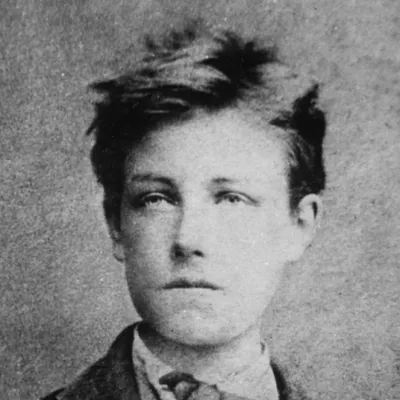
Arthur Rimbaud
Human Design Chart
Biography
His father deserted the family in 1860, leaving the boy with a very severe mother; Rimbaud made numerous attempts at running away. A teacher, Georges Izambard, influenced him to begin writing, his first published verse at 15. When he was 17, he composed the poem, "The Drunken Boat," which he submitted to Paul Verlaine. Verlaine was so impressed with the young man's abilities that he implored him to move to Paris. They began a strong, stormy relationship, with Verlaine attempting to kill Rimbaud twice, the latter of the two injuries very serious. His writing, "A Season in Hell," was written in 1873, the year that he was shot by Paul Verlaine in a lover's quarrel, giving an allegorical accounting of the matter.
In 1880, Rimbaud moved to North Africa to become a trader, explorer, gunrunner and possibly slave trader. While he was in Africa, Verlaine assumed that he was dead and published his prose poems, "Les Illuminations," 1886, which the majority of critics agree is Rimbaud's greatest work. This book contains the famous "Sonnet of the Vowels," in which each of the five vowels is associated with different colors. The poem, "Une Saison," was a spiritual autobiography saying farewell to poetry, his very last writings.
On 27 May 1891, Rimbaud had his right leg and thigh amputated due to a neoplasm in the knee. Suffering from syphilis, and not fully recovered from his operation, he died on 10 November 1891, 10:00 AM, Marseilles, France.
The Human Design of Arthur Rimbaud: Manifesting Generator 1/3
Manifesting Generator 1/3 — Design at a Glance
Arthur Rimbaud's Human Design indicated an inclination towards extraordinary speed: He could skip steps and quickly pull things into his life. As a Manifesting Generator, he was a hybrid of the speed of a manifestor and the energy of a generator. With his defined sacral center, he had constant energy that required reactions to impulses rather than independent initiation.
This tension between natural speed and the need to verify the sacral 'yes' shaped his dynamics. Often, he was too fast and skipped important steps, leading him later to backtrack to complete missing stages. This resulted in frustration, a non-self theme of his type. Additionally, he tended to do multiple things at once by reacting to various impulses and starting diverse projects simultaneously.
Without strategy and inner authority, this creative drive quickly turned into frustration. However, when the response to life was correct—starting only after the sacral center agreed—he found deep satisfaction in his work. Then it did not bother him to work on several projects at once; quite the opposite. The advice to finish one thing before starting another became a problem. With proper application, he gained strength through variety and a 'play mode' that allowed him to use his energy efficiently and satisfyingly without falling into hasty actions.
Sacral Authority
Arthur Rimbaud's decision-making was characterized by direct physical resonance. As a generator, he had sacral authority, meaning his strategy and inner guidance were the same: waiting for external stimuli and responding to them. This configuration simplified his process as he did not need to think but could feel.
His responses appeared as physical signals in the abdominal area—a voice inside or an energy surge. Arthur Rimbaud learned to pay attention to sounds like grunts, hums, or a confirming 'mm-hm'. When this reaction occurred, he felt vital and alive. The sacral motor then provided him with inexhaustible energy and enthusiasm for the activity itself without the need for external purpose. He was born to go into his work with joy.
Additionally, his activated spleen center acted as a supportive instance. This allowed quick, spontaneous reactions and immediate access to his instinctive perception of physical well-being. Arthur Rimbaud could reliably be guided by this inner compass, helping him make the right choice in the moment based on what was good for his body and gave it energy.
The 1/3 Profile — Investigator / Martyr
Arthur Rimbaud's design indicated a tendency not just to grasp knowledge theoretically but to validate it through radical practice. As someone with Profile 1/3, the Researcher-Experimentor, his life was a cyclical process of foundation building and trial and error. The energy in Gate 50 drove him towards expanding awareness and refining laws—a line that requires erecting a solid foundation. Simultaneously, the third line of the profile forced adaptation through mistakes. This created an internal tension: the fear of the first line not knowing enough clashed with the imperative of the third line to simply act and try.
This configuration meant that Arthur Rimbaud only accepted insights as valid if they were both theoretically tested and lived in reality. When he confirmed something, it was the result of rigorous validation. The third line of Gate 56 emphasized wisdom through mistakes and often difficult adaptation to new circumstances. His judgment thus did not rely on speculation but on his own painful experience. He learned by distancing himself from connections, engaging them again, and taking in and giving back ideas. This mechanism shaped him as someone who found his identity and understanding of the world only through constant experimentation and confrontation with failure. His authenticity arose precisely from this compulsion to prove what he had learned in the fire of action.
Single Definition — Defined & Open Centers
Arthur Rimbaud had a massive internal structure characterized by six defined centers. His design inclined towards mechanical reliability: logical thinking (defined Ajna Center), constant vital energy (defined Sacral Center) and stable identity (defined G Center). This combination created a 'fortress' of clear direction, conceptual clarity and instinctive intelligence (defined Spleen and Root Centers). Communication was reliable through the defined Throat Center.
This internal stability contrasted with three open centers: Head, Heart and Solar Plexus. Arthur Rimbaud appeared as someone who only took inspiration situationally (open Head Center) and absorbed foreign emotions like a barometer (open Solar Plexus). The open Heart Center warned against making promises or having to prove value.
The defined connection between Root and Sacral Centers drove a step-by-step, organized progress – the so-called logical format energy. This shaped his actions as systematic and focused. At the same time, he had to learn not to confuse his open centers with conditioning. The open Head Center tended to exhaust mental pressure or seek answers for foreign questions, which could lead to confusion. The open Solar Plexus absorbed the emotional climate of the environment, causing him to fluctuate between happiness and depression without these feelings always being his own. The open Heart Center drew him into a cycle of having to prove himself through performance, leading to self-doubt in case of failure.
Arthur Rimbaud's challenge was to use his defined energy source and identity while regarding the open centers as mirrors – without identifying with their contents. He could receive inspiration but had to wait for it to become clear. He felt emotions but should not personalize them. By trusting his inner authority and not reacting to the pressure of the open centers, he remained in his correct function: a stable, logical presence that was open to external impulses without being overwhelmed.
Channel 43-23: Structuring — Channels & Gates
Arthur Rimbaud's design inclined towards constant inspiration through authentic presence. He showed himself as someone who attracted attention not primarily through words but through the exemplary life of his individual identity. This dynamic came from the channel of Inspiration 1-8, connecting the G Center with the Throat Center. Gate 1 enabled a bold, creative expression of a unique perspective, while Gate 8 showcased this contribution to make it experiential for others. His impact relied on showing courage in highlighting oneself from the crowd and thereby inspiring others to live out their own uniqueness.
This inspirational power was complemented by further mechanisms. The channel of Beat 14-2 connected the Sacral Center with the G Center, bringing mutative impulses and new directions driven by trust in sacral reaction. Simultaneously, the channel of Mutation 60-3 between Root and Sacral Centers contributed to evolutionary change marked by pulsating energy requiring acceptance of limitation and patience while waiting for the right moment.
Cognitive processes were shaped by the channel of Structuring 43-23 connecting Ajna Center with Throat Center. Here, spontaneous insights (Gate 43) were processed and expressed through assimilation (Gate 23); these innovative perspectives required precise timing to be recognized. Finally, the channel of Preservation 27-50 between Sacral and Spleen Centers provided care in tribal context by preserving traditional values and taking responsibility for the community. Additional nuances came from prioritized gates such as Gate 56 (mental abstraction) and Gate 9 (detail work), deepening processing without overshadowing the central channel dynamics.
Individual Circuitry — Circuit Signature
Arthur Rimbaud's design revealed two parallel, strong energy flows that shaped his existence. The Knowledge Circuit propelled the innate path forward, marked by radical transformation and the search for new identity. In him, this circuit connected Ajna, Throat, Identity, Sacral and Root Centers into a cohesive whole. This connection allowed innovative flashes of insight and inspiration – fueled from channels of Mutation (3-60) and Inspiration (1-8) – to be expressed in pulsating, acoustic form. It was about creating unique individuality through deviation from the known, with emotional waves supporting expression through the throat.
Parallel to this, the Archer Circuit acted as an instinctive anchor for survival of the family core. Here it exclusively connected Sacral and Spleen Centers. This primordial flow focused on protection, care and nourishment to preserve one's genetics. The channel of Preservation (27-50) ensured that care and defense of familial assets remained prioritized.
Arthur Rimbaud lived in the tension between these two poles: On one side, the drive towards individual metamorphosis and expression of new truths through the Knowledge Circuit; on the other, the deep, timeless instinct to preserve and nourish the family fabric through the Archer Circuit. This configuration created a dynamic where radical inner change always corresponded with the need for security and protection of origin.
Right Angle Cross of Laws 3
Arthur Rimbauds Human-Design profile was marked by the Right Cross of Law 3, a fundamental energetic structure that shaped his entire inner framework. This configuration created a strict architectural frame for his life experience. It united various aspects of his nature into a coherent unit aimed at stability and clear internal logic.
The Right Cross of Law 3 functioned as structural scaffolding. It organized available energy in a pattern promoting constancy. Arthur Rimbaud moved within these prescribed boundaries, which gave him a specific kind of grounding. The mechanics of this cross emphasized the importance of laws as principles of order. They helped to structure chaos and place actions into meaningful contexts.
This structure did not only work in the background but actively shaped his perception of the world. Arthur Rimbaud sought patterns and rules that made life understandable. The cross provided him with a tool to reduce complexity and focus on essentials. It was less a source of inspiration than a foundation for understanding. Through this energetic architecture, he found orientation in an often unpredictable environment. The laws served as anchor points where he could hold fast to define his own identity and place within the whole.
Saturn Return · Uranus Opposition · Chiron Return · 2nd Saturn Return — Life Cycles
Arthur Rimbauds Human-Design profile showed a clear turning point: His first Saturn Return cycle marked the transition from youthful experimentation to adult responsibility. This phase demanded structuring and grounding, transforming previous energy into concrete, material or professional realities.
In 1880, at age 26, Arthur Rimbaud took up employment in Aden with a fur and coffee trading firm. This event was no coincidence but rather a typical expression of Saturn mechanics: Years of groundwork condensed into a solid result. The cycle called for anchoring in the here and now, moving from pure ideas to practical implementation. Arthur Rimbaud lived this demand of his design by creating a stable professional foundation. The Saturn Return acted as a catalyst for maturity, providing necessary conditions for long-term stability. Through this step, inner development became visible and tangible. It was a process of consolidation where Arthur Rimbaud channeled his energies towards what had substance and required responsibility.
Manifesting Generator · Sacral Authority — Synthesis
A central red thread runs through the design: the dynamic connection between initiation and reaction. As an Manifesting Generator (with sacral authority), this chart possesses both the ability to swiftly set things in motion – a pulse from the defined Throat Center – as well as the necessity to wait for sacral reactions. The Profile of Researcher/Experimenter (1/3) reinforces this aspect by emphasizing the urge to test and independently verify, implying an ongoing search for new experiences and insights. The defined mental landscape (Ajna Center) provides concepts and theories that underpin these experiments, while Channel Inspiration (1-8) promotes the expression of unique perspectives – a cycle of inner drive and outer reaction.
The design harbors a central paradox between the desire for autonomy and the necessity to engage with external stimuli. The Knowledge Circuit emphasizes individuality and the expression of personal knowledge, yet sacral authority demands a response to the current environment. Experienced cycles – a career event in Saturn Return (1880) and a physical crisis in Uranus Opposition (1891) – could be interpreted as expressions of this tension: seeking one's own path while confronting life's challenges.
5 Defined Channels
Incarnation Cross - Right Angle Cross of Laws 3
Solar Return
The Solar Return shows the moment when the sun returns to its exact birth position - your personal solar year.
Life Cycles
Discover the life cycles with a detailed triple view (birth chart, cycle chart, composite).
Human Design Profile
- Strategy
- To respond - wait for something to respond to
- Authority
- Sacral Authority
- Profile
- 1/3 - Investigator / Martyr
- Definition
- Single Definition
- Incarnation Cross
- Right Angle Cross of Laws 3
- Date of Birth
- 20.10.1854 06:00
- Place of Birth
- Charleville, France
Frequently Asked Questions
What was Arthur Rimbaud's Human Design type?
What Profile did Arthur Rimbaud have in Human Design?
What Authority did Arthur Rimbaud have?
What incarnation cross did Arthur Rimbaud have?
When was Arthur Rimbaud born?
Discover your own Human Design
Are you also a Manifesting Generator? Find out in a personal reading how to unfold your multi-talents and direct your energy wisely.
More Personalities
Back to overviewAlain-Fournier

Aldair

Alizée

Angeli

Arletty
Artus