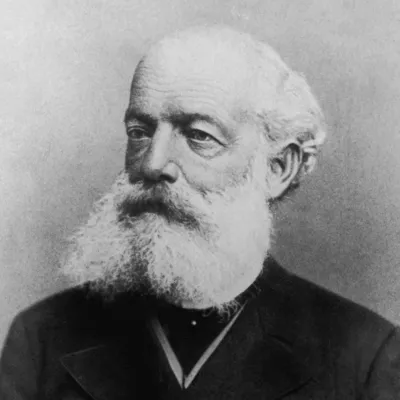
August Kekule Von Stradonitz
Human Design Chart
Biography
He died 13 July 1896.
The Human Design of August Kekule Von Stradonitz: Generator 4/6
Generator 4/6 — Design at a Glance
August Kekulé von Stradonitz possessed the Generator design with immense sacral endurance. His Human Design profile set him on a role akin to that of a workhorse: strong and steady, provided he found energy for his tasks. This strength was conditional; it did not ignite through sheer will alone but responded to signals from his environment. The strategy of his design did not require pushing projects forward but waiting for an internal 'yes' before taking action.
This mechanism protected him from two specific dangers. Firstly, it prevented him from investing energy in tasks that did not resonate internally; otherwise, he risked burnout through the sheer waste of his strength. Secondly, he suffered when external circumstances held him back from his heart project while his inner self still wanted to work on it. Living in harmony with this response to impulses rewarded him with deep satisfaction and fulfillment. Initiating against his internal compass or ignoring signals from his Sacral Center inevitably led to persistent frustration and a noticeable lack of energy. His success thus depended less on effort than on whether he managed to respond intuitively to the right life theme.
Sacral Authority
August Kekulé von Stradonitz's decision-making was guided by sacral authority. As a Generator, his strategy was also his inner guidance system, simplifying the process of choice. This configuration required an open Emotional Center; the actual answer did not come from the mind but as a physical reaction to external stimuli.
His authority manifested in the form of a 'gut feeling' or sudden surge of energy. August Kekulé von Stradonitz learned to listen to these inner signals: grunting, humming, or a loud 'mm-hm' signaled a yes, while silence or negative sounds indicated a no. When his sacral motor engaged, he felt vital and alive. Then, almost inexhaustible energy was at his disposal with which he accomplished tasks with great enthusiasm.
He was born to walk through life with joy and satisfaction, fully immersed in his activities without the need for external purpose. Additionally, his activated Spleen Center acted as a supportive authority. Directly connected to the Sacral Center, this connection enabled particularly quick and spontaneous reactions. He had immediate access to his physical well-being and instinctive perception, which he relied on reliably. This combination of sacral confirmation and spleen-based intuition shaped how he acted in the moment and made intuitive yet powerful decisions.
The 4/6 Profile — Opportunist / Role Model
August Kekulé von Stradonitz was someone whose life was marked by an internal tension between a drive for community and a need for detached wisdom. His Human Design profile as a 4/6-Profile set a development path: In the first three decades, he experimented intensely with relationships and friendships, where Line 6 still acted like Line 3 - unstable and searching. Once Line 6 became active, a conflict between Heart (Line 4) and Head (Line 6) emerged. He faced the challenge of standing against the impulse on the 'mountain' to reflect on higher questions while wanting to belong. This dynamic often led to confusion but ultimately served as a process towards inner clarity.
His Gate 64 on Line 4 provided internal certainty about the meaning of his experiences, even if processes initially seemed unclear. He was an inspiration for his network and gained trust through kindness. At the same time, he consciously sought crises to achieve experiential goals as prescribed by Line 6 from Gate 35. This correction process, combined with rigor and sometimes self-destruction, served authenticity. It was expected of him to be a wise role model that stood out through cooperation, always cautious not to open up to the 'wrong' people and get hurt. His life task involved integrating these polarities.
Single Definition — Defined & Open Centers
August Kekulé von Stradonitz's design inclined towards clear self-determination and vital endurance. His defined G-Center gave him a reliable identity and a sense of direction, while the defined Sacral Center functioned as an engine generating energy - provided he responded to external triggers rather than initiating action himself. This configuration marked him as someone who found satisfaction when investing his strength in matters that elicited an affirmative inner response.
At the same time, his design was characterized by several open centers making him susceptible to external influences. His open Head Center meant that inspiration did not flow consistently from within; he tended to absorb mental pressure and engage with others' questions, which could lead to confusion if he did not trust his internal authority. Similarly, his open Ajna Center indicated that concepts and theories were fleeting for him, and he had to learn not to identify every idea as personal truth.
His open Heart Center showed a lack of consistent willpower; he was not designed to make promises or prove his worth through competition. Instead, he risked frustration when trying to fulfill others' expectations. His open Solar Plexus Center absorbed emotions from the environment, leading him to experience foreign moods as his own and feel emotionally overwhelmed. Likewise, his open Spleen Center made him sensitive to well-being; spontaneous decisions were risky since they often stemmed from conditioned fear rather than healthy intuition. Finally, his open Root Center amplified external stress, leading to a cycle of adrenalized pressure and attempts to escape it through frenzy instead of consciously utilizing or avoiding it.
Channels for persistent determination and inner confirmation.
August Kekulé von Stradonitz's design inclined towards profound, persistent research. He was someone ready to immerse himself completely in a process to gain insights that could change collective understanding. This attitude was shaped by the Discovery Channel 29-46. This connection linked his life force in the Sacral Center with his direction in the G-Center. Gate 29 provided access to endurance and persistence, while Gate 46 established a link to Higher Self to be at the right place at the right time. For August Kekulé von Stradonitz, it was essential to let go of expectations and commit unwaveringly to an experience. Only through this clear commitment could he experience satisfaction that arose from completing such discovery cycles.
Additionally, further energetic patterns influenced him. Gate 64 promoted a visual mental process aimed at interpreting past experiences to gain clarity in the abstract mind. This transitional-stage character often caused confusion before completion but drove concept formation forward. Simultaneously, Gate 63 pushed the mental process through doubt to improve uncertain patterns and achieve security. This combination of doubt and visual interpretation created an intense inner dialogue.
In the realm of interaction, Gate 35 stood for change and progress through new experiences. It required readiness to embrace transitions, with true satisfaction only becoming apparent retrospectively through the meaning of experience. In personal rhythm, Gate 5 set the basic pace of life by fostering firm habits and rituals that built energy and perfected patterns. This supported him in finding his own tempo and using his strength effectively.
On the level of personality, Gate 25 with its mystical stance of innocence and individualization as well as Gate 10, which stood for a complex role gate for integration and genetically determined behavioral rules, influenced him. Gate 10 shaped his life through striving for correct behavior at the right time. Finally, Gate 9 in the Sacral Center enabled focused attention on details and perfection through repeated experiments, strengthening his ability to materialize ideas. Without this energetic support, the necessary taming power for his work would not have been available.
Collective Circuitry — Circuit Signature
August Kekulé von Stradonitz exhibited a cyclical way of perceiving strongly influenced by the past. His design connected the Identity and Sacral Centers directly through Channel 46-29 (Discovery). This connection generated an inner flow between the center for emotional wave motion and the power center. Emotions and experiences from earlier times served him not only as personal memories but also as a source to share with others. The Meaning Circuit emphasized the need to reflect on past events and discover their significance. These insights should not remain hidden but be made accessible to the collective to learn together from them. Energy worked in wave-like patterns: it had a clear beginning, middle, and end, similar to emotional cycles in the Solar Plexus, here anchored in identity and life force. Through this configuration, August Kekulé von Stradonitz learned that sharing past emotional perceptions was a central way to establish connection and meaning. The direct linking of power and identity enabled him to express these deep experiences authentically and powerfully without veering into pure logic or future-oriented planning. Instead, the focus remained on emotionally understanding what had already happened and how this understanding could be conveyed.
Right Angle Cross of Consciousness 3
August Kekule Von Stradonitz's design indicated a tendency towards a specific kind of internal structuring. He was marked by the right consciousness cross 3, showing himself as someone whose awareness was shaped by this configuration. This setup connected the energy of Gate 4 with Gate 56 and Gate 10 with Gate 28 in his chart.
Gate 4 stood for the desire for connection and belonging, a fundamental need to be part of something greater. Gate 56 brought the potential for inspiration, often as sudden insight or creative spark. Together they formed a force that oscillated between social contact and individual enlightenment.
On the other side, the cross linked Gate 10 with Gate 28. Gate 10 represented the will to assert oneself and the ability to set personal boundaries. Gate 28 stood for intuition and trust in inner voices or unconscious processes. This connection created a tension between actively asserting one's identity and letting go in favor of a higher flow.
For August Kekule Von Stradonitz, this meant that his consciousness constantly integrated these four poles: social being, inspiration, the will to define oneself, and intuitive surrender. His inner compass oriented around the question of how he could embed his individual insights into a larger whole without losing his own standpoint. This dynamic shaped his way of handling information and forming relationships.
Saturn Return · Uranus Opposition · Chiron Return · 2nd Saturn Return — Life Cycles
August Kekule Von Stradonitz's design indicated a tendency towards structural condensation in early middle age. In 1860, at the age of 31, he organized the Karlsruhe Congress. This marked his first Saturn return, a cycle where years of groundwork often condenses into a solid, public result and strengthens one's positioning.
With the Uranus opposition around the age of 41, a phase of sudden breakthrough began. In 1870, he discovered the azo coupling. This mechanical configuration favors unexpected innovations that break existing patterns and open new paths in professional orientation, often accompanied by feelings of liberation or renewal.
The Chiron return around ages 47 to 51 served as a fulfillment cycle where his incarnation purpose deepened and meaning became experiential. In 1876, August Kekule Von Stradonitz married Luise Högel. This step reflects typical development: when strategy and authority are respected, the deeper life task unfolds increasingly in personal areas, leading to inner coherence and outer confirmation.
Generator · Sacral Authority — Synthesis
August Kekule Von Stradonitz lived deeply within his sacral center (Design, Authority), a source of inexhaustible energy that was bound to an authentic reaction (Channels/Gates). This connection between internal vitality and external incentive shaped his approach: he found strength in the act itself, in immediate experience, not in abstract goals. The profile as networker/role model points towards development where the need for connectedness (Line 4) interacts with the desire for independent reflection (Line 6) – a constant balancing between social interaction and inner withdrawal. The Meaning-Finding Circuit reinforced this process by taking in past experiences and processing them in a cyclical pattern to gain insights and share them (Circuit).
A central paradox lay in the tension between the deep need for self-discovery and the ability to guide others. The defined G-Center identity suggests clear direction, yet the profile points towards an inner conflict: the search for meaning that corresponds both with personal depth and collective relevance (Profile). This was evident in documented events like organizing a congress and later discovery – moments where individual energy met external influence leading to new insights (Cycles).
1 Defined Channel
Incarnation Cross - Right Angle Cross of Consciousness 3
Solar Return
The Solar Return shows the moment when the sun returns to its exact birth position - your personal solar year.
Life Cycles
Discover the life cycles with a detailed triple view (birth chart, cycle chart, composite).
Human Design Profile
- Type
- Generator
- Strategy
- To respond - wait for something to respond to
- Authority
- Sacral Authority
- Profile
- 4/6 - Opportunist / Role Model
- Definition
- Single Definition
- Incarnation Cross
- Right Angle Cross of Consciousness 3
- Date of Birth
- 07.09.1829 17:15
- Place of Birth
- Darmstadt, Germany
Frequently Asked Questions
What was August Kekule Von Stradonitz's Human Design type?
What profile did August Kekule Von Stradonitz have?
What authority did August Kekule Von Stradonitz have?
What incarnation cross did August Kekulé von Stradonitz have?
When was August Kekulé von Stradonitz born?
Discover your own Human Design
Are you also a Generator? Find out in a personal reading how to use your sacral energy correctly and discover deep satisfaction.
More Personalities
Back to overviewAaliyah

Alexia

Angèle

Anne-Marie

Arcángel

Arno