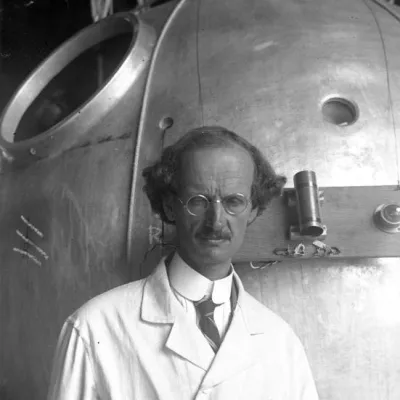
Auguste Piccard
Human Design Chart
Biography
He died in Lausanne, Switzerland on 24 March 1962, aged 78.
Auguste Piccard as a Generator 1/4 in Human Design
Generator 1/4 — Design at a Glance
Auguste Piccard possessed immense endurance and a powerful energy source, making him a robust „workhorse“. As a Generator, his inner engine was powered by the sacral center, which continuously generated energy as long as he engaged in tasks that truly resonated with him. However, this configuration also created specific risks: If he engaged in activities that did not resonate internally, he wasted his energy and tended towards exhaustion. Conversely, he suffered from frustration when external circumstances prevented him from continuing with his heart projects, even though he was still full of drive.
The key to his effectiveness lay not in initiative but in reaction. His design required him to wait for signals from the environment and only act when his inner self gave a clear „yes“. This strategy of reacting rather than initiating allowed him to use his energy efficiently. Living by this principle rewarded him with a deep sense of fulfillment. Ignoring this inner guidance and instead trying to force or initiate things inevitably led to persistent frustration and a lack of energy. His strength, therefore, lay in patiently waiting for the right impulse and then responding to it with full force.
Sacral Authority
Auguste Piccard's decision-making was characterized by a direct physical resonance. As a Generator, he possessed sacral authority, which also served as his strategy and simplified the process of choice. This inner guidance did not manifest in the head but as a reaction to external stimuli in the form of gut feelings or bursts of energy. His system signaled approval through sounds like an affirming „Mhm“ or disapproval through a negative „Hm-hm“. It was crucial that his emotional center remained open; this prevented him from making decisions in emotional troughs and ensured the reliability of the sacral response.
Once his sacral motor engaged with a topic, he felt vital and energized. He could then immerse himself in activities driven by enthusiasm and without the compulsion of external purpose. This configuration allowed him to go through life with joy and satisfaction. Additionally, his activated spleen center acted as a supportive authority. It gave him the ability to react particularly quickly and spontaneously. Through immediate access to his instinctive perception and physical well-being, he could reliably guide himself from these deep impulses, which shaped his actions in everyday life.
The 1/4 Profile — Investigator / Opportunist
Auguste Piccard was someone who not only gathered deep knowledge but was compelled to share it within a familiar network. As a 1/4, the „Researcher/Networker“, his design combined a pressing desire for thorough exploration (Line 1) with a longing for a group of trusted individuals (Line 4). For him, isolating knowledge was not an option; it was about conveying insights in a way that the community would accept. A specific caution marked him: Line 4 caused him to fear being exposed as unknowledgeable to his loved ones, which would cause him great heartache. Only in a loving environment with a deep trust foundation could he fully develop his abilities and become an authority in his heart themes.
His communication style was characterized by a fixed honesty. The fourth line of Gate 44 demanded honesty and directness without hypocrisy. He based himself on the „trunk“, not individual needs, which could lead to a strongly rejecting stance in matters of survival. At the same time, Gate 19 stood for mutual dependence and successful approach under recognition of individual traits. He checked whether sufficient means were available and who the right partner was to avoid identity loss through one-sided dependence. This configuration described a life task: uncovering hidden connections and passing them on to others within a safe framework, where the balance between deep research desire and the necessity of social validation formed the core of his actions.
Split Definition — Defined & Open Centers
Auguste Piccard was someone who operated under a constant internal pressure to ask questions and understand connections. His defined Head and Ajna Centers created a permanent mental activity that did not let him rest until a concept was understood. This thought process, however, was not directly linked to energy for implementation; it served to generate inspiration and encourage others to think, rather than initiating physical action himself.
Despite this mental intensity, Auguste Piccard had a reliable, deep energy source. His defined Sacral Center generated daily vital energy, which could only be correctly released in response to external stimuli. By waiting for life to speak to him, he could use his full energy for tasks that brought him satisfaction, rather than experiencing resistance through initiative. This sacral endurance allowed him to endure phases of stagnation until a breakthrough came.
His identity was marked by a defined G Center, which gave him a clear sense of his own direction and value. He knew who he was without needing to prove it. This contrasted with his open Heart Center, which was vulnerable to the attempt to demonstrate value through willpower or promises. By avoiding this trap, he did not suffer from the cycle of self-doubt that arises when one tries to achieve something for which they do not have constant energy.
Furthermore, Auguste Piccard was emotionally open. His undefined Solar Plexus Center absorbed the emotions of his surroundings, making him vulnerable to foreign moods. He tended to identify with these absorbed emotions rather than seeing them as external information. At the same time, his open Root Center took on external stress, which could lead to a feeling of chaos or pressure that did not come from him. His challenge was to not mistake this external adrenaline surge for his own drive, but to recognize when he needed to withdraw to gain clarity. Through trusting his sacral response and his inner direction, he could use these open centers as informative windows without being overwhelmed by their conditioning.
Channels for leadership, structure, intuition, reflection and care.
Auguste Piccard sought leadership not through coercion but through logical integration into existing patterns. The Alpha Channel 7-31 connected his G Center with the Throat Center. Gate 7 provided the logical role to lead society, while Gate 31 spoke as a collective leader. This configuration required him to gain trust and be invited by the majority before he could effectively lead. He could show the way, but not take it.
Parallel to this, he gathered experiences to organize later. The Lost Son Channel 13-33 also connected his G and Throat Centers. Gate 13 listened and stored secrets, while Gate 33 withdrew to reflect on these memories. This created a stance of the patient observer who shared lessons only when they were ripe.
His thinking was marked by spontaneous insights. The Structuring Channel 43-23 connected his Ajna and Throat Centers. Gate 43 received intuitive breakthroughs, which Gate 23 then assimilated and clearly articulated. This allowed him to formulate innovative perspectives that promoted efficiency, provided he waited for the right timing to express them.
The source of these insights lay in the Awareness Channel 61-24 between his Head and Ajna Centers. Gate 61 brought acoustic inspiration, which Gate 24 rationalized. This generated sudden moments of knowledge that broke through old thought patterns.
In the background, the Preservation Channel 27-50 between his Sacral and Spleen Centers worked. Gate 27 provided selfless care, while Gate 50 guarded traditional values. This anchored his activities in responsibility for the tribe and the preservation of structures.
Additionally, Gates like 19 (Resources, Spirituality), 44 (Awareness, Transformation), and 32 (Continuity, Material Success) shaped his attitude. Gate 42 (Experience, Completion) and 56 (Narration, Abstraction) supported his ability to complete processes and tell stories. Gate 28 (Risks in the Now) and 5 (Rhythm, Habits) guided his actions in the here and now. Gate 16 (Experimentation, Mastery) and 20 (Uniqueness, Integration) promoted his development. Gate 2 (Mutation, Direction) and 8 (Contribution, Leadership) rounded out his profile.
Individual Circuitry — Circuit Signature
Auguste Piccard's design inclined towards a pulsating, acoustic creativity aimed at forging new paths and initiating change. The Knowledge Circuit connected his Head, Ajna, and Throat Centers directly. This allowed him to articulate and express innovative flashes of insight and awareness, driven by the energy to strengthen his individual identity through mutations.
Parallel to this, a separate but equally powerful force was evident in the realm of structure and protection. The groups of defined centers remained energetically isolated from each other: one group included the centers mentioned above plus the G Center, the other the Sacral and Spleen Centers. There was no direct flow between these two blocks.
Within the second group, the Archer Circuit connected the Sacral and Spleen Centers through the Preservation Channel. This created a timeless, instinctive basis for survival, care, and the preservation of one's genetics and family. It was a primordial energy of sustenance and protection that operated independently of the creative expression forms of the first group.
Additionally, two further, separate circuits appeared in the Throat and Identity Centers. The Understanding Circuit brought logical, rational insight aimed at the future and wished to remain free of conditioning. The Meaning Circuit, on the other hand, related to emotions and experiences from the past, reflecting on their meaning and sharing them with the collective. Both circuits used the Throat Center for expression but were not connected to each other. Thus, at Auguste Piccard, there existed four parallel, non-connected energetic segments: creative expression, protective instinct, rational future vision, and emotional past reflection.
Right Angle Cross of the Four Ways 4
Auguste Piccards design points to a tendency towards inner orientation, characterized by the right cross of the four paths 4. This configuration does not create an external action trail but works as a quiet, deeply rooted structure within. It creates a space of collection where thoughts and feelings can condense without external pressure. The mechanics of this cross describe a process of inner condensation, where disparate impressions are brought together into a coherent, personal truth. For Auguste Piccard, this meant that his strength did not lie in loud expression, but in the ability to integrate and understand complex inner states. It was an energy that sought peace and contemplation to gain clarity. This inner work was essential for him to define his own identity and path, independent of external expectations or social demands. The right cross of the four paths 4 fosters a stance of patience and trust in one's own inner process. Auguste Piccard was marked by a deep, often unspoken wisdom that arose from this continuous inner struggle. His strength lay in the ability to feel and understand himself, which served as a foundation for all further steps. This configuration supported him in resting within himself and acting from this stillness, rather than being driven by external stimuli. It was a way of life based on inner authenticity and deep self-reflection.
Saturn Return · Uranus Opposition · Chiron Return · 2nd Saturn Return — Life Cycles
Auguste Piccards design points to a tendency towards profound inner structuring, which condenses into concrete, measurable achievements. This configuration describes a life task where years of groundwork and inner maturity form into stable, recognized results once the corresponding cyclical phases are reached.
In 1913, at the age of 29, he received his doctorate. For his design, this was a typical moment of the first Saturn return, when long-term efforts often condense into a stable, recognized foundation. This cycle marked the transition from preparation to established position, where the inner architecture of character now took a firm form.
Later, in 1932, at the age of 48, he set a new world record with Max Cosyns of 16,940 meters. This fell into the phase of the Chiron return, a fulfillment cycle in which the individual's incarnation cross unfolds and meaning becomes experiential. Provided that one lives according to strategy and authority, this is where the flowering of the life task is evident. The record was not just a performance, but the visible effect of a mature, self-actualizing energy. The mechanics of his design thus fostered not spontaneous impulsivity, but a cumulative development that reached its peaks in these specific time windows.
Generator · Sacral Authority — Synthesis
Auguste Piccard lived deeply rooted in his sacral drive (Generator type), which moved him to tireless research and action. This energy found expression in the pursuit of knowledge (Knowledge Circuit) and the ability to influence others through deep exploration (Profile 1/4). The defined Mental Center strengthened this urge to question and advance understanding of the world, while the Alpha Animal Channel (Gate 7/31) signaled a natural inclination towards leadership and showing new paths. Decisions were made through the gut feeling (sacral authority), which signaled which path truly fed his energy and placed him in a state of deeper satisfaction.
Simultaneously, a tension field was revealed between the desire for deep, independent knowledge and the necessity to share this knowledge (Line 4 of the Profile). The fear of not knowing enough and the potential exposure to others (Heart Pain) seemed to stand against the deep need for networks and influence. This led to an inner struggle between the striving for personal perfection and the desire to share the results of research with the world, which was shown in verifiable successes but was connected with effort (Saturn Return, Chiron Return).
5 Defined Channels
Incarnation Cross - Right Angle Cross of the Four Ways 4
Solar Return
The Solar Return shows the moment when the sun returns to its exact birth position - your personal solar year.
Life Cycles
Discover the life cycles with a detailed triple view (birth chart, cycle chart, composite).
Human Design Profile
- Type
- Generator
- Strategy
- To respond - wait for something to respond to
- Authority
- Sacral Authority
- Profile
- 1/4 - Investigator / Opportunist
- Definition
- Split Definition
- Incarnation Cross
- Right Angle Cross of the Four Ways 4
- Date of Birth
- 28.01.1884 23:00
- Place of Birth
- Basel, SWTZ
Frequently Asked Questions
What was Auguste Piccard's Human Design type?
What profile did Auguste Piccard have?
What authority did Auguste Piccard have?
What incarnation cross did Auguste Piccard have?
When was Auguste Piccard born?
Discover your own Human Design
Are you also a Generator? Find out in a personal reading how to use your sacral energy correctly and discover deep satisfaction.
More Personalities
Back to overviewAaliyah

Alexia

Angèle

Anne-Marie

Arcángel

Arno