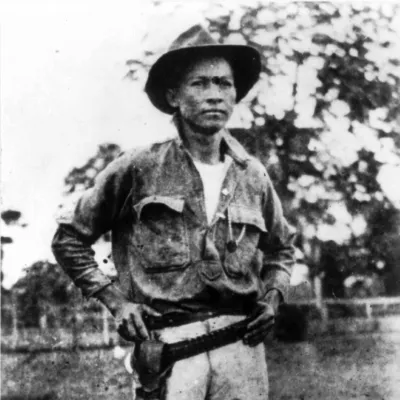
Augusto César Sandino
Human Design Chart
Biography
Sandino was assassinated on February 21, 1934 by National Guard forces of Gen. Anastasio Somoza García, who went on to seize power in a coup d'état two years later. After being elected by an overwhelming vote as president in 1936, Somoza Garcia resumed control of the National Guard and established a dictatorship and family dynasty that would rule Nicaragua for more than 40 years. Sandino's political legacy was claimed by the Sandinista National Liberation Front (FSLN), which finally overthrew the Somoza government in 1979.
Sandino is revered in Nicaragua, and in 2010 was unanimously named a "national hero" by the nation's congress. Sandino's political descendants, along with the icons of his wide-brimmed hat and boots, and influence of his writings from the years of warfare against the U.S. Marines, continue to help shape the national identity of Nicaragua.
Augusto César Sandino — Manifestor with Profile 4/6
Manifestor 4/6 — Design at a Glance
Augusto César Sandino's design inclined him towards a leading, pioneering stance. As a Manifestor, he was geared towards guiding the world into a new future, similar to an emperor in ancient Rome who possessed the vision of a great empire but did not lead the wars himself, instead guiding others to do so. This configuration often led to misunderstandings as he thought ahead of his environment. This resulted in strong polarization: while some loved and followed him for his great dreams, others hated him precisely because of these visions.
The ideal strategy for his design was to inform others timely and accurately about his intentions. Only then could he find the right followers who would support him. If he lived according to this strategy and his inner authority, he was rewarded with a sense of inner peace. Acting against his design, however, he felt a persistent, deep anger. His nature was thus characterized by this tension between the necessity to clearly communicate his visions and the resulting emotional reactions from the community's acceptance or rejection.
Emotional Authority
Augusto César Sandino was someone who did not make decisions based on a momentary impulse but waited for an inner calm that only came after the emotional waves subsided. His design was marked by an Emotional Authority anchored in the defined Emotional Center. In Human Design mechanics, this center, if defined, always carries the inner authority, independent of other defined areas. This meant that Sandino was constantly under the influence of an emotional wave that colored his perception of the world through current moods. What appeared inspiring in one moment could become negative in the next. His immediate feeling was thus only a snapshot, not yet his truth. Quick, spontaneous decisions based on this emotional excitement could have negative consequences. Instead, his system required patience: he let decisions mature, slept on them multiple times, and sought emotional distance. Only when the intense feelings subsided did the necessary clarity arise. This process was essential for long-term decisions that significantly influenced his life path. Through the delay and repeated review, he gained the calmness needed for well-founded judgments, rather than being led by passing moods.
The 4/6 Profile — Opportunist / Role Model
Augusto César Sandino was someone who, in the first three decades of his life, maintained an experimental attitude, especially in dealing with relationships and friendships. His Profile 4/6 acted similarly to a Line 3 in this early phase, encouraging him to try out various social roles and connections. Once the second half of his life began and Line 6 became active, an internal conflict emerged: the desire for belonging to a community (Line 4) was in opposition to the need to withdraw to contemplate the meaning of life (Line 6). This tension between heart and head characterized his later development. Augusto César Sandino increasingly became a role model through discipline and the ability to enforce laws or principles. Line 6 promoted in him the willingness to eliminate negative emotions and instead cultivate positive experiences with valuable people. At the same time, the fourth line protected his heart from opening too early or to the wrong people, requiring a certain caution in choosing his allies. His communication and individuality served to change the collective, waiting for the right moment to make his contribution. Respect and recognition in the network were crucial for him as he recognized and fostered the gifts of others. This dynamic enabled him to act as a wise networker, uniting the depth of the mind with the breadth of human connection.
Single Definition — Defined & Open Centers
Augusto César Sandino's Human Design profile indicated a tendency towards consequent, conceptual clarity, paired with a deep, emotional resonance. His defined Ajna Center ensured a constant mental function: He always thought, processed data and concepts in a specific, trustworthy way. This mental energy flowed directly into his defined Throat Center, allowing him to articulate what he thought. His communication was thus not an impulse reaction, but the articulation of his conceptual world.
At the same time, he possessed a firm inner identity through his defined G Center. He knew who he was and had a clear sense of direction, without having to rely on others. This self-assurance served as a foundation upon which his emotional authority, the defined Solar Plexus Center, could operate. Sandino was designed to find the truth of his decisions not in the present moment, but by waiting for the waves of his feelings. Only through patience and navigating emotional fluctuations did he achieve the necessary clarity to act.
This stable inner core stood in contrast to his open centers, which made him vulnerable to external conditioning. His open Head Center tended to interpret mental pressure and questions from others as his own urgency, leading to confusion if he did not trust his authority. The open Heart Center drove him to prove his worth through promises or competition, a cycle that could plunge him into self-doubt upon failure. Additionally, his open Root Center absorbed the stress and adrenaline pressure waves of the environment, making him vulnerable to overloading, as he did not recognize this foreign pressure as his own. His open Sacral Center also meant that he did not have a constant, generative energy source but reacted to the energy of others, requiring a careful selection of environment to avoid exhaustion.
Channels for inspiration, emotional openness and clear structure.
Augusto César Sandino was someone who, through his mere existence and authentic way of seeing the world, inspired others to discover their own potential. His design featured the Channel of Inspiration 1-8 in the Personality, a connection between the G and Throat Centers. This channel grants the ability to draw public attention through exemplary living and bold self-expression. Sandino lived his individual direction, not through mere explanations, but by fully embodying his unique identity. This acted as an example that inspired others to live their own creativity and truth, much like an artist whose performance moves listeners to action.
At the same time, he possessed the Channel of Openness 22-12, connecting Solar Plexus and Throat. Here, the emotional wave played a central role. His social interaction and expression were dependent on his mood; when he felt it, he could deeply touch and transform others with his voice and presence. However, this channel required patience to wait for the right timing, as forcing it could lead to misunderstandings.
In his design, he also had the Channel of Structuring 23-43, linking Ajna and Throat. This gave him the gift of clearly and efficiently articulating spontaneous insights and innovative thinking. His mind often worked faster than the environment, and he had to learn to communicate his knowledge at a pace that others could absorb to avoid rejection.
Additionally, Gates like 14 (Power and Direction Finding), 30 (Recognizing Feelings and Longings), and 29 (Persistence and Saying Yes) influenced him. These configurations shaped his ability to handle power, understand inner drives, and overcome obstacles through persistence, while Gates like 47 and 35 enhanced his ability to draw meaning from past experiences and grow through interaction.
Individual Circuitry — Circuit Signature
Augusto César Sandino's Human Design profile indicated a tendency towards a pulsating, acoustic expression style, driven by the need to articulate his individuality. His simple definition connected the Ajna, Throat, Solar Plexus, and Identity Centers in a single, continuous energetic flow. This knowledge circuit served to transform new knowledge and initiate change.
Three specific channels shaped this dynamic. The Channel of Inspiration (Gates 1 and 8) promoted spontaneous, innovative flashes of insight that acted as creative impulses. The Channel of Structuring (Gates 23 and 43) helped to bring these impulses into tangible forms, where mutations - deviations from the existing - strengthened his own identity. Additionally, the Channel of Openness (Gates 12 and 22) fostered a receptive attitude that allowed for the uptake of new information.
The energy flowed through the Solar Plexus Center, where emotional waves and pulsations arose. These feelings were not suppressed but served as fuel to express thoughts formed in the Ajna Center through the Throat Center. The Identity Center closed this loop by incorporating the authentic, unique personality into the expression. Thus, in Augusto César Sandino, a process emerged where inner inspiration and emotional resonance directly translated into structured, transformative communication, without the need for external validation. The mechanics described a closed loop of idea, feeling, and word aimed at walking the unique path.
Right Angle Cross of Contagion 2
Augusto César Sandino's Human Design profile carried the signature of the right Incarnation Cross. This configuration was characterized by a profound, often unconscious dedication to a cause or person perceived as a higher purpose or sanctification. It was not a rational choice but an existential bond that significantly shaped his actions and identity.
In Human Design, this cross describes a specific energetic structure created by the connection of certain Gates. It generates a strong attraction to what is perceived as 'the right thing' or 'the important thing.' Those with this configuration tend to become fully engrossed in this focus, often without clearly recognizing their own boundaries. It is a dynamic of dedication that carries both the potential for great devotion and the risk of self-dissolution into the object of attachment.
For Augusto César Sandino, this meant that his life was marked by such a central, infectious passion. This energy propelled him to dedicate himself to a cause he saw as a higher good, shaping his entire life path. The mechanics of this cross illustrate how an inner conviction becomes the driving force that pulls the individual in a specific direction, regardless of external circumstances or logical considerations. It was a force of unconditional dedication that structured his essence.
Saturn Return — Life Cycles
Augusto César Sandino's Human Design profile indicated a tendency towards impulsive, direct reactions in crisis situations. This was evident in 1920, at the age of 25, when he shot Dagoberto Rivas in the left leg. For his Human Design, this was a typical moment of the first Saturn Return. This cycle often marks the transition from youth to a serious engagement with one's life task and the associated tensions.
During this phase, years of internal preparation and external conflicts condensed into a solid, though painful, outcome. The Saturn Return forces one to recognize their own boundaries and the consequences of their actions. Sandino's action was not an isolated incident but an expression of a deep structural necessity to clearly position oneself in an acute crisis. The energy at work in this moment was characterized by the urgency to resolve a threat or conflict immediately and physically, rather than discussing or avoiding it.
This experience shaped his further understanding of authority and resistance. It made clear that his path was defined not by compromise but by clear, often hard decisions. The event served as a catalyst that brought his inner structure to the surface and set the direction of his life path. It was the moment when theoretical readiness for confrontation turned into a real, irreversible act that profoundly shaped his identity.
Manifestor · Emotional Authority — Synthesis
He was a pioneer, whose life was marked by a deep-rooted drive for authenticity and an unconventional path. The definition of the mental center (Ajna) and the channel of inspiration (1-8) pointed to a capacity to develop new perspectives and express them courageously, even if it meant going against the grain. This need to form and spread his own concepts seemed inseparable from the role of being a role model and inspiring others - a process that became more complex through emotional authority and the accompanying wave of feelings.
A central paradox lay in the tension between the desire for belonging (Line 4 in the Profile) and the need for independent reflection (Line 6). He lived the conflict between heart and head, always weighing whether to join a community or follow his own, often unconventional thoughts. A documented event marking a crisis in the first Saturn Return suggested that this internal conflict was highlighted in moments of intense pressure and decision.
3 Defined Channels
Incarnation Cross - Right Angle Cross of Contagion 2
Solar Return
The Solar Return shows the moment when the sun returns to its exact birth position - your personal solar year.
Life Cycles
Discover the life cycles with a detailed triple view (birth chart, cycle chart, composite).
Human Design Profile
- Type
- Manifestor
- Strategy
- To inform others before acting
- Authority
- Emotional Authority
- Profile
- 4/6 - Opportunist / Role Model
- Definition
- Single Definition
- Incarnation Cross
- Right Angle Cross of Contagion 2
- Date of Birth
- 18.05.1895 11:00
- Place of Birth
- Niquinohomo, NIC
Frequently Asked Questions
What was Augusto César Sandino's Human Design type?
What profile did Augusto César Sandino have?
What authority guided Augusto César Sandino?
What incarnation cross did Augusto César Sandino have?
When was Augusto César Sandino born?
Discover your own Human Design
Are you also a Manifestor? Find out in a personal reading how to use your initiation power peacefully and dissolve resistance.
More Personalities
Back to overviewChristian-Jaque
Kesha

Laurent-Eynac
Lucebert
Masaccio

Papus