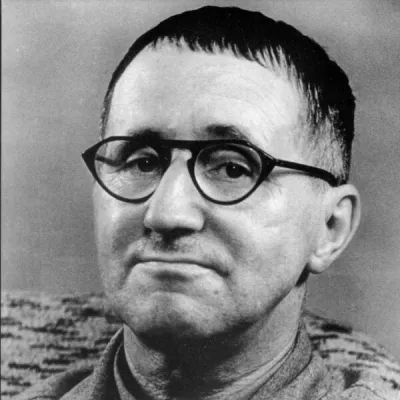
Bertolt Brecht
Human Design Chart
Biography
A Marxist, a vegetarian, a genius and a contradictory figure, he was also considered an opportunist with an all-too-convenient ability to temporize. Despite his purposely shabby dress, unwashed stench, rotting teeth and icy persona, Brecht was some sort of modern Mesmer, able to hypnotize almost everyone he met into doing his bidding. He was considered a virtuoso in the bedroom, keeping regular revolving mistresses. When he fled Nazi Germany, he had not only his family but two other women, both of whom wrote large amounts of his work according to his specifications. Some of his major works may contain as little as 10% of his actual writing, but he served as a brilliant editor.
The saddest case - and most revealing of his character - is the story of Margaret Steffin, a young German writer from the provinces who had the misfortune to fall under Brecht's spell at an early age. She was almost single-handedly responsible for "Courage" and "Stezuan," as well as "Galileo" and at least four other major plays, a novel, and countless poems and stories, all published under Brecht's name. He was not able to read the source material in French for the works, and the manuscripts are all in Steffin's handwriting. Suffering from TB, Steffin died alone in a Moscow hospital ward after arranging for Brecht's safe passage to America.
Human Design Analysis: Bertolt Brecht as Projector 3/5
Projector 3/5 — Design at a Glance
Bertolt Brecht's design set a tendency towards dense, focused perception. As a Projector, his aura acted like a bright flashlight that immediately recognized system errors in others and brought "light into the dark." This ability to see system errors directly was, however, associated with a specific risk: direct criticism often triggered resistance from those around him, comparable to shining light directly into someone's face.
Therefore, the mechanics of his design required a different approach. Instead of openly addressing other people’s shortcomings, Brecht should have shone through his own harmony. When he embodied functioning structures himself, it was attractive; others came to him on their own and sought his advice. The central strategy consisted in waiting for a respectful invitation before offering his knowledge. This protected against the friction that arises when unsolicited advice is given.
Since Brecht did not have a defined Sacral Center, he lacked a constant intrinsic energy source. Instead, he went through phases of high productivity followed by mandatory rest periods to avoid burnout. Living according to this rhythm was crucial: if he followed the strategy of invitation and shining, he was rewarded with success. Deviations from it led to bitterness as an expression of his non-self. His design therefore knew not only the path to insight but also the necessary conditions for its sustainable effect.
No Inner Authority
Bertolt Brecht's Design established a specific decision-making dynamic: He did not have an internal, physical authority. Instead, he found orientation through intensive exchange and the resonance in his open centers. As a mental projector, energetic interactions in dialogue activated dormant potentials, allowing him to view and express issues from multiple perspectives. This high resonant capacity served as a key to identify the appropriate environment and the right people for this necessary exchange.
The evaluation of collected information was a complex process that required time and solitude. Bertolt Brecht needed distance from the flood of information to recognize the main thread and distinguish what made sense and belonged to him. Through this temporal distance, he developed his specific intelligence: filtering out the essential elements, organizing them meaningfully, and structuring them. This formed his capital for success. A crucial aspect of his design was the necessity to be in an environment where he felt comfortable. Only there, among trustworthy people, could he deepen the exchange and over time develop a sure sense of what was right for him. His decision-making therefore did not rely on internal command but on structured reflection of external impulses.
The 3/5 Profile — Martyr / Heretic
Bertolt Brecht's Design set a tendency towards radical innovation: He had to consciously destroy old structures before he could impart new knowledge. His Profile 3/5, that of the experimenter and hero, marked him as someone who first had to try everything himself – often with painful failures – in order to gain practical insights from it. Line 3 drove him towards revolution and breaking outdated principles, which however frequently ended in dissatisfaction and destruction. Only after this phase of personal experience did he take on the role of the rescuer (Line 5).
This mechanism created a specific dynamic: His knowledge learned from mistakes was highly attractive to others, especially during crisis times. Line 5 required precise timing; Brecht only shared his insights when the environment expected them as a last resort and was ready to accept them. This tension between public failure through reckless experiments and later status as problem solver defined his path. He learned from the dissolution of the old to offer harmoniously effective solutions in conflict situations. His appeal lay precisely in not conveying abstract theories, but presenting a treasure trove of lived, often hard-won experience that others received as salvational knowledge.
Single Definition — Defined & Open Centers
Bertolt Brecht's design inclined towards a tendency of constant, independent conceptualization. His defined Ajna Center ensured a trustworthy mental function; he thought continuously and was not easily influenced from the outside. This conceptual clarity directly flowed into his defined Throat Center, serving as a pivot point to reliably transform thoughts into communication and action. He spoke out of his mind what he conceptualized, thereby making his statement power stable and limited.
In contrast, situational dependence on environmental impulses was shown through seven open centers. His open Head Center made him receptive to inspiration or mental pressure from the environment; he tended to seek answers that were not his own. The open G Center meant a lack of fixed identity; he adapted himself and sought direction through the right place and fitting people, rather than generating it himself.
His open Heart Center led to a lack of consistent willpower. He was prone to conditioning due to the need to prove his worth or give promises that he could not keep, which could lead to self-doubt. The open Sacral Center made his energy unstable; he absorbed foreign life force and risked exhaustion if he ignored boundaries. Additionally, his open Solar Plexus absorbed emotions from the environment, making him vulnerable to emotional waves of others experienced as his own.
The open Spleen Center prompted caution in spontaneous decisions, as intuition was not reliable here and fears could block action. Finally, his open Root Center took on external stress; he amplified the pressure of the environment and had to learn not to mistake this adrenalized state for his own drive. This constellation marked him as someone with a clear voice but high receptivity to the energetic and emotional currents of his world.
Channels for intuitive insight and digested expression.
Bertolt Brecht's design inclined towards innovative, mutative thinking that needed to be translated into clear formulations. The Channel of Structuring 2-43 connected his Ajna Center with the Throat Center. This allowed him to process spontaneous insights (Gate 43) through an assimilating process (Gate 23) and express them. His mind often worked far ahead; he developed techniques and concepts that promoted efficiency and changed collective perception. The challenge lay in timing: without waiting for the right resonance, his unique knowledge was rejected, leading to feelings of alienation. Success occurred when he showed patience in expressing concepts until they were understood.
Additionally, further gates played a role in his design. Gate 49 brought dynamics of transformation and reacting to principles within tribal context, connected with emotional wave movement. Gate 4 supported this through logical formulations that clarified suspicious patterns and protected from punishment. Gate 56 enabled the abstraction of mental processes into pictorial representations and narratives, which was important for collective stories. Gate 45 summed up energy on tribal level and expressed willpower strength, often in context of hierarchies. Gate 35 promoted change through interaction and new experiences, with true satisfaction only arising later from the meaning of these experiences.
Bertolt Brecht showed himself as someone who poured complex mental content into understandable, efficient structures. His thinking was individualistic and required dedication to his inner flow to not be perceived as an outsider. When his insights were correctly recognized, his knowledge penetrated the collective and changed it. He had to learn that his mind processed his knowledge in its own way and at its own pace; planning ahead was unnecessary. Through persistence in clearly explaining his innovative perspectives, he opened a path for recognition and evolutionary change in his environment.
Individual Circuitry — Circuit Signature
Bertolt Brecht's design inclined towards clear structuring, which was shown through the channel between Ajna and Throat Centers. This connection linked logical thinking with expression, allowing internal concepts to be precisely formulated. It was a process of form creation: thoughts were not only thought but translated into structured language.
This channel is part of the Knowledge Circuit whose general mechanics describe the emergence of a unique identity through new knowledge acquisition. The circuit aims at initiating change by emotionally filtering and expressing new knowledge. However, in Bertolt Brecht's case, only the segment between Ajna and Throat Centers was active. Other elements of this circuit – such as mutation energy or inspirational flashes – were not directly integrated into his design. Therefore, less emphasis was placed on explosive transformative impulses than on the ability to organize complex content and make it understandable. His identity was marked by this structural clarity, with the Throat Center serving as a channel to carry out logical conclusions of the Ajna Center outward. This configuration promoted an expression style based on logic and form rather than purely impulsive inspiration or emotional wave movement.
Right Angle Cross of Explanation 1
Bertolt Brecht's Design featured the Right Cross of Statement 1. This structure indicated a specific energetic alignment, which remains without detailed functional description in the available data. It was an abstract assignment within his Human-Design chart, whose concrete behavior-related effects or everyday mechanisms were not specified.
Without further explanation of the involved Gates or Channels, this cross configuration could not be translated into specific action patterns. It stood as a name for a particular energetic signature, whose practical relevance in Bertolt Brecht's individual experience could not be derived from the given information. The emphasis was thus solely on the existence of this specific cross configuration within his design.
This approach avoided speculation about possible character traits or life events that might theoretically result from it. Instead, the presentation remained strictly focused on the fact that this particular cross configuration was part of his mechanical makeup without offering further content depth. The analysis limited itself to making transparent this information gap and not inserting fictional interpretations to ensure an objective rendition of the raw content provided.
Saturn Return · Uranus Opposition · Chiron Return · 2nd Saturn Return — Life Cycles
Bertolt Brecht's life rhythm followed a clear structure of internal condensation and radical renewal. These phases marked structural turning points between maturation and transformation, shaping his artistic development.
The first Saturn return around the age of 28 demanded stability and focus. In 1926, at the age of 28, Brecht sporadically used the term "Lehrstück". This reflected the influence of Saturn: the necessity to structure ideas and lay solid foundations for future work.
Between these phases of consolidation, periods of change occurred. The Uranus opposition around the age of 42 often brought unexpected breaks or new directions. In 1940, at the age of 42, "Lukullus vor Gericht" was created for Radio Beromünster in Switzerland. This work demonstrated typical Uranian dynamics: a quick adaptation to changed circumstances and the use of new forms of expression during a time of upheaval.
The Chiron return around the age of 49 was a cycle of fulfillment, in which one's inner purpose increasingly unfolded – provided that one’s own strategy was heeded. It was not about healing old wounds but rather the blossoming of the incarnation cross. In 1947, at the age of 49, "The Life of Galileo" premiered at the Coronet Theatre in Beverly Hills. This was a moment when Brecht's life work and public recognition came together.
The second Saturn return around the age of 57 crowned this development with final confirmation and authority. On May 25, 1955, at the age of 57, Brecht was awarded the International Stalin Peace Prize in the Moscow Kremlin. This award was visible proof of the long-term condensation of his work and the status he had achieved within his artistic framework.
Projector · No Inner Authority — Synthesis
He was a Projector whose energy was aligned with identifying patterns and flaws in his environment (Design) and structuring these through insights (Channel of Structuring). This ability to see imperfections and derive new perspectives from them shaped his approach to the world. He did not seek validation in established systems but experimented and tested paths out (Profile Innovator/Hero), generating knowledge through personal experience and sharing it – a process repeatedly reinforced by cycles of Uranus and Saturn throughout his life.
A central paradox lay in his lack of inner authority (Authority) and defined mental center (Ajna). He needed exchange with others to gain clarity, yet simultaneously possessed a strong, consistent way of thinking that created concepts and influenced others. This combination of openness to foreign perspectives and the ability to powerfully express his own ideas (Throat Center) led to an ongoing tension between the desire for resonance and the need to articulate his unique vision – a dynamic that was evident in professional successes.
1 Defined Channel
Incarnation Cross - Right Angle Cross of Explanation 1
Solar Return
The Solar Return shows the moment when the sun returns to its exact birth position - your personal solar year.
Life Cycles
Discover the life cycles with a detailed triple view (birth chart, cycle chart, composite).
Human Design Profile
- Type
- Projector
- Strategy
- Wait for the respectful invitation
- Authority
- No inner authority - learn more
- Profile
- 3/5 - Martyr / Heretic
- Definition
- Single Definition
- Incarnation Cross
- Right Angle Cross of Explanation 1
- Date of Birth
- 10.02.1898 04:30
- Place of Birth
- Augsburg, Germany
Frequently Asked Questions
What is Bertolt Brecht's Human Design type?
Which Profile did Bertolt Brecht have?
What Authority did Bertolt Brecht have?
Which incarnation cross was active for Bertolt Brecht?
When was Bertolt Brecht born?
Discover your own Human Design
Are you also a Projector? Find out in a personal reading how to unfold your leadership qualities and recognize the right invitations.
More Personalities
Back to overviewSissy Spacek

Alain-Fournier

Anémone

Ann-Margret

Bourvil
Christian-Jaque