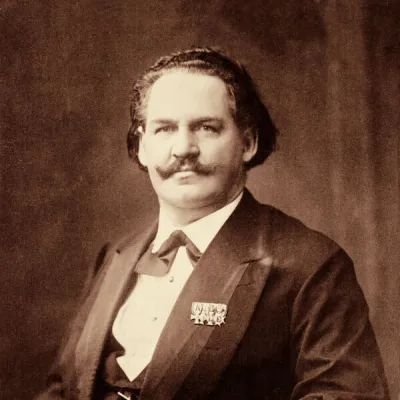
Carl Bechstein
Human Design Chart
Biography
Human Design Analysis: Carl Bechstein as Manifesting Generator 5/1
Manifesting Generator 5/1 — Design at a Glance
Carl Bechstein revealed himself as someone who constantly combined life force with remarkable speed. His design as a manifesting generator worked like a hybrid of two energies: the steady power of the sacral and the ability to implement ideas quickly. This allowed him to skip steps in realizing ideas and draw rapid results into his life.
However, this efficiency carried risks. The high speed risked overlooking important intermediate steps, which inevitably led him to backtrack and fill gaps. Such setbacks could quickly lead to frustration, the central non-self theme of this type. Additionally, his nature tended to react simultaneously to numerous impulses and work on multiple projects at once. Without inner clarity, this complexity threatened to transform his original creative joy into overload.
The key to Carl Bechstein's satisfaction lay in a strategy of responding. He acted effectively when he waited for external impulses and only then moved forward if his sacral center gave a clear "yes" and his inner authority agreed. Under these conditions, potential frustration transformed into deep satisfaction. Then, working on various tasks simultaneously ceased to be a problem but became a source of variety. He entered a productive play mode that allowed him to use his energy playfully and sustainably without exhausting himself through hasty action or multitasking.
Emotional Authority
Carl Bechstein's decision-making was characterized by a cyclical emotional wave that ebbed and flowed with highs and lows. His perception of the world was heavily influenced by his current mood; what seemed inspiring in one moment could be negatively evaluated in the next. However, these immediate reactions were only fleeting impressions and not necessarily the deeper truth of a situation.
This dynamic resulted from his inner authority: Emotional Authority carried by the defined Solar Plexus Center. In Human Design mechanics, this authority is considered primary; it always takes precedence over other defined centers regardless of what else is activated in the graph. Any type except Reflectors can possess this authority, but its mechanism remains specific: It operates under a constant up and down of emotions.
For Carl Bechstein, this meant that spontaneous decisions carried a high risk of negative consequences because they were based on incomplete emotional clarity. The process for making the right decision required patience, conscious deliberation, and multiple reviews or sleepovers of options. Only when intense feelings subsided and he had gained emotional distance did the necessary clarity and calmness emerge. This period of delay was essential to safely make long-term, life-defining decisions and to fully grasp the scope of a situation.
The 5/1 Profile — Heretic / Investigator
Carl Bechstein revealed himself through Profile 5/1 as someone who had to balance the tension between a deep desire for isolated research and the magnetic role of the "hero." Line 1 drove him towards intense, often solitary knowledge dissemination, while Line 5 attracted others to him with their search for solutions. This constellation created dynamic power: Others sought answers from him, which however carried the risk of exploitation if no clear boundaries were set.
The challenge lay in protecting against this external demand and preserving energy for personal development. Without such demarcation, exhaustion threatened due to constant inquiries and criticism. Central themes included dealing with self-doubt and transforming an attitude that rejected recognition or felt itself as talentless – often characterized as a "spoilsport" – into acceptance of one's own ability.
Carl Bechstein had to learn to say no in order to maintain the balance between private research and service to the collective. Only through this clear boundary setting could he optimally utilize his gifts without tearing himself apart. Calmness in dealing with doubts and logically refuting uncertainties were crucial, so as not to align personal development with others' expectations but rather to strengthen it as a foundation for authentic knowledge dissemination.
Triple Split Definition — Defined & Open Centers
Carl Bechsteins Design is characterized by fundamental stability and available life energy. His defined Sacral Center provided a reactive, sustainable power source; he did not act impulsively but responded to correct stimuli with deep, generative energy. This foundation was complemented by his defined Heart Center, which gave him willpower and the ability to control resources self-determinedly while keeping promises. His defined G Center endowed him with a firm identity and clear sense of direction, enabling him to act from a stable center of Higher Self.
This motoric and identity-forming structure formed the basis of his capacity for action. He was a person with clear intent and available power but waited on his inner authority to use this energy correctly. His defined Solar Plexus Center functioned as emotional authority; he learned to wait out the waves of his feelings before making decisions, rather than acting impulsively. Parallel to this, his defined Spleen Center served as an intuitive instance in the here and now, revealing spontaneous existential truths about health and well-being. Additionally, his defined Root Center provided a constant pressure for movement in the world, while his defined Throat Center made his communication reliable and authentic.
In contrast, his Head and Ajna Centers were open. This meant that mental clarity and inspiration were situational; he was not a constant thinker or problem solver in the mental field. Instead, he used the mind as a tool without identifying with it. He tended to absorb mental pressure waves from others but maintained distance because he knew answers did not have to come from his own head. This openness protected him from the trap of excessive thinking; ultimately, he acted from heart and gut, not intellectual analysis.
Channels for powerful action, finding meaning and deep connection.
Carl Bechstein showed a fundamental attitude based on charismatic self-empowerment. This trait came from the Channel of Charisma 34-20, which transformed raw physiological energy through the Sacral Center into immediate expressive power in the Throat Center. It was not about deliberate action but rather a reaction to external stimuli that pushed him to surrender to the moment and let his generative force act spontaneously.
Parallel to this, the Channel of Initiation 51-25 also played a role, promoting competition-oriented initiation. Here, the drive to be first (Gate 51) was linked with the Higher Self's ability to recognize beauty and individuality (Gate 25). This created an urge to uncover new levels of consciousness through personal triumph and the accompanying "shock."
Another defining aspect was his stubborn struggle for meaning and integrity, driven by the Channel of Life Struggle 38-28. This channel combined the pressure to defend one's truth against external distractions (Gate 38) with an intuitive ability to discern whether a fight is truly worthwhile (Gate 28). Carl Bechstein sought not just survival but deep meaning in the obstacles on his path.
Finally, the Channel of Community 37-40 formed the basis for fair agreements and cohesion. It linked the need for recognition and belonging (Gate 37) with a desire to provide sustenance and maintain pauses (Gate 40). Over time, it created bridges between individuals based on mutual respect and shared goals.
Additionally, Gates like Gate 63 (Doubt as a motor for security) and Gate 9 (Detail work in the Sacral Center) directed his focus towards perfectionism and resolving uncertain patterns. These configurations shaped his influence through inner reaction, competitive individualization, and meaning-driven struggle.
Individual Circuitry — Circuit Signature
Carl Bechsteins Design established a tendency towards inner strength and individual survival instinct. His Triple Definition formed three separate, parallel functioning energy fields that did not flow directly into one another.
The Knowledge Circuit connected his Spleen and Root Centers through the Channel "Life Struggle." This promoted a drive for transformation and the recognition of new paths, driven by the necessity of survival in the here and now. Parallel to this, the Centering Circuit linked Identity and Heart Centers via the "Initiation" channel. This created a fortified, courageous personality with strong inner convictions. Since this circuit did not connect to the Throat Center, these deep convictions often remained unspoken and primarily manifested through presence rather than verbal expression.
A third independent field was formed by the Ego Circuit, which linked Heart and Solar Plexus Centers via the "Community" channel. This focused on cooperation, resource management, and giving and taking in a social context, always with an awareness of necessary pauses for regeneration. Finally, the Integration Circuit ensured individual survival by connecting Throat and Sacral Centers through "Charisma." This allowed the synthesis of reaction, intuition, and manifestation in the present moment.
Carl Bechstein thus emerged as someone who combined inner individuality with cooperative resource building, where his deepest convictions were not primarily communicated but became effective through his presence and ability to act in the now. The separate groups ensured that these aspects existed alongside each other without mixing energetically or blocking one another, but rather as distinct pillars of his personality.
Left Angle Cross of Identification 1
Carl Bechsteins design points to a tendency towards external orientation. His perception and thought structure were strongly influenced by the environment, with a focus on recognizing, naming or categorizing things. This configuration describes a life task of uncovering hidden connections and passing them on to others. The left cross of Identifying 1 shaped his way of taking in and processing information. It was a process triggered by external stimuli, focusing attention on identifying patterns or facts in the outside world. Carl Bechstein appeared as someone who carefully observed their environment to understand and categorize it. This mechanism did not operate in isolation but sustainably formed his interaction with the world. The energy of this cross demanded a constant engagement with the visible and recognizable. Carl Bechstein lived in dynamics that drove him to analyze and structure reality. His mind sought clarity through classification and naming. This was not a passive process, but an active stance towards life. External orientation meant that his identification of connections always stood in dialogue with the environment. Carl Bechstein reacted to what he encountered by categorizing it. This ability to classify helped him bring order to the diversity of impressions. His design promoted a clear and factual perspective. He sought truth in things themselves, not in abstract theories. This shaped his entire existence as someone who acted and understood through recognition.
Saturn Return · Uranus Opposition · Chiron Return · 2nd Saturn Return — Life Cycles
Carl Bechsteins design points towards structured self-determination that condensed during the second decade of life. He appeared as someone who solidified their identity by materializing inner potentials through external commitments. This development corresponds to the first Saturn return, a cycle marking the transition from experimental phases to firm responsibility. During this time, previous potential became tangible through clear structures; it was not mere planning but the establishment of a sustainable foundation for further life.
In 1853 at age 27, Carl Bechstein founded the piano factory C. Bechstein. This event exemplified Saturn's influence: The inner vision took material and organizational form. Through this founding, he assumed professional responsibility and redefined his role in the world. The Saturn return acted here as a catalyst, translating diffuse ambitions into clear, binding projects. It was the moment when internal design became visible through external structuring and Carl Bechstein created a sustainable basis for further development. This phase was thus less characterized by spontaneous impulses than by conscious appropriation of responsibility and creation of stable conditions that determined his subsequent work.
Manifesting Generator · Emotional Authority — Synthesis
Carl Bechstein was a Manifesting Generator, whose life was marked by constant readiness to react and quick grasping of opportunities. His ability to immediately absorb impulses and turn them into action was fueled by deep sacral energy (defined Sacral Center) and allowed him to move forward with remarkable speed – though often at the risk of skipping important steps or having to focus on multiple projects simultaneously. However, his defined authority in the emotional center required waiting and careful examination to gain clarity and avoid impulsive decisions.
A central paradox in his design lay in the tension between this quick responsiveness and the need for emotional maturity. The ability to quickly initiate things (defined Throat Center connected with Motor Centers) stood in contrast to the necessity of waiting for emotional waves to ensure that decisions aligned with his inner truth. This interplay of initiative and reflection shaped his path, focusing on finding a balance between rapid action and conscious alignment.
4 Defined Channels
Incarnation Cross - Left Angle Cross of Identification 1
Solar Return
The Solar Return shows the moment when the sun returns to its exact birth position - your personal solar year.
Life Cycles
Discover the life cycles with a detailed triple view (birth chart, cycle chart, composite).
Human Design Profile
- Strategy
- To respond - wait for something to respond to
- Authority
- Emotional Authority
- Profile
- 5/1 - Heretic / Investigator
- Definition
- Triple Split
- Incarnation Cross
- Left Angle Cross of Identification 1
- Date of Birth
- 01.06.1826 04:00
- Place of Birth
- Gotha, Germany
Frequently Asked Questions
What was Carl Bechstein's Human Design type?
What profile did Carl Bechstein have in Human Design?
What authority did Carl Bechstein have?
What incarnation cross did Carl Bechstein have?
When was Carl Bechstein born?
Discover your own Human Design
Are you also a Manifesting Generator? Find out in a personal reading how to unfold your multi-talents and direct your energy wisely.
More Personalities
Back to overviewAldair

Alizée

Angeli

Arletty
Artus

Balthus