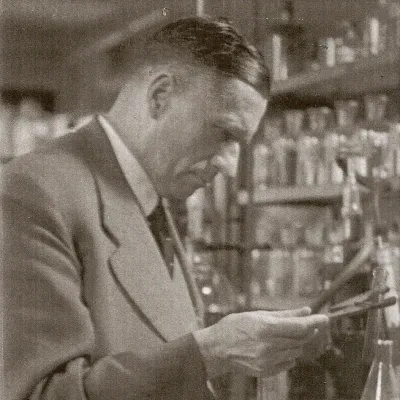
Carl Krauch
Human Design Chart
Biography
He was an executive at BASF (later IG Farben); during World War II, he was chairman of the supervisory board. He was a key implementer of the Reich’s Four-Year Plan to achieve national economic self-sufficiency and promote industrial production. He was Plenipotentiary of Special Issues in Chemical Production, a senator of the Kaiser Wilhelm Society, and an honorary professor at the University of Berlin.
In the Frankfurt Auschwitz Trials, as a witness on 19 February 1965, he denied all knowledge of the events in Monowitz, part of the Auschwitz complex and designed to produce synthetic fuel and butadiene rubber. Carl Krauch died on 3 February 1968.
Human Design Analysis: Carl Krauch as Generator 3/5
Generator 3/5 — Design at a Glance
Carl Krauch's design indicated a tendency towards great endurance and strength of work. As a Generator, he possessed abundant sacral energy that made him seem like a strong working horse – provided he had the energy for his tasks. However, his life force energy was not released through spontaneous initiation but rather by responding to signals from his environment. The strategy involved waiting until life presented an invitation and his inner self gave a clear "yes" before taking action.
This mechanism contained two central pitfalls. If Carl Krauch continuously completed tasks that he did not feel an internal desire for, he wasted his energy and was prone to exhaustion. Conversely, if he was prevented from continuing work on his heart projects when he still had plenty of energy for them, he suffered. Living in harmony with this impulse response rewarded him with deep satisfaction. On the other hand, initiating constantly without inner resonance led to eventual frustration and a lack of energy. Therefore, his path to fulfillment did not lie in constant pushing forward but rather in consciously responding to what came from outside.
Sacral Authority
Carl Krauch lived as a Generator, whose decision-making was shaped by Sacral Authority. This inner guidance is unique to this type and simplifies the process because strategy and authority are identical: responding to life. His authority featured the defined Sacral Center, which always took precedence over all other defined centers regardless of their expression.
This mechanism manifested in an immediate physical resonance to external stimuli. Instead of acting through intellectual analysis, he followed his "gut feeling." This was expressed as a surge of energy or an acoustic signal – such as grunting, humming, or a nodding yes-no sensation. When his Sacral motor engaged, Carl Krauch possessed vital energy and inexhaustible enthusiasm. He accomplished his tasks with great satisfaction, driven by a deep will to live without rigid purposefulness.
Additionally, the activated Spleen Center acted as a supportive instance. As it may have been directly connected to the Sacral Center, this allowed for quick, spontaneous reactions. Carl Krauch had direct access to his instinctive perception and physical well-being. He followed this reliable inner voice, enabling him to act clearly and energetically in the present rather than getting stuck in excessive planning or emotional delay.
The 3/5 Profile — Martyr / Heretic
Carl Krauch's design featured the Profile 3/5, presenting him as an experimenter and hero. This type matched the image of a heroic adventurer or cool storyteller who possessed a rich treasure trove of practical experiences and enjoyed sharing them with others. The third line, that of the experimenter, meant for Carl Krauch that he initially had little predefined trust; instead, he learned through his own experimentation and even from mistakes. This phase of adaptation and trial-and-error process was fundamental to his development.
In the second stage of life, the fifth line, the hero's line, came into play. Here, the self-acquired knowledge transformed into a role where he could solve problems for others. His ability to offer practical solutions, especially during crises, gave him an allure as people wanted to learn from his experiences. Recognition for this support was crucial. However, this profile also carried the shadow side of failing in public, which could be painful if experiments did not succeed. Carl Krauch thus lived in a tension field between the courage for spontaneous adaptation and the need for validation as a savior. His life task involved uncovering hidden connections through his own practice and making them useful to others, with generosity and timing playing central roles.
Split Definition — Defined & Open Centers
Carl Krauch's design featured five defined centers, which provided a consistent internal structure and clear expression. His defined G Center gave him a firm sense of self-identity and a reliable compass for his personal direction; he knew where he belonged without projecting this orientation onto others. This inner security directly influenced his defined Throat Center: His voice and actions were dependable and clear, springing from this stable identity rather than being impulsive or uncertain.
As a Generator with a defined Sacral Center, Carl Krauch had an enormous reservoir of vitality. His design required him not to initiate but to wait for stimuli before responding with the full force of his sacral energy. This ensured satisfaction and prevented exhaustion that comes from working against one's natural energy flow. Supporting this endurance was his defined Spleen Center, which gave him spontaneous intuitive judgment. He could decide in the moment what was healthy and correct for him without having to rationalize it. Additionally, his defined Root Center provided a constant adrenal undercurrent that propelled him forward and helped him deal with stress by directly confronting existential challenges.
In contrast, his four open centers revealed areas of conditioning trap. His open Head Center made him vulnerable to mental confusion; he tended to get entangled in questions not originating from him and often sought inspiration or answers from others to alleviate this pressure. The open Ajna Center amplified this: He could easily adopt other people's opinions as his own truth or give the impression of knowing more than he actually understood. His open Heart Center led to a frequent need for proving himself. He was prone to making promises and keeping them to demonstrate his worth, despite not having the consistent willpower to sustain this long-term alone. Finally, his open Solar Plexus absorbed the emotions of his surroundings. Carl Krauch felt others' moods intensely as if they were his own, which led him to avoid emotional confrontations to prevent being rejected or perceived as unstable.
Channels for intuitive clarity, self-expression and organic maturation.
Carl Krauch's design was characterized by intuitive self-affirmation and cyclical experience gathering. His defining trait was the ability to act clearly in the present moment, guided by a deep inner wisdom that he directly translated into words. This did not come from intellectual analysis but as spontaneous reactions to the now.
This attitude stemmed from Channel of Awakening 10-20, which connected his G Center with his Throat Center. It allowed Carl Krauch to transform personal knowledge into proper action and move securely through interactions via an unconscious behavioral code. Parallel to this, Channel of Perfect Form 57-10 linked intuitive insight from the Spleen with self-expression. This gave him acute sensitivity to the environment and helped him release unfounded future anxieties to act existentially unburdened.
The convergence of these forces was found in Channel of Lightning Flash 57-20, where his intuitive insights received a clear voice in the present moment. Carl Krauch could thus encourage others to awaken their own inner survival intelligence by speaking the truth of his moment. His spontaneous verbal outbursts reached the core of an issue faster than thoughtful deliberation.
Alongside this clarity in the moment, Channel of Maturation 42-53 shaped his relationship with life processes. It connected his Root Center with his Sacral Center and propelled him to complete experiences before reflecting on them. Carl Krauch sought new cycles for experience's sake without rigid expectations to gain wisdom for future steps.
Additionally, Gates like 51 (Willpower and Adaptation to Shocks) as well as 72 (Connection of worldly success and spirituality) contributed to complexity. Gate 18 introduced a political dimension with a focus on correction and human rights, while Gate 2 enhanced receptivity for evolutionary directions. This constellation created a person who acted through authentic existence and cyclical learning processes.
Individual Circuitry — Circuit Signature
Carl Krauch's design inclined towards impulsive, creative ideas that were immediately put into action. This was evident in the Knowledge Circuit: Channel 20-57 (Lightning Flash) connected his Throat Center with his Spleen. This connection allowed for intuitive insights to be expressed acoustically or through action-oriented expression instantly – an energy of
Right Angle Cross of Penetration 1
Carl Krauch's design pointed to a specific energetic alignment characterized by the so-called right cross of penetration. This configuration did not describe passive acceptance of circumstances but rather a deep desire for direct and unfiltered perception of reality. It was an energy aimed at breaking through surface phenomena to reveal underlying structures or truths.
In Human Design mechanics, this cross represents the ability to analyze complex situations actively and 'penetrate' them. This wasn't about intellectual understanding in an abstract sense but rather intuitive, almost physical insight. Carl Krauch showed himself through this mechanism as someone who did not accept obstacles or veils as final barriers but as something that needed to be overcome or pierced.
This energy contributed to his focus always being on the essential aspects. Distractions or superficial platitudes had no hold in this design; instead, there was a constant force seeking the core cause of things. The right cross of penetration ensured that Carl Krauch often went straight to the point in his actions and decisions without taking long detours. It was an energy of clarity amidst complexity, enabling him to work through resistances to reach his goals. This direct approach shaped how he dealt with information and challenges – always aiming to recognize and make use of underlying truths.
Saturn Return · Uranus Opposition · Chiron Return · 2nd Saturn Return — Life Cycles
Carl Krauch lived his life in clear, cyclical phases of maturation and restructuring. His design indicated that his inner stance did not develop linearly but was periodically recalibrated by recurring planetary influences. The first Saturn return marked the transition from youth to adult responsibility; here early impulses condensed into a stable life structure.
Later came the Uranus opposition. This cycle often brought a phase of detachment or breaking away from established patterns, creating new space for changed perspectives. It was a moment of necessary destabilization before new orders could form.
Around age 49 to 51, the Chiron return occurred. This was not a process of healing old wounds in a psychological sense but rather a phase of bloom and fulfillment. If Carl Krauch had lived according to his strategy up until then, his incarnation purpose became experiential; life revealed its deepest meaning and destiny.
The second Saturn return rounded off this development. It stood for the final consolidation of earned wisdom and structure. The combination of these cycles marked Carl Krauch as someone whose life was characterized by rhythmic phases of building up, letting go, finding meaning, and achieving final stability. Each phase served to adapt his inner architecture to growing life experience.
Generator · Sacral Authority — Synthesis
Carl Krauch was a Generator whose life was profoundly marked by sacral energy. This power source, combined with the Profile of an Explorer and Hero (3/5), drove him to gather experiences and transform them into practical knowledge. He lived out experimentation, learned from mistakes, and shared his insights willingly – a pattern that ran through his entire being and gave him the role of a trailblazer. The Channel of Awakening (10/20) reinforced this impulse by rooting him in the present and giving him a clear voice to express his principles.
At the same time, a paradox was revealed between his sacral authority and the Knowledge Circuit. While his Sacral Center instinctively led him to activities that gave him energy, the Knowledge Circuit challenged him to continuously learn new things and transform them. This created tension between the need for present satisfaction through work and the drive to intellectually develop further and initiate changes – an interplay that shaped his life journey.
4 Defined Channels
Incarnation Cross - Right Angle Cross of Penetration 1
Solar Return
The Solar Return shows the moment when the sun returns to its exact birth position - your personal solar year.
Life Cycles
Discover the life cycles with a detailed triple view (birth chart, cycle chart, composite).
Human Design Profile
- Type
- Generator
- Strategy
- To respond - wait for something to respond to
- Authority
- Sacral Authority
- Profile
- 3/5 - Martyr / Heretic
- Definition
- Split Definition
- Incarnation Cross
- Right Angle Cross of Penetration 1
- Date of Birth
- 07.04.1887 16:00
- Place of Birth
- Darmstadt, Germany
Frequently Asked Questions
What Human Design type was Carl Krauch?
Which Profile did Carl Krauch have?
What Authority did Carl Krauch have?
What incarnation cross was assigned to Carl Krauch?
When was Carl Krauch born?
Discover your own Human Design
Are you also a Generator? Find out in a personal reading how to use your sacral energy correctly and discover deep satisfaction.
More Personalities
Back to overviewAaliyah

Alexia

Angèle

Anne-Marie

Arcángel

Arno