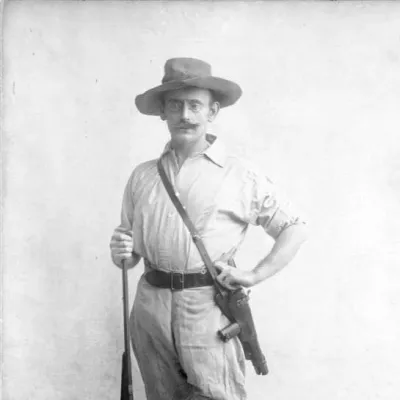
Carl Peters
Human Design Chart
Biography
Human Design Analysis: Carl Peters as Manifesting Generator 1/3
Manifesting Generator 1/3 — Design at a Glance
Carl Peters revealed himself as a Hybrid being that combined the constant energy source of Generators with the lightning-fast action capability of Manifestors. His design indicated a tendency towards great speed; he could skip steps and quickly pull things into his life. This efficiency, however, carried risks: Often, he was too quick, neglected necessary intermediate steps, and had to return later to fill gaps. Such setbacks easily led to frustration, the specific non-self theme of his configuration.
Furthermore, Carl Peters tended to handle multiple projects simultaneously as he reacted to different impulses. Without strict adherence to his strategy – waiting for an inner impulse before acting – his creative enthusiasm quickly turned into overburdening. His Sacral Center had steady energy, but it only worked satisfactorily when he responded rather than initiated.
With the correct application of this strategy, Carl Peters found deep satisfaction in creation. He needed variety and a playful mode; the compulsion to complete one thing before starting another stood against his nature. Instead, he thrived in parallel processing of various tasks as long as his inner authority approved each undertaking. His life task was to channel this speed through conscious reaction to impulses to avoid frustration and derive lasting satisfaction from his diverse efforts.
Emotional Authority
Carl Peters exhibited a decision-making stance characterized by emotional wave movements. His design carried Emotional Authority in the defined Emotional Center – a mechanism that always claimed priority over other factors for inner decisions regardless of external circumstances. This configuration caused his perception of the world to be strongly colored by his current mood: What appeared inspiring at one moment could turn negative in the next. His immediate feeling formed only a provisional snapshot, not yet the final truth.
Quick, spontaneous judgments from this emotional heat would often have led him astray. Instead, his system required patience and conscious hesitation during important decision-making moments. Carl Peters had to let decisions mature, take time, and reconsider them multiple times – ideally overnight. Only as initial emotional fluctuations subsided and an inner distance emerged did clarity and calmness set in for him. This process of waiting was not a sign of indecision but the necessary strategy of his design to gain deeper insights and make secure long-term life decisions.
The 1/3 Profile — Investigator / Martyr
Carl Peters revealed himself as a person whose life was driven by profound curiosity, paired with the necessity to test knowledge through personal experience. His design carried the Profile of the Researcher and Experimenter (1/3), creating an attitude that inseparably linked theory and practice. On one side stood the need for stable foundations and conservative principles – an approach based on building secure structures and preserving traditional patterns to change step by step. This formed the theoretical framework of his existence.
Simultaneously, the energy of the experimenter demanded learning through trial and error. For Carl Peters, it was crucial that he not only absorbed insights but applied them himself and allowed for failure. External pressure or compulsion towards inaction could even support him by creating necessary concentration for this learning process. If he valued something as good, he had previously analyzed it intellectually and practically tested it thoroughly. His judgment thus rested on double validation: the secure ground of tradition and the hard school of his own actions. This combination of cautious planning and bold experimentation shaped his way to understand and move through the world.
Split Definition — Defined & Open Centers
Carl Peters revealed himself as someone with tremendous inner vitality and a clear expression. His design indicated a tendency towards persistent work that only began after receiving internal confirmation. The defined Sacral Center generated daily energy that flowed correctly only in response to external impulses; when he initiated something on his own, he encountered resistance and frustration. This powerful foundation was guided by the also defined Throat Center, which reliably translated his messages into the world. His communication was not just talk but a manifestation of his inner truth, connected with the ability to transform through interaction.
Carl Peters did not make decisions in moments of excitement or fear but waited patiently for emotional clarity. His defined Solar Plexus served as an internal authority: he let waves of hope and pain subside before acting. This process protected him from impulsive mistakes and gave depth to his judgments. Supporting this stability was the defined Spleen Center, which provided spontaneous, intuitive warning signals in the present – a health and well-being protection mechanism that he could not rationalize but simply had to trust. The constant pressure of his defined Root Center propelled him forward, nourished his survival consciousness, and helped him thrive materially as long as he followed this rhythm.
However, Carl Peters was also prone to mental confusion. His open Head and Ajna Centers lacked a fixed thought structure; they absorbed inspirations from the environment but tended to get stuck in doubts or foreign questions. He had to learn not to accept every thought as his own truth but rather use the mind only as a tool. Additionally, he often searched for identity and direction because his open G Center did not have a fixed "I" structure. He adapted to his surroundings and found his place only through the right people and places, not by his own initiative. His open Heart Center lacked consistent willpower; he tended to make promises to prove value, which quickly led him into a cycle of self-doubt when he failed. His strength lay in not compensating for these open areas but trusting his defined energies.
Channels for focus, feelings, logic and caring values.
Carl Peters exhibited a fundamental disposition characterized by an intense, almost meditative focus. His design included the Channel of Concentration 52-9, which connected his Root and Sacral Centers, giving him a calm, passive drive to remain undistracted and evaluate details with logical precision. He gathered his energy like in a yoga pose, waited for the right sacral response, and then devoted himself with relentless dedication to perfecting a pattern he wanted to master. Without this focus, he felt restless; with it, he became an instance of correction and logical progress.
This concentrated logic was in tension with his emotional expression. The Channel of Openness 22-12 connected his Solar Plexus Center with the Throat Center but regulated his social interaction strictly through the emotional wave. Carl Peters was not constantly sociable; his warmth and transformative potential only surfaced when his mood allowed it. He used the quality of his voice to touch or transform others, yet if forced into social situations while at the lower end of his wave, he appeared harsh and withdrawn. His openness thus depended on patience until the internal timing was right.
Another defining aspect was his critical judgment. The Channel of Judgment 58-18 connected Root and Spleen Centers, driving him to constantly question and correct patterns. He had an insatiable drive for "better and more," which was tempered by the Gate of Correction. Carl Peters actively sought out flaws in systems or processes to improve them. Yet this energy only worked effectively when he was invited; uninvited, his critical data stream could be perceived as aggressive. He needed to carefully choose whom and when to offer his solutions to avoid conflicts.
At the same time, he carried the ability for care. The Channel of Preservation 27-50 connected Sacral and Spleen Centers, giving him an aura of trustworthiness. People sought support from him because he was naturally ready to take responsibility for others—whether by holding values or direct care. Yet here too, the need for a sacral response applied: Only when he felt his energy was available could he sustainably provide care without depleting himself. This combination of hard logic, emotional restraint, critical corrective drive, and instinctive care shaped his complex presence in the world.
Collective Circuitry — Circuit Signature
Carl Peters was marked by separated, parallel functioning energy blocks. His structure consisted of two non-directly connected groups: on the one hand, the connection between Sacral, Root, and Spleen Centers; on the other hand, the Throat Center linked with the Solar Plexus Center. This separation meant that rational strategies and emotional expressiveness existed as separate forces without forming a continuous flow.
In his Understanding Circuit, he connected Sacral, Root, and Spleen Centers. This gave him the ability for focused concentration and clear judgment formation. He used logical structures to strategically pursue goals, driven by an instinctive security of the Spleen and the endurance of the Sacral.
Parallel to this, in his Knowledge Circuit, the connection between Throat and Solar Plexus Centers was active. Here, an open, emotionally colored expression took place. His words were steered by inner emotional waves, giving him a genuine, pulsating communication style based on openness.
Thirdly, the Hunter Circuit connected his Sacral with his Spleen Center through the Channel of Preservation. This manifested as a deep need for preservation and care. The instinctive perception of the Spleen here drove the life-sustaining force of the Sacral to ensure security and nurturing.
These three circuits formed in Carl Peters a structure of strategic rationality, emotional expression, and instinctual preservation. Since there was no energetic bridge between the two main groups, these areas often acted independently: rational planning on one side, emotional and preserving impulses on the other.
Right Angle Cross of Service 3
Carl Peters revealed himself as someone whose life was marked by a profound dedication to the well-being of others. His design carried the signature of the right cross of service, a configuration that points towards a strong inner need for care and support. This orientation manifested not as compulsive duty fulfillment but as a natural inclination to help others and accompany them in their growth.
In Human Design, this cross describes a specific energy connection that links empathy with the ability to provide practical assistance. Carl Peters lived out this dynamic by often putting himself aside to make space for others. His strength lay in offering security and stability through his actions and presence.
This configuration does not mean self-denial in a negative sense but rather a conscious choice to invest energy into relationships and communities. Carl Peters found fulfillment in being seen and used without losing his own identity. His design promoted an attitude of humility and respect for the individual path of each person he supported. Through this kind of service, he created connections that were lasting and trustworthy. His way of life was a reflection of this energetic structure: always ready to give without compromising his integrity. This shaped his interactions and overall work significantly.
Saturn Return · Uranus Opposition · Chiron Return · 2nd Saturn Return — Life Cycles
Carl Peters' design indicated a tendency towards strategic, long-term alliances that crystallized into concrete political actions. This configuration often manifests in the first Saturn return (around 28 years), a cycle requiring structure and responsibility. Indeed, he signed a contract with the ruler of Usagara in 1884 – a moment when years of groundwork led to a sustainable outcome.
Later, another dynamic emerged: The Uranus opposition (around 41-42 years) often brings sudden breaks or the end of old structures. For Carl Peters, this occurred in 1897 when he was dishonorably discharged from service. This event marked a deep crisis where previous authority structures collapsed. His design pointed to the fact that such upheavals should not be dismissed as failures but rather as necessary pauses to break free from old ties. The mechanics of his chart indicated a path where external recognition is initially built and later replaced by inner clarity. Both events – the contract in 1884 and the dismissal in 1897 – illustrate how astrological cycles concretely impacted his life: once as confirmation of his role, another time as an enforced reorientation.
Manifesting Generator · Emotional Authority — Synthesis
Carl Peters lived a life deeply marked by a drive for independent insight and transformative action. The connection of a manifesting generator with emotional authority and the profile of researcher/experimenter points to someone who not only had energy for implementation (Sacral Center) but also the ability to take swift initiatives (manifesting component). This energy was, however, always modulated by an emotional wave that required careful weighing and maturing of decisions. The focus on testing and working out one's insights (Line 1/3) is reflected in his striving to understand things and then – with format energy (Channel 52-9) – bring them into the world, a pattern confirmed by an event at age 28.
A central paradox lay in the tension between the swift initiating power of the manifesting generator and the necessity for emotional clarity. Peters' design pointed to someone who could act quickly but also possessed a deep ability to critically examine himself and his decisions. This dynamic led to phases of intense activity followed by times of reflection – a pattern that found expression in a crisis event at age 41. It was the combination of quick action and the need for emotional maturity that shaped his life.
4 Defined Channels
Incarnation Cross - Right Angle Cross of Service 3
Solar Return
The Solar Return shows the moment when the sun returns to its exact birth position - your personal solar year.
Life Cycles
Discover the life cycles with a detailed triple view (birth chart, cycle chart, composite).
Human Design Profile
- Strategy
- To respond - wait for something to respond to
- Authority
- Emotional Authority
- Profile
- 1/3 - Investigator / Martyr
- Definition
- Split Definition
- Incarnation Cross
- Right Angle Cross of Service 3
- Date of Birth
- 27.09.1856 05:00
- Place of Birth
- Neuhaus, Germany
Frequently Asked Questions
What is Carl Peters' Human Design type?
What profile did Carl Peters have in Human Design?
What authority did Carl Peters have?
What incarnation cross did Carl Peters have?
When was Carl Peters born?
Discover your own Human Design
Are you also a Manifesting Generator? Find out in a personal reading how to unfold your multi-talents and direct your energy wisely.
More Personalities
Back to overviewAldair

Alizée

Angeli

Arletty
Artus

Balthus