
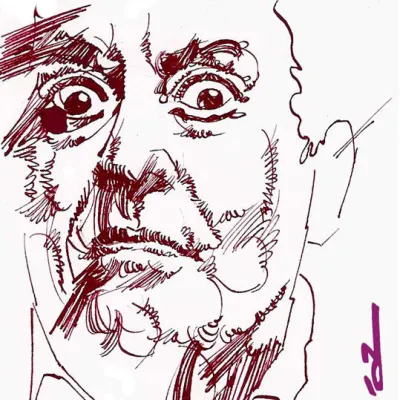
Carmelo Bene
Human Design Chart
Biography
In 1979 he wrote, in collaboration with French philosopher Gilles Deleuze, the essay "Superpositions". In 1984 his play Adelchi was published. In 1970 he wrote the screenplay A Boccaperta.
The Human Design of Carmelo Bene: Generator 3/6
Generator 3/6 — Design at a Glance
Carmelo Bene revealed himself as someone with immense endurance, but this was not arbitrary effort; it was based on a specific inner architecture. As a Generator, he had access to abundant sacral energy – an energy source in the abdominal area that gave him the ability to sustainably realize ideas and projects in the material world. However, this energy did not manifest through sheer willpower or spontaneous initiatives but only unleashed its full strength when he responded to external impulses.
His design indicated that true actionability and deep satisfaction occurred when his sacral center answered with a clear 'yes'. In these moments of reactive engagement, his power was inexhaustible. Conversely, ignoring this inner signal or attempting to initiate against the natural flow inevitably led to frustration and energy loss. The greatest danger for him lay in committing to tasks that did not genuinely interest him – a path often leading Generators into burnout. Equally painful was being prevented from pursuing his heart project despite the internal drive still being present. His life force thus functioned like a precise instrument: it materialized only what he authentically responded to and rewarded this alignment with a sense of deep fulfillment.
Emotional Authority
Carmelo Bene displayed a decision-making structure that did not rely on immediate clarity but rather on an essential inner waiting period. His inner authority was emotional, carried by the defined Solar Plexus Center. This configuration was subject to constant wave movements of feelings: moods swung between enthusiasm and rejection, with the current emotion always being only a provisional snapshot, not the deeper truth of a situation. Quick, spontaneous reactions to these fleeting impulses proved risky as they ignored the natural rhythm of emotional tides.
The mechanics of his inner guidance required patience. To reach true clarity and calmness, Carmelo Bene had to consciously let decisions rest, ideally over several nights. Only when the initial emotional heat subsided and a distance from the original reaction was established did the actual decision crystallize. This process of maturation was indispensable for long-term orientation points in his life. Emotional authority took precedence over all other defined centers; regardless of further energetic conditions in his design, it served as the primary instance that confirmed or refuted its validity through time and sleep.
The 3/6 Profile — Martyr / Role Model
Carmelo Bene revealed himself as someone who throughout his life oscillated between playful experimentation and a later necessity for reflective distance. His design indicated a tendency to carry the inner conflict between the desire for free play and the urge for wise overview. Until around age 30, he primarily acted from the line of the experimenter: marked by trial and error. This phase was often accompanied by uncertainty as his inner child sought space to play while external expectations demanded controlled action.
Only with Saturn's return did his dynamics fundamentally change. Line 6 became active, allowing him to find more contrast within himself. Carmelo Bene now withdrew more frequently to reflect on accumulated experiences. The playful experimental energy thus received wise guidance; he could gain an overview of the whole and better assess his expressive power. This process of humility through solitude protected him from negative influences and arrogance that would otherwise have disturbed his period of reflection.
In his later years, around age 50, this earlier uncertainty transformed into charming wisdom. Carmelo Bene became a role model for others. His skill no longer served merely to experiment but sought an immortality in expression. He conveyed insights from the perspective of both lines: that of the eight-year-old child and that of the eighty-year-old sage. Thus fulfilling his profile's task, he revealed hidden connections and communicated them so that others could absorb them.
Triple Split Definition — Defined & Open Centers
Carmelo Bene revealed himself as someone who possessed an immense, always available internal structure paired with situational openness towards the outside world. His design was characterized by six defined centers: Head and Ajna created a constant mental pressure to question and form concepts; Heart provided willpower and ego strength; Sacral center offered vital energy that could only be used correctly through reaction; Solar Plexus demanded patience in decision-making as an emotional authority; and Root overrode existential pressure. This closed system formed a firm motivation.
At the same time, three centers were open: Throat, G Center, and Spleen. This meant that communication, identity/direction, and physical intuition were not constantly available from within but conditioned by the environment. The challenge lay in not pressing the massive energy of the defined centers against the resistance of the open areas – for example, through initiating instead of reacting or seeking a firm identity – but rather using the strategy of waiting and reacting to avoid frustration when ideas encountered a world that was not yet ready to respond, and learning to leave expression and direction to the environment.
Channels for community, evolutionary change and abstract comprehension.
Carmelo Bene revealed himself as someone driven by an unrelenting, pulsating energy that forced evolutionary change. This driving force came from Channel 60-3 in his design. This stream connected Root Center with Sacral Center and generated an adrenalized rhythm of chaos to order. The mechanics required the acceptance of limitation through Gate 60, the fulcrum of all possibilities, as well as the organizing power of Gate 3 to structure new beginnings. This configuration led to a mechanical moodiness and melancholy during pauses in the pulse when internal pressure was high but no external action took place. The energy compelled the environment to adapt compulsively; it was unstoppable and required patience underground until new mutations appeared.
In contrast, there was a need for social validation in his personality carried by Channel 37-40. This channel connected Solar Plexus and Heart Center seeking recognized belonging as well as fair agreements. Gate 37 sought recognition in the whole while Gate 40 provided work for others' sustenance but needed reward and breaks. Here lay a conflict: The impulsive, mutative pressure of his design collided with the deliberate, negotiating approach of his personality that required emotional clarity and carefully formulated contracts.
Additionally, gates like Gate 9 in Sacral Center, which promoted detailed work and perfection through repetition, as well as Gate 16, which drove experimentation and mastery, were at play. These elements underscored a tendency towards concrete form despite the underlying mutative unpredictability.
Tribal Circuitry — Circuit Signature
Carmelo Bene revealed himself as someone whose identity was inseparably linked to the principle of mutual exchange. His design laid down a constant tendency toward cooperation and communal resource creation driven by the Sun in Gate 40. This impulse for mutual support – “Today I give, tomorrow you give” – formed the foundation of his self-understanding. Since this energy came from the Ego Circuit that connected Heart and Solar Plexus centers in him, it was a stable, timeless characteristic of his personality.
However, there was no connection to Sacral Center within this circuit. Mechanically speaking, this meant that the energy for this cooperative dynamic was not inexhaustible. Carmelo Bene therefore needed mandatory rest pauses for resource regeneration; without these pauses, his ability to support would have been exhausted.
Alongside this central identity field existed two additional energetically separate areas. The Knowledge Circuit connected his Sacral with Root Center via the Mutation Channel. Here lay a pulsating power for creating new paths and individual transformation. Parallel to this, the Meaning-Finding Circuit linked Head with Ajna Center through Abstraction. This area served visual reflection on past experiences to grasp their meaning and cyclically process insights. These three fields – identity through exchange, individual renewal, and sense-making reflection – existed side by side without directly overlapping.
Right Angle Cross of Planning 3
Carmelo Bene demonstrated a fundamental attitude based on strategic orientation and long-term goal setting. For his design, the architecture of thought was central; planning did not serve as a secondary preparation but rather as a defining life principle. This configuration corresponds to the right cross of Planning 3 in Human Design mechanics. This aspect describes an internal structure aimed at organizing complex relationships and aligning actions towards a clear, distant goal. It involves maintaining an overview of large wholes and setting steps consciously in a sequence that serves this ultimate objective. Carmelo Bene lived this tendency toward systematic anticipation and structured approach. His energy flowed into building concepts that provided support and direction. This was not a spontaneous reaction to the moment but a thought-out process of design. The mechanics of this cross emphasize the importance of continuity and linking individual actions into a coherent whole. Carmelo Bene used this internal logic to determine his path and align his actions towards a sustainable future, rather than yielding to immediate circumstances.
Saturn Return · Uranus Opposition · Chiron Return · 2nd Saturn Return — Life Cycles
Carmelo Bene utilized his Saturn Return cycles as structural milestones where his professional identity condensed and matured. The first Saturn Return often marked the transition from preparation to established practice. In 1968 at age 31, Carmelo Bene directed the short film “Hermitage.” This event served as concrete evidence of this phase: years of groundwork crystallized into a viable artistic result that solidified his position.
The second Saturn Return, which occurred roughly 28 years later, demanded a redefinition of this established role in the context of changed life circumstances and societal expectations. Carmelo Bene adapted to this new structure by developing a specific role for television’s “Maurizio Costanzo Show” in 1994 at age 57. This was not merely a repetition of earlier successes but a conscious adaptation of his artistic expression to a new medium and different public. Through these two cycles, it became evident how Carmelo Bene understood his career not as a linear ascent but as a series of structural consolidations where he transformed existing resources into new, stable forms.
Generator · Emotional Authority — Synthesis
Carmelo Bene was a Generator whose life was marked by a deep inner drive to react to impulses and release energy through action. This generative engine, combined with emotional authority, points to someone who experienced intense emotions but only found clarity after fully experiencing the entire emotional wave. The combination of sacral energy and emotional center led to a process of profound reaction – not initiating but responding – and resulted in a capacity to find deep fulfillment through work on heart projects. The profile as an experimenter/role model underscores this dynamic: a lifetime of experimentation, learning, and ultimately developing wisdom to inspire others.
A central paradox in Carmelo Bene’s design lies in the interplay between defined creativity (Head and Ajna Centers) and an open G Center. On one hand, he possessed the ability to develop and express complex ideas inspired by constant mental pressure. On the other hand, his identity was not fixed, making him vulnerable to external influences and characterized by a search for direction and belonging. This tension between inner inspiration and the need to define oneself in relationships created a dynamic field that both released creative energy and required an ongoing confrontation with self.
3 Defined Channels
Incarnation Cross - Right Angle Cross of Planning 3
Solar Return
The Solar Return shows the moment when the sun returns to its exact birth position - your personal solar year.
Life Cycles
Discover the life cycles with a detailed triple view (birth chart, cycle chart, composite).
Human Design Profile
- Type
- Generator
- Strategy
- To respond - wait for something to respond to
- Authority
- Emotional Authority
- Profile
- 3/6 - Martyr / Role Model
- Definition
- Triple Split
- Incarnation Cross
- Right Angle Cross of Planning 3
- Date of Birth
- 01.09.1937 09:30
- Place of Birth
- Campi Salentina, Italy
Frequently Asked Questions
What was Carmelo Bene's Human Design type?
Which Profile did Carmelo Bene have?
What authority did Carmelo Bene possess?
What incarnation cross did Carmelo Bene have?
When was Carmelo Bene born?
Discover your own Human Design
Are you also a Generator? Find out in a personal reading how to use your sacral energy correctly and discover deep satisfaction.
More Personalities
Back to overviewSissy Spacek

Aaliyah

Alexia

Anémone

Angèle

Ann-Margret
