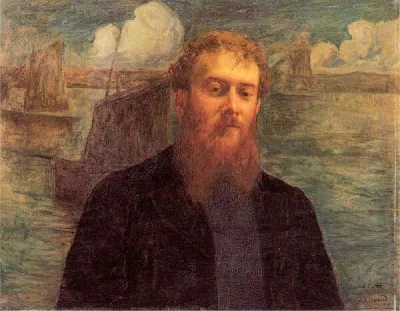
Charles Cottet
Human Design Chart
Biography
What does Manifesting Generator 5/1 mean for Charles Cottet?
Manifesting Generator 5/1 — Design at a Glance
Charles Cottet revealed himself as someone marked by a hybrid energy configuration: He possessed the constant power of a Generator, yet also had the ability to act swiftly and skip steps. This manifesting Generator design inclined towards great speed, allowing him to quickly draw things into his life.
However, this mechanism brought specific challenges. Often, Cottet was too quick and skipped important intermediate steps, leading him to have to return later and make up for them. Such experiences could lead to frustration, as they went against his inner sense of efficiency. Additionally, he tended to pursue multiple projects simultaneously, driven by various impulses. If he did not react to these inner signals but acted on his own initiative, his creative enthusiasm quickly turned into dissatisfaction.
Cottet's strategy was not to initiate himself but to react to life. Only when his Sacral Center gave a clear "yes" should he start. Regular checks to see if current tasks still found this inner approval were crucial. If he followed this strategy, he could draw deep satisfaction from his work. For him, it was important to stay in "play mode" and seek variety, rather than limiting himself to one thing. Thus, his speed became a source of satisfaction rather than the cause of frustration.
Sacral Authority
Charles Cottet had a simplified decision-making structure, as his strategy and inner authority were identical. As a Generator, his sacral authority was the central compass of his actions. This configuration required an open emotional center, meaning he did not react to initial impulses but waited for the clarity of the moment. His responses manifested physically: as a gut feeling, a surge of energy, or vocal expressions like grunting or humming. These signals marked the moment when he was vital and energized.
His design allowed him to engage in activities with great enthusiasm and inexhaustible energy, free from rigid purposefulness. He was born to move through life by fully immersing himself in things that spoke to his sacral energy. This gave him a natural satisfaction and joy in the work itself.
Additionally, an activated spleen center supported this authority. This connection gave him quick, spontaneous access to instinctive perception and physical well-being. He could make decisions based immediately on his sense of safety and health. This combination of sacral energy and spleen-supported intuition allowed Charles Cottet to reliably listen to his inner signals and use them as a basis for his actions, without being distracted by external expectations.
The 5/1 Profile — Heretic / Investigator
Charles Cottet revealed himself as someone who possessed deep, specialized knowledge and offered it to others for problem-solving. His design as a 5/1 Profile connected Line 1 of research with Line 5 of application. He loved the process of learning and tackling new challenges. Others often sought him out for solutions because he had a magnetic presence that made his knowledge attractive. This could, however, lead to overextension if he did not set clear boundaries. Similar to a scientist who is exhausted after long conferences due to answering too many questions, he risked losing his energy. His Gate 53 stood for assertiveness and new beginnings under high expectations. Neptune gave these beginnings a mystical quality, while Earth demanded grounding and pragmatism. At the same time, he was challenged to accept failures in new projects, as this was evolutionarily necessary. Line 1 taught him to store experiences without repeating them. The Sacral Center urged him to say yes to life and carry commitments through to the end. He had to learn to finish things without losing the meaning in the experiences. By setting boundaries, he could maintain the balance between his own research and helping others. His strength lay in uncovering hidden connections and making them practically useful without burning himself out.
Split Definition — Defined & Open Centers
Charles Cottet was characterized by a consistent and reliable way of expressing himself through communication and willpower. His defined Throat Center acted as a pivot point, translating messages from the body into clear communication and action. This was complemented by his defined Heart Center, which gave him a natural sense of willpower and the desire to determine his own life and resources. He had the energy to keep promises and push through his own limits, which strengthened his self-esteem.
As a Generator with a defined Sacral Center, he had a vast source of vital energy. His strategy was not to initiate but to wait and respond to life. Only through a confirming sacral response could he sustainably use his energy without falling into frustration or exhaustion. His defined Spleen Center provided spontaneous, intuitive judgments in the present moment, protecting his well-being and health, while his defined Root Center supplied the necessary pressure to move forward in the world and survive.
At the same time, Charles Cottet was marked by several open centers, making him susceptible to conditioning. His open Head Center had no consistent way of processing mental information; he tended to engage with questions and doubts that were not his own, which could lead to mental confusion. His open Ajna Center meant his mind was flexible, but he risked interpreting foreign concepts or opinions as his own truth. His open G Center had no fixed identity; he reflected his environment and often sought direction and love from others, rather than possessing it internally. Additionally, his open Solar Plexus absorbed the emotions of his surroundings, leading him to amplify foreign feelings and sometimes experience them as his own instability, rather than recognizing them as an external field.
Channels for ambition, maturation and material security.
Charles Cottet was someone who combined material responsibility with a deep, cyclical quest for experience. His design inclined him to maintain control over his own rhythm as he entered new life stages to gain wisdom from them.
This attitude was shaped by the Money Line 21-45. This channel connected the Heart with the Throat and created a drive to secure resources through willpower. Charles Cottet sought independence to protect his heart and often acted as his own boss, needing control to serve effectively. The tension between the Hunter (Gate 21), seeking control, and the Collector (Gate 45), exercising authority, challenged him to find a balance between hard work and necessary rest.
Simultaneously, the Transformation Channel 54-32 was at play. It connected the Root with the Spleen and propelled him through ambition and the desire for recognition. Charles Cottet worked hard to prove his worth and improve his social standing. The fear of failure or inability to keep up spurred him to develop talents that helped him grow beyond his starting point. This process, however, depended on the support of his environment, which recognized and rewarded his efforts.
The Maturity Channel 42-53 rounded out his profile. This channel between the Root and Sacral Center emphasized the need to fully experience cycles. Charles Cottet learned from each cycle by bringing it to a conclusion and reflecting on it. He sought not only results but the depth that only comes from fully experiencing beginnings (Gate 53) and growth (Gate 42).
Additionally, Gates like 59 (genetic binding strategy), 57 (intuitive clarity), and 41 (emotional evolution) further nuanced his way of experiencing relationships and changes. Gate 9 promoted the ability to work on details and perfect them, while Gate 16 supported experimental mastery.
Tribal Circuitry — Circuit Signature
Charles Cottet's design inclined him to cyclical emotional waves characterized by maturation processes. This was evident in the Meaning Circuit, where the channel 42-53 connected the Sacral with the Root Center. This connection generated rhythmic energy, processing past experiences into concrete action impulses. Emotions followed a natural wave pattern with a beginning, peak, and end, enabling an internal order in the processing of feelings.
Parallel to this, there was a separate but equally important structure in the Ego Circuit, aimed at cooperation and resource management. Here, the channel 21-45 connected the Heart with the Throat Center, translating material values and commitments into words and actions. Simultaneously, the channel 32-54 between the Spleen and Root Center secured physical transformation and survival. Since these two groups were not connected, they existed as separate forces: on one hand, the emotional processing of the past, on the other, the pragmatic securing of well-being and social support. This divided definition required Charles Cottet to live these different energies as parallel, independent areas without artificially merging them into a single experience. The pauses resulting from the lack of a direct connection to the Sacral Center in the Ego Circuit were essential to sustainably maintain resources for collaborative creation.
Left Angle Cross of Cycles 1
Charles Cottet's design established a tendency towards cyclical, repetitive creation that did not rely on linear progress but rather on the deepening and variation of a core theme. This configuration, known as the left cross of cycles 1, described a life energy that worked in waves: phases of intense activity and creation alternated with necessary periods of collection and internal processing. For Charles Cottet, this meant that his work often followed closed cycles, in which he would pick up ideas, work through them, and allow them to reappear in new form without a final 'check-off' or departure from the theme. The mechanics of this cross fostered a kind of endurance that was not fueled by external recognition but by the inner rhythm of the cycles themselves. Charles Cottet thus showed himself to be someone whose contribution lay less in one-time, explosive novelty and more in the consistent, rhythmic processing of his specific life task. This cyclical nature allowed him to explore themes with a depth that was only possible through recurring engagement, giving his overall work a certain coherence and recognizability that emerged from this specific energetic structure.
Saturn Return · Uranus Opposition · Chiron Return · 2nd Saturn Return — Life Cycles
Charles Cottet's design was marked by cyclical phases of condensation and public recognition. In 1892, at the age of 29, he undertook a study trip to Algeria. This marked his first Saturn return, a time when internal structures and long-term goals often become concrete and solidify in external actions. The trip served to collect impressions that would shape his future work.
A decade later, in 1900, he received the gold medal at the World Exhibition in Paris. At 37 years old, he went through the Uranus opposition. This aspect often brings unexpected turns or sudden visibility, affirming the previous path and carrying it into the public sphere. The award was no coincidence but the expression of a mature artistic position now recognized by the world.
In 1912, at 49 years old, he was appointed an officer of the Legion of Honor. This fell during the Chiron return, the cycle of fulfillment. Here it shows whether life has been lived in harmony with one's own strategy; the award was confirmation of his life purpose and lasting significance.
Finally, in 1923, he was admitted as an associate member to the Royal Academy of Belgium. At 60 years old, the second Saturn return began. This phase deepens the already achieved structures and firmly anchors the reputation. Cottet's path thus clearly followed the archetypal patterns of his design: from internal collection through public affirmation to institutional anchoring.
Manifesting Generator · Sacral Authority — Synthesis
Charles Cottet lived a process of continuous transformation, fueled by a powerful, sacral energy (sacral authority) and the drive to collect and disseminate knowledge (5/1 Profile). The connection of the Sacral Center with the Throat Center enabled him to quickly bring ideas and impulses into the world (Manifesting Generator), while the defined communication (defined Throat Center) allowed him to express and convey his inner insights. This drive, coupled with the cyclical rhythm of the Perceiver circuit, points to a lifestyle marked by deep experiences and the need to process and share them with others – a constant pendulum swing between inner reflection and outer manifestation.
A central paradox in Charles Cottet's design lay in the tension between the speed with which he could approach things (Manifesting Generator) and the necessity not to skip essential steps. The Money Line (Channel 21-45) indicates a natural authority and the urge to take responsibility, which was counterbalanced by the sacral authority based on reaction and inner consent. Thus, there was a play between quick action and the need to listen to his own inner compass, evident in events such as the study trip (1892) and the successes (1900, 1912, 1923).
3 Defined Channels
Incarnation Cross - Left Angle Cross of Cycles 1
Solar Return
The Solar Return shows the moment when the sun returns to its exact birth position - your personal solar year.
Life Cycles
Discover the life cycles with a detailed triple view (birth chart, cycle chart, composite).
Human Design Profile
- Strategy
- To respond - wait for something to respond to
- Authority
- Sacral Authority
- Profile
- 5/1 - Heretic / Investigator
- Definition
- Split Definition
- Incarnation Cross
- Left Angle Cross of Cycles 1
- Date of Birth
- 12.07.1863 09:00
- Place of Birth
- Le Puy-en-Velay, France
Frequently Asked Questions
What was Charles Cottet's Human Design type?
What profile did Charles Cottet have in Human Design?
What authority guided Charles Cottet?
What incarnation cross did Charles Cottet have?
When was Charles Cottet born?
Discover your own Human Design
Are you also a Manifesting Generator? Find out in a personal reading how to unfold your multi-talents and direct your energy wisely.
More Personalities
Back to overviewAldair

Alizée

Angeli

Arletty

Artus

Baekhyun