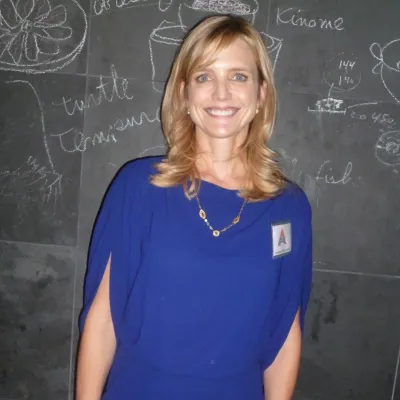
Courtney Thorne-Smith
Human Design Chart
Biography
Courtney Thorne-Smith as a Generator 3/5 in Human Design
Generator 3/5 — Design at a Glance
Courtney Thorne-Smith's design points to a tendency towards great endurance and energy, provided she reacts to impulses from her environment. As a Generator, she had a lot of sacral energy that she could use like a workhorse – strong and steady, if she was burning for her task. Her strategy did not lie in initiating but in reacting: She waited for a signal from life and then responded from the gut when her inner voice said 'yes'.
This mechanism was crucial for her well-being. If she followed this inner guidance, her system rewarded her with a feeling of deep fulfillment. Conversely, frustration or energy deficiency threatened if she acted against her will or did things that did not touch her. Two stumbling blocks marked this pattern: Either she wasted her energy on tasks without inner resonance, which could lead to burnout, or she was held back from her heart project, even though she was full of power to continue working. Her success thus depended on not exhausting her energy through constant initiating but through consistent reacting to what truly spoke to her. This way, she could unfold her intrinsic creative power without overtaxing herself.
Emotional Authority
Courtney Thorne-Smith's design points to a tendency towards emotional wave movement, which significantly shaped her decision-making. As a person with emotional authority, carried by the defined Solar Plexus Center, she was subject to constant fluctuations of her feelings. This inner authority always takes precedence in Human Design over all other defined centers, regardless of further configurations. This means that Courtney Thorne-Smith's perception of the world was always colored by her current mood: The same situation could appear inspiring in one moment and negative in the next.
Her immediate feeling was, however, only a snapshot, not a final judgment. Quick, spontaneous decisions made directly from this emotional heat carried the risk of proving wrong later on. The mechanics of her design therefore required patience and conscious hesitation. By taking time to let decisions mature and reviewing them several times, she gained emotional distance. Over time, the intense feelings subsided, and a deeper clarity and calmness set in. This process was particularly important for long-term decisions that could have a significant impact on her life course. Only through this waiting could she recognize the true resonance of a situation, beyond the often misleading first impression.
The 3/5 Profile — Martyr / Heretic
Courtney Thorne-Smith's design is characterized by a fundamental attitude of experimentation and practical testing. She primarily learned through trial and error, with adaptability and authentic self-expression being central themes. This 3/5 Profile type corresponds to the image of the heroic adventurer or humorous rebel who gathers a rich treasure of life experiences and presents it. The third line means that she initially did not believe anything blindly but had to try everything herself. From these experiments and also failures, she gained knowledge that she then used to solve other people's problems – the role of helper and rescuer of the fifth line.
This practical experiential world was attractive to her environment, as others wanted to learn from her insights. Yet, this hero role carried risks: Failing in public could be painful. Moreover, there was the danger that material forces could interrupt her creativity or lead to excessive ambition. In times of crisis, she was seen as a potential leader, similar to a temporary general who needs authority to solve problems. If she fulfilled this projection, her reputation grew; if not, she risked becoming a scapegoat. Leadership had the greatest value for her from the perspective of the collective in times of need, which shaped the dynamics between her personal experimenting and the external expectation of her heroic deeds.
Triple Split Definition — Defined & Open Centers
Courtney Thorne-Smith's design revealed a tendency for constant mental pressure combined with deep, physical vitality. She was someone who constantly asked questions and formed concepts, while her body provided an enormous energy source that could only be activated through reaction.
This configuration arises from her defined Head and Ajna Centers. These create a permanent mental process: inspiration meets conceptual thinking. Courtney Thorne-Smith was unable to turn this thought stream off; she generated constant questions and answers. Along with her defined Throat Center, she could reliably communicate these mental contents. Her voice served as a transmission organ that carried her inner concepts outward.
At the same time, she had a defined G Center, which gave her a firm sense of self-identity and a clear sense of direction. She knew who she was and where she belonged without having to rely on others. Added to this was a defined Sacral Center, the motor of her existence. This gave her a continuous, humming vitality. However, this energy was only available when she reacted to external impulses. Initiating actions without prior questioning would break this connection and lead to frustration.
In contrast, her open centers stood out. Her open Heart Center made her vulnerable to the pressure of proving her worth through willpower or promises. She tended to question whether she was doing enough to be recognized and risked getting caught in spirals of self-doubt when trying to meet expectations that did not align with her inner authority.
Her open Spleen Center led her to avoid spontaneous decisions. She was sensitive to the health and well-being vibrations of her environment. Without her own intuitive certainty in the moment, she could easily be conditioned by others to hold onto things that were not good for her out of fear of losing security.
Finally, her open Root Center absorbed external stress. Courtney Thorne-Smith was not designed to work under constant, adrenaline-inducing pressure. Attempts to escape or fight this pressure often led to hyperactivity or exhaustion, as she could not recognize this foreign impulse as her own. The challenge was to accept the mental pressure, wait for the sacral response, and not be carried away by the external stress wave.
Channels for intimacy, logical leadership and mental abstraction.
Courtney Thorne-Smith's design sets a tendency towards intense, physical intimacy paired with the ability to present logical structures for others. The Partnership Channel 59-6 rooted her in a powerful Quantum Sacral and emotional energy, known as Intimacy. This tribal channel connected the sexuality of Gate 59 with the emotional wave of pleasure and pain from Gate 6, making relationships personal, profound, and potentially fruitful. Her drive was to merge; her availability of intimacy allowed her to quickly penetrate the aura of others and ease confidentiality. However, the emotional wave of Gate 6 determined the timing of every release of intimate feelings, making her attractive or repulsive. Waiting for these wave cycles was crucial to gain clarity on whether a deep connection had formed, as premature actions through lack of self-spontaneity could cause confusion.
Parallel to this, Courtney Thorne-Smith was shown through the Alpha Animal Channel 7-31, which described logical, collective leadership with a view to the future. This channel connected the Gate of the Role of Self (7) with the Gate of Leading (31). She possessed the ability to act as a leader who first had to gain trust before taking charge. Her influence was based on tested patterns and the ability to understand trends. She chose her own sphere of influence, her "pack," and could show the way from a powerful position without taking responsibility away from others. Success arose here when she was invited by the majority to lead, as collective leadership is reinforced by the principle of the majority.
Additionally, the Abstraction Channel 64-47 shaped her mental landscape. It connected the Gate of Confusion (64) with the Gate of Understanding (47), leading to every experience being filtered through a kaleidoscope of mental images. Her mind constantly played with possibilities, which could lead to considerable mental confusion but also initiate new, inspiring journeys. Through patience, the space between the points condensed until a picture became visible and a unique story emerged that she could share. This active, experience-based mind was unsuitable for solving her own problems but excellent at discovering new perspectives and communicating them to the collective.
Collective Circuitry — Circuit Signature
Courtney Thorne-Smith's design revealed a tendency towards rational clarity that directly translated into her identity and expressiveness. The Understanding Circuit connected her Throat Center with her Identity Center. This created a direct flow of logical, strategic insights to verbal articulation, free from emotional filtering. She was someone who structured complex connections and communicated in a future-oriented manner.
Parallel to this, there was a separate, unconnected area in the Meaning Circuit. Here, the Channel of Abstraction linked the Head Center with the Ajna Center. This connection created cyclical, wave-like emotional waves that focused on processing past experiences. In contrast to the cool rationality of the first part, this was an intuitive, often inexplicable search for meaning that did not directly merge with her identity-defining communication.
A third, also isolated stream formed the Protector Circuit. Through the Channel of Union, the Sacral and Solar Plexus Centers were connected. This linked the primal life force with strong, wave-like emotions. It was about instinctive protection, care, and the preservation of one's genetics. As Courtney Thorne-Smith had a Triple Definition, these three systems—rational communication, emotional meaning-making, and instinctive protection—existed as parallel, non-directly energetically connected forces. They shaped her essence as separate yet equally important aspects, each with its own logic and mode of expression, without merging into a single, continuous flow.
Right Angle Cross of the Sphinx 4
Courtney Thorne-Smith's design revealed a tendency towards inner stability and the protection of the self. She was someone who carefully preserved her energy and did not easily invest it in external conflicts. This attitude stems from the configuration of the right cross of the Sphinx 4. This aspect describes an inner structure designed for stability and continuity. The energy here is not expansive or outwardly directed but serves to preserve what has already been achieved. It's about setting boundaries and protecting one's own substance rather than constantly conquering new things. Therefore, Courtney Thorne-Smith often appeared as a stabilizing force, radiating security through her presence and clear stance. She understood how to efficiently use her resources—whether emotional, physical, or temporal—to pursue long-term goals. This mechanism does not imply passivity but rather a focused, targeted application of energy. She acted not out of impulse but from a deep inner confidence based on an understanding of her own limits and strengths. Her design promoted a kind of wisdom gained through experience and holding positions. Courtney Thorne-Smith used this inner strength to serve as an anchor in uncertain times without losing her own identity. She remained true to herself and did not let external pressures throw her off course.
Saturn Return · Uranus Opposition · Chiron Return · 2nd Saturn Return — Life Cycles
Courtney Thorne-Smith's design revealed a tendency towards structural turning points where inner maturity and external validation met. In 1997, at the age of 30, the TV series Melrose Place ended. For her Human Design, this marked the first Saturn Return, a cycle that often condenses years of groundwork into a solid result and strengthens professional structures.
Ten years later, in 2007 at the age of 40, she married Roger Fishman. This fell on the Uranus Opposition, a phase in Human Design that marks a moment of breaking free from outdated patterns and searching for new freedom. The marriage was not just an event but the expression of a profound inner shift towards partnership autonomy that aligns with the Uranus influence.
In 2015, at the age of 48, the series Two and a Half Men ended. This marked the Chiron Return, a fulfillment cycle. In Human Design, this is not a time of healing old wounds but a blooming phase where the incarnation cross unfolds. The end of the series signaled the conclusion of a life phase and the increasing experience of meaning and purpose, provided she had followed her strategy. These three points show how astronomical cycles in her design shaped concrete life stations.
Generator · Emotional Authority — Synthesis
Courtney Thorne-Smith's design shows a deeply rooted dynamic between creative energy and emotional depth. As a Generator with defined sacral energy (Generator type) and emotional authority, she relies on absorbing and living out life energy through authentic engagement. The profile as an Explorer/Hero (3/5 Profile) emphasizes this drive to collect experiences and then share them, which is reinforced by the connection of the Head and Ajna Centers (mental pressure)—a constant drive to understand and inspire. This process, however, is always bound to the necessity of letting emotions mature to gain clarity from the wave of feelings.
A central paradox lies in the combination of powerful, sacral energy and the need for emotional clarity. The energy is there, but it must be filtered through the emotional wave pattern, leading to an inner tension between the immediate urge to act and the necessity to wait and feel. Documented events, such as the end of career stations (1997, 2015) and entering a relationship (2007), seem to occur in these cycles when energy and emotional maturity condense into a clear path.
3 Defined Channels
Incarnation Cross - Right Angle Cross of the Sphinx 4
Solar Return
The Solar Return shows the moment when the sun returns to its exact birth position - your personal solar year.
Life Cycles
Discover the life cycles with a detailed triple view (birth chart, cycle chart, composite).
Human Design Profile
- Type
- Generator
- Strategy
- To respond - wait for something to respond to
- Authority
- Emotional Authority
- Profile
- 3/5 - Martyr / Heretic
- Definition
- Triple Split
- Incarnation Cross
- Right Angle Cross of the Sphinx 4
- Date of Birth
- 08.11.1967 08:23
- Place of Birth
- San Francisco, CA, United States
Frequently Asked Questions
What is Courtney Thorne-Smith's Human Design type?
What Profile does Courtney Thorne-Smith have in Human Design?
What Authority guides Courtney Thorne-Smith's decisions?
Which incarnation cross is active for Courtney Thorne-Smith?
When was Courtney Thorne-Smith born?
Discover your own Human Design
Are you also a Generator? Find out in a personal reading how to use your sacral energy correctly and discover deep satisfaction.
More Personalities
Back to overviewSissy Spacek
Aaliyah

Alexia

Anémone
Angèle

Ann-Margret