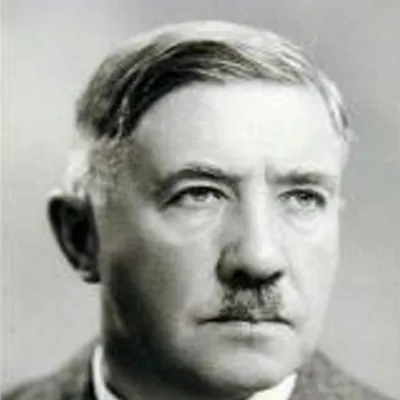
Daniël George van Beuningen
Human Design Chart
Biography
Van Beuningen was a collector of art from the 15th and 16th centuries out of the northern and southern parts of the Netherlands. During his life he gave several of his collections away to the Museum Boijmans Van Beuningen.
He died on 29 May 1955.
Daniël George van Beuningen as a Projector 4/6 in Human Design
Projector 4/6 — Design at a Glance
Daniel George van Beuningen had a focusing aura that shone like a bright flashlight, allowing him to immediately spot system errors. However, this ability to shed light on the dark could be unpleasant when he addressed corrections directly; others often felt it as an aggressive beam in their face. The more elegant approach was to attract through his own harmonious glow, so that people would ask for advice willingly. Therefore, his strategy was to wait for a sincere and respectful invitation rather than giving unsolicited guidance. As a Projector, he did not have a defined Sacral Center, meaning he didn't have constant intrinsic life energy at his disposal. Instead, he experienced phases of high productivity followed by necessary rest periods to prevent burnout. By living according to this design and waiting for the invitation, he was rewarded with success. Ignoring these dynamics and trying to swim against the current or lead without being asked led sooner or later to his non-self theme: bitterness. His path thus involved using his sharp perception not as a tool for direct correction but as an attractive quality that invited others to ask him for guidance.
Emotional Authority
Daniel George van Beuningens design tended towards emotional detachment in decision-making. Spontaneous impulses were unreliable for him; instead, he needed time to filter through the noise of emotions to reach clarity. This resulted from his emotional authority rooted in a defined Emotional Center. This center was subject to constant waves of highs and lows in feelings. The world appeared colored by his current mood: at one moment he could be totally excited about something, only to see it negatively the next. His immediate feeling was just a snapshot, not necessarily his truth yet. Quick decisions based on such emotions often had negative consequences. The more time Daniel George van Beuningen took, the deeper and broader his understanding became. This required patience and repeatedly sleeping on decisions. He should be hesitant and ask again and again. Over time, intense feelings subsided, emotional distance gained strength, clarity and calmness set in. This process was crucial for long-term life-defining steps. By waiting, he went through the necessary filter to find the true direction behind transient emotional noise.
The 4/6 Profile — Opportunist / Role Model
Daniel George van Beuningens design created a structural tension between his social Heart and intellectual Head. In the first three decades of his life, he intensely experimented with relationships and friendships, driven by Line 4 of the 4/6 profile. This phase served to test details and externalize doubts, gaining security for the future through precise questions. The mechanics of this line demanded a meticulous documentation of background knowledge, with the big heart acting cautiously to avoid opening up to the wrong people.
After Saturn's return, this dynamic fundamentally shifted. Daniel George van Beuningen now experienced an internal conflict between his deep need for belonging and the growing urge to reflect on life's meaning from a distance. Line 6 came into play, confronting him with unforeseen events he had to accept to grow. Instead of seeking guaranteed logic, he learned that unexpected circumstances strengthened his development and led to ego.
In his later years, it was expected of him to act as a wise role model. His authority no longer rested on experimental trial-and-error but on the ability to work through cooperation with others. Earlier uncertainty transformed into an attitude that integrated the unforeseen as part of the universal flow, thereby enabling deeper satisfaction and wisdom.
Split Definition — Defined & Open Centers
Daniël George van Beuningen was characterized by a strong, defined mental and willful system. His defined Head and Ajna centers generated a constant mental pressure to question and form concepts; this was not a choice but a permanent internal activity that he could not simply stop. This mental energy flowed into his defined Throat and Heart centers, giving him a reliable way of communication and a clear willpower. He spoke from the mind and acted with a natural ego strength that allowed him to keep promises and use his resources self-determinedly.
However, this structural firmness was in tension with his emotional authority. His defined Solar Plexus required patience: truth revealed itself to him only over time. He had to learn to wait for the emotional wave before making decisions to avoid impulsiveness and gain clarity. Simultaneously, his defined Spleen center served as an intuitive instance in the moment; it provided spontaneous, trustworthy signals for health and well-being that he had to accept without rational verification.
In contrast, his G-, Sacral, and Root centers were open. This made him situationally dependent on his environment. His open G center lacked a fixed identity; he absorbed direction and love from his surroundings and tended to question who he was or where the right direction lay when not at the correct place. His open Sacral center did not provide constant energy flow; he took vital energies of others in and had to learn to set boundaries to prevent exhaustion, rather than believing he must work constantly. Finally, his open Root center absorbed external stress; he amplified the pressure of his environment and could get lost in an endless cycle of tension and burnout if trying to resolve this non-self-owned adrenaline rush through personal action. His mechanics lay in connecting the stability of his will and thinking with the flexibility of his open centers by waiting for emotional clarity and using intuitive moments without getting entangled in foreign energies or stress states.
Channels for community, logic, structure and devotion.
Daniël George van Beuningen showed a mind marked by healthy skepticism and constant pattern filtering. His design inclined him to not solve questions himself but pass them on to others for verification primarily through the Channel of Logic 63-4. This channel connected the Head Center with the Ajna Center, generating an active, questioning spirit. The pressure arose from unresolved questions and was only relieved when question and answer were shared. It wasn’t about personal application but providing logical proof to the collective. A statement was only considered true if it worked and could be verified; unfounded belief had no place here.
Alongside this collective logic, Daniël George van Beuningen possessed the ability to clearly express unique perspectives. The Channel of Structuring 23-43 connected his Ajna Center with the Throat Center. Here spontaneous insights (Gate 43) met assimilation and clear formulation (Gate 23). This allowed him to communicate innovative thinking in a way that promoted efficiency and prompted others to rethink. However, this gift required patience; his ideas needed time to be accepted by the collective as they often foresaw.
Emotionally and instinctively, his design was marked by the Channel of Devotion 26-44, connecting Spleen Center with Heart Center, giving him a sharp sense for what the tribe needed or perceived as threat. He could sell products or ideas persuasively by instinctively recognizing unacknowledged needs. Simultaneously, the Channel of Community 37-40 between Solar Plexus and Heart Center emphasized the importance of fair agreements and mutual benefit within a group. He sought his place in the whole and understood that true connection rested on respect and shared work, not hierarchy.
Additionally, individual Gates influenced him: Gate 5 promoted a steady life rhythm and habits for energy building. Gate 35 sought change through interaction and new experiences. Gate 64 processed past experiences into mental concepts while Gate 49 emphasized emotional principles and tribal loyalty. Gate 30 knew the longing for positive feelings and the illusion of freedom. Gate 28 stood for risk in the here and now, and Gate 55 brought extreme mood swings along with deep emotional awareness.
Tribal Circuitry — Circuit Signature
Daniël George van Beuningens design inclined towards two parallel, separate energy fields. On one hand, the Knowledge Circuit drove transformation through new, emotionally colored expression and individual identity. Here Channel 43-23 (Structuring) connected Ajna Center with Throat Center. This connection allowed inner thought structures to be translated into concrete words, showing a pulsating creative energy aimed at personal change.
Simultaneously, the Ego Circuit functioned as a resource-oriented network for cooperation and material give-and-take. For Daniël George van Beuningen, Heart, Solar Plexus, and Spleen Centers were directly connected here. Channel 26-44 (Devotion) promoted the ability to support others while Channel 37-40 (Community) ensured a balance between giving and taking. This configuration worked conservatively and traditionally, with timeless, rat-like energy focused on tribal cohesion and resource care.
As there was no direct connection between these two groups, they existed as separate forces. Daniël George van Beuningen had to learn to integrate the pulsating drive for personal change in the Knowledge Circuit with the traditional necessity of cooperation in the Ego Circuit. This tension shaped his experience: a constant balancing act between the need for personal expression and responsibility towards the community and its material foundations.
Right Angle Cross of Consciousness 1
Daniël George van Beuningen was marked by the Conscious Cross 1. This configuration fundamentally determined his inner orientation. It combined a deep, often unconscious connection to the cosmos with the ability to translate this vastness into human experience. It was a design that did not seek superficial validation but rather an authentic resonance with the greater whole.
The mechanics of this cross promoted a stance of silent observation and internal trust. Daniël George van Beuningen showed himself as someone who made decisions less from logical analysis or social pressure, but from a deep sense for the right moment and direction. This was not an active assertion of will, but flowing with what proved natural and fitting.
His design supported a lifestyle where intuition and cosmic consciousness were at the forefront. He did not live for external success in the conventional sense, but for the quality of his inner experience and its impact on his environment. This energy required space to breathe and reflect; it flourished where authenticity was placed over conformity. Daniël George van Beuningen used these gifts to bridge the mundane with the transcendent without slipping into esotericism, but through lived presence and clarity.
Saturn Return · Uranus Opposition · Chiron Return · 2nd Saturn Return — Life Cycles
Daniël George van Beuningens life journey followed the classical, cyclical rhythms of human development. His design manifested in experiencing these universal transits that marked structure, change, and inner maturity. The first Saturn return came as a phase of consolidation, where earlier impulses were condensed into durable life structures. It was a moment of review: What stood firm? The Uranus opposition then brought a time of necessary letting go and reorientation, old patterns were broken to make room for new perspectives.
The Chiron Return marked the transition into the second half of life as a phase of bloom and fulfillment. Here it became experiential how one's essence unfolds when following their path; meaning and purpose came more clearly to light, not as healing from wounds but as completion of an individual pattern. The second Saturn return finally reinforced this acquired wisdom and stability further. Daniël George van Beuningen did not go through these stages as isolated events, but as a continuous process of maturation. Each cycle built on the previous one: structure created the basis for change, change enabled deeper understanding, and this understanding culminated in a consistent, mature existence form. This sequence shaped his life path through clear phases of building up, transformation, and confirmation of inner order.
Projector · Emotional Authority — Synthesis
Daniël George van Beuningen lived a life marked by the profound ability to recognize patterns and understand their potential impacts. This was evident in the combination of a mentally defined design – Head and Ajna Centers were active – with an emotional authority center. He possessed the gift of uncovering hidden flaws (Gate 63), yet did not address them impulsively, but filtered them through precise intellect (Gate 4) to transform into constructive insights. This ability for analysis and synthesis was central to his path, which was always marked by a drive towards clarity and a deep connection to collective consciousness.
A central paradox lay in the tension between his mental pressure to constantly question and understand, and the need to wait on emotional waves to make authentic decisions. While his mind sought answers (Channel 63-4), his emotional authority required patience and allowing feelings before clarity could arise. This duality shaped his approach by uniting intellectual sharpness with intuitive wisdom – a dynamic interplay that enabled him to penetrate complex systems and offer innovative solutions.
4 Defined Channels
Incarnation Cross - Right Angle Cross of Consciousness 1
Solar Return
The Solar Return shows the moment when the sun returns to its exact birth position - your personal solar year.
Life Cycles
Discover the life cycles with a detailed triple view (birth chart, cycle chart, composite).
Human Design Profile
- Type
- Projector
- Strategy
- Wait for the respectful invitation
- Authority
- Emotional Authority
- Profile
- 4/6 - Opportunist / Role Model
- Definition
- Split Definition
- Incarnation Cross
- Right Angle Cross of Consciousness 1
- Date of Birth
- 04.03.1877 19:00
- Place of Birth
- Utrecht, Netherlands
Frequently Asked Questions
What was Daniël George van Beuningen's Human Design type?
Which Profile did Daniél George van Beuningen have?
What Authority did Daniël George van Beuningen possess?
What incarnation cross did Daniél George van Beuningen have?
When was Daniél George van Beuningen born?
Discover your own Human Design
Are you also a Projector? Find out in a personal reading how to unfold your leadership qualities and recognize the right invitations.
More Personalities
Back to overviewSissy Spacek
Alain-Fournier

Anémone
Ann-Margret
Bourvil
Christian-Jaque