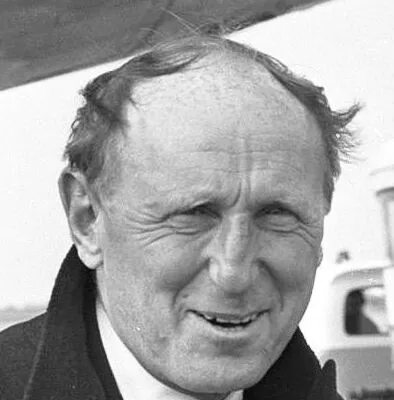
Danny Blanchflower
Human Design Chart
Biography
Blanchflower said of football: "The great fallacy is that the game is first and last about winning. It is nothing of the kind. The game is about glory, it is about doing things in style and with a flourish, about going out and beating the other lot, not waiting for them to die of boredom".
Human Design Analysis: Danny Blanchflower as Projector 2/5
Projector 2/5 — Design at a Glance
Danny Blanchflower's design inclined towards focused perception. As a Projector, his aura acted like a bright flashlight that immediately identified system errors and shed light on the dark spots. However, this ability to directly recognize weaknesses in others or structures could be perceived as unpleasant when addressed directly – similar to a blinding beam of light.
The strategic elegance of his design did not lie in pointing out flaws directly, which is often seen as aggressive. Instead, he radiated an appealing glow of inner harmony that naturally drew others to him and made them seek his advice. His strategy was therefore to wait for a respectful invitation before acting. This protected him from the non-self theme of bitterness that arises when Projectors act without being invited, ensuring his success.
Furthermore, phases of high productivity followed by mandatory rest periods characterized his energy pattern. Due to his undefined Sacral Center, he did not have constant intrinsic life force. Traditional schooling or standardized work models often do not accommodate this need for rhythmic breaks, increasing the risk of burnout. By respecting these cycles and waiting for invitations, Danny Blanchflower lived according to his design and avoided exhaustion as well as the associated bitterness.
Emotional Authority
Danny Blanchflower's decision-making process was marked by the necessity of time and emotional detachment; spontaneous reactions proved unreliable in his design due to his emotional authority anchored in a defined Emotional Center. This configuration was subject to constant waves of ups and downs in feelings. The world appeared colored by his current mood: one moment could be filled with enthusiasm, while the next would show the same situation in negative light.
Since feeling in the moment was merely a snapshot and not a guaranteed truth, quick emotional decisions often had negative consequences. His design's mechanics required patience. By taking time, Danny Blanchflower allowed decisions to mature. This process included consciously 'sleeping on' important questions. Over time, intense feelings subsided, creating emotional distance. Only then did clarity and calmness set in. This approach was particularly relevant for long-term decisions that significantly influenced his life path. Through perseverance in the process, he gained the necessary inner peace to recognize the deeper truth behind transient emotional coloring.
The 2/5 Profile — Hermit / Heretic
Danny Blanchflower's design inclined towards strict selectivity. His Profile 2/5, the Natural Talent/Hero-and-Savior profile, created an internal tension between a deep need for withdrawal and the external expectation to provide solutions as the last resort in crisis times. Line 2 functioned as a hermit line; it required intensive alone time to gain inner clarity and discover what Danny Blanchflower truly wanted to commit himself to. Without this phase of self-reflection, there was a risk of uncontrolled energy expenditure.
Simultaneously, Line 5, the Hero or Illusion line, projected a role of savior onto him. Others sought his advice and expected immediate help in emergencies. The challenge lay in not responding to every call for support. Danny Blanchflower had to learn to protect his 'Yes' to helping through a prior 'No' to general environmental demands. Only this way could he avoid the identity trap of being an ever-available helper and preserve his own energy. His effectiveness as a hero depended directly on how well he drew these boundaries and shared his unique insights purposefully without self-sacrifice.
Split Definition — Defined & Open Centers
Danny Blanchflower's design established a consistent, trustworthy mental structure through his defined Ajna and Throat centers. He had a constant ability for conceptual thinking and could reliably express what he thought. However, this communication was not dry logic but filtered by his emotional wave: His defined Solar Plexus acted as an inner authority. Danny Blanchflower showed himself to be someone who did not make decisions impulsively in the moment but waited until emotional clarity emerged. His truths revealed themselves only after going through emotional cycles, which gave him deep sensitivity yet required patience.
This stable inner life contrasted with his open centers that made him situational and context-dependent. His open Head Center meant inspiration did not come from within himself; he tended to be distracted by external questions or doubts rather than having internal mental pressure points. Similarly, his G Center was also open: Danny Blanchflower had no fixed, unchanging identity or direction but formed through the environment and people he encountered. He did not actively seek a fixed place but allowed himself to be led into appropriate contexts.
Also, willpower (open Heart Center) and generative energy (open Sacral Center) were not consistently available to him. He was not designed to give promises or break resistance by sheer will alone nor had he unlimited working power. Instead, he worked in spurts and needed to learn how to separate himself from the energy of others to avoid exhaustion. His open Spleen Center made him vulnerable to spontaneous decisions based on fear or a desire for immediate well-being, which would often have caused problems if he did not follow his emotional authority. The defined Root pressure provided the constant undercurrent, yet the way Danny Blanchflower dealt with it always depended on the correct evaluation of his feelings and waiting.
Channels for mystical principles, spontaneous insight and assimilation.
Danny Blanchflower lived in a continuous tension field between collective loyalty and individual insight. His design tended to confront the needs of the 'tribe' with an often anticipatory personal truth.
This conflict was marked by the Channel of Synthesis 19-49 on the Personality side. This channel connected the Root Center with the Solar Plexus, dictating a deep emotional dependence on belonging and principles. Danny Blanchflower felt strongly compelled to create cohesion or reject everything that did not meet the highest ideals of the collective. It was about protection, territory, and clearly defining who belonged – dynamics steered by emotional waves, not logic.
Simultaneously, the Channel of Structuring 23-43 in his design worked as an opposite pole. It connected the Ajna Center with the Throat Center and gave him the ability to assimilate spontaneous insights (Gate 43) and clearly express them (Gate 23). This created a unique perspective often felt as 'outsider'. While his personality sought adaptation and tribal loyalty, his design pushed him to communicate innovative truths that challenged or changed the collective.
The challenge was timing this individual voice so it would be accepted by an emotionally-led tribe without betraying personal values. Additional gates like Gate 4 (logical formulas for future security) and Gate 62 (patient pattern recognition) supported this process of structured communication but did not always fully catch the emotional pressure of tribal needs. Danny Blanchflower was thus challenged to bridge between the instinctive drive towards unity and the clear, sometimes isolating power of his own insights.
Tribal Circuitry — Circuit Signature
Danny Blanchflower's design revealed a tension between individual knowledge transformation and tribe-oriented resource cooperation. As someone with Split Definition, he had two separate, not directly connected energetic groups: the connection of Root and Solar Plexus Centers as well as that of Ajna and Throat Centers. This separation created a duel of two logics.
The Knowledge Circuit in him linked Ajna and Throat Centers through the Channel of Structuring (Gates 43-23). This promoted the ability to translate thoughts into clear structures and express new identities or innovations. The energy was pulsating, creative, and acoustically marked, driving towards immediate, emotionally colored articulation of changes.
Simultaneously, the Ego Circuit worked as part of the Tribe System. It connected Solar Plexus with Root Center through the Channel of Synthesis (Gates 49-19). This area stood for cooperation, mutual giving and taking, and resource accumulation. As there was no connection to the Sacral Center, constant life force was lacking; instead, this mechanism required cyclical rest phases for energy regeneration. The logic here was conservative, probing, and oriented towards traditional support.
So Danny Blanchflower had to navigate between the impulsive drive for individual creative expression and the necessity of tribe-oriented cooperation with necessary pauses. These two parallel forces shaped his actions: on one hand, creating new structures through the mind, on the other, managing resources within a community while respecting energy limits.
Right Angle Cross of Explanation 1
Danny Blanchflower's design carried the signature of the right cross of explanation. This configuration established a specific inner orientation that, however, did not further differentiate in the available data. It was a pure designation within the system without additional mechanical details or behavioral cues.
For Danny Blanchflower, this meant that this aspect of his character existed as an isolated point. Without further specification of the mechanics, the practical implementation of this energy remained undefined in everyday life. The design pointed to this structure but did not provide a concrete roadmap for its application. It was a placeholder in the overall architecture that did not generate explicit action impulses.
Danny Blanchflower lived with this open category. Since no additional content was provided, no specific pattern could be derived from this cross. It remained a neutral position on the chart that neither imposed pressure nor direction. The absence of details created a space of indeterminacy. Danny Blanchflower was not guided or restricted by this particular configuration. It existed as a static element without translating into observable behaviors. The right cross of explanation remained for him an abstract concept that did not demand a direct life practice.
Saturn Return · Uranus Opposition · Chiron Return · 2nd Saturn Return — Life Cycles
Danny Blanchflower's life journey followed the classical, structural milestones of human development. His design manifested in how he experienced these universal cycles. The first Saturn return marked his transition from youth to full responsibility; here years of groundwork condensed into a solid foundation. It was the phase where he clearly defined his role in the world and built stable structures.
The Uranus opposition brought about a necessary break. This cycle challenged him to question established patterns and free himself from old bindings to make space for new developments. It was a period of release that helped him avoid getting stuck in rigid roles, allowing him to be flexible with changes.
With the Chiron return, Danny Blanchflower reached his peak time. This fulfillment cycle allowed him to experience his deepest meaning and purpose. If he had lived according to his strategy, here unfolded his incarnation cross fully; life gained deeper significance and clarity. The second Saturn return then consolidated these gains. It stood for the maturity of the second half of life, in which he reflected on his achievements and developed a new, more serene perspective on his work. This sequence shaped his path from foundation through transformation to deeper meaning finding and final integration.
Projector · Emotional Authority — Synthesis
Danny Blanchflower lived a life marked by a profound ability to recognize patterns and uncover flaws (Design: Projector; Channel 23/43). This sharp perception, coupled with an emotional center (Authority: Emotional Authority), led him to intuitively understand the underlying dynamics in complex systems. He was designed to bring light into darkness for others, yet his impact unfolded most strongly when he did not actively seek solutions but inspired others through authentic being to find their own answers (Profile: 2/5). This tendency towards withdrawal and inner reflection contrasted with the expectation of immediate help.
The central paradox in Danny Blanchflower's design lay in the tension between his open centers (especially Root, Heart, and Sacral) and his defined Throat and Ajna Centers. On one hand, he was vulnerable to conditioning and other people's energies, potentially alienating him from a clear self-image. On the other hand, he possessed a steady mental filter (Ajna) and a clear expression power (Throat), enabling him to formulate and articulate insights—a channel of structuring (Gate 23/43). This combination created a dynamic interaction between receptivity and expression that enabled him to both perceive profound truths and communicate them authentically.
2 Defined Channels
Incarnation Cross - Right Angle Cross of Explanation 1
Solar Return
The Solar Return shows the moment when the sun returns to its exact birth position - your personal solar year.
Life Cycles
Discover the life cycles with a detailed triple view (birth chart, cycle chart, composite).
Human Design Profile
- Type
- Projector
- Strategy
- Wait for the respectful invitation
- Authority
- Emotional Authority
- Profile
- 2/5 - Hermit / Heretic
- Definition
- Split Definition
- Incarnation Cross
- Right Angle Cross of Explanation 1
- Date of Birth
- 10.02.1926 05:00
- Place of Birth
- Belfast, Northern Ireland, United Kingdom
Frequently Asked Questions
What was Danny Blanchflower's Human Design type?
What profile did Danny Blanchflower have?
What kind of authority did Danny Blanchflower have?
What incarnation cross was assigned to Danny Blanchflower?
When was Danny Blanchflower born?
Discover your own Human Design
Are you also a Projector? Find out in a personal reading how to unfold your leadership qualities and recognize the right invitations.
More Personalities
Back to overviewSissy Spacek

Alain-Fournier

Aldair

Anémone

Ann-Margret

Bourvil