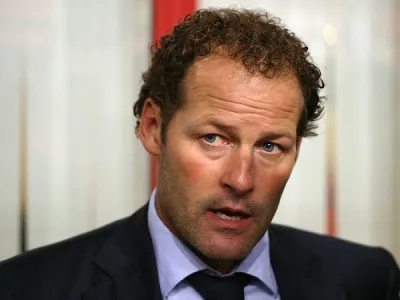
Danny Blind
Human Design Chart
Biography
July 1986 he was transferred to Ajax, attracted by manager Johan Cruijff. Superstar Marco van Basten was upset Cruijff's choice for this unknown, defensive player from a small club. But Van Basten was wrong. With Ajax, the sober playing defender would win all three European trophies (UEFA Cup Winners' Cup in 1987, the UEFA Cup in 1992 and the UEFA Champions League in 1995).
Blind secured the Intercontinental Cup, in 1995 against Brazil's Grêmio, by scoring the winning penalty in the penalty shoot-out and was again a penalty hero when he converted twice against Real Zaragoza in the European Super Cup Final of 1995, which Ajax won 5–1 over the two legs. The two penalties Blind converted were in the 65th and 69th minutes of the second leg.
With Ajax, Blind won five Dutch Eredivisie Championships and four national cups. He retired on 16 May 1999.
Blind was head coach at Ajax from 14 March 2005 until 10 May 2006. From 2007 to 2008, he was football director of Sparta. On 15 May 2008 he returned to Ajax, to become the new football director in Amsterdam but switched roles when Martin Jol joined the club to assistant-trainer.
Moving to the position of technical director for Ajax at the beginning of the 2011–12 season, on 9 February 2012, it was announced that Blind would retire from his duties as Technical Director at Ajax, concluding a heated dispute surrounding the club's board of directors.
On 1 August 2015, Blind succeeded Guus Hiddink as a coach of the Netherlands national team. On 3 September 2015 he debuted in the play against Iceland. That day Blind let his son Daley play. The Dutch lost with 1-0 in Amsterdam.
Human Design Analysis: Danny Blind as Projector 2/4
Projector 2/4 — Design at a Glance
Danny Blind's design tends towards a focused aura that immediately recognizes errors in other people's systems. As a projector, his energy acts like a bright flashlight, directing itself to areas around him that are still in the dark or not functioning optimally. This configuration grants the ability to 'shed light into darkness' by identifying structural weaknesses and illuminating paths.
However, the challenge of this design lies in its mode of communication: immediately addressing these errors is often perceived as unpleasant or even offensive by others, similar to a direct beam of light in someone's face. Thus, Danny Blind found it necessary to adopt a strategic restraint. Instead of correcting without pause, he was more effective by attracting others through his own harmonious behavior and waiting for them to seek an honest invitation. This strategy of waiting for appreciative inquiries allowed him to convey his insights in a way that was actually received without resistance.
Furthermore, his undefined Sacral Center shaped his energy profile: there was no constant intrinsic source of life force. Instead, phases of high productivity alternated with the urgent need for rest periods. These pauses were essential to avoid burnout and keep away from the non-self theme of bitterness. By respecting these rhythms, Danny Blind could sustainably bring his specific gift of system analysis and be rewarded for it rather than falling into frustration.
Emotional Authority
Danny Blind's design tends towards emotional wave movement where spontaneous reactions are seen as snapshots, not final truths. His inner authority stems from the defined Solar Plexus Center – the emotional authority. In Human Design mechanics, this authority always takes precedence over all other defined centers, regardless of further configurations in the chart.
This structure meant for Danny Blind that he did not make decisions based on first impulses. His emotional field went through a constant up and down; the world appeared to him either enthusiastically positive or strongly negative colored depending on his current mood. A quick decision was therefore often based on temporary excitement, not clarity. Decisions made in this emotional heat could prove misleading.
The mechanism required patience and time as filters. Danny Blind benefited from letting decisions rest ideally overnight or longer. Only when the initial emotional wave subsided and he gained distance did calmness set in. This process of 'sleeping on it' allowed him to delve deeper into the matter and gain comprehensive insights. For long-term, life-defining steps, this temporal buffer was essential to distinguish between impulsive feeling and actual inner truth. By waiting, he reached a state of clarity necessary for grounded actions.
The 2/4 Profile — Hermit / Opportunist
Danny Blind exhibited a lifestyle pattern marked by constant oscillation between solitude and network involvement. His design set up a tension: the need for withdrawal (Line 2) conflicted with the drive towards community (Line 4). This required clear communication of boundaries. Only then could he determine when to seek company and when to remain undisturbed.
During his alone time, Danny Blind immersed himself in internal processes. This phase served reflection and creation of inner clarity. Once the need for peace was satisfied, he left his 'cave' again to spend time with familiar people. This cycle was not random but a necessity of his Profile 2/4.
Line 2 emphasized the ability to reflect and build strength through withdrawal. It helped him process experiences. Line 4 represented 'solitude' in terms of externalization and integrity. Here, he shared knowledge slowly and conditionally within a close network.
Through this interplay, Danny Blind could reflect on his environment's knowledge in silence, evaluate it, and develop new ideas from it. Clear boundaries protected his energy and allowed him to utilize both the depth of solitude and connection to community without losing himself or becoming obscured.
Split Definition — Defined & Open Centers
Danny Blind showed a clear distinction between persistent mental structure and situational adaptability. His design was marked by a defined mental line connecting the Head, Ajna, and Throat Centers, creating an ongoing internal pressure to question, conceptualize, and articulate these processes verbally. This mental inspiration was his most stable pillar but did not provide energy for direct implementation; here, the mind served as a source of questions and concepts rather than a driver for actions.
At the same time, Danny Blind had a defined emotional authority in the Solar Plexus Center. His decisions required time, as truth only revealed itself at the end of the emotional wave cycle. Impulsive reactions to emotional storms led to confusion; patience was needed to gain clarity and strategically use the seductive power of his emotions. Additionally, he possessed a defined Root Center that provided a specific approach to dealing with stress and forward movement.
In contrast, his Centers for Identity (G), Willpower (Heart), generative Energy (Sacral), and Intuition (Spleen) were open. Danny Blind had no fixed inner direction or consistent endurance but absorbed these qualities from the environment. He tended to question whether he was in the right place to find his identity rather than possessing it himself. Without personal willpower, he was vulnerable to the pressure of making promises he could not keep or proving himself through overwork. His energy was unstable; he had to learn to let go of borrowed vitality and take breaks instead of pushing until exhaustion. Also, his intuition was conditioned; spontaneous decisions often relied on absorbed fears or false security feelings from others rather than his own sense. The challenge lay in not prematurely forcing mental inspiration and waiting for emotional clarity while learning to use external influences as information rather than personal truth.
Channels for acceptance, inner truth and emotional recognition.
Danny Blind showed a basic disposition of logical structuring: His mind was constantly engaged in organizing details into a coherent mental system. This trait came from Channel Accepting 17-62, connecting the Ajna Center with the Throat Center. Here, Gate 17 visualizes patterns while Gate 62 translates and names them through words. Anything that could not be integrated into this inner image was simply incomprehensible to him. This created a constant pressure in the Throat Center to express his organized opinions – but only effectively if the timing was right and listeners were ready to take in the details.
Alongside this constant trait, two additional channels worked situatively. Channel Awareness 61-24 connected Head with Ajna Centers and brought forth inspirational knowledge that could not be controlled but appeared as spontaneous insight ("Satori") when mental silence allowed it. Similarly, Channel Recognizing 30-41 between Root and Solar Plexus Centers was only present temporarily. It generated an emotional longing for new experiences driven by the urge of Gate 41 and the emotional intensity of Gate 30. These channels were not permanent drivers but responded to external occasions with inspiration or a desire for change.
Collective Circuitry — Circuit Signature
Danny Blind was marked by two separate, unconnected energetic circuits. One circuit linked Ajna with Throat Center via Channel Accepting. This promoted rational, future-oriented structure and the ability to clearly communicate logical insights – free from emotional coloring. The other circuit connected Solar Plexus and Root Centers through Channel Recognizing. Here, a cyclical, wave-like energy worked that reflected past experiences and sought meaning.
Since these circuits were not connected in Danny Blind, there was no automatic bridge between cool logic and emotional processing. A rational future perspective stood parallel to deep, often inexplicable reflection on the past. Danny Blind had to consciously switch or integrate to unite both aspects. The Knowledge Circuit was not activated; thus, there was a lack of direct connection from individual identity to creative expression through this specific mechanism. Instead, the tension field between the need for structured, emotionless communication and intense, wave-like emotional processing dominated. This configuration described a life task: creating clear rational structures while simultaneously respecting and processing the emotional depth of past experiences – two separate forces existing side by side without directly overlapping.
Right Angle Cross of the Four Ways 2
Danny Blind's Human Design reveals a tendency towards a deep, structural search for the essential. He appeared as someone who was not satisfied with superficial answers but was driven to understand the fundamental principles that underpin life and existence. This attitude is an expression of the "Right Cross of Four Lines 2".
This configuration in Human Design describes an inner drive to question truth and meaning – not as an intellectual game, but as an existential necessity. It's about integrating knowledge into a coherent whole that provides stability. Danny Blind was predisposed by this cross to find paths beyond the obvious. His energy focused on creating clarity out of complexity while pursuing a personal, authentic path.
The "Right Cross" implies a certain sharpness or directness in dealing with these questions; it is not gentle flowing but an active penetration of structures. The "four lines" point towards the different dimensions – physical, emotional, mental and spiritual – that must be brought into harmony. For Danny Blind, this meant that his greatest challenge and potential lay in uniting these levels and deriving a clear, unmistakable message or life stance from them. His design challenged him not only to know but to live this knowledge in a way that is understandable and inspiring to others without sacrificing his own integrity.
Saturn Return · Uranus Opposition · Chiron Return · 2nd Saturn Return — Life Cycles
Danny Blind's life path was structured by four prominent astrological cycles that shaped his phases from the start of his career to his later role as a trainer. In 1986, at age 25, he moved to Ajax Amsterdam. This coincided with his first Saturn return, a phase in which years of groundwork often culminates in a solid outcome and new responsibilities are taken on.
Ten years later, in 1999 at the age of 38, his active football career came to an end. This marked the Uranus opposition, a cycle of profound upheavals where old structures often break down to make way for a new identity. It was not just the end of a career but also a necessary transformation in life form.
In 2012, at age 51, Danny Blind concluded his work as technical director at Ajax. This aligned with his Chiron return, a fulfillment cycle ("flowering"), during which one's incarnation cross unfolds and meaning becomes tangible – provided the person lives according to their strategy and authority. It was a moment of delineation from the previous path in order to come closer to the true purpose.
Finally, he became the new trainer of the Dutch national team in 2015 at age 54. This fell during his second Saturn return, a time of maturation and final construction on a stable foundation. The cycles show a clear rhythm: building up, upheaval, finding meaning, and taking on new responsibility.
Projector · Emotional Authority — Synthesis
The central red thread in Danny Blind's chart is the dynamic interaction between pattern recognition and its communication. This manifests in the defined mental center (Head, Ajna, Throat) as well as in the highlighted channels of the Knowledge and Understanding Circuit. The ability to analyze information, logically organize it, and then express it—whether through words or visual representation—seems to be a defining characteristic. This tendency is reinforced by the emphasis on reflection (Gate 33) and the recognition of details (Gate 62), indicating that he does not merely absorb information but processes it deeply and integrates it into a larger context. The repeated evidence of career turning points in connection with career phases (1986, 1999, 2012, 2015) underscores the importance of this ability for his life path.
The central paradox in Danny Blind's design lies in the tension between the need for clarity and the inherent emotional wave. While the defined emotional center (Solar Plexus) allows for a deep, resonant perception, it simultaneously requires time and space to process emotions. This contrasts with the quick, analytical processes of the mental center and the urge to communicate information directly. The connection between Root and Solar Plexus centers (Channel 41/30) intensifies this inner conflict by linking a strong desire for experience with the necessity to emotionally process these experiences and integrate them into a larger context.
3 Defined Channels
Incarnation Cross - Right Angle Cross of the Four Ways 2
Solar Return
The Solar Return shows the moment when the sun returns to its exact birth position - your personal solar year.
Life Cycles
Discover the life cycles with a detailed triple view (birth chart, cycle chart, composite).
Human Design Profile
- Type
- Projector
- Strategy
- Wait for the respectful invitation
- Authority
- Emotional Authority
- Profile
- 2/4 - Hermit / Opportunist
- Definition
- Split Definition
- Incarnation Cross
- Right Angle Cross of the Four Ways 2
- Date of Birth
- 01.08.1961 04:03
- Place of Birth
- Oost-Souburg, Netherlands
Frequently Asked Questions
What is Danny Blind's Human Design type?
What Profile does Danny Blind have in Human Design?
What authority does Danny Blind have?
What incarnation cross does Danny Blind have?
When was Danny Blind born?
Discover your own Human Design
Are you also a Projector? Find out in a personal reading how to unfold your leadership qualities and recognize the right invitations.
More Personalities
Back to overviewSissy Spacek

Alain-Fournier

Aldair

Anémone

Ann-Margret

Bourvil