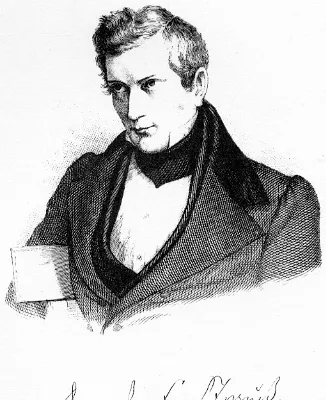
David Friedrich Strauss
Human Design Chart
Biography
Strauss was a pioneer in the historical investigation of Jesus.
He was 27 years old when his great work Das Leben Jesu kritisch bearbeitet ("The Life of Jesus, Critically Examined") was published. It was a sensation.
In 1848 he was nominated a member of the Frankfurt Parliament, but was defeated. He was elected for the Württemberg chamber, but his actions were so conservative that his constituents requested him to resign his seat. He forgot his political disappointments in the production of a series of biographical works, which secured him a permanent place in German literature.
He was a prolific writer. All of Strauss's works were published in a collected edition in 12 volumes. He died on 8 February 1874 at age 66 in Ludwigsburg.
The Human Design of David Friedrich Strauss: Manifesting Generator 5/1
Manifesting Generator 5/1 — Design at a Glance
David Friedrich Strauss was revealed as a Hybrid being that combined the constant energy of a Generator with the lightning-fast action of a Manifestor. His design tended to draw things into his life by skipping steps and pursuing multiple projects simultaneously. However, this speed was a double-edged sword: Often he acted too quickly, neglected necessary intermediate steps, and found himself having to backtrack to fill in gaps. This frequently led to frustration, the specific non-self theme of the manifesting Generator.
The mechanics of his type required him, despite his ability for quick initiation, primarily to react to impulses. Only when his Sacral Center gave a clear “yes” could he effectively deploy his creative power. Without this inner consent and respect for his authority, his versatility quickly turned into overextension. However, by learning to respond to life and regularly check the resonance of his projects, he found deep satisfaction. His optimal state was a playful mode where variety did not distract but rather nourished his energy. Then it was no problem to follow several threads simultaneously as long as inner consent was maintained.
Emotional Authority
David Friedrich Strauss was subject to an emotional wave that significantly shaped his judgment. His inner authority resided in the defined Emotional Center – a mechanism that always took precedence over other defined centers, regardless of their nature. This configuration meant he perceived the world through the filter of his current mood; enthusiasm could quickly turn into deep suspicion. An initial impression was not yet final truth but merely a snapshot. Spontaneous decisions stemming directly from this fleeting emotion often proved problematic for him and led to negative consequences.
His design strategy therefore required time. Only by consciously delaying and repeatedly “sleeping on” an issue could he let the intense feelings subside. This process of waiting created the necessary emotional distance that was essential for clarity and calmness. It was only when the initial wave subsided that the deeper truth emerged. This was particularly true for long-term life decisions with significant consequences. Thus, David Friedrich Strauss showed himself to be someone who had to allow patience to prevail in order to distinguish his inner voice from passing moods and make well-founded judgments.
The 5/1 Profile — Heretic / Investigator
David Friedrich Strauss revealed himself as someone whose deep knowledge base gave him almost magnetic appeal. People actively sought out solutions for their own problems with him, drawn by the treasures that his Profile 5/1 – Hero/Researcher – seemed to offer. This configuration combined the intense, often solitary learning of Line 1 with the public role of problem-solver in Line 5.
His design constellation specifically promoted this dynamic: Gate 41 on the fifth line brought a strong projection through others, acting like an empowerment that also included fantasy and limitations; Venus in fall signaled persistent irritation over constraints, forcing him to choose one focus direction. Simultaneously, Gate 44 demanded clear agreements and hierarchies to secure economic success and lasting harmony. Pluto increased power over the collective here and enabled enforceable structures.
Without clear boundaries, there was a risk of overload for him, similar to an expert who is left exhausted after hours of consultation while more requests pour in. To optimally utilize his gifts and maintain this benevolent balance between private research and public problem-solving, he had to learn to say no sometimes as well. Only then could he manage the expectations directed at him and sustainably provide his deep insights without burning himself out.
Triple Split Definition — Defined & Open Centers
David Friedrich Strauss was characterized by a design with six defined centers, which allowed for immense inner stability and a clear expression of willpower, vitality, and emotional depth. His defined throat connected directly to the Heart Center; he thus spoke from a strong 'I' - 'I want this', 'I do this'. This configuration gave him the ability to communicate his intentions and promises emphatically and set them into the world. This was supported by his defined Sacral Center, the engine of a Generator, which provided him with a constant source of life energy, assuming he responded to life rather than initiating it.
His defined Solar Plexus served as inner authority: Decisions were not made in impulsive moments but after waiting for the emotional wave until clarity was reached. This patience served to fully grasp the emotional truth of a situation. Additionally, his Spleen Center (Intuition/Existence) and Root Center were defined, giving him a strong survival consciousness and a persistent inner pressure to move forward in the material world and stay healthy.
In contrast, his undefined centers revealed specific vulnerabilities. His open Head Center was prone to being overwhelmed by foreign inspiration or mental confusion; he was vulnerable to engaging with questions that did not belong to him and suffering from the pressure of finding answers. The open Ajna Center meant that his conceptual thinking was flexible but also at risk of adopting foreign theories as personal truth or pretending uncertainty. Particularly defining was his open G Center: It gave him no fixed identity or direction. Instead, he often sought 'borrowed' identity through his environment and relationships. He tended to question who he really was and where love could be found rather than waiting for initiations from the environment that would show him the right place and thus the appropriate direction. This openness made him sensitive to false environments in which he did not feel well, hence unable to form correct connections.
Channels for powerful action, instinctive devotion and emotional clarity.
David Friedrich Strauss was driven by an intense inner torment seeking new experiences. This restlessness stemmed from Channel of Perception 30-41, where Root Pressure at Gate 41 ignites the imagination and Emotional Gate 30 intensifies this longing. He lived in a constant tension between the desire for experience and the need to wait for emotional clarity.
At the same time, he possessed an instinctive ability to read the 'market' or tribe and package his messages persuasively. Channel of Devotion 26-44 gave him a sense of what others needed - often before they knew it themselves - combined with the willpower to use this knowledge profitably. He acted less as a pure thinker but as someone who sold ideas and manipulated the tribe to implement his visions.
This busy energy was further accelerated by the Charisma 20-34. Here, the generative power of the Sacral Center (Gate 34) met the expressive ability of the Throat Center (Gate 20). This made it difficult for him to sit still; his influence arose from the ability to act in the moment and immerse himself in satisfying activities. Without this inner guidance, his energy would have chaotically erupted, but correctly used, it inspired others through sheer vitality.
Additionally, Gates like 31 (Transfer of Power) and 24 (mental mutation) made him question old knowledge and form new identities. His design marked a person who did not just theorize but acted through emotional intensity and instinctive selling of his ideas - always searching for the next experience to carry into the world with charismatic force.
Individual Circuitry — Circuit Signature
David Friedrich Strauss was shown by his design as someone who processed experiences in waves, swinging between separate energetic poles. His triple definition created three independent energy fields without direct exchange among them.
The Sense-Making Circuit connected his Solar Plexus Center with the Root Center. This generated an emotional wave: feelings and past experiences were processed into a coherent understanding that served for orientation. This insight was cyclical - it had a clear beginning, peak, and end - before it could be shared.
Parallel to this, the Ego Circuit worked through the connection of Heart and Spleen Centers. Here cooperation and joint creation of resources through devotion were at play. As there was no direct link to the Sacral Center, this configuration required necessary rest periods for regenerating energy for the tribe or community.
A third, completely separate field formed by the Integration Circuit between Throat and Sacral Centers. This channel gave him a certain charisma: The ability to draw intuitive power from life and make it effective through speech or action in direct now. These three areas - emotional sense-making, cooperative resource creation, and charismatic presence - existed alongside each other as independent forces that did not directly merge but worked parallel in his life.
Left Angle Cross of the Alpha 2
David Friedrich Strauss exhibited a fundamental disposition marked by profound internal tension between the desire for individual affirmation and the necessity to integrate into larger frameworks. This configuration, the left cross of Alpha 2, described a life task where personal ambitions often clashed with feelings of isolation or misunderstanding. It was a dynamic process in which the search for recognition wasn't seen as an egoistic drive but rather as an attempt to understand one's place within complex social or intellectual structures. Strauss' design suggested that he could have been torn between the impulse to step forward and the fear of rejection, driving him to constantly re-evaluate and adjust his position instead of settling on a fixed stance. The mechanics of this cross indicated that true fulfillment could only be achieved through accepting this duality – by learning to align individual needs with responsibility towards the whole without sacrificing his own self. This was not a linear path but an ongoing balancing process, shaping his entire existence and helping him maintain inner coherence despite external resistance.
Saturn Return · Uranus Opposition · Chiron Return · 2nd Saturn Return — Life Cycles
David Friedrich Strauss's life work unfolded in clear, cyclical phases of condensation and public recognition. His design laid out a structure where internal maturation processes corresponded with concrete external milestones. In 1835, at the age of 27, he published 'The Life of Jesus Critically Examined.' This fell during his first Saturn return, a time when years of intellectual groundwork condensed into a substantial public result.
His chart mechanics pointed to periods where his positioning in societal fields changed. In 1848, he lost the election for the German parliament. This occurred during an Uranus opposition, often associated with necessary structural breaks or the failure of expectations for a new political order.
Another significant point was his Chiron return around 1856 (age 48). In Human Design mechanics, this cycle marks not healing but the bloom and unfolding of one's purpose. Indeed, in that year 'Life and Writings of the Poet and Philologist Nicodemus Frischlin' appeared, confirming his intellectual depth and making his life's meaning tangible.
Finally, 1865 saw his second Saturn return (age 57) with the publication of 'The Half and the Whole.' This cycle served to consolidate his thought world by encapsulating previous insights into a mature whole. Strauss' life thus followed a pattern where inner maturity translated outwardly through public peaks.
Manifesting Generator · Emotional Authority — Synthesis
David Friedrich Strauss lived a path profoundly marked by internal dynamism. His design as an Manifesting Generator (with defined sacral center) points to someone who acted from a constant energy source and also possessed the ability to quickly respond to impulses – a hybrid between initiation and reaction. This energetic endowment was strengthened by his emotional authority, compelling him not to rush decisions but to let them ripen within an emotional wave. The profile as Hero/Researcher (5/1) underscored this tendency; he gathered deep knowledge and offered it for problem-solving, yet made himself vulnerable to overloading.
Central to his life was a paradox between the drive for rapid manifestation (Channel of Charisma) and the need for emotional clarity. He had the ability to swiftly set things in motion, but his emotional authority required careful consideration, leading to internal tensions. Recurring events in Saturn and Uranus cycles – both professional successes and setbacks – reflected this shift between quick progress and the need for reflection, with the sense-making circuit supporting the processing of past experiences.
3 Defined Channels
Incarnation Cross - Left Angle Cross of the Alpha 2
Solar Return
The Solar Return shows the moment when the sun returns to its exact birth position - your personal solar year.
Life Cycles
Discover the life cycles with a detailed triple view (birth chart, cycle chart, composite).
Human Design Profile
- Strategy
- To respond - wait for something to respond to
- Authority
- Emotional Authority
- Profile
- 5/1 - Heretic / Investigator
- Definition
- Triple Split
- Incarnation Cross
- Left Angle Cross of the Alpha 2
- Date of Birth
- 27.01.1808 03:00
- Place of Birth
- Ludwigsburg, GER
Frequently Asked Questions
What was David Friedrich Strauss's Human Design type?
Which profile did David Friedrich Strauss have?
What authority guided David Friedrich Strauss?
What incarnation cross defined David Friedrich Strauss?
When was David Friedrich Strauss born?
Discover your own Human Design
Are you also a Manifesting Generator? Find out in a personal reading how to unfold your multi-talents and direct your energy wisely.
More Personalities
Back to overviewAlain-Fournier

Aldair

Alizée

Angeli

Arletty
Artus