Denise Biellmann
Human Design Chart
Biography
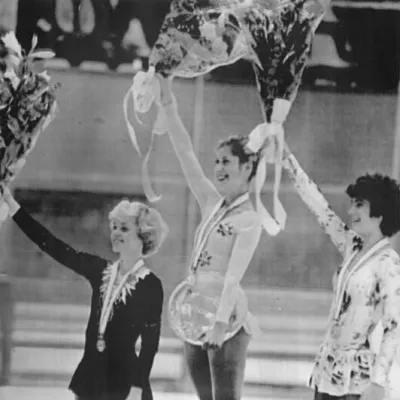
At the age of 15, she was the first female skater to land the triple lutz in competition, which she performed for the first time at the 1978 European Championships. At the 1980 Winter Olympics, she won the free skating event and placed fourth overall.
The Biellmann spin was named after her, although she did not invent the spin but popularized it. It was present in skating at least since the 1965 European Championships when Tamara Moskvina performed it after being inspired by a gymnastics competition. It remains the only figure skating spin to be officially named after a person in ISU regulations. Nevertheless, by the end of her ISU career, the spin was causing her back pain. Biellmann retired from amateur competition shortly after her win at the 1981 World Championships.
Biellmann remained involved in the international figure skating community as a participant in both professional shows and competitions. She participated in the Eurovision Dance Contest 2007 representing Switzerland with partner Sven Ninnemann.
What does Projector 2/4 mean for Denise Biellmann?
Projector 2/4 — Design at a Glance
Denise Biellmann's design showed a tendency towards focused perception. She was someone who immediately recognized system errors and brought 'light into darkness' for others. Her aura appeared like a bright flashlight, directly pointing out weaknesses.
This mechanism stems from her nature as a Projector. Since she does not draw constant life energy from a defined Sacral Center, she lacks intrinsic reserves of energy for continuous action. Instead, she has a dense, focused projection. When this energy is directed at the errors of others – comparable to shining light in someone's face – it often leads to conflicts and defensive reactions in her environment.
The optimal strategy for this design does not lie in direct initiative or exerting pressure. Rather, Denise Biellmann attracts people through her own harmony. By simply being pleasant 'light', she draws others towards her who seek advice. The waiting time for a respectful invitation is crucial here. Only then will her leadership be subtle and accepted rather than felt as criticism.
Furthermore, her undefined Sacral Center requires mandatory rest phases for regeneration. Without these pauses, the typical risk of burning out arises since the energy does not flow sustainably. Living according to this pattern of attraction and waiting leads to success. Deviating from it and trying to advance through self-imposed pressure or constant activity results in bitterness as an expression of her non-self-experience.
Emotional Authority
Denise Biellmann's design showed a tendency towards not making decisions based on the first emotional impulse but rather subjecting them to a necessary maturation period. She was someone who learned not to immediately follow the initial wave of emotions, as this often only represented a momentary coloring and did not reveal deeper truths.
This attitude results from her emotional authority, carried by the defined Solar Plexus Center. In Human Design mechanics, this authority always takes precedence over all other defined centers, regardless of further configurations in the chart. This means that Denise Biellmann's inner compass needle was always determined by the emotional cycle. This cycle is not a static state but a wave peak and valley of feelings. What appears overwhelming correct at one moment can be irrelevant or even false hours or days later.
Therefore, for her, the strategy of 'sleeping on it' was crucial. Quick, spontaneous judgments based on current mood carried the risk of being based on deceptive snapshots. By taking time and questioning decisions multiple times, she let initial intense waves subside. Only when this emotional distance was gained and calmness set in did clarity emerge for Denise Biellmann. This process of patience served to ensure that her long-term life decisions were based on a stable inner truth rather than fleeting emotional waves.
The 2/4 Profile — Hermit / Opportunist
Denise Biellmann's design showed a tendency towards dynamic tension between the deep desire for withdrawal and the wish for connected community. As Profile 2/4, 'Nature Talent / Networker', she was someone who constantly swung between two poles: Line 2 with her hermit quality of inner reflection and Line 4 seeking brotherhood and influence in the network.
This configuration described a life task to absorb knowledge from the social environment, process it during solitary times, and develop brilliant ideas. The challenge lay in clearly communicating these transitions: 'Now I need disturbance-free time' versus 'Now I wish for company'. Only through creating a safe environment where this constant back-and-forth was understood could she fully unleash her potential.
Line 2 promoted strong self-strength and learning from painful experiences as well as memory. She delved into internal processes to gain clarity. Once this inner need was satisfied, the energy of Line 4 returned – with a drive for certainty on specific topics and the wish to be effective in the network. Denise Biellmann's design thus required no static positioning but conscious navigation between cave and community to translate inner insights into outer impact.
Split Definition — Defined & Open Centers
Denise Biellmann's design placed a constant mental pressure to ask questions and form concepts without being able to directly manifest them from her own strength. The defined Head and Ajna Centers generated perpetual inspiration but lacked the energy for direct manifestation; attempting to impulsively release this pressure led to frustration, while waiting for the right moment brought clarity. Her defined Throat served as a reliable channel to translate these thoughts and concepts into words or actions, supported by the stable willpower of her defined Heart Center, which helped her keep promises and maintain her own worth.
Crucial to her process was the defined Solar Plexus as an emotional authority. It required patience: Denise Biellmann had to wait out the emotional wave to gain clarity rather than acting impulsively on the highs or lows of her feelings. Simultaneously, her defined Spleen Center offered spontaneous intuitive safety in the present moment, a quick warning system for health and well-being that worked independently of her slower emotional decision-making.
This stable inner life contrasted with her open centers. Her open G Center meant no fixed identity but situational adaptation to environment and relationships; she tended to orient outwardly to find her direction rather than dictating it internally. Her open Sacral required respect for her fluctuating energy flow, as she was prone to overloading from "borrowed" energy of others. Additionally, her open Root absorbed external stress from the environment, necessitating a constant distinction between her own and foreign pressure to avoid exhaustion.
Channels for curious exploration, devotion, community and abstraction.
Denise Biellmann revealed herself through an instinctive and entrepreneurial intelligence: the ability to connect visceral feelings for improvement potential with convincing ego strength. This dynamic draws from Channel 44-26, which links the Spleen Center with the Heart Center. It grants a deeply rooted tribal memory and the gift of intuitively recognizing what a market or collective needs—often before others know it themselves—and effectively promoting this as a "product." This is not logical analysis but rather a visual instinct for value and necessity.
This driving impulse towards individual market engagement stood in tension with a curious, explorative attitude. Channel 11-56 served here as a communicative tool: It connected the Ajna Center with the Throat Center and enabled the transformation of abstract philosophical perspectives into compelling narratives. This storytelling quality was less about self-reflection but rather a gift to the collective to bridge the gap between the intuitively found "product" and public perception. The magical connection of ideas (Gate 11) and inspiration (Gate 56) allowed for presenting complex connections in ways that inspired or taught others, driven by a desire for constant discovery of new perspectives without a fixed goal.
Additionally, other energies were at work: Channel 37-40 emphasized the importance of emotional clarity and fair agreements within group structures, while Channel 64-47 fostered an active, experience-based mind constantly seeking meaning. Individual Gates like Gate 28 (willingness to take risks in the present moment) and Gate 57 (intuitive clarity) supported these dynamics through a sharper perception of the moment and inner security. Overall, this profile oscillated between the drive for established leadership and an open search for new narrative paths.
Collective Circuitry — Circuit Signature
Denise Biellmann's design shows a tendency towards two parallel, distinct energetic focal points. On one hand, there is a focus on processing emotional experiences from the past, while on the other hand, there is an orientation toward resource-oriented tribal functions. These forces do not operate as a continuous flow but rather exist side by side.
Denise Biellmann's Purpose Circuit connects the Head, Ajna, and Throat Centers directly. This creates a channel for visually emotional wave movements. The energy of this configuration is cyclical: it begins, reaches a midpoint, and then ends again. Central to this is finding meaning behind past events and sharing these felt insights with the collective. Curiosity drives this process of abstraction, often making communication illogical and more influenced by feelings than cool reason.
Parallel to this, the Ego Circuit operates, connecting the Heart, Solar Plexus, and Spleen Centers. This serves tribal formation through cooperation and mutual support. Devotion and awareness of community foster a give-and-take relationship. However, without a connection to the Sacral Center, there is no constant life force. Therefore, regular rest pauses were necessary to generate new resources for the tribe. This traditional, conservative energy contrasts with the cyclical reflection on the past of the other part. Both systems shaped Denise Biellmann's experiential world as separate yet equally important poles: once individual meaning-seeking in waves, and communal resource care with necessary breaks.
Right Angle Cross of Rulership 4
Denise Biellmann's design was characterized by a fundamental orientation towards leadership and the ability to guide others. This aligned with the structure of the right authority cross 4, a configuration archetypally associated with authority, decision-making, and taking responsibility.
In this Human-Design context, the right authority cross 4 does not describe a passive role but an active position within social or professional structures. The energy of this cross supports the person in setting clear directions and creating frameworks where others can orient themselves. It is about power in its natural sense, initiating processes and securing outcomes rather than negative control.
The emphasis for Denise Biellmann was on this archetypal structure without specific event assignment. This means her energetic alignment was primarily shaped by these leadership qualities, independent of individual life events. She had the inner resonance to step into situations where leadership was needed and could rely on a stable foundation that helped her make decisions with conviction.
This configuration also promoted the ability to work effectively with others by setting clear expectations and enforcing them. It mattered less to be liked by everyone than for things to get done. Thus, Denise Biellmann's design tended towards a direct, goal-oriented approach focused on efficiency and results.
Saturn Return · Uranus Opposition · Chiron Return · 2nd Saturn Return — Life Cycles
The given raw data describes exclusively astrological transits such as Saturn returns, Uranus oppositions, and the Chiron return. There is no mention of any specific Human Design mechanics, such as defined Gates, Channels or Centers. Without these structural foundations of the design, a person-specific characterization cannot be derived. A Human Design reading is based on the analysis of this inner architecture; its absence prevents any substantiated statement about Denise Biellmann's energetic expression, strategy, or authority.
The mentioned transits are general astrological phenomena and not HD configurations. The first Saturn return often marks a phase of structuring, yet without reference to a specific Center or Channel, this remains a general observation that does not apply specifically to Denise Biellmann’s design. Similarly, the Chiron return cannot be described in Human Design as an incarnation cross fulfillment cycle since the cross itself is absent. The Uranus opposition and second Saturn return follow the same logic: they are temporal markers, not design-inherent mechanisms.
As no HD-specific content is present, a chapter in the sense of a character analysis cannot be written. Any claim about Denise Biellmann's nature would in this case be an unchecked invention and would violate the rule of using only provided facts. The design remains invisible here; there is no basis for interpreting her life task or energetic pattern. Therefore, the analysis ends at the boundary of what is present: There are no HD data, hence no HD reading.
Projector · Emotional Authority — Synthesis
A central thread in Denise Biellmann's design is the dynamic balance between inner clarity and the need for external validation. The combination of defined Head and Ajna Centers indicates a strong ability to analyze and understand, yet this mental energy needs a channel to manifest – which is emphasized by her Projector Design. She is here to recognize patterns and shed light on darkness, ideally after an internal emotional maturation (emotional authority) and upon invitation from others. The Profile as Natural Talent/Networker reinforces this dynamic: phases of withdrawal for reflection (Line 2) alternate with a need for exchange and connection (Line 4), where the quality of relationships is crucial to her inspiration.
A central paradox lies in the tension between her ability to recognize patterns and offer solutions (Gate 11, Channel of Curiosity) and her undefined Sacral Center. While she can project energy onto others, she lacks a constant source for it herself. This leads to a potential dependence on external stimulation and an internal pressure to be constantly active, while at the same time periods of rest are essential for her well-being. This field of tension between the urge to give and the necessity to recharge shapes her path towards self-actualization.
4 Defined Channels
Incarnation Cross - Right Angle Cross of Rulership 4
Solar Return
The Solar Return shows the moment when the sun returns to its exact birth position - your personal solar year.
Life Cycles
Discover the life cycles with a detailed triple view (birth chart, cycle chart, composite).
Human Design Profile
- Type
- Projector
- Strategy
- Wait for the respectful invitation
- Authority
- Emotional Authority
- Profile
- 2/4 - Hermit / Opportunist
- Definition
- Split Definition
- Incarnation Cross
- Right Angle Cross of Rulership 4
- Date of Birth
- 11.12.1962 05:35
- Place of Birth
- Zürich, Switzerland
Frequently Asked Questions
What is Denise Biellmann's Human Design type?
What Profiles does Denise Biellmann have in Human Design?
Which Authority guides Denise Biellmann?
Which incarnation cross is Denise Biellmann associated with?
When was Denise Biellmann born?
Discover your own Human Design
Are you also a Projector? Find out in a personal reading how to unfold your leadership qualities and recognize the right invitations.
More Personalities
Back to overviewSissy Spacek

Alain-Fournier

Aldair

Anémone

Ann-Margret

Bourvil