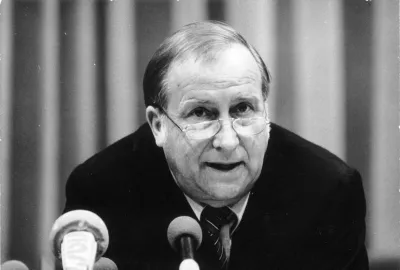
Detlev Rohwedder
Human Design Chart
Biography
What does Projector 3/5 mean for Detlev Rohwedder?
Projector 3/5 — Design at a Glance
Detlev Rohwedder's design inclined towards precise system analysis. As a projector, he did not have an intrinsic energy source like other types but rather acted as a focused light beam on his surroundings. This aura allowed him to immediately recognize weaknesses and errors in complex structures. However, this direct perception carried the risk of being perceived by others as unpleasant or critical when addressing these flaws without warning.
His strategy was to wait for a genuine invitation from others before taking over a leadership role. Due to his undefined Sacral center, he was subject to natural energy cycles: phases of high efficiency alternated with necessary rest periods to prevent exhaustion. Living in harmony with this rhythm and the invitation strategy led him to be rewarded for his expertise. If he pursued personal goals without external validation or ignored his need for recovery, bitterness characteristic of projectors would develop. Thus, his design marked him as someone who uncovered systemic problems, whose effectiveness was strongly dependent on proper interaction with his environment.
No Inner Authority
Detlev Rohwedder's design was characterized by the complete absence of an inner authority – a configuration considered extremely rare in Human-Design mechanics. He had no defined centers below the Throat center or none at all throughout his chart, making him either a mental projector (approximately 1.7% of humanity) or a reflector (approximately 1–1.5%). This structure meant he lacked fixed physical decision-making instances to rely on. Instead, his orientation was heavily influenced by external factors and cyclical patterns.
As a mental projector, Detlev Rohwedder found his decisions through intense exchanges with various people. In these dialogues, dormant potentials in his open centers were activated, allowing him to view issues from numerous perspectives. Evaluating this complex information flow required time and withdrawal to filter out the essentials and structure them meaningfully – his specific capital of success. Alternatively, as a reflector, his decision-making was tied to the moon cycle. He needed about 28 days for the moon to traverse his body graph and reveal reliable conditioning patterns. In both cases, it was crucial for him to be in an environment where he felt comfortable and could exchange trustingly to deepen his sense of what truly belonged to him. He did not rush; processing time was essential for clarity.
The 3/5 Profile — Martyr / Heretic
Detlev Rohwedder's design established the fundamental structure of an experimenter with a heroic aspiration. As a 3/5 type, he primarily learned through personal experimentation and failure before formulating solutions for others. This configuration created a natural attraction as his practical experience seemed valuable to others. Simultaneously, this profile carried the risk that public failures would be particularly painful if the hero status was threatened in public.
The third line of his profile highlighted a lack of continuity and indecision. During phases of change, this could lead to a loss of instinct or clinging to outdated structures. Parallel to this, the fifth line emphasized metamorphosis and excellence. Here it was about working through details to absolute clarity before presenting them externally. In crisis times, clear communication of solutions was expected from this energy. The tension between the impulsive experimentation of the third line and the necessity to present perfectly worked-out details shaped his approach to handling responsibility. If he failed publicly in doing so, his entire self-image as a competent rescuer was at stake.
Single Definition — Defined & Open Centers
Detlev Rohwedders design predisposed him to a constant mental pressure of questioning and forming concepts. The definition between the Head Center and Ajna Center created an ongoing internal drive to understand things and question consciousness itself. This mental process was always active; he thought continuously, processing data and creativity in a specific, trustworthy manner. Since there was no direct energy available for implementing these thoughts, the challenge lay in not transforming this pressure into hasty actions but using it as inspiration for others who could put the ideas into practice.
This firm mental framework contrasted with his many open centers, making him vulnerable to external conditioning. His open G Center meant he lacked a fixed identity or direction; he tended to blend with his environment and sought the right place where he could flourish. The open Heart Center led to not being designed to assert willpower or keep promises to prove his worth, which made him vulnerable in a competitive setting. Additionally, his open Solar Plexus Center absorbed others' emotions, putting him at risk of personalizing foreign moods and feeling emotionally overwhelmed. His open Sacral Center meant he lacked a steady energy flow and easily became exhausted when working on borrowed energy from others without knowing his own limits. His wisdom lay in not seeing these open fields as deficiencies but using them as mirrors for the environment while relying on his inner authority to find the right time and direction.
Channels for logical filtering and abstract comprehension.
Detlev Rohwedders design predisposed him towards analytical rigor and seeking underlying patterns. His mind was not geared towards intuitive certainty, but rather fact-checking and constructing logical connections. This attitude was particularly shaped by two defined channels in the Head Center and Ajna Center.
The Logic Channel 63-4 connected the Gate of Doubt with the Gate of Formulation. This created a mind that constantly filtered patterns to check if they were consistent. Here, doubt was not a lack of trust but the essential foundation for every logical conclusion. Only when an answer was practically testable and consistent did it count as true. Unfounded belief space had no place in this mechanism; it was about proving through experimentation and logic.
Parallel to this, the Abstraction Channel 64-47 linked the Gate of Confusion with the Gate of Understanding. This channel subjected every experience to a kaleidoscope of mental images. Detlev Rohwedder sought stories and perspectives to understand the past and draw meaning from the mysterious. This mental power played with all possibilities regardless of rules until an inspiring image or new sequence became clear. The mind served here not for solving personal problems but discovering collective truths through patient waiting for clarity.
Additionally, prioritized gates contributed to his character: Gate 32 brought a drive towards material stability and continuity while also pushing radical changes when needed. Gate 61 promoted the pressure of individual knowledge as spontaneous mutation, often accompanied by internal static until silence. Gate 42 emphasized the importance of completing processes for new commitments, and Gate 62 ensured precise debriefing, logically organizing details and facts to create convincing frameworks.
Collective Circuitry — Circuit Signature
Detlev Rohwedders design predisposed him towards structured, rational analysis that operated free from emotional wave movements. His chart showed a simple definition: Head Center and Ajna Center were directly connected while all other centers remained undefined. This configuration created a clear focus on logical knowledge acquisition.
The Understanding Circuit worked through him via the Logic Channel (Gates 63–4). This channel linked the Head Center with the Ajna Center, fostering the ability to order complex matters through cool ratio. It was about improving structures and sharing rational insights ideally unburdened by conditioning. This energy oriented itself towards future solutions and visual clarity.
Parallel to this, the Meaning Circuit showed its effect via the Abstraction Channel (Gates 64–47). This channel also linked Head Center and Ajna Center but brought a different quality: reflecting on past events. Here it was about extracting deeper meaning from occurrences and sharing these felt insights with others. Both circuits thus utilized the same central connection in the chart – the flow between Head and Ajna – to integrate both future-oriented logic and retrospective sense-seeking. Detlev Rohwedder lived in this tension between the necessity of logically improving things and the need to emotionally process and pass on past experiences.
Right Angle Cross of Maya 3
Detlev Rohwedder's Human Design profile featured the right cross of the Maya. This configuration is characterized by a profound and often painful confrontation with one's essence, coupled with a clear intention to serve others. The mechanics of this pattern described a journey that initially led through darkness and confusion before light and clarity emerged. Detlev Rohwedder demonstrated himself as someone who underwent this inner transformation to develop a message for others. It was not an easy fate but rather a process of dying and awakening. The energy of this cross demanded devotion to something greater than the ego. Detlev Rohwedder lived out this dynamic by translating his personal experiences into universal language. The focus was on healing through understanding and sharing insights that could stem from the deepest shadows of life. This structure shaped his actions as a service to humanity, where the personal cost was high but the resulting wisdom helped others find their own paths. Detlev Rohwedder thus embodied the principle that true leadership arises from personal trials and overcoming darkness.
Saturn Return · Uranus Opposition · Chiron Return · 2nd Saturn Return — Life Cycles
Detlev Rohwedder's Human Design profile indicated a tendency towards structural responsibility that condensed into phases of external upheaval. When he joined the SPD in 1971 at age 39, this coincided with the Uranus opposition aspect. This cycle often marks a point where inner maturation meets outer societal changes; his decision to engage politically was an answer to this dynamic constellation, which questions old ties and opens new reform-oriented paths.
Later, in 1990 at age 58, Rohwedder took up the role of President of the Treuhandanstalt. This fell during his second Saturn return, a phase where long-term life structures must be redefined and solidified. Taking on this responsible position during German reunification highlighted the mechanics of this cycle: he entered into a position that not only carried administrative power but also the burden of historical responsibility. His design showed an ability to establish order in times of great uncertainty and institutional frameworks, typical for the second Saturn return which requires stability and long-term commitment.
Projector · No Inner Authority — Synthesis
Detlev Rohwedder lived a path marked by the need to recognize patterns and make them accessible to others (Channel Logic). As a projector without inner authority, he sought answers not within himself but through interaction and exchange. This led him to engage intensively with the systems and structures of his environment to uncover their weaknesses – a process amplified by the defined Head Center, enabling inspiration for others. His Line 3/5 in Profile suggests that he experimented extensively before providing this knowledge to others and stepping into a kind of heroic role.
Rohwedder's design contained a central paradox: the ability to recognize logical connections precisely (Head and Ajna Centers) coupled with the absence of inner authority. This led to constant pressure to formulate questions and seek answers, but also dependence on external validation. The observed career events – joining a political party in 1971 and taking up a key position in 1990 – seem to reflect this dynamic: an ongoing search for the right pattern in the outer context before acting oneself.
2 Defined Channels
Incarnation Cross - Right Angle Cross of Maya 3
Solar Return
The Solar Return shows the moment when the sun returns to its exact birth position - your personal solar year.
Life Cycles
Discover the life cycles with a detailed triple view (birth chart, cycle chart, composite).
Human Design Profile
- Type
- Projector
- Strategy
- Wait for the respectful invitation
- Authority
- No inner authority - learn more
- Profile
- 3/5 - Martyr / Heretic
- Definition
- Single Definition
- Incarnation Cross
- Right Angle Cross of Maya 3
- Date of Birth
- 16.10.1932 13:45
- Place of Birth
- Gotha, GER
Frequently Asked Questions
What is Detlev Rohwedder's Human Design type?
What Profiles did Detlev Rohwedder have?
What Authority did Detlev Rohwedder possess?
What incarnation cross did Detlev Rohwedder have?
When was Detlev Rohwedder born?
Discover your own Human Design
Are you also a Projector? Find out in a personal reading how to unfold your leadership qualities and recognize the right invitations.
More Personalities
Back to overviewSissy Spacek

Alain-Fournier

Anémone

Ann-Margret

Bourvil
Christian-Jaque